Highlights

Measurement of the neutron incoherent scattering length of Hg199 using stored ultracold neutrons

C. Abel et al. (nEDM Collaboration)

Phys. Rev. C 114, 045501 (2026) - Published 1 October, 2026

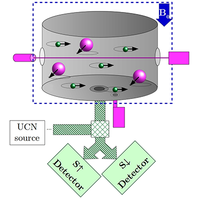
The imbalance between matter and antimatter in our Universe remains one of the great mysteries of modern physics. The neutron’s electric dipole moment (EDM) is a sensitive probe of new sources of CP violation that could help explain this asymmetry. Searches for an EDM rely on extraordinarily precise measurements of the neutron spin precession, using polarized mercury atoms to monitor the applied magnetic field. But the mercury atoms themselves can interact with neutrons in a way that produces a tiny, spin-dependent frequency shift, potentially mimicking an EDM signal. In this study, the nEDM Collaboration, with the experiment based at the Paul Scherrer Institute, directly investigates this subtle neutron-mercury interaction. The results provide a precise characterization of an important systematic effect, improving the control of a key source of uncertainty in EDM measurements.

Precise determination of electron-capture Q value of Sn113 decay related to electron neutrino mass measurements

Zhuang Ge, Tommi Eronen, Vasile Alin Sevestrean, Ovidiu Niţescu, Sabin Stoica, Marlom Ramalho, Jouni Suhonen, Anu Kankainen, Marjut Hukkanen, Arthur Jaries, Ari Jokinen, Joel Kostensalo, Jenni Kotila, Maxime Mougeot, Iain D. Moore, Wirunchana Rattanasakuldilok, Jouni Ruotsalainen, and Marek Stryjczyk

Phys. Rev. C 114, 035501 (2026) - Published 10 September, 2026

High-precision measurements of nuclear decay energies can reveal rare low-Q transitions with enhanced sensitivity to the absolute neutrino mass. Using the JYFLTRAP double Penning trap and the PI-ICR technique, the electron-capture Q value of 113Sn was determined with an eightfold improvement in precision over the previous evaluation. Combining the new mass result with known excited states in 113In identifies two energetically allowed low-Q electron-capture branches. In particular, an allowed transition to the 1029.650-keV state has Q*EC=9.60(20) keV and lies close to the L-shell binding energies. Atomic and nuclear calculations show enhanced spectral sensitivity near the endpoint, making this decay an interesting complementary system for future direct neutrino-mass studies.

High-voltage and electrode system for a cryogenic experiment to search for the neutron electric dipole moment

M. A. Blatnik, S. M. Clayton, S. A. Currie, B. W. Filippone, M. Makela, C. M. O'Shaughnessy, N. S. Phan, J. C. Ramsey, G. V. Riley, A. Roberts, T. Sandborn, T. J. Schaub, G. M. Seidel, E. Smith, I. L. Smythe, J. Surbrook, W. Wei, W. Yao, and T. M. Ito

Phys. Rev. C 113, 045503 (2026) - Published 30 April, 2026

The neutron electric dipole moment (nEDM) is a key probe of CP violation and physics beyond the Standard Model. Experimental sensitivity scales with the applied electric field, making higher fields essential for improved measurements. A 1994 proposal to perform an nEDM experiment in superfluid 4He suggested several potential advantages, including in-situ production of ultracold neutrons with reduced loss and the possibility of higher electric fields. Here, the authors report the outcome of a comprehensive program to develop the high-voltage and electrode system for such an experiment, including new insights into relevant physical phenomena and detailing selected technical solutions with their corresponding experimental demonstrations. The results demonstrate the necessary technology for operation at electric fields up to E=75 kV/cm, compared with E≈10 kV/cm in recent nEDM experiments—a major step toward significantly enhanced sensitivity.

Backscattering study of electrons from 0.1 to 3.4 MeV

M. Kanafani, X. Fléchard, O. Naviliat-Cuncic, R. Garreau, T. E. Haugen, L. Hayen, S. Leblond, E. Liénard, X. Mougeot, G. Quéméner, A. Rani, J.-C. Thomas, and S. Vanlangendonck

Phys. Rev. C 113, 025501 (2026) - Published 9 February, 2026

Benchmarking simulation codes for electron transport and scattering in matter is a crucial step for estimating uncertainties in precision measurements in β decay and other applications. This work reports the measurement and the quantitative analysis of backscattering probabilities of electrons in the energy range 0.1 to 3.4 MeV where experimental data are scarce. Using a setup for precise identification of backscattered events impinging on a YAP:Ce scintillator, the authors achieved meaningful agreement between simulations and experimental data covering a large range of energies and large incident angles. The results should help mitigate the usually large relative uncertainties considered for electron backscattering probabilities. Reaching an improved understanding of the systematic uncertainties at the percent level, compared to the previous 10% level, promises to be of high value to the community engaged in precision β spectroscopy.

Detection of molecular hydrogen in a neutron beam lifetime experiment

J. Caylor, R. Biswas, B. Crawford, M. S. Dewey, N. Fomin, G. L. Greene, S. F. Hoogerheide, J. Hungria-Negron, H. P. Mumm, J. S. Nico, F. E. Wietfeldt, D. O. Valete, and J. Zuchegno

Phys. Rev. C 112, 065501 (2025) - Published 12 December, 2025

Precision knowledge of the neutron lifetime is important in predicting the cosmological abundance of helium following the Big Bang, the flux of solar neutrinos, and the influence of beyond-standard-model theories with new massive particles on electroweak interactions. However, the neutron lifetime puzzle—the several-standard-deviation discrepancy between the neutron storage “bottle” experiments and the neutron decay “beam” experiments—limits a confident extraction of the experimental lifetime. This work addresses a previously unquantified systematic effect in the beam experiments, the loss of trapped protons due to charge exchange with molecular hydrogen in the residual gas. These new results, using the BL2 experimental apparatus at NIST, provide direct information on the effects of charge exchange of protons and show that this effect is not responsible for the observed difference in lifetime from the two measurement techniques, concluding that the neutron lifetime puzzle remains.

Two-neutrino 0+→0+ double-β decay of Ca48 within the density-functional-theory–based no-core configuration-interaction framework

Jan Miśkiewicz, Maciej Konieczka, and Wojciech Satuła

Phys. Rev. C 112, 055502 (2025) - Published 6 November, 2025

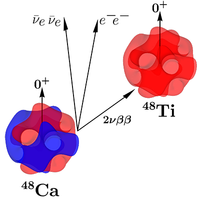
This work describes the first calculation of a nuclear matrix element for the two-neutrino double-beta transition (2νββ 48Ca→48Ti) within a recently developed theory framework, no-core configuration-interaction based on density-functional theory (DFT-NCCI). The authors build on a tested approach, and explicitly include nuclear deformation. A clever choice of the single-particle wave functions reduces the computational effort. The result obtained for this transition is complementary to those obtained in other nuclear frameworks, giving confidence in modeling this very rare process with DFT-NCCI. This is not only relevant for modeling 2νββ decay in heavier nuclei within a unified formalism but is also highly relevant for modeling the 0νββ decay process for which nuclear matrix elements differ significantly between various approaches.

Nuclear-level effective theory of μ→e conversion: Inelastic process

W. C. Haxton and Evan Rule

Phys. Rev. C 111, 025501 (2025) - Published 7 February, 2025

Because processes involving charged leptons are expected to conserve flavor, any evidence of muon-to-electron conversion is recognized as an important signal to constrain physics beyond the Standard Model. Whereas most experiments so far have assumed elastic transitions for muon-to-electron conversion, this paper shows how inelastic transitions which leave the nucleus in an excited state would allow for more probes of new physics. Such transitions can modify the near-endpoint spectrum of conversion electrons, to which the underlying flavor-symmetry violating operator is sensitive. The authors find that 27Al, the target of ongoing muon-to-electron conversion experiments, is an excellent isotope choice to observe inelastic transitions.

Constraining theoretical corrections to Gamow-Teller transition rates

L. Xayavong and Y. Lim

Phys. Rev. C 111, 015501 (2025) - Published 13 January, 2025

β decays provide important tests of the Standard Model, but the precision is limited by model dependencies and small but crucial corrections such as isospin breaking. By comparing theoretical and experimental ratios of mirror decays, the authors find cancellation of many of the model dependencies, allowing constraints on the remaining corrections and ultimately on possible new physics.

Ab initio electroweak corrections to superallowed β decays and their impact on Vud

Vincenzo Cirigliano, Wouter Dekens, Jordy de Vries, Stefano Gandolfi, Martin Hoferichter, and Emanuele Mereghetti

Phys. Rev. C 110, 055502 (2024) - Published 18 November, 2024

The authors propose a new approach for the calculation of nuclear-dependent corrections to superallowed β decays based on effective field theory (EFT). The calculation is timely given the observation in recent years of a 2–3 σ anomaly in the test of the first row of the Cabibbo-Kobayashi-Maskawa matrix. Within a comprehensive assessment, the authors methodically develop a master formula for superallowed β decays, paving the way for ab-initio nuclear many-body computations of nuclear-structure-dependent corrections. The results show promise for state-of-the-art extractions of Vud from nuclear processes with controlled uncertainty quantification, and for using precision β-decay experiments to search for physics beyond the standard model.

Ab initio investigation of the Li7(p,e+e−)Be8 process and the X17 boson

P. Gysbers, P. Navrátil, K. Kravvaris, G. Hupin, and S. Quaglioni

Phys. Rev. C 110, 015503 (2024) - Published 10 July, 2024

Recent observations by the ATOMKI Collaboration of anomalies in electron-positron pair production following proton capture on light nuclides has led to the postulation of a new boson with mass around 17 MeV. Here a team of scientists from the United States, Canada, and France presents the most detailed microscopic calculations to date of the proton capture reactions, and is unable to find a conventional explanation for the anomalies. While these calculations do not confirm the existence of the so-called X17 boson, they provide strong motivation for continued and independent experiments to investigate the ATOMKI results. Further refinements of the calculations may provide theoretical constraints for future data.

Half-life of Ge71 and the gallium anomaly

E. B. Norman, A. Drobizhev, N. Gharibyan, K. E. Gregorich, Yu. G. Kolomensky, B. N. Sammis, N. D. Scielzo, J. A. Shusterman, and K. J. Thomas

Phys. Rev. C 109, 055501 (2024) - Published 30 May, 2024

Several past experiments such as SAGE, GALLEX, and BEST reported lower than expected neutrino capture rates on 71Ga. The origin of this so-called “gallium anomaly” could potentially indicate new neutrino physics, unless there was a more mundane explanation. Because the measured half-life of the electron-capture decay of 71Ge can be used to calculate the neutrino-capture cross section on 71Ga, the authors carried out three separate measurements to determine the half-life of 71Ge with high precision. Their new result of 11.468±0.008 days for the 71Ge half-life is consistent with the currently accepted value, but significantly more precise. It rules out an unexpectedly long 71Ge half-life as a potential explanation of the puzzling anomaly, leaving the anomaly’s origin an open question.

Data-driven reevaluation of ft values in superallowed β decays

Chien-Yeah Seng and Mikhail Gorchtein

Phys. Rev. C 109, 045501 (2024) - Published 10 April, 2024

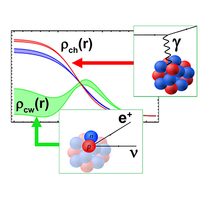
Efforts toward a precise determination of Vud and low-energy tests of the electroweak Standard Model have been ongoing for many years. The authors report a comprehensive re-evaluation of the ft values in superallowed nuclear β decays based on a fully data-driven analysis of the nuclear β-decay form factor. They utilize isospin relations to connect the nuclear charged weak distribution to the measurable charge distributions. The approach supersedes previous shell-model estimations and allows for a rigorous quantification of theory uncertainties in the phase-space factor, using experimental input rather than nuclear models. The work identifies the need for specific future experimental research to drive further understanding toward a regime of precision that is relevant for weak-interaction physics and thus for physics beyond the Standard Model.

Cyclotron radiation emission spectroscopy of electrons from tritium β decay and Kr83m internal conversion

A. Ashtari Esfahani et al. (Project 8 Collaboration)

Phys. Rev. C 109, 035503 (2024) - Published 25 March, 2024

Neutrino mass is a key parameter in nuclear and particle physics and in cosmology. The Project 8 Collaboration developed an innovative method with potential to improve the current mass limits by more than an order of magnitude. Announced in a paper published last September (PRL 131, 102502; see also the Synopsis at https://physics.aps.org/articles/v16/s121), the method measures the frequency of radiation from tritium β-decay electrons spiraling in a magnetic field. In the current paper the authors provide the details of this unique measurement technique including the hardware and the role of simulations and precision spectroscopy that enabled their new direct mass measurement. This first, small-volume demonstration, along with the precision reached, shows a clear path to improve in future experiments on the conservative upper limit for the neutrino mass obtained here.

Atomic corrections for the unique first-forbidden β transition of Re187

O. Niţescu, R. Dvornický, and F. Šimkovic

Phys. Rev. C 109, 025501 (2024) - Published 13 February, 2024

The shape of the spectrum of electrons emitted in β decay near the highest (endpoint) energy offers a direct way to determine the absolute values of neutrino masses. The authors reexamine one of the most promising candidates for determining the neutrino mass scale, the unique first-forbidden β transition from 187Re(5/2+) to 187Os(1/2−). Their results show that exchange effects between the emitted electrons and the atomic bound electrons can considerably impact the shape of the electron spectrum near the endpoint. The authors conclude that atomic effects, especially the exchange effect, should be considered in current and future investigations of the neutrino mass scale from β decays.

Comprehensive revision of the summation method for the prediction of reactor ν¯e fluxes and spectra

Lorenzo Périssé, Anthony Onillon, Xavier Mougeot, Matthieu Vivier, Thierry Lasserre, Alain Letourneau, David Lhuillier, and Guillaume Mention

Phys. Rev. C 108, 055501 (2023) - Published 27 November, 2023

Nuclear reactors are the most copious human-made source of electron antineutrinos (ν¯e) on Earth; yet, determining their flux and spectrum with accuracy remains a considerable challenge. In fact, measurements of the antineutrino flux from reactors have shown a deficit with respect to predictions, which has become known as the reactor antineutrino anomaly. This work combines a careful analysis of up-to-date nuclear decay data with advanced theoretical corrections to the V-A theory of β decay to produce, for the first time, a flux prediction with a comprehensive uncertainty budget. This new prediction achieves a better agreement with existing experimental neutrino data and methodically pins down points for improvements. It will likely stimulate targeted research to check and improve the experimental inputs, with potentially wide-ranging impact, from weak-interaction physics to many aspects of nuclear reactor science and technology.

Gallium neutrino absorption cross section and its uncertainty

S. R. Elliott, V. N. Gavrin, W. C. Haxton, T. V. Ibragimova, and E. J. Rule

Phys. Rev. C 108, 035502 (2023) - Published 25 September, 2023

The 71Ga radiochemical experiments provided the first constraint on the flux of low-energy electron neutrinos coming from the Sun. Crucial neutrino calibration experiments, however, using intense β-decay sources, yielded rates below that predicted by theory. A recent effort to check the “gallium anomaly” using a more intense source exacerbated the discrepancy. This paper carefully reexamines the nuclear physics of neutrino absorption on 71Ga, slightly reducing but not eliminating the puzzling anomaly.

Dispersive formalism for the nuclear structure correction δNS to the β decay rate

Chien-Yeah Seng and Mikhail Gorchtein

Phys. Rev. C 107, 035503 (2023) - Published 27 March, 2023

Searches for new physics are often performed along the precision frontier, requiring more careful treatment of corrections previously treated approximately. For example, interpretation of high-precision measurements of β decay require the radiative correction arising from nuclear structure that was previously estimated using oversimplified nuclear models. In this paper, the authors carefully work out the formalism needed to use input from microscopic nuclear calculations, including a multipole expansion of the relevant matrix elements. This work prepares a path to a more rigorous theory framework and more precise limits on physics beyond the Standard Model.

Ab initio calculation of the β-decay spectrum of He6

G. B. King, A. Baroni, V. Cirigliano, S. Gandolfi, L. Hayen, E. Mereghetti, S. Pastore, and M. Piarulli

Phys. Rev. C 107, 015503 (2023) - Published 27 January, 2023

Searches for new physics can be conducted by brute force or, like the perihelion shift of Mercury, looking for subtle but persistent discrepancies. This detailed paper carries out high-precision calculations of the β-decay spectrum of 6He, and estimates the experimental precision needed to reveal hints of charged-current interactions beyond the Standard Model and/or sterile neutrinos.

Search for electron-neutrino transitions to sterile states in the BEST experiment

V. V. Barinov et al.

Phys. Rev. C 105, 065502 (2022) - Published 9 June, 2022

First results from the BEST Collaboration searching for short-baseline neutrino oscillations to sterile neutrinos with a high-intensity 51Cr monoenergetic neutrino source reaffirm that the so-called gallium anomaly, a deficit in electron neutrinos, persists. 4σ deficits were observed in the 71Ge production rates at two different distance scales, which could be interpreted as oscillations between an electron neutrino and a hypothetical sterile neutrino. The results are consistent with oscillations with a mass squared difference above about 0.5 eV2 and a large mixing angle sin22θ≈0.4.

Improved calculations of β decay backgrounds to new physics in liquid xenon detectors

S. J. Haselschwardt, J. Kostensalo, X. Mougeot, and J. Suhonen

Phys. Rev. C 102, 065501 (2020) - Published 11 December, 2020

Understanding the exact shape of the β-decay backgrounds in present and future large liquid xenon detectors is crucial to exploring new physics from experiments using such detectors. This paper presents a state-of-the-art evaluation of such backgrounds, including previously ignored contributions. The results provide an improved understanding of the β-decay background shape and its possible systematic uncertainties and motivate future direct measurements of the relevant spectra.

Sign In to Your Journals Account

Filter

Section

Filter

Article Lookup

Enter a citation