Highlights

Superallowed 0+→0+ nuclear β decays: 2020 critical survey, with implications for Vud and CKM unitarity

J. C. Hardy and I. S. Towner

Phys. Rev. C 102, 045501 (2020) - Published 2 October, 2020

Superallowed β-decay between nuclear analog states with isospin 1 and spin-parity 0+ offers access to fundamental tests of the properties of the electroweak interaction. With 15 such transitions precisely measured, the data collectively probe the conservation of the weak vector current, set tight limits on the presence of beyond-standard-model scalar currents, and yield the most precise value for the Vud element of the CKM quark-mixing matrix. Vud is a critical ingredient required to test the unitarity of that matrix. This work provides an in-depth review of the relevant nuclear physics input and connects these data to the fundamental couplings.

Chiral effective field theory calculations of weak transitions in light nuclei

G. B. King, L. Andreoli, S. Pastore, M. Piarulli, R. Schiavilla, R. B. Wiringa, J. Carlson, and S. Gandolfi

Phys. Rev. C 102, 025501 (2020) - Published 20 August, 2020

Quantum Monte Carlo calculations of electroweak transitions are performed for A≤10 nuclei based upon two- and three-nucleon chiral interactions and the associated one- and two-body axial currents. Except for β decay of 8He, 8Li, and 8B, two-body currents contribute less than 3%. The exceptional nuclei exhibit matrix elements suppressed in impulse approximation based on the leading order (GT) transition operator. For a given interaction, the two-body transition densities exhibit a universal behavior at short distance for all systems under study.

Improved determination of the β−ν¯e angular correlation coefficient a in free neutron decay with the aSPECT spectrometer

M. Beck, F. Ayala Guardia, M. Borg, J. Kahlenberg, R. Muñoz Horta, C. Schmidt, A. Wunderle, W. Heil, R. Maisonobe, M. Simson, T. Soldner, R. Virot, O. Zimmer, M. Klopf, G. Konrad, S. Baeßler, F. Glück, and U. Schmidt

Phys. Rev. C 101, 055506 (2020) - Published 26 May, 2020

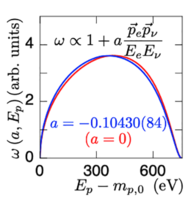
This work presents the until now most precise measurement of the angular correlation coefficient a between the momenta of the electron and the electron-antineutrino in free neutron decay. The coefficient a is inferred from a detailed analysis of the integral proton recoil spectrum measured with the aSPECT setup, a MAC-E-Filter type spectrometer with 4π acceptance. The result can be used to determine the axial-vector coupling constant gA in the weak interaction and shows a tantalizing disagreement with recent measurements of gA via the β-decay asymmetry in neutron decay.

Improved limits on Fierz interference using asymmetry measurements from the Ultracold Neutron Asymmetry (UCNA) experiment

X. Sun et al. (UCNA Collaboration)

Phys. Rev. C 101, 035503 (2020) - Published 16 March, 2020

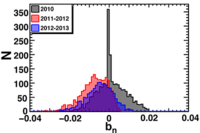
The UCNA Collaboration reanalyzed and combined results from previous experiments that measured the β-decay asymmetry for polarized ultracold neutrons confined in a trap in order to search for the so-called Fierz interference term. They demonstrate that systematic uncertainties from the asymmetry analysis related to the experimental efficiency and calibration can be reduced. This work suggests that a robust path forward to improved limits on the Fierz term in next-generation neutron-decay experiments exists and holds promise of providing an improved probe of whether physics beyond the Standard Model is at play.

Precise branching ratio measurement for the superallowed β+ decay of Si26: Completion of a second mirror pair

M. Bencomo, J. C. Hardy, V. E. Iacob, H. I. Park, L. Chen, V. Horvat, N. Nica, B. T. Roeder, A. Saastamoinen, and I. S. Towner

Phys. Rev. C 100, 015503 (2019) - Published 26 July, 2019

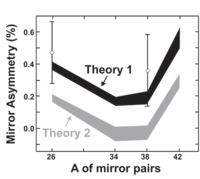
Superallowed β decay is an important tool in characterizing the vector component of the weak interaction. Precise β-decay results presently give the best measurement of the up-down quark weak-mixing element, Vud. This new result completes the measurement of a second set of superallowed mirror transitions (26Si-26mAl and 26mAl-26Mg in this case) and has the precision to constrain the theoretical isospin-symmetry-breaking corrections needed in the extraction of Vud.

Relativistic effects in ab initio electron-nucleus scattering

Noemi Rocco, Winfried Leidemann, Alessandro Lovato, and Giuseppina Orlandini

Phys. Rev. C 97, 055501 (2018) - Published 4 May, 2018

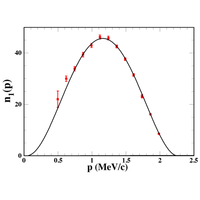
This work reports on a study of relativistic effects in ab initio calculations of electron-nucleus scattering, which permits extension to larger values of momentum transfer. The application of this technique to neutrino-nucleus scattering should be particularly useful, because comparison with data requires averages over large kinematic regions.

New result for the neutron β-asymmetry parameter A0 from UCNA

M. A.-P. Brown et al. (UCNA Collaboration)

Phys. Rev. C 97, 035505 (2018) - Published 26 March, 2018

A neutron β-decay asymmetry measurement using polarized ultracold neutrons (UCN) determines the correlation between the spin of the neutron and the momentum of the decay electron. The authors extract the ratio of the weak axial-vector to vector couplings with reduced uncertainties. This new result from the first measurement of this asymmetry using UCN contributes a benchmark for lattice QCD calculations and the possibility for improved precision on the CKM matrix element Vud from neutron β decay.

Electron time-of-flight: A new tool in β-decay spectroscopy

C. Roick, D. Dubbers, B. Märkisch, H. Saul, and U. Schmidt

Phys. Rev. C 97, 035502 (2018) - Published 7 March, 2018

The authors demonstrate an enhanced electron time-of-flight (ToF) method that overcomes limitations of conventional ToF experiments. They use an inverse magnetic mirror configuration in which the ToF is almost independent of emission angle. In particular at lower β-decay energies, where flight times are long, one can obtain the electron kinetic energy with significantly improved accuracy. Applications range from the precise calibration of energy-sensitive scintillators to future neutron-decay experiments.

QEC value of the superallowed β emitter Sc42

T. Eronen, J. C. Hardy, L. Canete, A. Jokinen, J. Hakala, A. Kankainen, V. S. Kolhinen, J. Koponen, I. D. Moore, I. M. Murray, H. Penttilä, I. Pohjalainen, O. Poleshchuk, J. Reinikainen, S. Rinta-Antila, N. Soukouti, A. Voss, and J. Äystö

Phys. Rev. C 95, 025501 (2017) - Published 10 February, 2017

Precise measurements of superallowed 0+→0+ β decay presently provide the most precise value for the weak mixing amplitude Vud. As the largest element of the CKM matrix, Vud is a critical piece of the Standard Model of the electroweak interaction. The new, precise Penning-trap mass measurement of the decay energy for the superallowed transition in 42Sc opens the door for a much more precise ft value determination if its half-life can be measured more precisely as well.

Hadronic weak charges and parity-violating forward Compton scattering

Mikhail Gorchtein and Hubert Spiesberger

Phys. Rev. C 94, 055502 (2016) - Published 14 November, 2016

The authors consider contributions to parity-violating electron-proton scattering from two-photon exchange, where the electromagnetic interaction of the nucleon has a parity-violating component. Unlike the standard short-ranged weak interaction conveyed by a massive Z boson, the considered mechanism induces novel long-range parity-violating forces. This is relevant for upcoming measurements at electron accelerator facilities at the University of Mainz and Jefferson Laboratory, including the Q-Weak experiment. The results will allow access to the weak charge of the nucleon and thereby, potentially, to physics beyond the Standard Model.

Test of Lorentz invariance in β decay of polarized Na20

A. Sytema, J. E. van den Berg, O. Böll, D. Chernowitz, E. A. Dijck, J. O. Grasdijk, S. Hoekstra, K. Jungmann, S. C. Mathavan, C. Meinema, A. Mohanty, S. E. Müller, J. P. Noordmans, M. Nuñez Portela, C. J. G. Onderwater, C. Pijpker, R. G. E. Timmermans, K. K. Vos, L. Willmann, and H. W. Wilschut

Phys. Rev. C 94, 025503 (2016) - Published 16 August, 2016

General relativity and the standard model are invariant under Lorentz transformations. Lorentz invariance violation is one manifestation of CPT violation. Weak interactions violate discrete symmetries (C, P, CP, and T) suggesting searches for violation of CPT and Lorentz invariance in weak interactions such as 20Na β+ decay. This search for a dependence of the 20Na lifetime on the nuclear spin direction improves the limit on sidereal variation in the relative lifetime difference by a factor of 15.

High-sensitivity measurement of He3−He4 isotopic ratios for ultracold neutron experiments

H. P. Mumm, M. G. Huber, W. Bauder, N. Abrams, C. M Deibel, C. R. Huffer, P. R. Huffman, K. W. Schelhammer, R. Janssens, C. L. Jiang, R. H. Scott, R. C. Pardo, K. E. Rehm, R. Vondrasek, C. M. Swank, C. M. O'Shaughnessy, M. Paul, and L. Yang

Phys. Rev. C 93, 065502 (2016) - Published 13 June, 2016

Many important experiments such as the neutron electric dipole moment and lifetime, or properties of superfluid helium require superpure helium, i.e., helium with a million times smaller 3He contamination compared to natural helium. Whereas, in principle, techniques are available to produce superpure helium, no experimental techniques have been available to measure such a small concentration. This paper details the use of accelerator mass spectrometry (AMS) to measure the 3He concentrations in superpure helium.

Measurement of the branching ratio for the β decay of O14

P. A. Voytas, E. A. George, G. W. Severin, L. Zhan, and L. D. Knutson

Phys. Rev. C 92, 065502 (2015) - Published 30 December, 2015

A new measurement significantly lowers the uncertainty on the branching ratio of the 14O 0+→0+ superallowed β-decay transition. Combined with the recently improved Q value, this result renders the 14O system the third most precise among the “traditional 14” transitions that are used in the determination of the CKM Vud matrix element.

Electromagnetic and neutral-weak response functions of He4 and C12

A. Lovato, S. Gandolfi, J. Carlson, Steven C. Pieper, and R. Schiavilla

Phys. Rev. C 91, 062501(R) (2015) - Published 4 June, 2015

The authors calculate ab-initio quasi-elastic electromagnetic and neutral-weak response functions for A=4 and A=12 nuclei by using realistic nuclear two- and three-body forces and one- and two-body electroweak currents, in combination with quantum Monte Carlo methods and maximum-entropy techniques. In the electromagnetic case, their novel approach allows a direct comparison with experimental data. The results challenge the conventional picture that quasi-elastic inclusive scattering is dominated by single-nucleon knockout.

Assessment of molecular effects on neutrino mass measurements from tritium β decay

L. I. Bodine, D. S. Parno, and R. G. H. Robertson

Phys. Rev. C 91, 035505 (2015) - Published 27 March, 2015

The best direct limits on absolute neutrino mass come from tritium β decay. This work discusses in detail how molecular effects distort the β-decay spectrum following decay of the tritium molecule. It closes an open detail in setting a stringent limit on the neutrino mass from the shape of the tritium spectrum.

Superallowed 0+→0+ nuclear β decays: 2014 critical survey, with precise results for Vud and CKM unitarity

J. C. Hardy and I. S. Towner

Phys. Rev. C 91, 025501 (2015) - Published 12 February, 2015

Precise measurements of the β decay between nuclear states of spin-parity 0+ and isospin 1 provide fundamental tests of the properties of the electroweak interaction. Collectively, these transitions sensitively probe the conservation of the vector weak current, set tight limits on the presence of scalar currents, and provide the most precise value for Vud. The latter result has become a linchpin in the most demanding test of the unitarity of the CKM matrix.

Search for time reversal invariance violation in neutron transmission

J. David Bowman and Vladimir Gudkov

Phys. Rev. C 90, 065503 (2014) - Published 29 December, 2014

The authors analyze a novel null test to search for time reversal invariance in a model neutron transmission experiment. The proposed experimental procedure involves nuclear reactions and is sensitive to the neutron-nucleus interactions. The approach could significantly increase the discovery potential compared to the limits of present experiments.

Two-neutrino double-β decay of Nd150 to excited final states in Sm150

M. F. Kidd, J. H. Esterline, S. W. Finch, and W. Tornow

Phys. Rev. C 90, 055501 (2014) - Published 19 November, 2014

In order to understand the nature of the neutrino, a worldwide search for neutrino-less double-β decay is planned. The present paper measures the half-life for two-neutrino decay of one of a small number of nuclei that are viable candidates for neutrino-less decay. This measurement uses a powerful coincidence technique to determine the two-neutrino half-life of 150Nd, and compare it to predictions. This is an important step in enhancing the potential search for the neutrino-less mode with this nucleus.

Measurement of the β-asymmetry parameter of Cu67 in search for tensor-type currents in the weak interaction

G. Soti, F. Wauters, M. Breitenfeldt, P. Finlay, P. Herzog, A. Knecht, U. Köster, I. S. Kraev, T. Porobic, P. N. Prashanth, I. S. Towner, C. Tramm, D. Zákoucký, and N. Severijns

Phys. Rev. C 90, 035502 (2014) - Published 25 September, 2014

Precision measurements of weak nuclear decays can probe physics beyond the standard model. Here the parity-violating asymmetry in the β decay of polarized 67Cu, while consistent with the electro-weak standard model, provides important new constraints on possible tensor-type interactions.

Precision half-life measurement of the β+ decay of K37

P. D. Shidling, D. Melconian, S. Behling, B. Fenker, J. C. Hardy, V. E. Iacob, E. McCleskey, M. McCleskey, M. Mehlman, H. I. Park, and B. T. Roeder

Phys. Rev. C 90, 032501(R) (2014) - Published 11 September, 2014

Potassium-37 is one of several isotopes that could be used to directly test the standard model weak interaction.

Sign In to Your Journals Account

Filter

Section

Filter

Article Lookup

Enter a citation