Recent Articles

Coexistence of magnon and spinon excitations in SeCuO3

Youngsu Choi, Dirk Wulferding, Kalaivanan Raju, Raman Sankar, and Kwang-Yong Choi

Phys. Rev. B 114, 074407 (2026) - Published 6 August, 2026

Using temperature-, field-, and angle-dependent Raman scattering, the authors observe here a sharp magnon coexisting with a broad spinon continuum in the quasi-one-dimensional quantum magnet SeCuO3. Both excitations exhibit identical angular dependence governed by the same Raman scattering symmetry. This common scattering symmetry demonstrates that coherent magnons emerge from the confinement of fractionalized spinons inherent to a one-dimensional quantum magnet.

Tunable hybrid magnons mediated by coherent spin pumping in a CoZr/GdFeCo heterostructure

Ying Jin, Jie Xu, Fu Liu, Bokai Liang, Guozhi Chai, Wenbo Sui, and Changjun Jiang

Phys. Rev. B 114, 074408 (2026) - Published 6 August, 2026

X-ray imaging of antiferromagnetic cluster octupole domains in Mn3Sn

M. T. Birch, S. Wintz, Y. Sun, A. Kikkawa, M. Weigand, T. Arima, and Y. Tokura

Phys. Rev. B 114, 094409 (2026) - Published 6 August, 2026

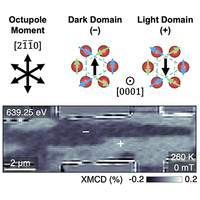
Here, the authors use element-specific x-ray microscopy to image antiferromagnetic cluster octupole domain structures in focused ion-beam fabricated Mn3Sn devices. The magnetic contrast arises from pre-edge x-ray magnetic circular dichroism that is independent of the small net moment, revealing how mesoscale textures evolve under applied magnetic fields and link to the anomalous Hall response. The results establish x-ray microscopy as a powerful route to image domain structures in time-reversal symmetry breaking antiferromagnets.

Quantum oscillation fingerprints of altermagnetism in hole-doped RuO2

Yuchi Yang and Yusheng Hou

Phys. Rev. B 114, 094410 (2026) - Published 6 August, 2026

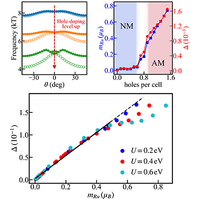
Here, the authors focus on a representative pair of simple closed-pocket Fermi surfaces in hole-doped RuO2 and establish a quasilinear correlation between the local magnetic moment of Ru atoms and quantum-oscillation-based signature of spin splitting. Combined with the distinct quantum oscillation characteristics of the nonmagnetic, intermediate, and stable altermagnetic regimes, this correlation provides experimentally accessible fingerprints for identifying magnetic states and tracking altermagnetic spin splitting in hole-doped RuO2.

Josephson effects in an interaction-asymmetric junction across the BCS-BEC crossover

Tingyu Zhang and Hiroyuki Tajima

Phys. Rev. B 114, 094503 (2026) - Published 6 August, 2026

η-pairing state in a flatband lattice: Effect of interband coupling on logarithmic scaling of entanglement entropy

Seik Pak, Hanbyul Kim, Chan Bin Bark, Sang-Jin Sin, Jae-yoon Choi, and Moon Jip Park

Phys. Rev. B 114, 105108 (2026) - Published 6 August, 2026

Intrinsic orbital Hall effect and tunable-sign orbital Nernst effect in monolayer MoSi2P4

Chen Chen, Yuqing Tong, Xiaoyang He, Yiming Li, Jianping Yang, Shilei Ji, and Xing'ao Li

Phys. Rev. B 114, 105402 (2026) - Published 6 August, 2026

Tuning superconducting pairing symmetry via a staggered potential in the doped honeycomb Hubbard model

Yanmei Cai, Yicheng Xiong, Ying Liang, and Tianxing Ma

Phys. Rev. B 114, 115102 (2026) - Published 6 August, 2026

Localized oxygen states and Schottky barrier height in oxides

Inhwan Kim, Sohm Apte, Hanran Jin, and Alexander A. Demkov

Phys. Rev. B 114, 125103 (2026) - Published 6 August, 2026

Bound states in the continuum enabled all-dielectric metasurfaces towards deep-nanoscale terahertz molecular fingerprinting

Jie Wang, Xiao Wang, Maoxiong Zhao, Hongwei Zhao, Min Chen, and Haixiao Deng

Phys. Rev. B 114, 125406 (2026) - Published 6 August, 2026

Electroluminescence in dopant-free GaAs/AlGaAs single heterojunctions: Two-dimensional free excitons, H-band, and the tidal effect

N. Sherlekar, S. R. Harrigan, L. Tian, B. Khromets, B. Cunard, Y. Qi, M. C. Tam, H. S. Kim, Z. R. Wasilewski, J. Baugh, M. E. Reimer, and F. Sfigakis

Phys. Rev. B 114, L111301 (2026) - Published 6 August, 2026

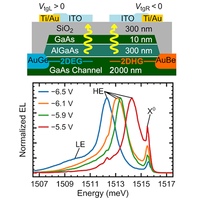
The authors demonstrate here electrically generated and controllable 2D-like excitons in a heterostructure where such behavior would not normally be expected, and develop an analytical model to explain the results. The potential impact is twofold: the work introduces voltage-tunable H-band electroluminescence as a new gate-defined excitonic emitter platform, and it shows that single-heterojunction devices can support unexpectedly bright electroluminescence through electrostatic confinement rather than a conventional quantum well heterostructure.

Competing hydrogenation pathways to metastable CaH6 revealed by machine learning potential molecular dynamics

Ryuhei Sato, Peter I. C. Cooke, Maélie Caussé, Hung Ba Tran, Seong Hoon Jang, Di Zhang, Hao Li, Shin-ichi Orimo, Yasushi Shibuta, and Chris J. Pickard

Phys. Rev. B 114, 074102 (2026) - Published 5 August, 2026

Dissipation-induced deviations from Kibble-Zurek scaling in non-Hermitian quantum annealing

H. Najafzadeh, S. Sadeghizade, R. Jafari, and A. Langari

Phys. Rev. B 114, 074303 (2026) - Published 5 August, 2026

Dynamical spin correlations in kagome antiferromagnets: Comparison of the Abrikosov fermion and Schwinger boson approaches beyond mean field

Daiki Sasamoto and Joji Nasu

Phys. Rev. B 114, 074405 (2026) - Published 5 August, 2026

Antiferromagnetism, spin liquid, and plaquette singlet phases in the Shastry-Sutherland model: A variational cluster approximation approach

Jean Paul Latyr Faye, Oumar Ndiaye, and David Sénéchal

Phys. Rev. B 114, 074406 (2026) - Published 5 August, 2026

Bose metal near pair density wave order in a spin-orbit coupled Kondo lattice

Piers Coleman, Aaditya Panigrahi, and Alexei Tsvelik

Phys. Rev. B 114, 084502 (2026) - Published 5 August, 2026

BCS states and d-wave condensates in the two-dimensional Hubbard model

Kazue Matsuyama and Jeff Greensite

Phys. Rev. B 114, 084503 (2026) - Published 5 August, 2026

Absence of superconductivity in fcc metallic hydrogen and low Tc in yttrium hydrides resulting from distinct vibrational modes of hydrogen sublattices

Li Zhang, Liying Song, Xilian Jin, Ziwei Li, Yijia Chen, Qingbiao Jin, Quanjun Li, Bingbing Liu, and Tian Cui

Phys. Rev. B 114, 094102 (2026) - Published 5 August, 2026

Yu-Shiba-Rusinov states in Ising superconductors

Michael Hein, Juan Carlos Cuevas, and Wolfgang Belzig

Phys. Rev. B 114, 094502 (2026) - Published 5 August, 2026

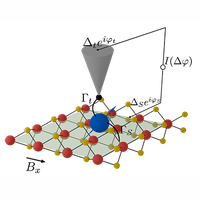
Ising superconductors are two-dimensional materials that can host an unconventional superconducting state stabilized by strong spin-valley locking. Here, the authors theoretically propose the use of magnetic impurities as local probes of the superconducting state by studying Yu-Shiba-Rusinov bound states. They identify experimentally accessible signatures, including the bound-state spectrum and the supercurrent between the sample and a superconducting STM tip.

Transconductance as a probe of valley thermodynamics in multilayer WSe2

Katsunori Wakabayashi, Souren Adhikary, and Tomoaki Kameda

Phys. Rev. B 114, 115403 (2026) - Published 5 August, 2026
Sign In to Your Journals Account

Filter

Recent Issues

Vol. 114, Iss. 30
15 November 2026
Vol. 114, Iss. 29
15 November 2026
Vol. 114, Iss. 28
15 November 2026
Vol. 114, Iss. 27
1 November 2026
Category
Article Type
Section

Filter

Article Lookup

Enter a citation