Recent Articles

Elementary excitations, melting temperature, and correlation energy in Wigner crystals

Ambuj Jain and Chunli Huang

Phys. Rev. B 114, 175110 (2026) - Published 8 September, 2026

Orbital Wigner functions and quantum transport in multiband systems

Johannes Mitscherling, Dan S. Borgnia, SuryaNeil Ahuja, Joel E. Moore, and Vir B. Bulchandani

Phys. Rev. B 114, 175111 (2026) - Published 8 September, 2026

Quantum transport in Hubbard-Rashba mesoscopic rings: Particle-hole symmetry and localization

D. Verrilli, F. Dalmagro, Mayra Peralta, and N. Bolívar

Phys. Rev. B 114, 175112 (2026) - Published 8 September, 2026

Magnetotransport and magnetic field dependence of the electronic structure in monolayer InSe: Effects of the Mexican hat dispersion

Xianbo Xiao, Qian Ye, Yan Du, Zhengfang Liu, Qingping Wu, and Xiaoying Zhou

Phys. Rev. B 114, 175301 (2026) - Published 8 September, 2026

Comment on “Extension of the adiabatic theorem”

Jie Gu

Phys. Rev. B 114, 177101 (2026) - Published 8 September, 2026

Coexisting magnetic, charge, and superconducting orders in the two-dimensional Hubbard model

Robin Scholle, Pietro M. Bonetti, Walter Metzner, and Demetrio Vilardi

Phys. Rev. B 114, 185107 (2026) - Published 8 September, 2026

The authors analyze here the competition and coexistence of magnetic, charge, and d-wave superconducting orders in the two-dimensional Hubbard model using renormalization-group-improved Hartree–Fock calculations. The resulting phase diagram reveals superconductivity coexisting with Néel order on the electron-doped side and with spiral or stripe order on the hole-doped side. In the stripe phase, the superconducting gap is spatially modulated together with the charge order.

Quantum geometry of the non-Hermitian skin effect

Ken-Ichiro Imura and Kohei Kawabata

Phys. Rev. B 114, 185108 (2026) - Published 8 September, 2026

Geometric quantum drives and topological dynamical responses: Hyperbolically driven quantum systems and beyond

Jihong Wu, Chuan Liu, Daniel Bulmash, and Wen Wei Ho

Phys. Rev. B 114, 185109 (2026) - Published 8 September, 2026

Bridging the gap between numerics and experiment in freestanding graphene

Maksim Ulybyshev, Savvas Zafeiropoulos, Christopher Winterowd, and Fakher Assaad

Phys. Rev. B 114, 185110 (2026) - Published 8 September, 2026

Here, the authors revisit the question of the logarithmic renormalization of the Fermi velocity in graphene. Using large-scale Quantum Monte Carlo simulations of lattices with up to 2×10⁴ interacting electrons, they directly connect experimental data with unbiased, nonperturbative calculations starting from a microscopic Hamiltonian. Their results reveal that even random-phase approximation corrections are quantitatively insufficient at realistic interaction strengths for suspended graphene, while continuum perturbation theory misses important lattice-scale effects. Remarkably, the optical conductivity still remains constant pointing to exact cancellation of different corrections.

Cation-disorder-enhanced nonradiative carrier capture in kesterite Cu2ZnSnS4

Baoying Dou, Ke Zhao, Wentao Yang, Boyan Sun, and Chengyan Liu

Phys. Rev. B 114, 185201 (2026) - Published 8 September, 2026

Path integral Monte Carlo on a sphere

Riccardo Fantoni

Phys. Rev. B 114, 185409 (2026) - Published 8 September, 2026

Spectrally customized polaritons with low losses in two-dimensional boron allotropes

Xiao-Qi Sun, Cheng-Long Zhou, Yong Zhang, and Hong-Liang Yi

Phys. Rev. B 114, 185410 (2026) - Published 8 September, 2026

Quantum vortex fractionalization and skyrmionic textures in s+id superconducting systems

Xiang-Nan Yuan, Xiao-Yue Zhang, Yue Xie, Rui-Feng Chai, and Guo-Qiao Zha

Phys. Rev. B 114, 185411 (2026) - Published 8 September, 2026

Inhomogeneous superconductivity in (001), (110), and (111) KTaO3 two-dimensional electronic gases: Effect of electronic confinement on the transition temperature

Mattia Trama, Roberta Citro, and Carmine Antonio Perroni

Phys. Rev. B 114, L140501 (2026) - Published 8 September, 2026

Electronic mechanism of pressure-enhanced superconductivity in scandium

Xinrui Jia, Xin Zhong, and Hanyu Liu

Phys. Rev. B 114, L140502 (2026) - Published 8 September, 2026

High-order perturbation expansion of hydrodynamic phonon theory

Jordi Tur-Prats, Albert Beardo, Lluc Sendra, Almudena Diaz-Serrano, Brendan McBennett, Joshua L. Knobloch, Juan Camacho, and F. Xavier Alvarez

Phys. Rev. B 114, L171301 (2026) - Published 8 September, 2026

Far from equilibrium, heat flux profiles can exhibit complex and rapidly evolving shapes, hindering the formulation of macroscopic heat transport equations for energy currents in nanostructured semiconductors. Here, the authors address this challenge by decomposing the phonon distribution into a smooth component that captures its slowly evolving features and an arbitrarily complex component that accounts for higher-order corrections. Combined with the Boltzmann transport equation, this decomposition enables the prediction of heat transport under extreme confinement by modeling the slowly evolving component deterministically using the finite element method, while capturing the rapidly evolving component stochastically through a Monte Carlo scheme.

Role of charge in thermodynamic uncertainty relations

David Christian Ohnmacht, Wolfgang Belzig, and Juan Carlos Cuevas

Phys. Rev. B 114, L171401 (2026) - Published 8 September, 2026

The authors demonstrate here that the charge value of transport mechanisms impacts the validity of thermodynamic uncertainty relations (TURs) in the context of quantum transport in nanoscale junctions. They show that the recently established quantum TUR can be violated by the presence of transport processes that carry more than one charge, like Andreev reflection processes. To adequately address thermodynamic constraints in systems containing higher-order charge transport mechanisms, the authors propose a modified quantum TUR suitable for noninteracting electronic transport.

Layer-selective proximity symmetry breaking enables anomalous and nonlinear Hall responses in 1H−NbX2 (X=S, Se, Te)

Yusuf Wicaksono and Toshikaze Kariyado

Phys. Rev. B 114, L171402 (2026) - Published 8 September, 2026

Spinon shift current in a noncentrosymmetric quantum spin chain

Ryosuke Yamashita, Shintaro Takayoshi, and Takahiro Morimoto

Phys. Rev. B 114, 134405 (2026) - Published 4 September, 2026

NMR evidence of pairing fluctuations above Tc and absence of spin magnetism in the time-reversal symmetry-breaking state of Ba1−xKxFe2As2

Florian Bärtl, Nadia Stegani, Federico Caglieris, Ilya Shipulin, Yongwei Li, Ruidan Zhong, Quanxin Hu, Yu Zheng, Chi-Ming Yim, Sven Luther, Jochen Wosnitza, Rajib Sarkar, Hans-Henning Klauss, Julien Garaud, Albert Samoilenka, Anton Talkachov, Egor Babaev, Hannes Kühne, and Vadim Grinenko

Phys. Rev. B 114, 134504 (2026) - Published 4 September, 2026

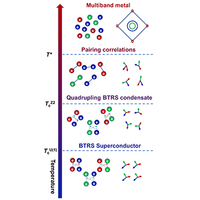
Four- or higher-order fermionic condensates can form in non-BCS multicomponent superconductors. Here, the authors present spectroscopic evidence for pairing correlations that appear well above the superconducting critical temperature in the highly overdoped Ba1−xKxFe2As2 system with broken time-reversal symmetry (BTRS). The NMR and μSR findings show that multicomponent superconductivity appears homogeneously throughout the entire sample volume and that the BTRS state is unrelated to conventional spin magnetism.

Sign In to Your Journals Account

Filter

Recent Issues

Vol. 114, Iss. 30
15 November 2026
Vol. 114, Iss. 29
15 November 2026
Vol. 114, Iss. 28
15 November 2026
Vol. 114, Iss. 27
1 November 2026
Category
Article Type
Section

Filter

Article Lookup

Enter a citation