Recent Articles

Influence of ligand field and correlation on the electronic structure of NiO and CoO from DFT+DMFT calculations

Daniel Mutter, Frank Lechermann, Daniel F. Urban, and Christian Elsässer

Phys. Rev. B 114, 235109 (2026) - Published 8 October, 2026

Site-selective renormalization and competing magnetic instabilities in paramagnetic Y3Cu2Sb3O14

Yanpeng Zhou and Gang Li

Phys. Rev. B 114, 235110 (2026) - Published 8 October, 2026

Dual character of Zn impurity in SnTe: Tuning thermoelectric and topological properties

Kacper Pryga and Bartlomiej Wiendlocha

Phys. Rev. B 114, 235203 (2026) - Published 8 October, 2026

Local symmetry and mode-selective electron-phonon coupling of oxygen-related defects in AlN

Erfei Zhang, Ning Tang, Yiming Tan, Lei Fu, Tianyu Zhang, Han Yang, Lin Shi, Ping Wang, Jiaming Wang, Guowei Lv, Xuelin Yang, Fujun Xu, Tongjun Yu, Xinqiang Wang, Weikun Ge, and Bo Shen

Phys. Rev. B 114, 235303 (2026) - Published 8 October, 2026

Lieb-Schultz-Mattis constraints for hyperbolic lattices

G. Shankar and Joseph Maciejko

Phys. Rev. B 114, 245110 (2026) - Published 8 October, 2026

The Lieb-Schultz-Mattis (LSM) theorem powerfully constrains the low-energy behavior of quantum many-body systems. In spin systems with spin rotation and conventional (Euclidean) lattice translation symmetries, it forbids a unique, gapped, symmetric ground state at half-odd-integer spin per unit cell. Here, the authors generalize this theorem to hyperbolic lattices — synthetic structures that emulate negatively curved space. Unlike Euclidean lattice translations, hyperbolic translations are noncommutative. By adapting a flux-threading argument, the authors derive LSM constraints on gapped phases of hyperbolic quantum matter.

Disordered Su-Schrieffer-Heeger model

Michael Hilke

Phys. Rev. B 114, 245111 (2026) - Published 8 October, 2026

Coexistence of spontaneously polarized layer Hall effect and quantum anomalous Hall effect in noncompensated antiferromagnetic heterostructures

Xuqi Li, Wenhao Liang, Di Han, Yuanzheng Chu, Shifei Qi, and Zhenhua Qiao

Phys. Rev. B 114, 245301 (2026) - Published 8 October, 2026

Phase-dependent electronic structure of two-dimensional Ag layers at the graphene/SiC interface

Sawani Datta, Boyang Zheng, Arpit Jain, Kathrin Küster, Joshua A. Robinson, Vincent H. Crespi, and Ulrich Starke

Phys. Rev. B 114, 245409 (2026) - Published 8 October, 2026

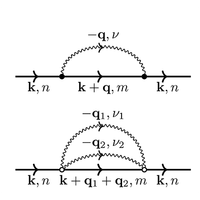
Importance of nonlinear long-range electron-phonon interaction for the carrier mobility of anharmonic halide perovskites

Matthew Houtput, Ingvar Zappacosta, William Wenborn, Serghei Klimin, Samuel Poncé, Jacques Tempere, and Cesare Franchini

Phys. Rev. B 114, L200301 (2026) - Published 8 October, 2026

The carrier mobility in many materials is dominated by scattering of the carriers with phonons. It is often calculated using only linear, one-electron–one-phonon interaction. Here, the authors present a first-principles calculation of the mobility including the nonlinear, long-range electron-phonon interaction, for the representative halide perovskite CsPbI3. It is shown that the temperature dependence of the carrier mobility decreases by about 10% due to the one-electron–two-phonon interaction, which is attributed to the strong anharmonicity and low phonon frequencies present in halide perovskites.

Many-body Euler topology

Axel Fünfhaus, Titus Neupert, Thilo Kopp, and Roser Valentí

Phys. Rev. B 114, L231104 (2026) - Published 8 October, 2026

The authors introduce here many-body Euler numbers as a counterpart to many-body Chern numbers to diagnose the spontaneous breaking of time reversal symmetry in (fractional) Chern insulators. In addition, a classification scheme to realize different topological phases in interacting systems using symmetry indicators is laid out.

Fingerprints of excitonic collective modes in the two-dimensional electron gas

Jakob Wolff, Silvana Botti, Lucia Reining, and Matteo Gatti

Phys. Rev. B 114, L231302 (2026) - Published 8 October, 2026

Kinematic foundations of defect-mediated plasticity: A gauge-theoretic framework

Kevin T. Grosvenor, Mario Solís, and Piotr Surówka

Phys. Rev. B 114, 194103 (2026) - Published 7 October, 2026

Crystal electric field analysis of the magnetic properties of ferromagnetic CeRu2Ge2 single crystal

Shovan Dan, Suman Nandi, Gourav Dwari, Bishal Baran Maity, Bhagyashree A. Chalke, Ruta Kulkarni, P. D. Babu, and Arumugam Thamizhavel

Phys. Rev. B 114, 214405 (2026) - Published 7 October, 2026

Neural networks as low-cost surrogates for impurity solvers in quantum embedding methods

Rohan Nain, Philip M. Dee, Kipton Barros, Steven Johnston, and Thomas A. Maier

Phys. Rev. B 114, 225114 (2026) - Published 7 October, 2026

Morphological evolution of a semiconductor surface driven by irradiation-induced anisotropic plastic flow

Tyler P. Evans and Scott A. Norris

Phys. Rev. B 114, 225406 (2026) - Published 7 October, 2026

Relation between the areal rate of Zitterbewegung and Berry curvature in two-band systems

Sonja Predin

Phys. Rev. B 114, 235202 (2026) - Published 7 October, 2026

Charge transport in two-dimensional conductors with hybrid three-component plasma

A. D. Levin, V. A. Chitta, Z. D. Kvon, N. N. Mikhailov, and G. M. Gusev

Phys. Rev. B 114, 235302 (2026) - Published 7 October, 2026

Discerning Hall and non-Hall transverse currents in linear and nonlinear regimes

Yu-Fei Liu, Jinchen Liu, Tiema Qian, Hou Chen Li, Tianye Huang, Jian-Xiang Qiu, Xiaoyu Zeng, Peng Guo, Jian Tang, Thao Dinh, Qiong Ma, Xufan Li, Ni Ni, Anyuan Gao, and Su-Yang Xu

Phys. Rev. B 114, 235407 (2026) - Published 7 October, 2026

Rapid advances in nonlinear Hall transport provide new probes of quantum geometry, but transverse signals generally mix Hall and non-Hall contributions that are difficult to disentangle. Here, the authors introduce a unified experimental protocol that exchanges current and voltage directions to identify antisymmetric Hall and symmetric non-Hall responses. Measurements across representative quantum materials validate the method in both linear and nonlinear regimes.

Unbiased large-N approach to competing vestigial orders of density-wave and superconducting instabilities

Grgur Palle and Rafael M. Fernandes

Phys. Rev. B 114, 245108 (2026) - Published 7 October, 2026

Vestigial orders are partially melted versions of ordered states stabilized by fluctuations of the order parameter. Observed in several quantum materials, their theoretical description has often relied on a large-N approximation that suffers from ambiguities due to multiple interfering channels. Here, the authors uncover the structural reasons for the ambiguities and from them derive a large-N prescription that removes the ambiguities, yielding unequivocal physical results. This prescription is then applied to multicomponent density wave and superconducting instabilities, where they find exotic vestigial phases describing spin-quadrupolar, charge-4e superconducting, and altermagnetic orders.

Spectroscopic signatures of emergent SO(5) symmetry at the deconfined critical point of the J−Q3 model

Shutao Liu, Yan Liu, Chengkang Zhou, Zhe Wang, Jie Lou, Changle Liu, Zheng Yan, and Yan Chen

Phys. Rev. B 114, 245109 (2026) - Published 7 October, 2026

Sign In to Your Journals Account

Filter

Recent Issues

Vol. 114, Iss. 30
15 November 2026
Vol. 114, Iss. 29
15 November 2026
Vol. 114, Iss. 28
15 November 2026
Vol. 114, Iss. 27
1 November 2026
Category
Article Type
Section

Filter

Article Lookup

Enter a citation