Recent Articles

Magnetic Bloch bands and Weiss oscillations in Dirac mass superlattices

Aman Anand, Reinhold Egger, and Alessandro De Martino

Phys. Rev. B 112, 235404 (2025) - Published 1 December, 2025

Ultrafast carrier relaxation dynamics in HgSe nanoparticles probed by optical pump terahertz probe spectroscopy

Paulamee Pandit, Ranit Ram, N. Ravishankar, D. V. S. Muthu, and A. K. Sood

Phys. Rev. B 112, 235405 (2025) - Published 1 December, 2025

Tailored hotspots from Airy-based surface plasmon polaritons

Rosario Martínez-Herrero, Ángel S. Sanz, and Javier Hernandez-Rueda

Phys. Rev. B 112, 235406 (2025) - Published 1 December, 2025

Robust broadband large-area photonic waveguides based on topological states

Shiqi Tong and Jiawen Xu

Phys. Rev. B 112, 245101 (2025) - Published 1 December, 2025

Constrained random phase approximation: The spectral method

Merzuk Kaltak, Alexander Hampel, Martin Schlipf, Indukuru Ramesh Reddy, Bongjae Kim, and Georg Kresse

Phys. Rev. B 112, 245102 (2025) - Published 1 December, 2025

Influence of interstitial Li on the electronic properties of LixCsPbI3 for photovoltaic and battery applications

Wei Wei, Julian Gebhardt, Daniel F. Urban, and Christian Elsässer

Phys. Rev. B 112, 245103 (2025) - Published 1 December, 2025

Characterization of fractional Chern insulator quasiparticles in twisted homobilayer MoTe2

Zhao Liu, Bohao Li, Yuhao Shi, and Fengcheng Wu

Phys. Rev. B 112, 245104 (2025) - Published 1 December, 2025

Spacetime supersymmetry in the truncated lattice Schwinger model

Yanting Cheng and Shang Liu

Phys. Rev. B 112, 245105 (2025) - Published 1 December, 2025

High pressure–high temperature equation of state and metallization of neon by shock waves from quantum molecular dynamics

D. V. Minakov, V. B. Fokin, G. S. Demyanov, and P. R. Levashov

Phys. Rev. B 112, 245107 (2025) - Published 1 December, 2025

Influence of local strain on the optical probing of a Ni2+ spin in a charged self-assembled epitaxial quantum dot

K. E. Połczyńska, S. Karouaz, W. Pacuski, and L. Besombes

Phys. Rev. B 112, 245301 (2025) - Published 1 December, 2025

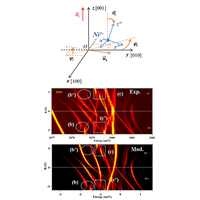
This study uncovers how local strain reshapes the spin landscape of a single Ni2+ ion (S=1) embedded in a charged semiconductor quantum dot. It reveals how strain anisotropy, spin–carrier exchange, and subtle symmetry breaking create rich optical signatures – offering new pathways to probe, model, and control individual spins for quantum technologies.

Theory of nonlinear electron relaxation in thin gold films and their signatures in optical observables

Jonas Grumm, Malte Selig, Holger Lange, and Andreas Knorr

Phys. Rev. B 112, 245402 (2025) - Published 1 December, 2025

Controllable dynamic magnetism in reconfigurable ferroelastic domain-wall networks engineered via nanocavities

Guangming Lu, Shai Rabkin, Wei Liu, Suzhi Li, Guohua Dong, Hyeok Yoon, Harold Y. Hwang, Beena Kalisky, and Ekhard K. H. Salje

Phys. Rev. B 112, 245403 (2025) - Published 1 December, 2025

Hierarchy of many-body localized bound states in an interacting open lattice

Yanxia Liu and Shu Chen

Phys. Rev. B 112, 245404 (2025) - Published 1 December, 2025

Experimentally probing non-Hermitian spectral transition and eigenstate skewness

Jia-Xin Zhong, Jeewoo Kim, Kai Chen, Jing Lu, Kun Ding, and Yun Jing

Phys. Rev. B 112, L220301 (2025) - Published 1 December, 2025

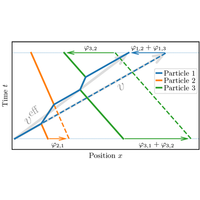
Probing complex-valued spectra and biorthogonal eigenstates in non-Hermitian systems remains experimentally challenging. The authors present here a Green’s function based method that directly measures these fundamental quantities in two-dimensional acoustic lattices. By capturing the full response matrix, they demonstrate eigenstate skewness and geometry-dependent spectral transitions. This universal method overcomes the limits of conventional pump‑probe or complex‑frequency techniques, providing a robust route for exploring exotic non‑Hermitian phenomena across wave‑based platforms.

Conformal boundary as holographic dual to the hyperbolic fracton model

Alejo Costa Duran, Mauricio Sturla, Ludovic D. C. Jaubert, and Han Yan (闫寒)

Phys. Rev. B 112, L220401 (2025) - Published 1 December, 2025

Controllable and nondissipative inertial dynamics of skyrmions in a bosonic platform

Imam Makhfudz

Phys. Rev. B 112, L220402 (2025) - Published 1 December, 2025

Dynamical transition in the Kitaev spin liquid under an external magnetic field

Yi-Xin Dai and Qing-Feng Sun

Phys. Rev. B 112, L220403 (2025) - Published 1 December, 2025

Berezinskii-Kosterlitz-Thouless phase transition in nanoporous films of superconducting NbN

A. Verma, R. Vedin, J. Jesudasan, J. Lidmar, I. Maccari, and S. Bose

Phys. Rev. B 112, L220501 (2025) - Published 1 December, 2025

Quadrature for the generalized hydrodynamics equation and absence of shocks in the Lieb-Liniger model

Friedrich Hübner and Benjamin Doyon

Phys. Rev. B 112, L241101 (2025) - Published 1 December, 2025

The authors develop here a new quadrature to solve the hydrodynamic equations of integrable models (called generalized hydrodynamics). Using this, the authors analytically prove the absence of shock formation in the Lieb-Liniger model, which had previously been conjectured based on experimental and numerical results. In addition, the quadrature also provides a new efficient algorithm to solve the generalized hydrodynamics equation, and new explicit formulas for the evolution of correlation functions.

Edge dependence of the supercurrent in the quantum Hall regime

Seong Jang, Geon-Hyoung Park, Kenji Watanabe, Takashi Taniguchi, and Gil-Ho Lee

Phys. Rev. B 112, L241401 (2025) - Published 1 December, 2025
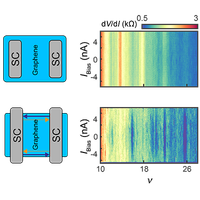
The authors show here that the supercurrent in graphene Josephson junctions under quantum Hall conditions is strictly mediated by physical edges. By comparing native, etched, edge-free, and gate-defined geometries, they find that the Josephson coupling disappears without edges and reemerges only when edge conduction is restored. This demonstrates that the supercurrent originates from Andreev bound states formed by paired upstream and downstream modes along the edges, highlighting edge engineering as a key strategy for realizing hybrid topological superconductivity in quantum Hall systems.

Sign In to Your Journals Account

Filter

Recent Issues

Vol. 114, Iss. 30
15 November 2026
Vol. 114, Iss. 29
15 November 2026
Vol. 114, Iss. 28
15 November 2026
Vol. 114, Iss. 27
1 November 2026
Category
Article Type
Section

Filter

Article Lookup

Enter a citation