Recent Articles

Vibrational angular momentum generation in thermally driven chiral systems

Jichen Feng, Ethan Abraham, Joseph E. Subotnik, and Abraham Nitzan

Phys. Rev. B 113, 094301 (2026) - Published 2 March, 2026

Double exchange bias and ultraslow magnetization relaxation in TbFe-based bilayers

Johannes Seyd and Manfred Albrecht

Phys. Rev. B 113, 094401 (2026) - Published 2 March, 2026

Laser-induced ultrafast magnetization dynamics in BiYIG/Co-based heterostructures: Complementary insights from pump-probe Faraday and Kerr rotation measurements

Dimple Sneha Pamarthi, Elena Popova, Nirina Randrianantoandro, Michel Hehn, Niels Keller, and Marwan Deb

Phys. Rev. B 113, 094402 (2026) - Published 2 March, 2026

Nonreciprocal superradiant quantum phase transition induced by the magnon Kerr effect

Guo-Qiang Zhang, Si-Yan Lin, Wei Feng, Lijiong Shen, Yi-Hao Kang, and Wei Xiong

Phys. Rev. B 113, 094403 (2026) - Published 2 March, 2026

Hanle lineshapes and spin-rotation signatures from in-plane anisotropic spin relaxation in heterogeneous spin devices

Josef Světlík, Juan F. Sierra, Lorenzo Camosi, Williams Savero Torres, Franz Herling, Vera Marinova, Dimitre Dimitrov, and Sergio O. Valenzuela

Phys. Rev. B 113, 094404 (2026) - Published 2 March, 2026

Diamagnetic Meissner response of odd-frequency superconducting pairing from quantum geometry

Ankita Bhattacharya and Annica M. Black-Schaffer

Phys. Rev. B 113, 094501 (2026) - Published 2 March, 2026

Odd-frequency superconductivity is ubiquitous in multiband systems but is commonly believed to yield a paramagnetic Meissner response and thus be unstable. The authors show here that this paradigm breaks down once quantum geometry is considered. For general two-band superconductors, the authors establish that the geometric interband contribution to the Meissner response from odd-frequency pairing is in fact diamagnetic, thus stabilizing odd-frequency superconductivity. In flat-band systems this geometric contribution can even dominate the Meissner response, which identifies flat-band materials as promising platforms for robust odd-frequency superconductivity.

Nematic enhancement of superconductivity in multilayer graphene via quantum geometry

Gal Shavit

Phys. Rev. B 113, 094502 (2026) - Published 2 March, 2026

Information phases of partial projected ensembles generated from random quantum states and scrambling dynamics

Alan Sherry, Saptarshi Mandal, and Sthitadhi Roy

Phys. Rev. B 113, 104301 (2026) - Published 2 March, 2026

How is quantum information distributed in complex many-body systems? Here, using partially projected ensembles, the authors show that the Holevo information in such ensembles uncovers sharp “information phases” invisible to standard entanglement measures. For Haar random states and late-time scrambling dynamics, it exhibits a qualitative change in scaling—from exponential decay to linear growth—separated by nonanalytic transitions as subsystem sizes vary. The decaying regime establishes a measurement-invisible quantum correlated phase, providing a finer probe for understanding scrambling and information structure in chaotic quantum systems beyond conventional entanglement measures.

Emergence of ferromagneticlike anomalous Hall resistivity in the antiferromagnetic topological semimetal DyPdBi

Yanglin Zhu, Yansong Wei, David Graf, and Yuyan Han

Phys. Rev. B 113, 104401 (2026) - Published 2 March, 2026

Altermagnetic skyrmions in two-dimensional lattices exhibiting the anisotropic skyrmion Hall effect

Kaiying Dou, Zhonglin He, Wenhui Du, Ying Dai, Baibiao Huang, and Yandong Ma

Phys. Rev. B 113, 104402 (2026) - Published 2 March, 2026

Interplay of electron-magnon scattering and spin-orbit induced electronic spin-flip scattering in a two-band Stoner model

Felix Dusabirane, Kai Leckron, Baerbel Rethfeld, and Hans Christian Schneider

Phys. Rev. B 113, 104403 (2026) - Published 2 March, 2026

Controlled expansion for pairing in a polarized band with strong repulsion

Zhiyu Dong and Patrick A. Lee

Phys. Rev. B 113, 104501 (2026) - Published 2 March, 2026

Majorana flat bands in the vortex line of superconducting Weyl semimetals

Zhicheng Zhang and Kou-Han Ma

Phys. Rev. B 113, 104502 (2026) - Published 2 March, 2026

Approximate Markovianity in high-temperature hidden Markov networks

Yifan F. Zhang and Sarang Gopalakrishnan

Phys. Rev. B 113, 115101 (2026) - Published 2 March, 2026

Berry curvature of low-energy excitons in rhombohedral graphene

Henry Davenport, Frank Schindler, and Johannes Knolle

Phys. Rev. B 113, 115102 (2026) - Published 2 March, 2026

Photoluminescence study of hydrogen-passivated type-II silicon clathrate films

Yinan Liu, Joseph P. Briggs, Reuben T. Collins, Meenakshi Singh, P. Craig Taylor, Khalid Mateen, Moussa Kane, and Carolyn A. Koh

Phys. Rev. B 113, 115201 (2026) - Published 2 March, 2026

Unified theory of the photovoltaic Hall effect by field- and light-induced Berry curvatures

Yuta Murotani, Tomohiro Fujimoto, and Ryusuke Matsunaga

Phys. Rev. B 113, 115202 (2026) - Published 2 March, 2026

Electric field induced spin and/or valley polarization in Weiss oscillations of monolayer 1T′−MoS2

Yang Li, Wen Zeng, and Rui Shen

Phys. Rev. B 113, 115301 (2026) - Published 2 March, 2026

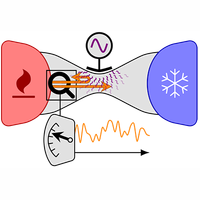
Fluctuation-dissipation bounds in time-dependently driven conductors

Ludovico Tesser, José Balduque, and Janine Splettstoesser

Phys. Rev. B 113, 115401 (2026) - Published 2 March, 2026

The current noise in quantum conductors not only affects current precision, but also reveals information about the system. Close to equilibrium, this noise fulfils the fluctuation-dissipation theorem. This is more difficult out of equilibrium, especially under temperature bias and time-dependent driving, crucial for quantum heat engines. Here, the authors demonstrate a constraint between the nonequilibrium noise and dissipated or generated power for arbitrary conductors and driving. Unlike the fluctuation-dissipation theorem, the bound found here is most restrictive far from equilibrium, where temperature biases are large.

Quantifying humidity effects on commensurability-dependent friction in bilayer graphene: A generalized registry index model

Binyang Shao, Xiaoyan Ren, Kun Liu, Lili Zhang, Yigang Cao, Xingju Zhao, and Shunfang Li

Phys. Rev. B 113, 115402 (2026) - Published 2 March, 2026

Sign In to Your Journals Account

Filter

Recent Issues

Vol. 114, Iss. 30
15 November 2026
Vol. 114, Iss. 29
15 November 2026
Vol. 114, Iss. 28
15 November 2026
Vol. 114, Iss. 27
1 November 2026
Category
Article Type
Section

Filter

Article Lookup

Enter a citation