Recent Articles

Formalism for the giant Goos-Hänchen shift in metasurface sensors with phase singularity

Lotfi Berguiga, Sébastien Cueff, Lydie Ferrier, Fabien Mandorlo, Taha Benyattou, Xavier Letartre, and Cécile Jamois

Phys. Rev. B 113, 195413 (2026) - Published 14 May, 2026

Protocol for detecting the nonlocality of multi-Majorana systems

Bai-Ting Liu, Peng Qian, Zhan Cao, and Dong E. Liu

Phys. Rev. B 113, 195414 (2026) - Published 14 May, 2026

Disentangling the Kitaev quantum spin liquid using the Clifford circuits augmented matrix product states method

Xiang Li, Xiangjian Qian, and Mingpu Qin

Phys. Rev. B 113, L201112 (2026) - Published 14 May, 2026

Complete characterization of local thermoelectric properties using a micro four-point probe

Neetu Lamba, Braulio Beltrán-Pitarch, Jesús Prado-Gonjal, Anthony V. Powell, Nini Pryds, Ole Hansen, and Dirch H. Petersen

Phys. Rev. B 113, L201201 (2026) - Published 14 May, 2026

Gate-tunable resonances and one-dimensional channel in a graphene nanoslide

Christophe De Beule, Ming-Hao Liu (劉明豪), Bart Partoens, and Lucian Covaci

Phys. Rev. B 113, L201403 (2026) - Published 14 May, 2026

Oscillatory photoresistance on the high-field side of the cyclotron resonance

M. A. Zudov

Phys. Rev. B 113, L201404 (2026) - Published 14 May, 2026

Experimental evidence of the mixed-coordinated rhombohedral phase in magnesium fluoride under high pressure

Tianheng Huang, Zhongwei Zhang, Nana Li, Cong Liu, Chi Ding, Chris J. Pickard, Wenge Yang, Hui-Tian Wang, Dingyu Xing, and Jian Sun

Phys. Rev. B 113, 174105 (2026) - Published 13 May, 2026

Location of the liquid-vapor critical point in aluminum

Xuyang Long and Kai Luo

Phys. Rev. B 113, 174106 (2026) - Published 13 May, 2026

Quantum sensing with discrete time crystals in the Lipkin-Meshkov-Glick model

Rahul Ghosh, Bandita Das, and Victor Mukherjee

Phys. Rev. B 113, 174302 (2026) - Published 13 May, 2026

Tensor network renormalization: Application to dynamic correlation functions and non-Hermitian systems

Ying-Jie Wei and Zheng-Cheng Gu

Phys. Rev. B 113, 174303 (2026) - Published 13 May, 2026

Biorthogonal quench dynamics of entanglement and quantum geometry in PT-symmetric non-Hermitian systems

Hsueh-Hao Lu and Po-Yao Chang

Phys. Rev. B 113, 174304 (2026) - Published 13 May, 2026

Structural and physical properties of single-crystalline Cr3−xSe4 (x<0.2)

Lin Yang, Anni Hu, Yao Lv, Jingying Peng, Ye Chen, Jiawen Zhang, Huiqiu Yuan, Ping Huang, and Yu Liu

Phys. Rev. B 113, 174404 (2026) - Published 13 May, 2026

Spontaneous continuous-symmetry breaking and tower of states in a comb chain

Jingya Wang, Zenan Liu, Bin-Bin Mao, Xu Tian, Zijian Xiong, Zhe Wang, and Zheng Yan

Phys. Rev. B 113, 174405 (2026) - Published 13 May, 2026

Antiferromagnetic moment reorientation via spin-flop coupling in La0.5Sr0.5FeO3/La0.7Sr0.3MnO3 bilayers

Ishmam Nihal, Matthew Frame, Christoph Klewe, and Yayoi Takamura

Phys. Rev. B 113, 174407 (2026) - Published 13 May, 2026

Superdiffusion resilience in Heisenberg chains with two-dimensional interactions on a quantum processor

Keerthi Kumaran, Manas Sajjan, Bibek Pokharel, Kevin Wang, Joe Gibbs, Jeffrey Cohn, Barbara Jones, Sarah Mostame, Sabre Kais, and Arnab Banerjee

Phys. Rev. B 113, 174408 (2026) - Published 13 May, 2026

Interfacial bond tailored altermagnetic tunnel junctions

Chao Mao, Shiqi Liu, Shunfang Li, Jinbo Yang, and Jie Yang

Phys. Rev. B 113, 174409 (2026) - Published 13 May, 2026

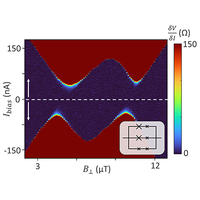
High-efficiency superconducting diode effect in a gate-tunable double-loop SQUID

Wyatt Gibbons, Teng Zhang, Kevin Barrow, Tyler Lindemann, Jukka I. Väyrynen, and Michael J. Manfra

Phys. Rev. B 113, 174505 (2026) - Published 13 May, 2026

The authors present here measurements of a double-loop superconducting quantum interference device (SQUID) with two gate-tunable hybrid InAs/Al Josephson junctions on each branch. This device enables controlled interferometry of three highly non-sinusoidal current-phase relationships (CPRs), revealing a significant superconducting diode effect. Through optimized gate and flux tuning, they achieve a device configuration where more than triple the supercurrent can flow in one direction compared to the other, and they accurately model this behavior with the expected CPR of the full device.

Doping evolution of the charge density wave and charge density fluctuations in La2−xSrxCuO4

Charles C. Tam, Mengze Zhu, Maud C. Barthélemy, Lauren J. Cane, Oliver J. Lipscombe, Stefano Agrestini, Jaewon Choi, Mirian Garcia-Fernandez, Ke-Jin Zhou, and Stephen M. Hayden

Phys. Rev. B 113, 174506 (2026) - Published 13 May, 2026

Chiral superconductivity from a parent Chern band and its non-Abelian generalization

Yan-Qi Wang, Zhi-Qiang Gao, and Hui Yang

Phys. Rev. B 113, 174507 (2026) - Published 13 May, 2026

Rashba's method of invariants

T. L. Linnik

Phys. Rev. B 113, 179604 (2026) - Published 13 May, 2026

Here, an overview is provided of the development of the invariant method in semiconductor physics, starting from the its origins and highlighting the role of Emmanuel I. Rashba in developing it. The author examines the application of the invariant method to construct an appropriate effective-mass Hamiltonian. The key effects of the spin-orbit interaction are discussed, including not only classical Rashba and Dresselhaus splitting but also a new kind of magnetic spin splitting which has been predicted and experimentally verified recently. It is demonstrated that the invariant method has become a universal tool in modern solid-state physics, widely applied not only to three-dimensional but also to two-dimensional crystals, including graphene, silicene, and transition metal dichalcogenide monolayers, all of which play an important role in modern spintronics.

Sign In to Your Journals Account

Filter

Recent Issues

Vol. 114, Iss. 30
15 November 2026
Vol. 114, Iss. 29
15 November 2026
Vol. 114, Iss. 28
15 November 2026
Vol. 114, Iss. 27
1 November 2026
Category
Article Type
Section

Filter

Article Lookup

Enter a citation