

- Perspective
- Open Access
Rashba's method of invariants
Phys. Rev. B 113, 179604 – Published 13 May, 2026
DOI: https://doi.org/10.1103/t7jq-5rq6
Abstract
This brief review is dedicated to the memory of E. I. Rashba and presents both a history of the development of the invariants method as applied to constructing the Hamiltonian of the effective mass method in semiconductor physics, as well as its modern use for describing a wide range of problems in two-dimensional crystals and crystals with complex magnetic and electric order.
Physics Subject Headings (PhySH)
Collections
This article appears in the following collection:
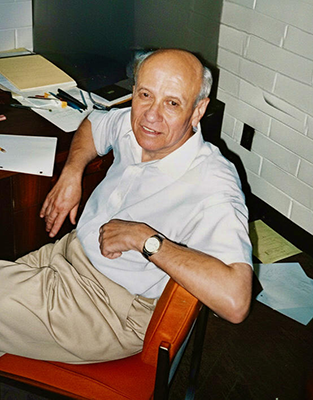
Honoring the legacy of Emmanuel Rashba
The passing of Professor Emmanuel Rashba in early 2025 was an irreparable loss to the physics community. For many decades prior, his numerous significant contributions have been driving solid state physics to surprising new places, realizations, and applications. To pay tribute to his many enduring, groundbreaking ideas, Physical Review B presents a special Collection with contributions by some of his disciples, collaborators, and connoisseurs of his mastery in top-shelf solid state research. Papers belonging to the collection will be published through 2026. It was initiated by Mark Dykman and Alexander Efros and colleagues. An Editorial from them and the contributed articles are linked below.
Article Text
References (42)
- S. Pekar, The method of effective masses of electrons in crystals, Zh. Eksp. Teor. Fiz. 16, 933 (1946).
- J. M. Luttinger and W. Kohn, Motion of electrons and holes in perturbed periodic fields, Phys. Rev. 97, 869 (1955).
- J. M. Luttinger, Quantum theory of cyclotron resonance in semiconductors: General theory, Phys. Rev. 102, 1030 (1956).
- G. L. Bir and G. E. Pikus, Symmetry and Strain-Induced Effects in Semiconductors (Wiley, New York, 1974).
- E. I. Rashba, Looking back, J. Supercond. Nov. Magn 16, 599 (2003).
- L. P. Bouckaert, R. Smoluchowski, and E. Wigner, Theory of Brillouin zones and symmetry properties of wave functions in crystals, Phys. Rev. 50, 58 (1936).
- R. J. Elliott, Spin-orbit coupling in band theory—character tables for some “double” space groups, Phys. Rev. 96, 280 (1954).
- G. Dresselhaus, Spin-orbit coupling effects in zinc blende structures, Phys. Rev. 100, 580 (1955).
- E. I. Rashba, Symmetry of energy bands in crystals of wurtzite type: I. Symmetry of bands disregarding spin-orbit interaction, Sov. Phys. Solid State 1, 368 (1959).
- E. I. Rashba and V. I. Sheka, Symmetry of energy bands in crystals of wurtzite type: II. Symmetry of bands including spin-orbit interaction, Fiz. Tverd. Tela: Collected Papers 2, 162 (1959).
- F. T. Vas'ko and N. A. Prima, Spin splitting of the spectrum of two-dimensional electrons, Sov. Phys. Solid State 21, 994 (1979).
- Y. A. Bychkov and E. I. Rashba, Oscillatory effects and the magnetic susceptibility of carriers in inversion layers, J. Phys. C 17, 6039 (1984).
- G. Bihlmayer, O. Rader, and R. Winkler, Focus on the Rashba effect, New J. Phys. 17, 050202 (2015).
- V. I. Sheka, Symmetry of energy bands of an electron with spin, Sov. Phys. Solid State 2, 1096 (1960).
- G. E. Pikus, A new method of calculating the energy spectrum of carriers in semiconductors. I. Neglecting spin-orbit interaction, Sov. Phys. JETP 14, 898 (1962).
- G. E. Pikus, A new method of calculating the energy spectrum of carriers in semiconductors. II. Account of spin-orbit interaction, Sov. Phys. JETP 14, 1075 (1962).
- E. I. Rashba, Properties of semiconductors with an extremum loop: I. Cyclotron and combinational resonance in a magnetic field perpendicular to the plane of the loop, Sov. Phys. Solid State 2, 1109 (1960).
- E. I. Rashba, Combined resonance in semiconductors, Sov. Phys. Usp. 7, 823 (1965).
- R. L. Bell, Electric dipole spin transitions in InSb, Phys. Rev. Lett. 9, 52 (1962).
- E. I. Rashba and V. I. Sheka, Electric-dipole spin resonance, in Landau Level Spectroscopy, edited by G. Landwehr and E. I. Rashba (Elsevier, Amsterdam, 1991), Chap. 4, pp. 131–206.
- M. S. Dresselhaus, G. Dresselhaus, and A. Jorio, Group Theory: Application to the Physics of Condensed Matter (Springer-Verlag, Berlin, 2008).
- E. L. Ivchenko and G. E. Pikus, Superlattices and Other Heterostructures. Symmetry and Optical Phenomena (Springer-Verlag, Berlin, 1995).
- R. Winkler, Spin-Orbit Coupling Effects in Two-Dimensional Electron and Hole Systems (Springer-Verlag, Berlin, 2003).
- L. C. L. Y. Voon and M. Willatzen, The k-p Method: Electronic Properties of Semiconductors (Springer-Verlag, Berlin, 2009).
- V. I. Sheka and T. L. Linnik, Method of Invariants in Semiconductor Theory (Vinichenko, Kyiv, 2017).
- R. Winkler and U. Zulicke, Invariant expansion for the trigonal band structure of graphene, Phys. Rev. B 82, 245313 (2010).
- W.-J. Jang, H. Kim, Y.-R. Shin, M. Wang, S. K. Jang, M. Kim, S. Lee, S.-W. Kim, Y. J. Song, and S. Kahng, Observation of spatially-varying Fermi velocity in strained-graphene directly grown on hexagonal boron nitride, Carbon 74, 139 (2014).
- A. V. Gert, M. O. Nestoklon, and I. N. Yassievich, Effective Hamiltonian of silicene in the presence of electric and magnetic fields, J. Exp. Theor. Phys. 123, 851 (2016).
- L. C. L. Y. Voon, A. Lopez-Bezanilla, J. Wang, Y. Zhang, and M. Willatzen, Effective Hamiltonians for phosphorene and silicene, New J. Phys. 17, 025004 (2015).
- M. Zhou, R. Zhang, J. Sun, W.-K. Lou, D. Zhang, W. Yang, and K. Chang, Multiband k · p theory of monolayer XSe (, Ga), Phys. Rev. B 96, 155430 (2017).
- E. A. Fajardo and R. Winkler, Effective dynamics of two-dimensional Bloch electrons in external fields derived from symmetry, Phys. Rev. B 100, 125301 (2019).
- I. D. Avdeev and D. S. Smirnov, Hyperfine interaction in atomically thin transition metal dichalcogenides, Nanoscale Adv. 1, 2624 (2019).
- E. Yalcin, I. V. Kalitukha, I. A. Akimov, V. L. Korenev, O. S. Ken, J. Puebla, Y. Otani, O. M. Hutchings, D. J. Gillard, A. I. Tartakovskii, and M. Bayer, Spin relaxation of localized electrons in monolayer : Importance of random effective magnetic fields, Phys. Rev. B 110, L161405 (2024).
- L.-D. Yuan, Z. Wang, J.-W. Luo, E. I. Rashba, and A. Zunger, Giant momentum-dependent spin splitting in centrosymmetric low-Z antiferromagnets, Phys. Rev. B 102, 014422 (2020).
- L.-D. Yuan, Z. Wang, J.-W. Luo, and A. Zunger, Prediction of low-Z collinear and noncollinear antiferromagnetic compounds having momentum-dependent spin splitting even without spin-orbit coupling, Phys. Rev. Mater. 5, 014409 (2021).
- S. A. Egorov, D. B. Litvin, and R. A. Evarestov, Antiferromagnetism-induced spin splitting in systems described by magnetic layer groups, J. Phys. Chem. C 125, 16147 (2021).
- R. Winkler and U. Zülicke, Collinear orbital antiferromagnetic order and magnetoelectricity in quasi-two-dimensional itinerant-electron paramagnets, ferromagnets, and antiferromagnets, Phys. Rev. Res. 2, 043060 (2020).
- R. Winkler and U. Zülicke, Theory of electric, magnetic, and toroidal polarizations in crystalline solids with applications to hexagonal lonsdaleite and cubic diamond, Phys. Rev. B 107, 155201 (2023).
- R. Winkler and U. Zulicke, Standard model of electromagnetism and chirality in crystals, arXiv:2405.20940.
- S. I. Pekar and E. I. Rashba, Combined resonance in crystals in inhomogeneous magnetic fields, J. Exp. Theor. Phys. 20, 1295 (1965).
- M. Zeng, M.-Y. Zhu, Y.-P. Zhu, X.-R. Liu, X.-M. Ma, Y.-J. Hao, P. Liu, G. Qu, Y. Yang, Z. Jiang, K. Yamagami, M. Arita, X. Zhang, T.-H. Shao, Y. Dai, K. Shimada, Z. Liu, M. Ye, Y. Huang, Q. Liu, and C. Liu, Observation of spin splitting in room-temperature metallic antiferromagnet CrSb, Adv. Sci. 11, 2406529 (2024).
- S. Reimers, L. Odenbreit, L. Šmejkal, V. N. Strocov, P. Constantinou, A. B. Hellenes, R. J. Ubiergo, W. H. Campos, V. K. Bharadwaj, A. Chakraborty, T. Denneulin, W. Shi, R. E. Dunin-Borkowski, S. Das, M. Kläui, J. Sinova, and M. Jourdan, Direct observation of altermagnetic band splitting in CrSb thin films, Nat. Commun. 15, 2116 (2024).

