Highlights

Stabilization of collinear ferromagnetic order in Ir-doped triple-layer ruthenate Sr4Ru3O10

Feng Ye, Zachary Morgan, Yu Zhang, Yifei Ni, and G. Cao

Phys. Rev. B 108, L241109 (2023) - Published 14 December, 2023

The triple-layer, spin-orbit-coupled metal Sr4Ru3O10 features, peculiarly, a strong ferromagnetic state along the c axis but a contrasting metamagnetic state within the basal plane. Mere 4% Ir substitution for Ru readily alters the structural balance between the RuO6 layers, establishing a collinear ferromagnetic state with magnetic moments fully aligned along the c axis. The emerging perpendicular magnetic anisotropy increases the critical field for the metamagnetic transition, highlighting a critical coupling between the magnetic properties and the underlying lattice facilitated through orbital degrees of freedom and the enhanced spin-orbit interaction.

Mott insulating low thermal expansion perovskite TiF3

Donal Sheets, Kaitlin Lyszak, Menka Jain, Gayanath W. Fernando, Ilya Sochnikov, Jacob Franklin, Jason N. Hancock, and R. Matthias Geilhufe

Phys. Rev. B 108, 235140 (2023) - Published 13 December, 2023

A class of transition metal trifluorides harbors a structural quantum phase transition, above which extremely large negative thermal expansion (NTE) is shown in ScF3. A related material (TiF3) has reported a much weaker effect and attempts have been made to describe the differing thermal expansion behavior of this system using uncorrelated electronic structure calculations. Here, the authors use a combination of infrared reflectivity, ac magnetometry, and density functional theory calculations to demonstrate that in fact that TiF3 is a strongly correlated electron system, where uncorrelated approaches are ineffective. The work concludes that Mott physics is an important consideration in describing the evolution of the unusual NTE effect in these systems.

Flat bands and electronic localization in twisted bilayer graphene nanoribbons

Elias Andrade, Pierre A. Pantaleón, Francisco Guinea, and Gerardo G. Naumis

Phys. Rev. B 108, 235418 (2023) - Published 13 December, 2023

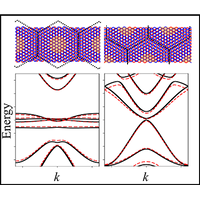
In an infinite twisted bilayer graphene lattice, flat bands emerge, representing electrons localized at the AA stacking regions. This study investigates the behavior of these bands when dealing with incomplete moiré supercells in twisted bilayer graphene nanoribbons. The findings reveal a transition from dispersive to flat bands near charge neutrality as the supercell completeness varies. Moreover, it is observed that the microscopic edges can influence the energy of states localized at the AA regions near the borders.

Bipolaronic superconductivity out of a Coulomb gas

J. Sous, C. Zhang, M. Berciu, D. R. Reichman, B. V. Svistunov, N. V. Prokof'ev, and A. J. Millis

Phys. Rev. B 108, L220502 (2023) - Published 13 December, 2023

Bipolaronic superconductivity induced by bond phonons survives even in the presence of very strong long-ranged Coulomb repulsion leading to transition temperatures in line with values found in 3D materials at low densities, providing a robust way to obtain superconductivity in the low-density limit.

Symmetry-enriched criticality in a coupled spin ladder

Suman Mondal, Adhip Agarwala, Tapan Mishra, and Abhishodh Prakash

Phys. Rev. B 108, 245135 (2023) - Published 12 December, 2023

This work investigates the interplay between microscopic symmetries and the effective degrees of freedom that define the macroscopic phase of matter. Considering a spin-ladder model and tuning the parameters, a myriad of distinct symmetry-enriched critical states is shown. Although the effective description in each of these phases is identical, i.e., the compact boson conformal field theory, symmetries act on the fields in subtly different ways leading to sharp distinctions in the nature of observables, including the presence of topological edge modes.

Loss-induced Floquet non-Hermitian skin effect

Yaohua Li, Cuicui Lu, Shuang Zhang, and Yong-Chun Liu

Phys. Rev. B 108, L220301 (2023) - Published 12 December, 2023

A mechanism for a loss-induced Floquet non-Hermitian skin effect (NHSE) is proposed, where gain/loss combined with Floquet engineering leads to the NHSE. This mechanism utilizes periodic coupling, which is a well-established experimental method, to realize the NHSE through loss instead of nonreciprocal coupling. The key to this mechanism is the Floquet-induced next-nearest neighbor coupling. This proposal is also applicable to high-dimensional systems and can be realized in photonic waveguides and other related systems.

Local structure, bonding, and asymmetry of ((NH2)2CH)PbBr3, CsPbBr3, and (CH3NH3)PbBr3

F. Bridges, J. Gruzdas, C. MacKeen, K. Mayford, N. J. Weadock, V. Urena Baltazar, Y. Rakita, Louis Waquier, Julian A. Vigil, Hemamala I. Karunadasa, and M. F. Toney

Phys. Rev. B 108, 214102 (2023) - Published 11 December, 2023

The local structure of hybrid organic-inorganic halide perovskites is of considerable interest due to the impact on optoelectronic and ion-conducting properties. Here, it is shown that the lead bromide perovskites are nearly perfect at low temperature, with negligible static disorder, through a temperature-dependent x-ray absorption spectroscopy study. As the crystal heats up, two things happen: the organic molecular-ion motion changes the Pb-Br bond strength at the orthorhombic-tetragonal transition, and anharmonicity (C3) contributes to a significant thermal disorder at room temperature.

Engineering entangled coherent states of magnons and phonons via a transmon qubit

Marios Kounalakis, Silvia Viola Kusminskiy, and Yaroslav M. Blanter

Phys. Rev. B 108, 224416 (2023) - Published 11 December, 2023

Entangled coherent states exhibit a special form of entanglement between two or more bosonic modes, which is useful for several tasks in quantum information and fundamental studies of quantum mechanics. Here, the authors propose a scheme for generating and controlling such states between distant magnets or mechanical resonators, using a superconducting qubit that couples via its inductance to the quanta of the collective magnetic excitations (magnons) or the vibrational excitations in mechanical beams (phonons). The results establish a promising platform for quantum information using magnonic and mechanical hybrid quantum devices.

Single-electron routing in a silicon quantum-dot array

Takeru Utsugi, Takuma Kuno, Noriyuki Lee, Ryuta Tsuchiya, Toshiyuki Mine, Digh Hisamoto, Shinichi Saito, and Hiroyuki Mizuno

Phys. Rev. B 108, 235308 (2023) - Published 11 December, 2023

Free electron transport on two-dimensional quantum dot arrays has the potential to dramatically improve the efficiency of quantum computing implemented on a solid-state device. Here, the authors have successfully controlled the paths of electrons on a silicon quantum dot array using a single-electron router. They perform proof-of-principle experiments for single-electron routing, which selectively transports individual electrons along a desired path, and develop the theory for estimating a minimum error rate of the routing.

Localized f-electron magnetism in the semimetal Ce3Bi4Au3

M. O. Ajeesh, S. K. Kushwaha, S. M. Thomas, J. D. Thompson, M. K. Chan, N. Harrison, J. M. Tomczak, and P. F. S. Rosa

Phys. Rev. B 108, 245125 (2023) - Published 11 December, 2023

Cerium-based compounds crystallizing in the cubic Ce3X4T3 (X=Bi, Sb and T=transition metal) structure present a wide variety of semiconducting ground states ranging from a conventional band gap in Ce3Sb4Au3 to prototypical Kondo insulating behavior in Ce3Bi4Pt3. The variation in physical properties among members stems from the delicate interplay between the crystal lattice, electron filling, and the hybridization between f electrons and the conduction electron sea. Here, the authors show that the substitution of Pt by Au forces cerium moments into a localized state rendering Ce3Bi4Au3 a magnetically ordered semimetal. These experimental results combined with realistic many-body simulations enable a broader comparison between Ce3X4T3 compounds and shed light on the distinct ground states in this family.

Pb9Cu(PO4)6(OH)2: Phonon bands, localized flat-band magnetism, models, and chemical analysis

Yi Jiang, Scott B. Lee, Jonah Herzog-Arbeitman, Jiabin Yu, Xiaolong Feng, Haoyu Hu, Dumitru Călugăru, Parker S. Brodale, Eoghan L. Gormley, Maia G. Vergniory, Claudia Felser, S. Blanco-Canosa, Christopher H. Hendon, Leslie M. Schoop, and B. Andrei Bernevig

Phys. Rev. B 108, 235127 (2023) - Published 8 December, 2023

Doped lead apatite (LK-99) has been proposed as a candidate ambient temperature and pressure superconductor, a dramatic claim requiring careful investigation from experiment and theory. Here, the authors synthesize an LK-99 sample and find a multiphase, transparent material that does not support high-temperature superconductivity. This is in agreement with ab initio calculations here that suggest the copper dopant does not meaningfully enter the structure and that the flat bands they generate at the Fermi level are largely unhybridized, with no quantum geometry to support a superfluid state.

Magnetic-field periodic quantum Sondheimer oscillations in thin-film graphite

Toshihiro Taen, Andhika Kiswandhi, and Toshihito Osada

Phys. Rev. B 108, 235411 (2023) - Published 7 December, 2023

Conventional quantum oscillations are periodic in an inverse of magnetic fields. Here, the authors observe magnetic-field periodic oscillations in a graphite thin film under magnetic fields where only two Landau levels remain. At this quasiquantum limit, they propose a new quantum oscillation mechanism: the quantum Sondheimer effect. The oscillations arise from the formation of the resonant modes periodically appearing in the magnetic fields. The period is inversely proportional to the film thickness, demonstrating its out-of-plane electron motion nature.

Visualizing the merger of tunably coupled graphene quantum dots

Daniel Walkup, Fereshte Ghahari, Steven R. Blankenship, Kenji Watanabe, Takashi Taniguchi, Nikolai B. Zhitenev, and Joseph A. Stroscio

Phys. Rev. B 108, 235407 (2023) - Published 6 December, 2023

The ability to pattern and simultaneously study a nanometer-scale potential landscape within hBN-based graphene devices using scanning tunneling microscopy (STM) opens a path for detailed investigation of model quantum systems. Here, the authors create a double-well potential and applied a strong magnetic field to induce Landau levels and the formation of quantum dots with single-electron charging characteristics. The system can be broadly tuned form weakly coupled dots to combined single dot while STM provides multiple measurement and manipulation modalities.

Decodable hybrid dynamics of open quantum systems with Z2 symmetry

Yaodong Li and Matthew P. A. Fisher

Phys. Rev. B 108, 214302 (2023) - Published 4 December, 2023

Within a toy model of open quantum systems, this work discusses the relation between measurement-induced phase transitions (MIPTs) of quantum entanglement and quantum error correction (QEC), which also has a phase transition at an “error threshold”. In particular, the authors show how concepts from QEC can facilitate the observation of MIPTs and, conversely, how insights from MIPTs can inform the design of decoding algorithms.

Understanding muon diffusion in perovskite oxides below room temperature based on harmonic transition state theory

T. U. Ito, W. Higemoto, and K. Shimomura

Phys. Rev. B 108, 224301 (2023) - Published 4 December, 2023

In certain perovskite oxides, positive muon (μ+) diffusion occurs with a small activation energy of ∼0.1 eV, contrary to the conventional assumption in μ+ spin spectroscopy for oxides that μ+ is tightly bound to an oxygen atom and immobile below room temperature. Here, the authors analyze the over-barrier diffusion of μ+ observed in KTaO3 using harmonic transition state theory and show that μ+ zero-point vibrations may significantly lower the activation barrier to facilitate fast μ+ diffusion below room temperature.

Importance of nonuniform Brillouin zone sampling for ab initio Bethe-Salpeter equation calculations of exciton binding energies in crystalline solids

Antonios M. Alvertis, Aurélie Champagne, Mauro Del Ben, Felipe H. da Jornada, Diana Y. Qiu, Marina R. Filip, and Jeffrey B. Neaton

Phys. Rev. B 108, 235117 (2023) - Published 4 December, 2023

Excitons in solids often reside in a narrow region of reciprocal space. Yet, it is standard for first-principles exciton calculations to sample the entire Brillouin zone uniformly, at great computational cost and resulting in underconverged exciton binding energies. Here, the authors demonstrate that a straightforward-to-implement nonuniform sampling approach yields highly converged exciton binding energies, which can significantly differ from previous best theoretical estimates, at a fraction of the computational expense of uniform sampling approaches. This will enable the prediction of exciton binding energies of increasingly complex materials.

Electronic structure, dimer physics, orbital-selective behavior, and magnetic tendencies in the bilayer nickelate superconductor La3Ni2O7 under pressure

Yang Zhang, Ling-Fang Lin, Adriana Moreo, and Elbio Dagotto

Phys. Rev. B 108, L180510 (2023) - Published 28 November, 2023

The recently discovered high-temperature superconductor La3Ni2O7 with Tc ~ 80 K under pressure has revolutionized the field of correlated electrons. The authors find here that an orbital-selective spin-singlet “dimer” linking the two planes of this bilayer via the d3z2−r2 orbital provides the primary building block to study its electronic properties. Furthermore, an in-plane robust interorbital hopping between eg states, competes with the more natural intraorbital hopping, leading to a dominant spin stripe (π, 0) order, as well as a rich phase diagram.

Building entanglement entropy out of correlation functions for interacting fermions

Saranyo Moitra and Rajdeep Sensarma

Phys. Rev. B 108, 174309 (2023) - Published 22 November, 2023

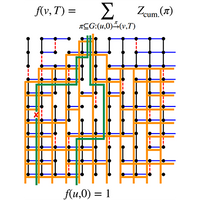
There are very few analytical methods to calculate entanglement entropy (EE) of large quantum many-body states. Here, the authors show how to construct EE of generic interacting fermions in arbitrary spatial dimensions in terms of measurable correlation functions. They provide approximate answers for EE when only few-particle correlations are known. The field theory they construct is applicable to systems both in and out of thermal equilibrium.

Strong magnetic proximity effect in van der Waals heterostructures driven by direct hybridization

C. Cardoso, A. T. Costa, A. H. MacDonald, and J. Fernández-Rossier

Phys. Rev. B 108, 184423 (2023) - Published 22 November, 2023

The conventional spin proximity effect is normally pictured in terms of a small spin splitting of the bands of a nonmagnetic material, due to exchange coupling to a ferromagnet. In this work, the authors show a different type of proximity mechanism, where only one spin channel in the nonmagnetic material becomes strongly hybridized with the ferromagnet, whereas the other remains unaffected. In the case of graphene coupled to CrI3, a ferromagnetic insulator, the authors show that the hybridization proximity is both strong and electrically tunable.

Transport anomalies in multiband superconductors near the quantum critical point

Maxim Dzero, Maxim Khodas, and Alex Levchenko

Phys. Rev. B 108, 184513 (2023) - Published 22 November, 2023

Exploring quantum superconductor-metal transitions in correlated electron systems reveals intriguing phenomena under diverse nonthermal influences like pressure, chemical substitution, or magnetic field. This study delves into the impact of thermal and quantum fluctuations on transport properties as the system nears the superconducting state from the metallic phase. The focus is on multiband superconductors, unraveling the nuanced role of superconducting fluctuations. Interestingly, depending on the trajectory towards the quantum critical point, these fluctuations may induce localizing corrections to the normal-state conductivity.

Sign In to Your Journals Account

Filter

Section

Filter

Article Lookup

Enter a citation