Recent Articles

Thickness Dependence of the Dzyaloshinskii-Moriya Interaction in Co2FeAl Ultrathin Films: Effects of Annealing Temperature and Heavy-Metal Material

M. Belmeguenai, Y. Roussigné, H. Bouloussa, S. M. Chérif, A. Stashkevich, M. Nasui, M. S. Gabor, A. Mora-Hernández, B. Nicholson, O.-O. Inyang, A. T. Hindmarch, and L. Bouchenoire

Phys. Rev. Applied 9, 044044 (2018) - Published 30 April, 2018

The interfacial Dzyaloshinskii-Moriya interaction (IDMI) provides a very important energy contribution in ultrathin-film magnetism, as it favors chiral magnetic structures and nonreciprocity in spin-wave propagation—features that open prospects for spintronic devices, such as magnetic random-access memory. Thus the authors use Brillouin light scattering to measure spin-wave nonreciprocity and investigate the dependence of the IDMI on thickness and annealing in ultrathin films of a Heusler alloy, with various buffer-layer materials. It turns out that the sign and strength of the effective IDMI constant depend on stacking order as well.

Designing Hybrids of Graphene Oxide and Gold Nanoparticles for Nonlinear Optical Response

Rajesh Kumar Yadav, J. Aneesh, Rituraj Sharma, P. Abhiramnath, Tuhin Kumar Maji, Ganesh Ji Omar, A. K. Mishra, Debjani Karmakar, and K. V. Adarsh

Phys. Rev. Applied 9, 044043 (2018) - Published 30 April, 2018

The nonlinear optical absorbance of conventional materials is very weak, yet its magnitude dominates device performance in, for example, optical limiting and pulse shaping. Therefore, achieving a strong nonlinear optical response is a longstanding goal. The authors propose charge transfer between donor and acceptor materials as a means to greatly enhance nonlinear response, toward the realization of high-performance optical limiters. Excellent agreement between experiment and theory for a test hybrid material validates the idea, and guides the design and fabrication of an actual liquid-cell-based absorptive optical limiter, which outperforms benchmark devices.

Reference-Free Single-Point Holographic Imaging and Realization of an Optical Bidirectional Transducer

Seungwoo Shin, KyeoReh Lee, YoonSeok Baek, and YongKeun Park

Phys. Rev. Applied 9, 044042 (2018) - Published 30 April, 2018

One of the fundamental limitations in photonics is the lack of a transducer for interconverting optical and electronic information. The experiments in this study demonstrate just such a bidirectional transducer, for measuring and modulating optical fields. The authors go on to propose an approach for reference-free holographic imaging by showing the unique determination of the pattern that maximizes focused intensity at a point as an optical phase conjugation, using the time-reversal symmetry of light scattering. Furthermore, broadband applicability of this approach is demonstrated, at visible and infrared wavelengths.

Tunable Noncollinear Antiferromagnetic Resistive Memory through Oxide Superlattice Design

Jason D. Hoffman, Stephen M. Wu, Brian J. Kirby, and Anand Bhattacharya

Phys. Rev. Applied 9, 044041 (2018) - Published 27 April, 2018

A central challenge in the burgeoning field of antiferromagnetic spintronics is to find materials with an antiferromagnetic state that can be both controlled and read out. To address this challenge, the authors create artificial La0.67Sr0.33MnO3/LaNiO3 superlattices that are nearly antiferromagnetic, featuring a state that can be controlled with a small external magnetic field and read out via resistance measurements. This approach introduces ferromagnetlike controllability in an antiferromagnetic system, in a tunable manner, without sacrificing the advantageous properties (such as low stray fields) of antiferromagnetism.

Quantifying Tip-Sample Interactions in Vacuum Using Cantilever-Based Sensors: An Analysis

Omur E. Dagdeviren, Chao Zhou, Eric I. Altman, and Udo D. Schwarz

Phys. Rev. Applied 9, 044040 (2018) - Published 26 April, 2018

Should you trust what you see? The authors show that the potentials recovered using distance-based techniques in scanning probe spectroscopy deviate more than previously assumed. To facilitate accurate measurement with efficient data acquisition, they propose modulating the drive amplitude at a constant height from the surface, while monitoring both oscillation amplitude and phase. This approach enables quicker scans with better accuracy, compared to standard techniques, with the further advantage that since no feedback loop is active during the amplitude sweep, the interaction potential can be consistently recovered deep into the repulsive regime.

Optically Tunable Resistive-Switching Memory in Multiferroic Heterostructures

Ming Zheng, Hao Ni, Xiaoke Xu, Yaping Qi, Xiaomin Li, and Ju Gao

Phys. Rev. Applied 9, 044039 (2018) - Published 26 April, 2018

Controlling physical properties using light or electric field, rather than magnetic field or electrical current, is of keen interest for tomorrow’s energy-efficient, high-density, nonvolatile memory applications. The authors combine the effects of electric-field-induced ferroelastic strain and photoexcited delocalization for significant tuning of electronic transport in manganite-based multiferroic heterostructures. The strong correlation of these effects is essentially driven by electronic phase separation. These results provide a framework for realizing multifield tuning of phase separation in complex oxides, for advanced device physics.

Mechanism of Benzene Tribopolymerization on the RuO2(110) Surface

J. Yang, Y. Qi, H. D. Kim, and A. M. Rappe

Phys. Rev. Applied 9, 044038 (2018) - Published 26 April, 2018

Nano- and microelectromechanical systems (NEMS and MEMS) are interesting as switches for next-generation computing electronics. Unfortunately, repeated switching causes the formation of gunk known as tribopolymer in the junction, which spoils device performance. To understand the mechanism behind this phenomenon at the intersection of physics, chemistry, and electronics, the authors use density functional theory to study the switching of a RuO2 NEMS in the presence of benzene. Tribopolymer formation involves a chain reaction of an oxidized biphenyl-like structure, with abstraction of surface oxygen, leading to strongly chemisorbed species that continue to polymerize.

Effect of a Phonon Bottleneck on Exciton and Spin Generation in Self-Assembled In1−xGaxAs Quantum Dots

Y. Q. Huang, I. A. Buyanova, X. J. Yang, A. Murayama, and W. M. Chen

Phys. Rev. Applied 9, 044037 (2018) - Published 26 April, 2018

Semiconductor quantum dots (QDs) hold great potential for solid-state light-emitting devices and optical and spin-based quantum information processing, but the efficiency of QD-based spin LEDs remains limited, and their physics not fully understood. Using tunable laser spectroscopy, the authors discover that here an intrinsic obstacle to spin generation is phonon bottleneck, a lack of phonon-mediated relaxation pathways that can arise in a zero-dimensional system. This insight provides design rules for energy-level engineering in spin-optoelectronic applications of QDs, yielding about a threefold increase in spin generation efficiency, even at elevated temperatures.

Quantum Algorithms to Simulate Many-Body Physics of Correlated Fermions

Zhang Jiang, Kevin J. Sung, Kostyantyn Kechedzhi, Vadim N. Smelyanskiy, and Sergio Boixo

Phys. Rev. Applied 9, 044036 (2018) - Published 26 April, 2018

Physical systems with strongly correlated electrons (fermions) are notoriously difficult to study using traditional computers. Meanwhile, as programmable quantum computers become a reality, efficient (and preferably general) quantum algorithms are needed, in the face of limited qubit-qubit connectivity in the near term. Addressing both problems, the authors develop quantum algorithms that run on two-dimensional qubit lattices with nearest-neighbor interactions, to simulate strongly correlated fermions. Their approach avoids the parity problem in mapping fermionic operators to qubit operators, with hardly any overhead, and can be used for a whole class of problems.

Dynamic Magnetostriction of CoFe2O4 and Its Role in Magnetoelectric Composites

A. Aubert, V. Loyau, Y. Pascal, F. Mazaleyrat, and M. LoBue

Phys. Rev. Applied 9, 044035 (2018) - Published 24 April, 2018

Applications involving magnetostrictive materials require an accurate approach to characterizing their properties. The dynamic deformation induced by an alternating magnetic field—the piezomagnetic effect—is often defined by the strain derivative of the quasistatic magnetostrictive curve. However, this can be inaccurate for “semihard” magnetic materials, such as cobalt ferrite. This study shows that measurements of dynamic magnetostriction are more reliable than strain derivatives in characterizing the piezomagnetic effect. The results give a better understanding of e.g. the magnetoelectric effect in composites, which could be exploited in sensors and energy-harvesting devices.

Giant Tunnel Magnetoresistance with a Single Magnetic Phase-Transition Electrode

Jia Zhang, X. Z. Chen, C. Song, J. F. Feng, H. X. Wei, and Jing-Tao Lü

Phys. Rev. Applied 9, 044034 (2018) - Published 24 April, 2018

A magnetic tunnel junction with a single magnetic electrode, rather than the usual two, would be interesting for magnetoresistance (MR) -based devices in spintronics, but a low MR ratio remains as one of the main obstacles. This study uses first-principles calculations to investigate MPT-TMR, the change in tunneling magnetoresistance due to a magnetic phase transition of the electrode, in an α’-FeRh/MgO/Cu tunnel junction. In this case the MPT-TMR ratio is predicted to be high—up to hundreds of percents. This plus structural simplicity, tunable spin injection with nearly complete spin polarization, and electric-field-driven switching make this system quite promising for applications.

Electromagnon Resonance at Room Temperature with Gigantic Magnetochromism

H. Shishikura, Y. Tokunaga, Y. Takahashi, R. Masuda, Y. Taguchi, Y. Kaneko, and Y. Tokura

Phys. Rev. Applied 9, 044033 (2018) - Published 23 April, 2018

Light at terahertz frequencies is seen as key to future applications, but the related technology is still at a developmental stage. In contrast to the usual magnon (magnetic collective excitation) possessing an ac magnetic response in the GHz range, magnetoelectric coupling in a multiferroic material provides a resonance with electrical activity in the coveted THz region—an electromagnon. This study of multiferroic Y-type hexaferrites demonstrates robust electromagnon resonances and their versatile magnetic control, even at room temperature, thus providing an avenue to THz applications.

Allotropes of Phosphorus with Remarkable Stability and Intrinsic Piezoelectricity

Zhenqing Li, Chaoyu He, Tao Ouyang, Chunxiao Zhang, Chao Tang, Rudolf A. Römer, and Jianxin Zhong

Phys. Rev. Applied 9, 044032 (2018) - Published 23 April, 2018

The assembly of ultrathin, metastable phosphorus nanotubes into two-dimensional arrays provides many low-energy allotropes, most being energetically more favorable than the experimentally viable “black” and “blue” phosphorenes. In this study, calculations show that two forms in particular are pure elementary piezoelectric materials, with remarkable piezoelectricity greater than that of well-known h-BN and MoS2. These engineered varieties of two-dimensional phosphorus are interesting for potential piezotronic applications, such as nanoscale sensors and energy harvesters.

Floquet-Network Theory of Nonreciprocal Transport

Huanan Li, Tsampikos Kottos, and Boris Shapiro

Phys. Rev. Applied 9, 044031 (2018) - Published 20 April, 2018

In photonics, devices that break time-reversal symmetry are at the leading edge of technology for communication, imaging, and quantum information. Knowing the fundamental rules that lead to nonreciprocal wave transport (NWRT) in the case of periodic (Floquet) driving would allow the design of driving schemes with narrow- or broadband NWRT at predefined frequencies. To this end, the authors provide a theoretical framework that lays out the rules and provides a general recipe for designing these schemes. This development will impact applications ranging from frequency converters to reconfigurable optical, microwave, and acoustic isolators and circulators, and beyond.

Topology-Optimized Multilayered Metaoptics

Zin Lin, Benedikt Groever, Federico Capasso, Alejandro W. Rodriguez, and Marko Lončar

Phys. Rev. Applied 9, 044030 (2018) - Published 20 April, 2018

Compact metasurface devices herald an exciting revolution in optics technology. Their design complexity and functionality has been restricted to intuitive by-hand designs for single-layered devices. This study proposes a large-scale approach known as topology optimization, applied to multiple, closely spaced device layers, which greatly expands the scope and functionality of metadevices. In particular, the authors demonstrate angular phase control, the ability to encode arbitrary information using different angles of incidence, which enables e.g. the design of a one-piece, aberration-corrected metalens, and of an angle-convergent metalens.

Tuning the Electronic, Optical, and Magnetic Properties of Monolayer GaSe with a Vertical Electric Field

Congming Ke, Yaping Wu, Guang-Yu Guo, Wei Lin, Zhiming Wu, Changjie Zhou, and Junyong Kang

Phys. Rev. Applied 9, 044029 (2018) - Published 20 April, 2018

Fully electrical control of devices is keenly pursued for applications in optoelectronics and spintronics. Inspired by the continual discovery of interesting features in two-dimensional semiconductors, the authors investigate the electronic structure and properties of monolayer GaSe in a transverse electric field. Density functional theory predicts a giant Stark effect, switchable optical anisotropy, and controllable spin-orbit coupling and spin polarization in this group-IIIA monochalcogenide. This study provides welcome guidelines for exploiting GaSe in various realms of device physics.

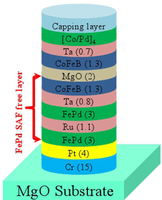
L10 Fe−Pd Synthetic Antiferromagnet through an fcc Ru Spacer Utilized for Perpendicular Magnetic Tunnel Junctions

De-Lin Zhang, Congli Sun, Yang Lv, Karl B. Schliep, Zhengyang Zhao, Jun-Yang Chen, Paul M. Voyles, and Jian-Ping Wang

Phys. Rev. Applied 9, 044028 (2018) - Published 19 April, 2018

Nonvolatile magnetic random-access memory (MRAM) based on perpendicular magnetic tunnel junctions (PMTJs) has been proposed as a universal memory solution for computing, where high thermal stability and low energy consumption are key. Unfortunately, PMTJs using materials with interfacial perpendicular magnetic anisotropy (PMA) cannot provide the required stability and scalability. This study presents a perpendicular structure using the synthetic antiferromagnet Fe-Pd, which possesses an ultralow damping constant and high PMA. This allows PMTJs with 25% room-temperature magnetoresistance that are compatible with 400°C thermal treatment, for integration with CMOS technology.

Best-Practice Criteria for Practical Security of Self-Differencing Avalanche Photodiode Detectors in Quantum Key Distribution

A. Koehler-Sidki, J. F. Dynes, M. Lucamarini, G. L. Roberts, A. W. Sharpe, Z. L. Yuan, and A. J. Shields

Phys. Rev. Applied 9, 044027 (2018) - Published 18 April, 2018

Although quantum key distribution (QKD) promises information-theoretic security that can never be hacked, several studies have investigated how its security can be compromised by targeting the detectors in the system. Have they found truly fundamental problems with the physics of the scheme, or merely sloppy implementation? This study seeks to define best-practice criteria for these detectors, to distinguish between genuine loopholes and incorrect operation. The authors show that if these directions are followed, many of the attacks previously demonstrated simply do not work—bringing this technology a big step closer to everyday life.

Multiwavelength Optical Switch Based on Controlling the Fermi Energy of Graphene

Xiangqian Jiang, Jinlin Bao, and Xiudong Sun

Phys. Rev. Applied 9, 044026 (2018) - Published 18 April, 2018

Several graphene-based active plasmonic optoelectronic switches have been demonstrated, but have been limited to a single wavelength. This study uses transmission and reflection to propose a multiwavelength optical switch based on a graphene/dielectric/graphene multilayered corrugated structure, exploiting the electrical tunability of graphene. By adjusting the Fermi energy of the graphene layer, high modulation depth at four different wavelengths is possible, with significant implications for active devices such as high-speed modulators for optical telecommunication.

Theory of Excitation Transfer between Two-Dimensional Semiconductor and Molecular Layers

Judith F. Specht, Eike Verdenhalven, Björn Bieniek, Patrick Rinke, Andreas Knorr, and Marten Richter

Phys. Rev. Applied 9, 044025 (2018) - Published 18 April, 2018

Hybrid inorganic/organic semiconductor devices combine and enhance the optoelectronic features of their constituents. To ideally exploit the advantageous properties of this class of materials, extensive parameter studies are needed to explore the operating regimes for optimized device performance. This theoretical study investigates the influence of system preparation and geometry on nonradiative excitation-transfer efficiency across the hybrid interface. The coupling efficiency depends strongly, and not intuitively, on multiple parameters such as resonance-energy detuning, molecular coverage, and charge-carrier concentration and temperature.

Sign In to Your Journals Account

Filter

Recent Issues

Vol. 26, Iss. 5
November 2026
Vol. 26, Iss. 4
October 2026
Vol. 26, Iss. 3
September 2026
Vol. 26, Iss. 2
August 2026
Category
Article Type

Filter

Article Lookup

Enter a citation