Recent Articles

Generalized heralded generation of non-Gaussian states using an optical parametric amplifier

Xiao-Xi Yao, Bo Zhang, and Yusuf Turek

Phys. Rev. A 113, 033712 (2026) - Published 9 March, 2026

Controllable frequency combs in the coupled waveguide optomechanical system with phase shifter

Deng-Wei Zhang, Li-Li Zheng, Bao Wang, and Xin-You Lü

Phys. Rev. A 113, 033713 (2026) - Published 9 March, 2026

Controllable nonreciprocal Goos-Hänchen shift via a spinning YIG sphere and parametric amplification

Xu Deng, Kai-Kai Zhang, Tong Zhang, Tao Shui, and Wen-Xing Yang

Phys. Rev. A 113, 033714 (2026) - Published 9 March, 2026

Benchmarking of Bayesian bounds for noisy frequency estimation of a spin-1/2 system

Maoyu Yan, Li-Bo Chen, and Wen Yang

Phys. Rev. A 113, 032410 (2026) - Published 6 March, 2026

Achieving subfemtotesla signal amplification with hyperpolarized spins

Chang Guo, Ying Huang, Yuanhong Wang, Haowen Su, Min Jiang, and Xinhua Peng

Phys. Rev. A 113, 032411 (2026) - Published 6 March, 2026

Blind quantum computing with different qudit resource state architectures

Alena Romanova and Wolfgang Dür

Phys. Rev. A 113, 032606 (2026) - Published 6 March, 2026

Hyperfine and Zeeman optical pumping and transverse laser cooling of a thermal atomic beam of dysprosium using a single 421-nm laser

Rohan Chakravarthy, Jonathan Agil, Arijit Sharma, Jung Bog Kim, and Dmitry Budker

Phys. Rev. A 113, 033103 (2026) - Published 6 March, 2026

Phase transitions and spectral singularities in a class of one-dimensional parity-time-symmetric complex potentials

Jinlin Fan, Ruolin Chai, Feilong Wang, Zhibin Zhao, and Qiongtao Xie

Phys. Rev. A 113, 033507 (2026) - Published 6 March, 2026

Cooling a levitated milligram mirror to the ground state using Pound-Drever-Hall locking

Alexander Hodges, Jinjin Du, Shilu Tian, and Jason Twamley

Phys. Rev. A 113, 033508 (2026) - Published 6 March, 2026

Steering photonic breathers via position-modulated Kerr nonlinearity in a segmented optomechanical array

Siliu Xu, Yu Wang, Yuan Zhao, Zhuo Fan, and Shihua Chen

Phys. Rev. A 113, 033509 (2026) - Published 6 March, 2026

Spatiotemporal dynamics of formation and propagation of spectrally singular modes in a broadband quasi-PT-symmetric photonic crystal

V. A. Bushuev and B. I. Mantsyzov

Phys. Rev. A 113, 033510 (2026) - Published 6 March, 2026

Magnon squeezing near a quantum critical point in a cavity-magnon-qubit system

Gang Liu, Gen Li, Rong-Can Yang, Wei Xiong, and Jie Li

Phys. Rev. A 113, 033707 (2026) - Published 6 March, 2026

Erratum: Two-body P-state energies at order α6 [Phys. Rev. A 109, 022819 (2024)]

Vojtěch Patkóš, Vladimir A. Yerokhin, and Krzysztof Pachucki

Phys. Rev. A 113, 039901 (2026) - Published 6 March, 2026

Stabilization of three-body resonances to bound states in a continuum

Lucas Happ and Pascal Naidon

Phys. Rev. A 113, 032203 (2026) - Published 5 March, 2026

Quasiprobabilistic nature of the spatiotemporal Born rule

James Fullwood, Zhihao Ma, and Zhen Wu

Phys. Rev. A 113, 032204 (2026) - Published 5 March, 2026

Phase-space tableau simulation for quantum computation

Selman Ipek, Atak Talay Yucel, Farzad Shahi, Cagdas Ozdemir, and Cihan Okay

Phys. Rev. A 113, 032409 (2026) - Published 5 March, 2026

Measurement-based quantum computation in symmetry-protected topological states of one-dimensional integer spin systems

Wang Yang, Arnab Adhikary, and Robert Raussendorf

Phys. Rev. A 113, 032605 (2026) - Published 5 March, 2026

Dissociative recombination without curve crossings: NeH+ and ArH+

Åsa Larson and Ann E. Orel

Phys. Rev. A 113, 032807 (2026) - Published 5 March, 2026

K-shell ionization and characteristic x-ray radiation by high-energy electrons and positrons in oriented silicon crystals

S. V. Trofymenko and I. V. Kyryllin

Phys. Rev. A 113, 032808 (2026) - Published 5 March, 2026

Rotational splittings in diatomic molecules of interest to searches for new physics

Ayaki Sunaga and Timo Fleig

Phys. Rev. A 113, 032809 (2026) - Published 5 March, 2026
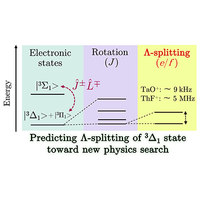
The authors present a theoretical model for calculating the rotational-coupling effects on diatomic open-shell systems based on the four-component multireference wave function. The calculated splittings could contribute to ongoing experimental efforts to measure the electric dipole moment of the electron, and to probe for nuclear charge-parity violation through the nuclear magnetic quadrupole moment.

Sign In to Your Journals Account

Filter

Recent Issues

Vol. 114, Iss. 4
October 2026
Vol. 114, Iss. 3
September 2026
Vol. 114, Iss. 2
August 2026
Vol. 114, Iss. 1
July 2026
Category
Article Type
Section

Filter

Article Lookup

Enter a citation