Highlights

How to quantify coherence: Distinguishing speakable and unspeakable notions

Iman Marvian and Robert W. Spekkens

Phys. Rev. A 94, 052324 (2016) - Published 18 November, 2016

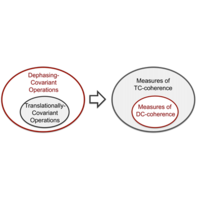
A general framework for studying quantum coherence as a resource is presented, where coherence is classified as “speakable” or “unspeakable” based on whether or not the identity of the subspaces that appear in the coherent superposition is significant.

Analog quantum simulation of (1+1)-dimensional lattice QED with trapped ions

Dayou Yang, Gouri Shankar Giri, Michael Johanning, Christof Wunderlich, Peter Zoller, and Philipp Hauke

Phys. Rev. A 94, 052321 (2016) - Published 16 November, 2016

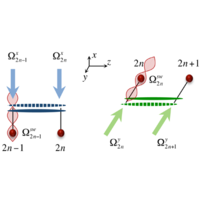
Experimentally feasible quantum simulation schemes are proposed to emulate a simple lattice gauge theory in trapped-ion chains, which may overcome the difficulty of simulating the relevant real-time dynamics numerically.

Evolution of an isolated monopole in a spin-1 Bose-Einstein condensate

Konstantin Tiurev, Pekko Kuopanportti, András Márton Gunyhó, Masahito Ueda, and Mikko Möttönen

Phys. Rev. A 94, 053616 (2016) - Published 16 November, 2016

The evolution of an isolated monopole is investigated in a ferromagnetically coupled, spin-1 Bose-Einstein condensate in the absence of external magnetic fields. It is predicted that a polar-core spin vortex may emerge spontaneously in the resulting ferromagnetic order-parameter field.

Dispersion relations for stationary light in one-dimensional atomic ensembles

Ivan Iakoupov, Johan R. Ott, Darrick E. Chang, and Anders S. Sørensen

Phys. Rev. A 94, 053824 (2016) - Published 14 November, 2016

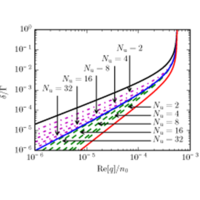
A unified theoretical treatment is presented that allows one to obtain the dispersion relations for stationary light in one-dimensional ensembles of atoms with various internal level schemes. The results open the possibility of tailoring, by controlling the spatial arrangement of the atoms, the light propagation to meet specific desired functionalities.

Collapse and revival of the monopole mode of a degenerate Bose gas in an isotropic harmonic trap

C. J. E. Straatsma, V. E. Colussi, M. J. Davis, D. S. Lobser, M. J. Holland, D. Z. Anderson, H. J. Lewandowski, and E. A. Cornell

Phys. Rev. A 94, 043640 (2016) - Published 24 October, 2016

Experimental observation confirms the in-phase and out-of-phase eigenmodes description of the temperature dependence in the oscillations of an excited Bose-Einstein condensate, where a truly isotropic confining potential helps to observe the collapse and revival of the monopole mode of the finite-temperature gas.

Stationary light pulses and narrowband light storage in a laser-cooled ensemble loaded into a hollow-core fiber

Frank Blatt, Lachezar S. Simeonov, Thomas Halfmann, and Thorsten Peters

Phys. Rev. A 94, 043833 (2016) - Published 19 October, 2016

Efficient light storage in an atomic ensemble with very high optical depth is demonstrated. The experiment is a step forward to achieving strong interactions between individual photons.

Enhanced nonlinear imaging through scattering media using transmission-matrix-based wave-front shaping

Hilton B. de Aguiar, Sylvain Gigan, and Sophie Brasselet

Phys. Rev. A 94, 043830 (2016) - Published 18 October, 2016

A method is proposed to optimize signals in nonlinear microscopy in order to circumvent difficulties associated with scattering media. In comparison to traditional nonlinear optimization techniques, the obtained results show a faster and more efficient imaging capability.

Floquet engineering from long-range to short-range interactions

Tony E. Lee

Phys. Rev. A 94, 040701(R) (2016) - Published 10 October, 2016

A method is proposed to reshape a long-range interaction into a short-range one by modulating the magnetic-field gradient in time. The method is applicable to all spinor quantum simulators with long-range interactions.

Ground-state properties and elementary excitations of quantum droplets in dipolar Bose-Einstein condensates

F. Wächtler and L. Santos

Phys. Rev. A 94, 043618 (2016) - Published 10 October, 2016

The ground state of dipolar Bose-Einstein condensates (BEC) is studied in the regimes of three different phases, where a characteristic growth of the peak density of the BEC is predicted when the dipolar quantum droplets are formed.

Prominent role of multielectron processes in K-shell double and triple photodetachment of oxygen anions

S. Schippers, R. Beerwerth, L. Abrok, S. Bari, T. Buhr, M. Martins, S. Ricz, J. Viefhaus, S. Fritzsche, and A. Müller

Phys. Rev. A 94, 041401(R) (2016) - Published 6 October, 2016

The absolute cross sections of double and triple photodetachment of O- ions are measured with the photon-ion merged-beams technique, where good agreements are found between the measurements and the results from multiconfiguration Dirac-Fock calculations.

Memory-preserving equilibration after a quantum quench in a one-dimensional critical model

Spyros Sotiriadis

Phys. Rev. A 94, 031605(R) (2016) - Published 23 September, 2016

Quench dynamics is studied for a one-dimensional system that is described by the noninteracting and massless bosonic quantum field theory. The discovery of the system’s memory of all initial correlations, which is accessible by local measurements at infinitely large times, suggests a failure of using a Gaussian generalized Gibbs ensemble to describe the relaxation of the system.

Exact steady state of a Kerr resonator with one- and two-photon driving and dissipation: Controllable Wigner-function multimodality and dissipative phase transitions

Nicola Bartolo, Fabrizio Minganti, Wim Casteels, and Cristiano Ciuti

Phys. Rev. A 94, 033841 (2016) - Published 22 September, 2016

A theory is developed to analytically represent a general class of driven-dissipative nonlinear resonators. The solvable model allows one to reveal the mesoscopic regime of interacting photons and dissipative phase transitions.

Ionization in orthogonal two-color laser fields: Origin and phase dependences of trajectory-resolved Coulomb effects

Martin Richter, Maksim Kunitski, Markus Schöffler, Till Jahnke, Lothar Ph. H. Schmidt, and Reinhard Dörner

Phys. Rev. A 94, 033416 (2016) - Published 19 September, 2016

Features of Coulomb focusing are identified in a photoelectron’s momentum distribution in strong-field ionization. The unstreakable nature of these features reveals a subtle connection between the initial condition of the electron and the phase of the two-color laser field at the time of tunnel ionization, and the Coulomb interaction between the electron and the ion core.

Efficient single-photon absorption by a trapped moving atom

N. Trautmann, G. Alber, and G. Leuchs

Phys. Rev. A 94, 033832 (2016) - Published 19 September, 2016

The influence of the center-of-mass motion of a trapped atom on the efficiency of resonant single-photon absorption is investigated. It is found that, even for small trapping frequencies, high single-photon excitation efficiency can be achieved by squeezing the center-of-mass wave packet with modulated trapping frequencies.

Rotation sensing using a K-Rb-Ne21 comagnetometer

Rujie Li, Wenfeng Fan, Liwei Jiang, Lihong Duan, Wei Quan, and Jiancheng Fang

Phys. Rev. A 94, 032109 (2016) - Published 8 September, 2016

A precision measurement of the Earth’s rotation is reported by using a K-Rb-21Ne comagnetometer, where it is found that the existence of the light shift arising from the circularly polarized pump laser enables the comagnetometer to sense dual-axis rotations.

Wave instabilities and unidirectional light flow in a cavity with rotating walls

Sylvain Lannebère and Mário G. Silveirinha

Phys. Rev. A 94, 033810 (2016) - Published 8 September, 2016

The behavior of electromagnetic waves confined to a cylindrical cavity is investigated. When the walls of the cavity are set into relative rotational motion the system may become unstable and a strongly unidirectional and nonreciprocal light flow becomes possible.

Optomechanical many-body cooling to the ground state using frustration

Thomás Fogarty, Haggai Landa, Cecilia Cormick, and Giovanna Morigi

Phys. Rev. A 94, 023844 (2016) - Published 25 August, 2016

A scheme to reach the zero-point motion of an ion chain via optomechanical coupling is proposed. The ideas might aid the development of strategies for laser cooling bulk materials.

Nonresonant two-photon transitions in length and velocity gauges

U. D. Jentschura

Phys. Rev. A 94, 022117 (2016) - Published 23 August, 2016

Quantum mechanics is in principle gauge invariant, but its interpretation could be gauge dependent. Some properties of the length-velocity gauge transformation are elucidated in this study about a two-photon transition process in atomic hydrogen.

Experimental quantum data locking

Yang Liu, Zhu Cao, Cheng Wu, Daiji Fukuda, Lixing You, Jiaqiang Zhong, Takayuki Numata, Sijing Chen, Weijun Zhang, Sheng-Cai Shi, Chao-Yang Lu, Zhen Wang, Xiongfeng Ma, Jingyun Fan, Qiang Zhang, and Jian-Wei Pan

Phys. Rev. A 94, 020301(R) (2016) - Published 12 August, 2016

A resource-efficient encryption scheme is experimentally demonstrated. As a proof-of-principle, a photo is transmitted over a lossy channel applying quantum data (un)locking and error correction.

Quantum enigma machine: Experimentally demonstrating quantum data locking

Daniel J. Lum, John C. Howell, M. S. Allman, Thomas Gerrits, Varun B. Verma, Sae Woo Nam, Cosmo Lupo, and Seth Lloyd

Phys. Rev. A 94, 022315 (2016) - Published 12 August, 2016
Classical security theory states that a message is safely transmitted if the length of the encryption key equals that of the message itself. Taking advantage of the quantum uncertainty principle, it is experimentally demonstrated how to beat this limit, reducing to an arbitrarily small amount the leak of information.

Sign In to Your Journals Account

Filter

Section

Filter

Article Lookup

Enter a citation