Highlights

Optimizing measurement strengths for qubit quasiprobabilities behind out-of-time-ordered correlators

Razieh Mohseninia, José Raúl González Alonso, and Justin Dressel

Phys. Rev. A 100, 062336 (2019) - Published 27 December, 2019

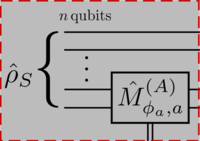
Quasiprobability distributions for out-of-time-ordered correlators are a robust witness of information scrambling, being very relevant to the study of quantum many-body physics, but typically hard to measure. Here a dramatically simplified scheme is presented for the case of sequential qubit measurements, thus opening exciting opportunities.

Algorithm for solving unconstrained unitary quantum brachistochrone problems

Francesco Campaioli, William Sloan, Kavan Modi, and Felix A. Pollock

Phys. Rev. A 100, 062328 (2019) - Published 20 December, 2019

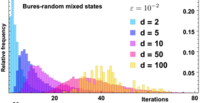
The quantum brachistochrone problem (QBP) aims to find the optimal map steering a quantum system from a given initial state to a given final state in the minimum time, related to the quantum speed limit. An iterative method is introduced to solve the unconstrained, unitary QBP for mixed states. It could be interesting for quantum control applications.

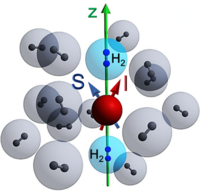
Spin coherence and optical properties of alkali-metal atoms in solid parahydrogen

Sunil Upadhyay, Ugne Dargyte, Vsevolod D. Dergachev, Robert P. Prater, Sergey A. Varganov, Timur V. Tscherbul, David Patterson, and Jonathan D. Weinstein

Phys. Rev. A 100, 063419 (2019) - Published 16 December, 2019

Spin coherence properties of alkali-metal atoms trapped in a solid parahydrogen matrix are investigated in a joint experimental and theoretical study. Dramatic differences in optical pumping properties and ensemble transverse spin relaxation time between alkali-atom species are observed and explained by a first-principles theoretical model.

Emergence of singularities from decoherence: Quantum catastrophes

Aaron Z. Goldberg, Asma Al-Qasimi, J. Mumford, and D. H. J. O'Dell

Phys. Rev. A 100, 063628 (2019) - Published 16 December, 2019

Dynamics of two coupled macroscopic quantum systems subject to a weak continuous measurement is studied using a master equation approach and compared with classical and quantum solutions for the equivalent closed systems. Decoherence in such systems can lead to singularities in the form of caustics. The authors show that continuous weak measurements do not lead to the closed classical result and instead measurement backaction introduces noise that softens the singularities.

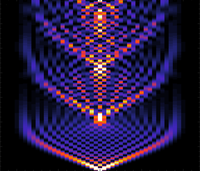
Massive phonons and gravitational dynamics in a photon-fluid model

Francesco Marino

Phys. Rev. A 100, 063825 (2019) - Published 13 December, 2019

Excitation dynamics in a photon fluid with both local and nonlocal interactions are investigated theoretically. Collective excitations are found to display a gapped Bogoliubov spectrum, which at low energies corresponds to that of massive phonons with a relativistic energy-momentum relation. This could provide a setting for analog simulations of semiclassical gravity and quantum gravity phenomenology.

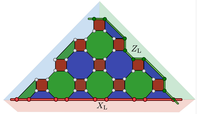
Fault-tolerant protection of near-term trapped-ion topological qubits under realistic noise sources

A. Bermudez, X. Xu, M. Gutiérrez, S. C. Benjamin, and M. Müller

Phys. Rev. A 100, 062307 (2019) - Published 4 December, 2019

Taking into account an increasingly realistic noise model, a low-resource toolbox of fault-tolerant quantum error detection and correction scheme is provided. By extensive numerical simulations, a thorough microscopic characterization is performed, showing that a flag-qubit-based approach can significantly boost the performance of a trapped-ion processor.

Dynamics of reverse annealing for the fully connected p-spin model

Yu Yamashiro, Masaki Ohkuwa, Hidetoshi Nishimori, and Daniel A. Lidar

Phys. Rev. A 100, 052321 (2019) - Published 18 November, 2019

Reverse annealing, a variant of quantum annealing, is investigated by probing quantum transitions in a p-spin model and comparing it with the predictions offered by equilibrium statistical mechanics. It is shown that reverse annealing can provide an exponential speedup over conventional quantum annealing for this particular problem.

Entanglement improvement via a quantum scissor in a realistic environment

Liyun Hu, M. Al-amri, Zeyang Liao, and M. S. Zubairy

Phys. Rev. A 100, 052322 (2019) - Published 18 November, 2019

An efficient scheme for enhancing quantum state amplification and entanglement is proposed. In comparison to previous methods, the usage of quantum scissors leads to a higher probability of success, better robustness against decoherence, and an overall reduction of resources.

Eavesdropping attack on a trusted continuous-variable quantum random-number generator

Johannes Thewes, Carolin Lüders, and Marc Aßmann

Phys. Rev. A 100, 052318 (2019) - Published 13 November, 2019

A trusted quantum random-number generator based on a thermal light source is attacked. In the experiment, Eve gets access to the light source and Alice’s local oscillator, reducing the extractable randomness down to the one of a vacuum state.

Mean-field phases of an ultracold gas in a quasicrystalline potential

Dean Johnstone, Patrik Öhberg, and Callum W. Duncan

Phys. Rev. A 100, 053609 (2019) - Published 12 November, 2019

The ground-state properties of an ultracold Bose gas in an eightfold symmetric lattice are studied. Mott-insulator, density wave, and supersolid phases are identified. A density wave phase that spontaneously breaks rotational symmetry appears for strong long-range interactions.

Quantized conductance through a dissipative atomic point contact

Laura Corman, Philipp Fabritius, Samuel Häusler, Jeffrey Mohan, Lena H. Dogra, Dominik Husmann, Martin Lebrat, and Tilman Esslinger

Phys. Rev. A 100, 053605 (2019) - Published 8 November, 2019

Dissipation at a quantum point contact for ultracold atoms is investigated in a joint theoretical and experimental study. Robust quantized conductance plateaus are featured in both the theoretical model and experimental measurements. Furthermore, the atomic density can be reconstructed around the quantum point contact by monitoring the atom losses.

Locality and heating in periodically driven, power-law-interacting systems

Minh C. Tran, Adam Ehrenberg, Andrew Y. Guo, Paraj Titum, Dmitry A. Abanin, and Alexey V. Gorshkov

Phys. Rev. A 100, 052103 (2019) - Published 6 November, 2019

Exponentially suppressed heating rates are demonstrated in power-law-interacting systems with sufficiently long-range interactions. The proof uses new Lieb-Robinson bounds for many-body interactions, making important connections and developments in the theories of heating and localization for experimentally realizable systems.

Cold atoms in twisted-bilayer optical potentials

A. González-Tudela and J. I. Cirac

Phys. Rev. A 100, 053604 (2019) - Published 6 November, 2019

Twisted-bilayer van der Waals materials are currently at the forefront of condensed matter research. This work proposes a method to simulate twisted bilayers using cold atoms in state-dependent optical lattices. The proposed setup could open up possibilities to observe similar physics in condensed matter systems and explore parameter regimes beyond solid state realizations.

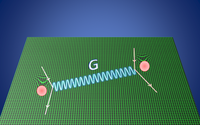
Fundamental building block for all-optical scalable quantum networks

Seung-Woo Lee, Timothy C. Ralph, and Hyunseok Jeong

Phys. Rev. A 100, 052303 (2019) - Published 4 November, 2019

The fundamental limits for achieving scalability in all-optical quantum communication settings are addressed. A specific scheme is proposed to reach such a limit in an efficient and fast way, in this respect outperforming the standard version of quantum repeaters and also advanced photonic and matter-based protocols.

Efficient variational approach to dynamics of a spatially extended bosonic Kondo model

Yuto Ashida, Tao Shi, Richard Schmidt, H. R. Sadeghpour, J. Ignacio Cirac, and Eugene Demler

Phys. Rev. A 100, 043618 (2019) - Published 31 October, 2019

An efficient variational approach to study the dynamics of a localized quantum spin coupled to a bath of mobile spinful bosons is developed. A recently proposed impurity-decoupling transformation with the variational Gaussian ansatz for bosons is used to analyze coherent time evolution. This formalism can be applied potentially to a wide class of challenging quantum impurity problems.

Quantum description of surface-enhanced resonant Raman scattering within a hybrid-optomechanical model

Tomáš Neuman, Ruben Esteban, Geza Giedke, Mikołaj K. Schmidt, and Javier Aizpurua

Phys. Rev. A 100, 043422 (2019) - Published 29 October, 2019

A cavity-quantum-electrodynamics-based theoretical model to describe surface-enhanced resonant Raman scattering is presented. Similarities and differences between the resonant and off-resonant surface-enhanced Raman scattering are discussed. Potential applications include a mechanism of on-demand frequency-selective pumping of molecular vibrations.

Aging of a quantum battery

Faezeh Pirmoradian and Klaus Mølmer

Phys. Rev. A 100, 043833 (2019) - Published 23 October, 2019

Just like lithium-ion batteries, quantum batteries age and become less effective. The effect, due to decoherence and decay of emitters, is quantified and a recipe given so that the battery can be recharged back to its full capacity.

Leggett-Garg macrorealism and the quantum nondisturbance conditions

Roope Uola, Giuseppe Vitagliano, and Costantino Budroni

Phys. Rev. A 100, 042117 (2019) - Published 22 October, 2019

Macrorealism, the notion that macroscopic physical properties are well defined at all times and that it is possible to measure the properties without disturbing them, is tricky to test in an experiment, by admitting the “clumsiness loophole.”   Here, a compatibility condition is found, so that a generalized version of macrorealism can hold for every initial state.  This allows one to design stricter experimental tests of macrorealism for which an explanation in terms of “clumsy” measurements is harder to justify.

Bloch-band picture for light-pulse atom diffraction and interferometry

Daniel Gochnauer, Katherine E. McAlpine, Benjamin Plotkin-Swing, Alan O. Jamison, and Subhadeep Gupta

Phys. Rev. A 100, 043611 (2019) - Published 21 October, 2019

An experimental validation of a Bloch-band picture for the analysis of Bragg diffraction in an atom interferometer with Bose-Einstein condensates is presented. Based on this picture, a method to determine atomic band structure in an optical lattice is demonstrated.

Optimal position detection of a dipolar scatterer in a focused field

Felix Tebbenjohanns, Martin Frimmer, and Lukas Novotny

Phys. Rev. A 100, 043821 (2019) - Published 14 October, 2019
The quest for bringing optically levitated systems into the quantum regime resulted in several sophisticated detection platforms. Here, tackling the same question from a different perspective, a scheme is derived for achieving the best possible (i.e., Heisenberg limit) position-detection efficiency for measuring a dipolar scatterer in a single-beam optical trap.

Sign In to Your Journals Account

Filter

Section

Filter

Article Lookup

Enter a citation