Highlights

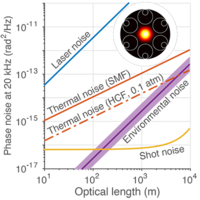
Fundamental thermal noise in antiresonant hollow-core fibers

Vincent Michaud-Belleau, Eric R. Numkam Fokoua, Peter Horak, Natalie V. Wheeler, Shuichiro Rikimi, Thomas D. Bradley, David J. Richardson, Francesco Poletti, Jérôme Genest, and Radan Slavík

Phys. Rev. A 106, 023501 (2022) - Published 1 August, 2022

To understand the effect of fundamental thermal noise in hollow-core optical fibers, the authors propose an adapted noise model and compare it to careful measurements. They find that the use of evacuated hollow cores could allow for an order-of-magnitude improvement in phase sensitivity with respect to standard fiber, enabling better precision in interferometric applications such as fiber gyroscopes and laser frequency stabilization.

Asymmetry and nonlinearity of current-bias characteristics in superfluid–normal-state junctions of weakly interacting Bose gases

Shun Uchino

Phys. Rev. A 106, L011303 (2022) - Published 26 July, 2022

This paper investigates transport characteristics in superfluid–normal-state junctions with a weakly interacting Bose gas. The author finds a rectification effect intrinsic to such junction systems.

Real surreal trajectories in pilot-wave hydrodynamics

Valeri Frumkin, David Darrow, John W. M. Bush, and Ward Struyve

Phys. Rev. A 106, L010203 (2022) - Published 25 July, 2022

In certain instances, the particle paths predicted by Bohmian mechanics are considered to be at odds with classical intuition, and so deemed to be “surreal.” Through a combined experimental and numerical study, the authors demonstrate that individual trajectories in the hydrodynamic pilot-wave system exhibit the key features of their surreal Bohmian counterparts.

Continuous thermomajorization and a complete set of laws for Markovian thermal processes

Matteo Lostaglio and Kamil Korzekwa

Phys. Rev. A 106, 012426 (2022) - Published 20 July, 2022

The authors generalize the previous concept of thermomajorization by introducing the concept of continuous thermomajorization, and show that this partial order of energy distributions provides necessary and sufficient conditions for the existence of a thermalization process generated by a Markovian master equation. The results may pave the way to an algorithmic approach to the development of quantum thermodynamic protocols.

Quantum Fourier transform on photonic qubits using cavity QED

Yu Shi and Edo Waks

Phys. Rev. A 106, 013709 (2022) - Published 14 July, 2022

The authors propose the implementation of a photonic quantum Fourier transform protocol on a cavity QED setup involving a single atom-cavity system, which requires no active feedforward control. The authors analyze the performance of the protocol and show that the proposed methods could work at the tens-of-photons level.

Resonant and nonresonant integrated third-order parametric down-conversion

Milica Banic, Marco Liscidini, and J. E. Sipe

Phys. Rev. A 106, 013710 (2022) - Published 14 July, 2022

The viability of third-order parametric down-conversion, a process that converts a single photon into triplets, has been considered in a number of platforms. Here, the authors extend this list to include integrated systems, deriving analytic equations to investigate this process in waveguides and resonators. They perform simulations aligned with existing fabrication technology in order to make realistic predictions and point experimentalists in the right direction.

Efficient perturbative framework for coupling of radiative and guided modes in nearly periodic surfaces

Sophie Fisher, Raphaël Pestourie, and Steven G. Johnson

Phys. Rev. A 106, 013507 (2022) - Published 13 July, 2022

Brute-force simulations are typically used to investigate coupling between radiative and guided waves in slowly varying photonic structures, but when these structures are large, such simulations become too cumbersome. Here, a semianalytical formalism is introduced that computes this coupling accurately and inexpensively, motivating its use in the design of large-area optical metasurfaces.

Asymmetric longitudinal optical binding force between two identical dielectric particles with electric and magnetic dipolar responses

Xiao-Yong Duan, Graham D. Bruce, Feng Li, and Kishan Dholakia

Phys. Rev. A 106, 013108 (2022) - Published 12 July, 2022

Predictions indicate that two identical particles can interact asymmetrically with two identical light beams, such that they move off to one side of the system like soldiers walking in formation.

Complex scaling flows in the quench dynamics of interacting particles

Tilman Enss, Noel Cuadra Braatz, and Giacomo Gori

Phys. Rev. A 106, 013308 (2022) - Published 8 July, 2022

The authors present analytical solutions, using a complex scaling parameter, for the short-time dynamics of a trapped many-body system subject to a sudden change from noninteracting to resonantly interacting. They apply this technique to Borromean three-body systems and an impurity in an ideal Bose-Einstein condensate.

Creating triple-NOON states with ultracold atoms via chaos-assisted tunneling

G. Vanhaele, A. Bäcker, R. Ketzmerick, and P. Schlagheck

Phys. Rev. A 106, L011301 (2022) - Published 5 July, 2022

The authors propose a protocol for creating triple-NOON states with ultracold rubidium atoms subject to a periodic driving modulation that facilitates the collective tunneling of the atoms to the other sites. They show that chaos-assisted tunneling can reduce the collective tunneling time without significantly affecting the purity of the superposition.

Proposal for transduction between microwave and optical photons using Er167-doped yttrium orthosilicate

Faezeh Kimiaee Asadi, Jia-Wei Ji, and Christoph Simon

Phys. Rev. A 105, 062608 (2022) - Published 30 June, 2022

Microwave photons can readily interact with superconducting qubits, but must be converted into shorter-wavelength optical photons before they can be used to transmit information, for example between systems in a quantum network. Here, the authors outline a microwave-to-optical transducer using dark states in rare-earth ions. As their scheme requires no external magnetic field, it avoids disturbing field-sensitive superconducting qubits.

Unitary Fermi superfluid near the critical temperature: Thermodynamics and sound modes from elementary excitations

G. Bighin, A. Cappellaro, and L. Salasnich

Phys. Rev. A 105, 063329 (2022) - Published 30 June, 2022

In superfluid 4He the first sound refers to the propagation of a density wave while the second sound is related to the propagation of a temperature or entropy wave. The authors show that in superfluid Fermi gases this simplified picture is not always valid. Moreover, they calculate the first and second sound velocities, and the superfluid fraction near the critical point in unitary Fermi gases, and find good agreement with recent experimental results.

Vibrational excitation in the e+CO2 system: Nonlocal model of ΣΠ vibronic coupling through the continuum

Jan Dvořák, Karel Houfek, and Martin Čížek

Phys. Rev. A 105, 062821 (2022) - Published 27 June, 2022

In this article, the authors present a theoretical model for vibrational excitation of CO2, where the virtual state and shape resonance doublet interact directly with each other and also indirectly through the electronic continuum as the molecule bends. Based on ab initio fixed-nuclei R-matrix calculations, parameters of the model are determined using a fitting procedure that utilizes the high symmetry of the system.”

Optically enhanced discharge excitation and trapping of Ar39

Y.-Q. Chu, Z.-F. Wan, F. Ritterbusch, W.-K. Hu, J.-Q. Gu, S.-M. Hu, Z.-H. Jia, W. Jiang, Z.-T. Lu, L.-T. Sun, A.-M. Tong, J. S. Wang, and G.-M. Yang

Phys. Rev. A 105, 063108 (2022) - Published 21 June, 2022

The authors achieve a twofold increase in the loading rate of the rare 39Ar in a magneto-optical trap by optically enhancing the metastable production in a plasma source. The result constitutes a significant advance for the use of 39Ar in earth science applications, such as dating alpine ice cores and mapping ocean currents.

Optimal linear-optical noiseless quantum amplifiers driven by auxiliary multiphoton Fock states

Jaromír Fiurášek

Phys. Rev. A 105, 062425 (2022) - Published 15 June, 2022

Quantum scissors refer to interferometric schemes that allow combined teleportation and amplification of quantum states. Here, the author demonstrates that quantum scissors without feedforward can be optimized to have higher success probability than previously shown, and that quantum scissors can themselves be outperformed by generalized interferometric couplings.

Magneto-optical trapping of a group-III atom

Xianquan Yu, Jinchao Mo, Tiangao Lu, Ting You Tan, and Travis L. Nicholson

Phys. Rev. A 105, L061101 (2022) - Published 7 June, 2022

The authors demonstrate the first magneto-optical trap of indium atoms, which belong to group III of the periodic table. These atoms offer a unique combination of features, such as the simultaneous presence of Feshbach resonances and optical clock transitions. The techniques introduced in this work can be applied to other elements in group III.

Near-threshold behavior of positronium-antihydrogen scattering cross sections

Takuma Yamashita, Yasushi Kino, Emiko Hiyama, Svante Jonsell, and Piotr Froelich

Phys. Rev. A 105, 052812 (2022) - Published 31 May, 2022

The authors numerically study the scattering of antihydrogen and positronium atoms, at collision energies just above the threshold for the rearrangement reaction resulting in antihydrogen positive ions. The formation of such ions is of interest for ongoing or planned experiments involving antimatter with antihydrogen at CERN.

Topologically protected frequency control of broadband signals in dynamically modulated waveguide arrays

Francesco S. Piccioli, Alexander Szameit, and Iacopo Carusotto

Phys. Rev. A 105, 053519 (2022) - Published 23 May, 2022

In this theoretical proposal, the authors show how acousto-optic modulation can be used to generate two-dimensional topologically nontrivial band structures using one-dimensional optical waveguide arrays by using the frequency of the light as a synthetic dimension. The scheme paves the way for the use of the standard photonic technology of laser-written waveguides for the spectral manipulation of broadband signals, both for classical waves and for single- or few-photon quantum wave packets.

Controlling long ion strings for quantum simulation and precision measurements

Florian Kranzl, Manoj K. Joshi, Christine Maier, Tiff Brydges, Johannes Franke, Rainer Blatt, and Christian F. Roos

Phys. Rev. A 105, 052426 (2022) - Published 18 May, 2022

In order to better characterize the performance of trapped ion systems and ease the experimental difficulties of addressing individual ions, the authors apply carefully-timed pulse sequences to ion chains up to 51 ions long. These techniques allow them to generate entanglement between all neighboring ion pairs and to quantify and mitigate sources of decoherence in the chains.

Efficient sampling from shallow Gaussian quantum-optical circuits with local interactions

Haoyu Qi, Diego Cifuentes, Kamil Brádler, Robert Israel, Timjan Kalajdzievski, and Nicolás Quesada

Phys. Rev. A 105, 052412 (2022) - Published 6 May, 2022

Gaussian boson sampling is a candidate model for demonstrating quantum computational advantage in photonic systems. Here, the authors narrow down the range of possible architectures for such a demonstration, by introducing a classical algorithm that can simulate optical systems with shallow-depth circuits and local gates in polynomial time.

Sign In to Your Journals Account

Filter

Section

Filter

Article Lookup

Enter a citation