Highlights

Cost and routing of continuous-variable quantum networks

Federico Centrone, Frederic Grosshans, and Valentina Parigi

Phys. Rev. A 108, 042615 (2023) - Published 20 October, 2023

The authors give insight into the amount of entanglement that can be achieved from Gaussian graph states as well as the amount of squeezing required to prepare them. They find that these quantities are highly dependent on the structure of the quantum network.

Nearly Heisenberg-limited noise-unbiased frequency estimation by tailored sensor design

Francisco Riberi, Gerardo A. Paz-Silva, and Lorenza Viola

Phys. Rev. A 108, 042419 (2023) - Published 19 October, 2023

The authors consider frequency estimation in the presence of spatiotemporally correlated noise. They show that the usual approach involving unbiased estimators is ill-suited in such cases, and introduce new estimators which, at the cost of doubling the required resources, are insensitive to noise and retain the precision scaling of standard ones.

Transition from classical to quantum loss of light coherence

Pierre Lassègues, Mateus Antônio Fernandes Biscassi, Martial Morisse, André Cidrim, Pablo Gabriel Santos Dias, Hodei Eneriz, Raul Celistrino Teixeira, Robin Kaiser, Romain Bachelard, and Mathilde Hugbart

Phys. Rev. A 108, 042214 (2023) - Published 18 October, 2023

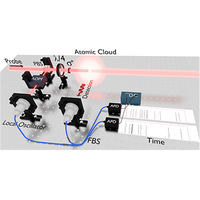
The authors study the loss of light coherence when scattered by a macroscopic atomic cloud of cold neutral atoms through intensity-intensity correlation measurements. They demonstrate experimentally and theoretically the transition between classical and quantum mechanisms regimes for the coherence loss.

Experimentally realizable continuous-variable quantum neural networks

Shikha Bangar, Leanto Sunny, Kübra Yeter-Aydeniz, and George Siopsis

Phys. Rev. A 108, 042414 (2023) - Published 16 October, 2023

The authors propose a continuous-variable quantum-classical neural network protocol that could be potentially realized in current photonic experiments. Their protocol only uses Gaussian operations, and a nonlinear operation is obtained through repeat-until-success measurements on ancillary qumodes. They applied their method to simulate quantum machine learning and computing problems.

Green's-function treatment of Rydberg molecules with spins

Chris H. Greene and Matthew T. Eiles

Phys. Rev. A 108, 042805 (2023) - Published 11 October, 2023

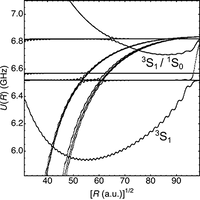
The authors present a method based on the Coulomb Green’s function to derive the electronic structure of ultra-long-range Rydberg molecules including spins, providing a promising alternative to the standard method based on basis-set expansion, which was shown to have serious convergence problems. Use of this approach should enable more accurate studies of Rydberg-molecule spectra and the electron-atom scattering phase shifts upon which they depend.

Scattering-matrix approach for a quantitative evaluation of the topological protection in valley photonic crystals

Gaëtan Lévêque, Yan Pennec, Pascal Szriftgiser, Alberto Amo, and Alejandro Martínez

Phys. Rev. A 108, 043505 (2023) - Published 10 October, 2023

The authors explore limitations to topological protection in valley Hall waveguides by developing a phenomenological semi-analytical model for analyzing different sources of backscattering. The model can be used to predict the performance of larger-scale structures that are intractable using direct finite-element simulations.

Deep macroscopic pure-optical potential for laser cooling and trapping of neutral atoms

O. N. Prudnikov, R. Ya. Ilenkov, A. V. Taichenachev, V. I. Yudin, and S. N. Bagaev

Phys. Rev. A 108, 043107 (2023) - Published 9 October, 2023

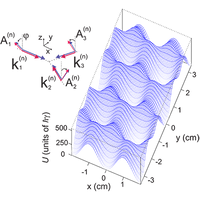
It is possible to trap neutral atoms in optical lattices without using magnetic fields, but it is currently difficult to achieve deep trapping potentials in such systems. Here, the authors propose using bichromatic light to induce an optical rectification effect that results in a strong spatial force variance and therefore deep dissipative potentials, demonstrating that such lattices could replace magneto-optical traps in neutral atom cooling and trapping applications.

Impact of mode regularization for quasinormal-mode perturbation theories

Sebastian Franke, Juanjuan Ren, and Stephen Hughes

Phys. Rev. A 108, 043502 (2023) - Published 4 October, 2023

The authors develop a regularized quasinormal-mode perturbation theory for quasinormal modes of leaky resonators, which can be used to predict the impact of weak perturbations placed outside the resonators of interest. The general method is then applied to two illustrative examples, a one-dimensional double-barrier system and a three-dimensional plasmonic dimer structure.

Electromagnetically-induced-transparency spectra of Rydberg atoms dressed with dual-tone radio-frequency fields

Maitreyi Jayaseelan, Andrew P. Rotunno, Nikunjkumar Prajapati, Samuel Berweger, Alexandra B. Artusio-Glimpse, Matthew T. Simons, and Christopher L. Holloway

Phys. Rev. A 108, 033712 (2023) - Published 22 September, 2023

Rydberg atoms driven by radio-frequency (rf) fields can be used as very sensitive electric-field detectors. Here, the authors extend this concept to dual-frequency rf fields, and show that their theoretical modeling and experimental results match.

Unavoidability of nonclassicality loss in PT-symmetric systems

Jan Peřina, Jr., Adam Miranowicz, Joanna K. Kalaga, and Wiesław Leoński

Phys. Rev. A 108, 033512 (2023) - Published 15 September, 2023

The authors study the dynamics of two nonlinearly coupled oscillator modes in a PT-symmetric system, in which gain and loss are provided by coupling a pair of bosonic modes to separate baths. The authors show that even when the model parameters are fine-tuned to achieve a balance between gain and loss in the semiclassical limit, the fluctuations of the bath lead to a gradual loss of nonclassicality and entanglement between the modes.

Optimal single-qubit tomography: Realization of locally optimal measurements on a quantum computer

Bacui Li, Lorcán O. Conlon, Ping Koy Lam, and Syed M. Assad

Phys. Rev. A 108, 032605 (2023) - Published 13 September, 2023

The authors map qubit tomography to a quantum multiparameter estimation problem and find the optimal single-qubit measurements. Using a quantum computing demonstration they show that the optimal separable measurement bound can be saturated.

Error mitigation for quantum approximate optimization

Anita Weidinger, Glen Bigan Mbeng, and Wolfgang Lechner

Phys. Rev. A 108, 032408 (2023) - Published 8 September, 2023

Quantum error mitigation involves reducing errors in hybrid quantum-classical algorithms, which is particularly relevant for near-term noisy quantum devices. The authors introduce an error mitigation technique based on redundant parity encoding of logical variables. They demonstrate the use of this technique by applying it to the quantum approximate optimization algorithm.

Simulations of a frequency-chirped magneto-optical trap of MgF

Kayla J. Rodriguez, Nickolas H. Pilgram, Daniel S. Barker, Stephen P. Eckel, and Eric B. Norrgard

Phys. Rev. A 108, 033105 (2023) - Published 8 September, 2023

The authors present a theoretical analysis of a frequency-chirped molecular magneto-optical trap (MOT) that may open the way for efficient cooling of a class of light molecules. They show that this approach can increase the capture velocity of the MOT which could be used to capture more molecules from typical molecular sources and, in some cases, perhaps remove the need for laser slowing before capture in the MOT.

Microwave spectroscopy of low-l singlet strontium Rydberg states at intermediate n, 50≲n≲70

R. A. Brienza, Y. Lu, C. Wang, S. K. Kanungo, T. C. Killian, F. B. Dunning, J. Burgdörfer, and S. Yoshida

Phys. Rev. A 108, 022815 (2023) - Published 28 August, 2023

The authors use microwave spectroscopy to measure the quantum defects for lower-l singlet strontium Rydberg states at intermediate n. The results are used to develop a revised set of Rydberg-Ritz quantum defect parameters that could help make accurate predictions of the energy intervals between other high-lying states.

Measurement of non-Abelian gauge fields using multiloop amplification

Qing-Xian Lv, Hong-Zhi Liu, Yan-Xiong Du, Lin-Qing Chen, Meng Wang, Jia-Hao Liang, Zhao-Xin Fu, Zi-Yuan Chen, Hui Yan, and Shi-Liang Zhu

Phys. Rev. A 108, 023316 (2023) - Published 28 August, 2023

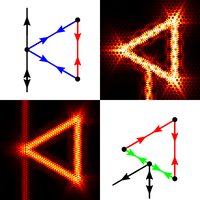
The authors propose a scheme to measure the non-Abelian gauge field through multiloop evolution and robust holonomic quantum gates, and experimentally demonstrate it in the degenerate eigensubspace of a double-Λ four-level atomic system of 87Rb. The results could be useful for the development of high-resolution and high-precision measurements of the gauge fields.

Sub-μm axial precision depth imaging with entangled two-color Hong-Ou-Mandel microscopy

Cyril Torre, Alex McMillan, Jorge Monroy-Ruz, and Jonathan C. F. Matthews

Phys. Rev. A 108, 023726 (2023) - Published 24 August, 2023

Using two entangled photons of different colors in a Hong-Ou-Mandel interference scheme, the authors show that they can precisely measure the thickness of a semitransparent sample. The depth sensitivity is adjustable and the method is resilient against fluctuations commonly encountered in biological samples.

Aspects of the phenomenology of interference that are genuinely nonclassical

Lorenzo Catani, Matthew Leifer, Giovanni Scala, David Schmid, and Robert W. Spekkens

Phys. Rev. A 108, 022207 (2023) - Published 10 August, 2023

The authors show that a certain wave-particle duality relation is a type of uncertainty relation whose functional form is known to be able to witness the impossibility of a noncontextual model. In this way, they show that the quantum trade-off between path distinguishability and fringe visibility can witness contextuality and they discuss the requirements on an interferometric experiment necessary for achieving a noise-robust test.

Reducing Rydberg-state dc polarizability by microwave dressing

J. C. Bohorquez, R. Chinnarasu, J. Isaacs, D. Booth, M. Beck, R. McDermott, and M. Saffman

Phys. Rev. A 108, 022805 (2023) - Published 9 August, 2023

The authors demonstrate a reduction of the dc polarizability of cesium atom Rydberg states in a 77-K environment utilizing microwave field dressing. The results could be useful for stabilizing Rydberg resonances against varying dc fields present near surfaces and potentially enabling the development of hybrid Rydberg-atom–superconducting-resonator quantum gates.

Asymmetry and tighter uncertainty relations for Rényi entropies via quantum-classical decompositions of resource measures

Michael J. W. Hall

Phys. Rev. A 107, 062215 (2023) - Published 27 June, 2023

The author proposes a general method of constructing quantum–classical decompositions of resources such as uncertainty, with the quantum contribution specified by a measure of the noncommutativity of a given set of operators relative to the quantum state, and the classical contribution generated by the mixedness of the state. One result of this formalism is that entropic uncertainty relations, computed by employing the entropy instead of the variance as a measure of uncertainty about a measurement outcome, are stronger than previously known.

General framework for two-photon spontaneous emission near plasmonic nanostructures

S. Smeets, B. Maes, and G. Rosolen

Phys. Rev. A 107, 063516 (2023) - Published 27 June, 2023
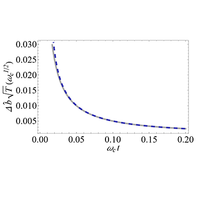
The authors develop a framework for efficient calculation of two-photon spontaneous emission in arbitrary nanostructures using one-photon Purcell factors. The formalism will aid the design of entangled two-photon sources for various applications, including quantum technologies and spectroscopy.

Sign In to Your Journals Account

Filter

Section

Filter

Article Lookup

Enter a citation