

APS Open Science has extended its APC waiver for all submissions and transfers. Submit now!

Inside the first Replication Study published in APS Open Science

20 October, 2026

Gianbiagio Curato (Cybersecurity Architect, Intesa Sanpaolo), lead author of the first replication study published in APS Open Science, discusses the process, challenges, and value of reproducible research.

29 April, 2026

In this editorial, Badreddine Assouar—chief editor of APS Open Science—introduces the inaugural papers from the American Physical Society’s newest open access, community driven journal for research at every step of discovery.

22 October, 2026

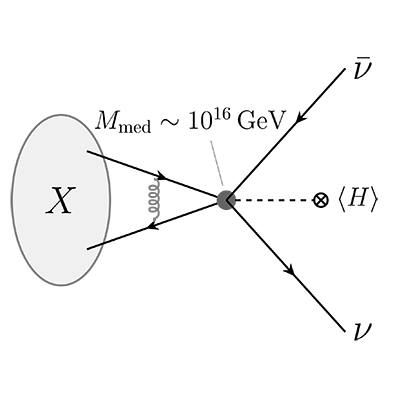
If the 220 PeV KM3NeT neutrino is a two-body decay line from a long-lived dark-matter bound state, its energy fixes the relic mass, its flux the lifetime, and the lifetime the mass of the mediator that lets the relic decay: 10¹⁴ to 10¹⁶ GeV, the Majorana-mass window of unified models. Future events will test this reading against a flaring astrophysical source.

21 October, 2026

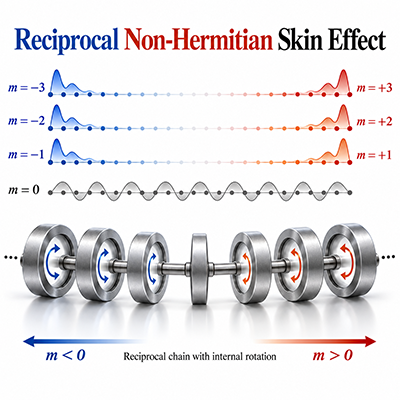
This paper demonstrates that a reciprocal one-dimensional lattice with conserved internal rotation supports an unbounded, integer-graded non-Hermitian skin effect. Rather than breaking reciprocity, the system’s angular momentum channels act as independent directional chains, with conjugate channels accumulating at opposite boundaries to balance the system globally.

7 October, 2026

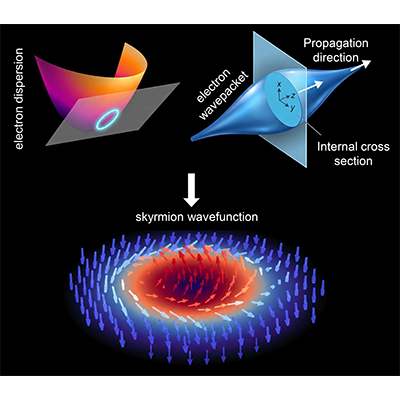
Researchers have created non-diffracting free-electron wave packets that carry tunable skyrmion and meron spin textures encoded within individual electron wavefunctions. By engineering the electron’s spatiotemporal spectrum, these matter waves exhibit propagation-invariant topological structures, bridging structured light concepts with free-electron quantum optics.

15 September, 2026

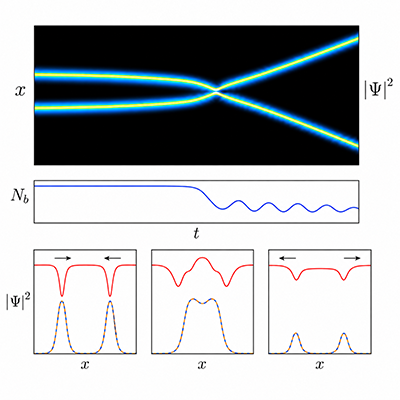
New simulations of spinor Bose-Einstein condensates reveal that spin interactions fundamentally alter how solitary waves interact, causing otherwise stable bound states to break apart. This escape dynamics is driven by continuous particle exchange between hyperfine states, a phenomenon successfully mapped by a newly proposed classical Lagrangian model.

11 September, 2026

In the study the authors use network analysis to reveal that artificial intelligence systems sustain significantly higher and longer-lasting strategic tension in chess compared to human grandmasters. This finding highlights a fundamental difference in competitive decision-making, where AI maintains dense tactical complexities while human players systematically simplify the board.

Chess Reveals Differences Between Human and AI Strategies

11 September, 2026
Chess grandmasters move toward a less complex game faster than AI players, suggesting different approaches for balancing short- and long-term prospects.

12 August, 2026

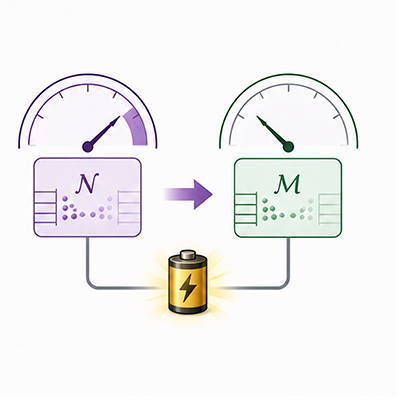
As quantum technologies advance toward miniaturization, understanding the energetic limits of quantum information processing becomes essential. This work establishes an operational characterization of the free energy of quantum processes, providing a unified framework to quantify the optimal work gain or expenditure for manipulating channels, states, and measurements.

3 August, 2026

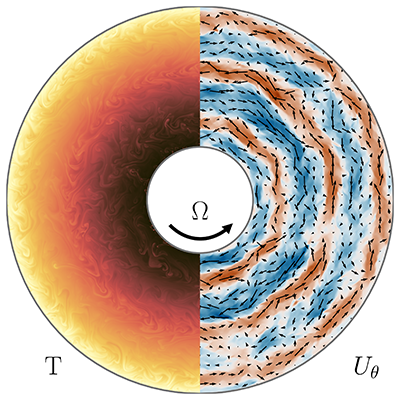
Measuring fluid velocities in rapidly rotating, thermally driven flows is challenging because conventional particle-tracking methods can be impractical, especially in planetary fluid dynamics experiments involving curved boundaries. Researchers address this problem with a new thermal image velocimetry (TIV) formulation, which uses dense optical flow to track evolving free-surface temperature patterns instead of suspended particles. The approach provides accurate velocity measurements while circumventing many of the optical constraints of traditional visualization methods, thus, broadening the experimental toolkit for probing the complex dynamics of rotating convective turbulence.

30 July, 2026

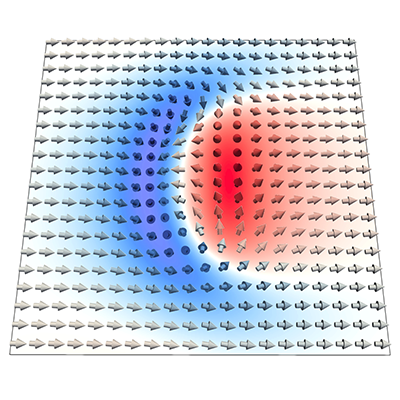
Researchers have theoretically predicted the “asymmetric antibimeron” (AAB)—a novel topological spin texture composed of an antivortex and a crescent-shaped vortex found in in-plane magnetized chiral ferromagnets—offering a promising new platform for high-density spintronic memory and logic devices.

21 July, 2026

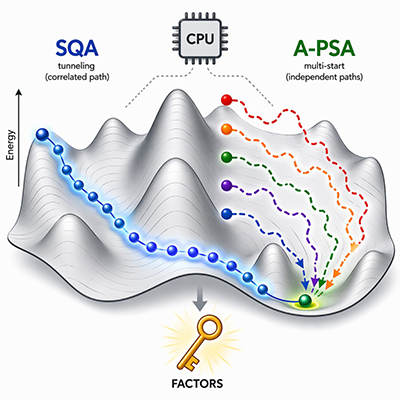
This study replicates hardware-focused Simulated Quantum Annealing (SQA) factorization benchmarks on standard CPUs, adding a rigorously tuned multi-start classical baseline (A-PSA) to ensure a fair comparison. The authors found that SQA’s advantage is highly situational; classical multi-start methods win out on less rugged landscapes, and SQA only proves superior when the problem’s complexity explicitly demands tunneling-like behavior.

16 July, 2026

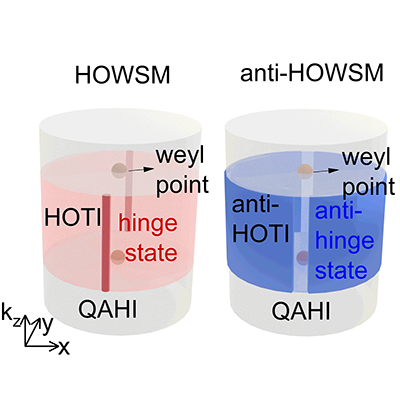
Researchers have identified a novel three-dimensional topological phase known as an “anti-higher-order Weyl semimetal,” which uniquely reverses the conventional boundary hierarchy. By mathematically enforcing the systematic absence - rather than the presence - of localized states at specific hinge orientations, this discovery establishes anti-topology as a powerful dual counterpart to the traditional topological paradigm.

16 July, 2026

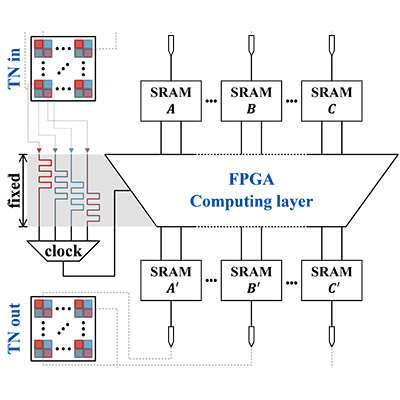
By implementing a novel quad-tile partitioning strategy on field-programmable gate arrays (FPGAs), researchers have drastically reduced the computational cost scaling of fundamental tensor network algorithms. This highly parallel, hardware-driven approach significantly outperforms traditional CPU computations, opening new pathways for efficient, large-scale simulations of quantum many-body systems.

29 April, 2026

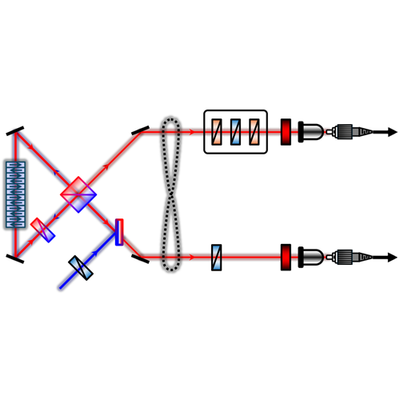
A new method verifies that a quantum state is entangled when only a limited or suboptimal set of measurements are experimentally accessible, providing an efficient way to verify entanglement in real-world scenarios.

Sign In to Your Journals Account

Filter

Filter

Article Lookup

Enter a citation