Recent Articles

Colloquium: An algebraic model of localized surface plasmons and their interactions

T. J. Davis and D. E. Gómez

Rev. Mod. Phys. 89, 011003 (2017) - Published 30 January, 2017

Localized surface plasmons are collective modes of the conduction electrons excited by light in metal nanoparticles. Although plasmons have been known for some time, their use for controlling light at the nanometer scale only became possible with developments in near field optics. To model interactions between such collective modes is a complex problem that requires heavy computation. In this Colloquium an algebraic model for plasmons is discussed that elucidates the physics of these collective modes and their interactions.

Colloquium: Status of α-particle condensate structure of the Hoyle state

Akihiro Tohsaki, Hisashi Horiuchi, Peter Schuck, and Gerd Röpke

Rev. Mod. Phys. 89, 011002 (2017) - Published 26 January, 2017

In 1954, Fred Hoyle made a prediction regarding the existence of a resonant state of carbon-12 that would be associated with a triple-alpha process which would be fundamental in nucleosynthesis in stars and would explain the amount of carbon-12 in the Universe. This prediction was spectacularly confirmed by experiments. Nevertheless, the precise properties of the Hoyle state are still the subject of investigation. This Colloquium describes the current theoretical and experimental investigation of this important prediction.

Dynamics of non-Markovian open quantum systems

Inés de Vega and Daniel Alonso

Rev. Mod. Phys. 89, 015001 (2017) - Published 20 January, 2017

This review gives a summary of the many techniques that are used in the analysis of open quantum systems. Emphasis is on those cases where it is unsuitable to use a memoryless or Markovian point of view, generally because there is no large separation of time scales between system and environment dynamics. The approaches reviewed include master equations, Heisenberg equations of motion, chain mapping representations, and various stochastic methods such as path integral Monte Carlo and stochastic equations. Guidance is given on how to evaluate the suitability of each of these methods for application in different physical problems.

Colloquium: Persistent spin textures in semiconductor nanostructures

John Schliemann

Rev. Mod. Phys. 89, 011001 (2017) - Published 5 January, 2017

Spintronics continues to be a field of fast evolution where new concepts and devices are continuously being developed. One of the limiting factors in spintronics is the decoherence time in the materials used. This Colloquium reviews the current situation in the understanding of decoherence in some important semiconductors which are being considered in applications.

Nonlinear optical signals and spectroscopy with quantum light

Konstantin E. Dorfman, Frank Schlawin, and Shaul Mukamel

Rev. Mod. Phys. 88, 045008 (2016) - Published 28 December, 2016

By variation of the photon statistics and the entanglement between time and frequency components, quantum states of light feature spectroscopy signals which are not subject to classical Fourier limitations on temporal and spectral resolution. This review surveys the properties of entangled photon pairs relevant to spectroscopic applications and it presents an intuitive diagrammatic approach which allows calculation of a variety of ultrafast, nonlinear spectroscopy signals from multilevel model systems exposed to quantum light.

Particle and nuclear physics instrumentation and its broad connections

M. Demarteau, R. Lipton, H. Nicholson, and I. Shipsey

Rev. Mod. Phys. 88, 045007 (2016) - Published 20 December, 2016

Progress in the physical sciences depends as much on innovations in instrumentation that enable more refined experiments as on new theoretical ideas. This article reviews the instrumentation developments in particle and nuclear physics that have brought new understanding in those fields, their impact upon broader societal issues, and their interdependence with commercial advances.

Colloquium: Herbertsmithite and the search for the quantum spin liquid

M. R. Norman

Rev. Mod. Phys. 88, 041002 (2016) - Published 2 December, 2016

As the temperature slowly goes down to absolute zero all the thermal motion ceases and only quantum effects are possible. At these low temperatures most materials will order in well-defined structures. Nevertheless, there is a class of materials called quantum spin liquids that even at the lowest temperatures they refuse to order because of frustration, that is, the impossibility of satisfying all participating elements. This Colloquium reviews this fascinating topic.

Active particles in complex and crowded environments

Clemens Bechinger, Roberto Di Leonardo, Hartmut Löwen, Charles Reichhardt, Giorgio Volpe, and Giovanni Volpe

Rev. Mod. Phys. 88, 045006 (2016) - Published 23 November, 2016

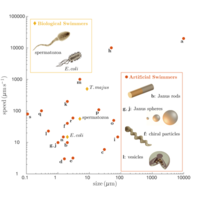
This article reviews both experimental and theoretical advances in the field of active matter which consists of natural and artificial objects capable of self-propulsion. Prime examples of active particles are Brownian particles, biological or manmade microscopic and nanoscopic objects, that can propel themselfes by taking up energy from their environment and converting it into directed motion. The review provides a guided tour through the basic principles and fabrication of active particles and discusses also many interesting future directions these manmade micromachines and nanomachines could take as autonomous agents for healthcare, sustainability, and security applications.

Quantum memories at finite temperature

Benjamin J. Brown, Daniel Loss, Jiannis K. Pachos, Chris N. Self, and James R. Wootton

Rev. Mod. Phys. 88, 045005 (2016) - Published 15 November, 2016

While the typical scenario for quantum error correction involves active intervention there are advantages to a passive quantum memory, for which a suitably designed interaction Hamiltonian will naturally protect the coherence of low-lying states from decoherence induced by a thermal environment. This review summarizes and discusses the various theoretical attempts to find a workable scenario for a passive quantum memory.

Time-dependent density-functional description of nuclear dynamics

Takashi Nakatsukasa, Kenichi Matsuyanagi, Masayuki Matsuo, and Kazuhiro Yabana

Rev. Mod. Phys. 88, 045004 (2016) - Published 9 November, 2016

Many excitation modes of atomic nuclei and their reactions can be described as time-dependent processes, in which nuclei oscillate, rotate, collide, and split. A theoretical framework to describe nuclear dynamics at low energy is the time-dependent density functional theory. This reviews the foundations and extensions of this theory and its applications to nuclear collective motion, including giant resonances, heavy-ion collisions, and shape coexistence. Conceptual differences between nuclear and electronic applications are also discussed.

Materials perspective on Casimir and van der Waals interactions

L. M. Woods, D. A. R. Dalvit, A. Tkatchenko, P. Rodriguez-Lopez, A. W. Rodriguez, and R. Podgornik

Rev. Mod. Phys. 88, 045003 (2016) - Published 2 November, 2016

Electromagnetic fluctuation-induced interactions known as van der Waals, Casimir, and Casimir-Polder forces are an active and exciting area of research. This review summarizes recent progress in this field with emphasis on theoretical and computational developments and their applications to materials including molecular structures, Dirac-like systems, optical metamaterials, composites with nontrivial boundary conditions, and biological matter.

CP violation in the Bs0 system

Marina Artuso, Guennadi Borissov, and Alexander Lenz

Rev. Mod. Phys. 88, 045002 (2016) - Published 13 October, 2016

Sources of CP violation beyond those of the standard model of particle physics are needed to explain the dominance of matter over antimatter in the universe. The bound state of a bottom antiquark and a strange quark and its charge conjugate is a fertile hunting ground, as standard model CP violating effects are typically small. This article reviews the many studies of CP violation in Bs decays, the quantum mixing of Bs and anti-Bs, and their interference.

Colloquium: Protecting quantum information against environmental noise

Dieter Suter and Gonzalo A. Álvarez

Rev. Mod. Phys. 88, 041001 (2016) - Published 10 October, 2016

Quantum-mechanical systems retain their properties so long as the phase of quantum superpositions evolve stably over time. Contact with an environment can disrupt this phase evolution. But for environments that do not exchange energy with the quantum system, strategies exist where the controlled driving of the system can recover or maintain the quantum phase. This Colloquium surveys the host of techniques that are available to “refocus” the phase when disturbed by various forms of classical or quantum environment. While the first such techniques were developed long ago, ideas from quantum information theory have introduced new strategies for accomplishing this goal.

Alternatives to an elementary Higgs

Csaba Csáki, Christophe Grojean, and John Terning

Rev. Mod. Phys. 88, 045001 (2016) - Published 6 October, 2016

Experiments point to the Higgs particle being the excitation of an elementary scalar field, as originally proposed in the standard model. To many theorists, however, its low mass suggests it may be more than that. This article provides a comprehensive review of these alternative Higgs models. The current run of the LHC will test the nature of the Higgs with greater precision. Particle physicists will find this review to serve as a guide to interpret the experimental results to come.

CODATA recommended values of the fundamental physical constants: 2014

Peter J. Mohr, David B. Newell, and Barry N. Taylor

Rev. Mod. Phys. 88, 035009 (2016) - Published 26 September, 2016

This review article contains the 2014 self-consistent set of values of the constants and conversion factors of physics and chemistry recommended by the Committee on Data for Science and Technology (CODATA). The CODATA values are based on a least-squares adjustment that that takes into account all data available up to the end of 2014. Details of the data selection and methodology are described.

Leptonic and semileptonic decays of B mesons

Jochen Dingfelder and Thomas Mannel

Rev. Mod. Phys. 88, 035008 (2016) - Published 21 September, 2016

In the standard model of particle physics, the strong and weak interaction eigenstates of the three generations of quarks differ and are related by the unitary Cabibbo-Kobayashi-Maskawa matrix. This article reviews measurements of the decays of the mesons containing a bottom quark into final states with leptons. These measurements provide determinations of the matrix elements and other observables, and offer constraints on the standard model as well as pointers to possible new physics.

Publisher’s Note: Google matrix analysis of directed networks [Rev. Mod. Phys. 87, 1261 (2015)]

Leonardo Ermann, Klaus M. Frahm, and Dima L. Shepelyansky

Rev. Mod. Phys. 88, 039905 (2016) - Published 20 September, 2016

Sap flow and sugar transport in plants

K. H. Jensen, K. Berg-Sørensen, H. Bruus, N. M. Holbrook, J. Liesche, A. Schulz, M. A. Zwieniecki, and T. Bohr

Rev. Mod. Phys. 88, 035007 (2016) - Published 16 September, 2016

Green plants harvest the energy of the Sun in the leaves by converting light energy into chemical energy in the bonds of sugar molecules, using water from the soil and carbon dioxide from the air. This review provides an overview of the vascular anatomy of plants and the physical models that describe the long-distance transport of water and minerals from root to leaf, and, in particular, of sugars from the leaves to the entire body of the plant sustaining growth and communication throughout even the tallest tree.

Control principles of complex systems

Yang-Yu Liu and Albert-László Barabási

Rev. Mod. Phys. 88, 035006 (2016) - Published 6 September, 2016

Complex networks range from subcellular biological networks to the Internet. Our ability to control these systems deeply challenges our understanding. Control also may well be a guiding principle in their design. This article reviews the emerging science of the control of complex networks.

Classification of topological quantum matter with symmetries

Ching-Kai Chiu, Jeffrey C. Y. Teo, Andreas P. Schnyder, and Shinsei Ryu

Rev. Mod. Phys. 88, 035005 (2016) - Published 31 August, 2016

In recent years an increasing amount of attention has been devoted to quantum materials with topological characteristics that are robust against disorder and other perturbations. In this context it was discovered that topological materials can be classified with respect to their dimension and symmetry properties. This review provides an overview of the classification schemes of both fully gapped and gapless topological materials and gives a pedagogical introduction into the field of topological band theory.

Sign In to Your Journals Account

Filter

Recent Issues

Vol. 98, Iss. 4
October - December 2026
Vol. 98, Iss. 3
July - September 2026
Vol. 98, Iss. 2
April - June 2026
Vol. 98, Iss. 1
January - March 2026
Category
Article Type

Filter

Article Lookup

Enter a citation