M. Malinowski, D.T.C. Allcock, and C.J. Ballance
PRX Quantum 4, 040313 (2023) - Published 19 October, 2023
A concrete proposal for a 1000-qubit trapped-ion quantum processor takes advantage of integrated switching electronics to reduce the wiring complexity without reducing operation fidelity.
V. Esteso, R. Duquennoy, R.C. Ng, M. Colautti, P. Lombardi, G. Arregui, E. Chavez-Angel, C.M. Sotomayor-Torres, P.D. Garcia, M. Hilke, and C. Toninelli
PRX Quantum 4, 040314 (2023) - Published 20 October, 2023
A single-molecule thermometer provides two-dimensional mapping with high spatial and temperature resolution under cryogenic conditions.
Álvaro M. Alhambra
PRX Quantum 4, 040201 (2023) - Published 30 November, 2023
A pedagogical guide to understand important aspects of the physics and complexity of quantum many-body systems, focusing on short-range interactions and thermal equilibrium.
Isaac B.W. Harris, Cathryn P. Michaels, Kevin C. Chen, Ryan A. Parker, Michael Titze, Jesús Arjona Martínez, Madison Sutula, Ian R. Christen, Alexander M. Stramma, William Roth, Carola M. Purser, Martin Hayhurst Appel, Chao Li, Matthew E. Trusheim, Nicola L. Palmer, Matthew L. Markham, Edward S. Bielejec, Mete Atatüre, and Dirk Englund
PRX Quantum 4, 040301 (2023) - Published 2 October, 2023
First-principle calculations and experimental validation show that color centers in diamond exhibit large hyperfine coupling, making them promising candidates to build quantum registers.
Matija Medvidović and Dries Sels
PRX Quantum 4, 040302 (2023) - Published 4 October, 2023
Classical variational methods are used to simulate the dynamics of two-dimensional quantum models with continuous degrees of freedom using neural networks, pushing the limits of classical computation in simulating these systems.
Nicholas C. Rubin, Dominic W. Berry, Fionn D. Malone, Alec F. White, Tanuj Khattar, A. Eugene DePrince, III, Sabrina Sicolo, Michael Küehn, Michael Kaicher, Joonho Lee, and Ryan Babbush
PRX Quantum 4, 040303 (2023) - Published 6 October, 2023
An improvement and detailed accounting of the fault-tolerant resources required for simulation of periodic systems provides context for quantum computation in materials science.
Jakub Czartowski, A. de Oliveira Junior, and Kamil Korzekwa
PRX Quantum 4, 040304 (2023) - Published 6 October, 2023
A novel resource-theoretic framework is developed to bridge the gap between thermodynamic processes with and without memory effects.
Sisi Zhou, Spyridon Michalakis, and Tuvia Gefen
PRX Quantum 4, 040305 (2023) - Published 9 October, 2023
Preprocessing protocols for quantum control are optimized using Fisher information to set ultimate precision bounds for noisy measurements of quantum states.
Florian Kanitschar, Ian George, Jie Lin, Twesh Upadhyaya, and Norbert Lütkenhaus
PRX Quantum 4, 040306 (2023) - Published 10 October, 2023
Discrete-modulated continuous-variable quantum key distribution is provably secure under experimentally viable conditions in the finite-key regime against collective i.i.d. attacks.
Eleftherios-Ermis Tselentis and Ämin Baumeler
PRX Quantum 4, 040307 (2023) - Published 11 October, 2023
Local quantum theory is found to impose novel limitations on causal structures and correlations.
G. Kestler, K. Ton, D. Filin, C. Cheung, P. Schneeweiss, T. Hoinkes, J. Volz, M.S. Safronova, A. Rauschenbeutel, and J.T. Barreiro
PRX Quantum 4, 040308 (2023) - Published 12 October, 2023
Alkaline-earth atoms are trapped with fields from a nanophotonic structure for the first time, with possible applications in quantum sensing and atomtronic-photonic circuits.
Aaron J. Friedman, Oliver Hart, and Rahul Nandkishore
PRX Quantum 4, 040309 (2023) - Published 13 October, 2023
A systematic study of chaotic quantum dynamics with measurements shows that outcome-dependent feedback is needed to observe measurement-induced phases of matter.
P. Renault, J. Nokkala, G. Roeland, N.Y. Joly, R. Zambrini, S. Maniscalco, J. Piilo, N. Treps, and V. Parigi
PRX Quantum 4, 040310 (2023) - Published 16 October, 2023
A continuous-variable optical setup is used to simulate the open-system quantum dynamics with engineered environments, with applications in quantum biology, synchronization, and understanding the quantum-to-classical transition.
Robin Harper and Steven T. Flammia
PRX Quantum 4, 040311 (2023) - Published 17 October, 2023
An efficient method for modeling and measuring noise in a quantum device is proposed and experimentally tested, helping to illuminate the effectiveness of error correction against correlated noise.
Kohei Kawabata, Zhenyu Xiao, Tomi Ohtsuki, and Ryuichi Shindou
PRX Quantum 4, 040312 (2023) - Published 18 October, 2023
A new method, based on singular values of non-Hermitian matrices, is shown to be able to identify chaos and nonintegrability in open quantum many-body systems.
M. Malinowski, D.T.C. Allcock, and C.J. Ballance
PRX Quantum 4, 040313 (2023) - Published 19 October, 2023
A concrete proposal for a 1000-qubit trapped-ion quantum processor takes advantage of integrated switching electronics to reduce the wiring complexity without reducing operation fidelity.
V. Esteso, R. Duquennoy, R.C. Ng, M. Colautti, P. Lombardi, G. Arregui, E. Chavez-Angel, C.M. Sotomayor-Torres, P.D. Garcia, M. Hilke, and C. Toninelli
PRX Quantum 4, 040314 (2023) - Published 20 October, 2023
A single-molecule thermometer provides two-dimensional mapping with high spatial and temperature resolution under cryogenic conditions.
Paul C. Jerger, Yu-Xin Wang (王语馨), Mykyta Onizhuk, Benjamin S. Soloway, Michael T. Solomon, Christopher Egerstrom, F. Joseph Heremans, Giulia Galli, Aashish A. Clerk, and David D. Awschalom
PRX Quantum 4, 040315 (2023) - Published 24 October, 2023
Measurements of quantum quench phase shifts enable a direct probe of an NV center’s nuclear spin-bath polarization, with applications in quantum memories and metrology.
Ronan Gautier, Mazyar Mirrahimi, and Alain Sarlette
PRX Quantum 4, 040316 (2023) - Published 25 October, 2023
A new perspective on cat-qubit gates is introduced, leading to four new gate designs that improve upon the standard Zeno gate and that can increase gate fidelities by an order of magnitude for realistic experimental parameters.
Poetri Sonya Tarabunga, Emanuele Tirrito, Titas Chanda, and Marcello Dalmonte
PRX Quantum 4, 040317 (2023) - Published 26 October, 2023
A novel quantum many-body method is developed for measuring magic, a fundamental resource in quantum information protocols.
Jielun Chen (陈捷伦), E.M. Stoudenmire, and Steven R. White
PRX Quantum 4, 040318 (2023) - Published 27 October, 2023
Novel results show that the quantum Fourier transform is compatible with area-law entanglement dynamics, opening the way for classical simulations using tensor networks.
Marco Fellous-Asiani, Jing Hao Chai, Yvain Thonnart, Hui Khoon Ng, Robert S. Whitney, and Alexia Auffèves
PRX Quantum 4, 040319 (2023) - Published 30 October, 2023
A full-stack approach to the energetics of quantum computers is introduced, allowing one to minimize their energy consumption for a given computational accuracy.
Masoud Ghalaii, Sima Bahrani, Carlo Liorni, Federico Grasselli, Hermann Kampermann, Lewis Wooltorton, Rupesh Kumar, Stefano Pirandola, Timothy P. Spiller, Alexander Ling, Bruno Huttner, and Mohsen Razavi
PRX Quantum 4, 040320 (2023) - Published 1 November, 2023
Spaceborne quantum communication protocols are studied under restrictive eavesdropping scenarios, showing that even simple QKD protocols can offer positive key rates at high channel losses.
Ilya A. Simakov, Grigoriy S. Mazhorin, Ilya N. Moskalenko, Nikolay N. Abramov, Alexander A. Grigorev, Dmitry O. Moskalev, Anastasiya A. Pishchimova, Nikita S. Smirnov, Evgeniy V. Zikiy, Ilya A. Rodionov, and Ilya S. Besedin
PRX Quantum 4, 040321 (2023) - Published 3 November, 2023
Direct control of the longitudinal coupling between fluxonium qubits and their coupler enables a novel entangling gate.
Paul Hilaire, Yaron Castor, Edwin Barnes, Sophia E. Economou, and Frédéric Grosshans
PRX Quantum 4, 040322 (2023) - Published 6 November, 2023
Linear-optical quantum information processing is shown not to intrinsically reduce the loss tolerance performances of quantum error correction.
Jorge Miguel-Ramiro, Ferran Riera-Sàbat, and Wolfgang Dür
PRX Quantum 4, 040323 (2023) - Published 8 November, 2023
A quantum repeater protocol that distributes three-qubit states over arbitrary distances with polylogarithmic overhead is introduced.
Karthik Siva, Gerwin Koolstra, John Steinmetz, William P. Livingston, Debmalya Das, L. Chen, J.M. Kreikebaum, N.J. Stevenson, C. Jünger, D.I. Santiago, I. Siddiqi, and A.N. Jordan
PRX Quantum 4, 040324 (2023) - Published 9 November, 2023
Continuous weak measurements enable reconstruction of time-dependent Hamiltonians, enhancing the time resolution of quantum gate errors beyond what is revealed by standard tomographic and benchmarking techniques.
Alexander M. Dalzell, B. David Clader, Grant Salton, Mario Berta, Cedric Yen-Yu Lin, David A. Bader, Nikitas Stamatopoulos, Martin J. A. Schuetz, Fernando G. S. L. Brandão, Helmut G. Katzgraber, and William J. Zeng
PRX Quantum 4, 040325 (2023) - Published 13 November, 2023
A detailed resource analysis of an established quantum algorithm for convex optimization reveals that the practical run times implied by this quantum solution are impractical for problems of interest in finance.
Zihan Cheng and Matteo Ippoliti
PRX Quantum 4, 040326 (2023) - Published 15 November, 2023
Building on the insight of unraveling noise channels into optimized measurements, a classical algorithm for sampling noisy random circuits is developed, increasing our understanding of the boundary of “practically hard” quantum computation in real-world noisy settings.
N. Goldman, O.K. Diessel, L. Barbiero, M. Prüfer, M. Di Liberto, and L. Peralta Gavensky
PRX Quantum 4, 040327 (2023) - Published 17 November, 2023
A general construction shows how to design unconventional interaction processes in bosonic systems, providing a route for the exploration of exotic quantum phases of matter.
L. Innocenti, S. Lorenzo, I. Palmisano, F. Albarelli, A. Ferraro, M. Paternostro, and G. M. Palma
PRX Quantum 4, 040328 (2023) - Published 20 November, 2023
The interplay between measurements, reconstructed observables, and the estimators used to process measurement outcomes is examined in a framework that connects shadow tomography with the general theory of measurement frames.
José D. Guimarães, James Lim, Mikhail I. Vasilevskiy, Susana F. Huelga, and Martin B. Plenio
PRX Quantum 4, 040329 (2023) - Published 21 November, 2023
Noise can be used as a computational resource for simulating open quantum systems on NISQ devices.
Hao-Chung Cheng (鄭皓中)
PRX Quantum 4, 040330 (2023) - Published 22 November, 2023
A judicious application of the so-called pretty-good measurement in quantum coding considerably simplifies the derivation of one-shot achievability, sharpening many existing quantum information-processing protocols.
Yosuke Mitsuhashi and Nobuyuki Yoshioka
PRX Quantum 4, 040331 (2023) - Published 27 November, 2023
The concept of unitary designs is extended to scenarios involving symmetry, which can be applied in the contexts of randomized benchmarking and many-body simulations.
Shengqi Sang, Zhi Li, Timothy H. Hsieh, and Beni Yoshida
PRX Quantum 4, 040332 (2023) - Published 28 November, 2023
Quantum correlation and information spread superlinearly with time in quantum dynamics subject to repeated measurements.
Sivaprasad Omanakuttan, Anupam Mitra, Eric J. Meier, Michael J. Martin, and Ivan H. Deutsch
PRX Quantum 4, 040333 (2023) - Published 29 November, 2023
Novel techniques based on Lie group and algebraic quantum optimal control are employed in a new protocol to implement entangling universal logic gates on qudits.
Mao Lin, Christopher Chamberland, and Kyungjoo Noh
PRX Quantum 4, 040334 (2023) - Published 1 December, 2023
The advantage of decoding large instances of GKP codes from a lattice perspective is demonstrated, and several instances of optimized GKP codes that outperform the currently known codes are found.
Valentin Heyraud, Zejian Li, Kaelan Donatella, Alexandre Le Boité, and Cristiano Ciuti
PRX Quantum 4, 040335 (2023) - Published 4 December, 2023
An efficient method to evaluate the trainability of variational quantum circuits allows for the exploration of strategies to overcome the barren plateau problem.
Philippe Faist, Mischa P. Woods, Victor V. Albert, Joseph M. Renes, Jens Eisert, and John Preskill
PRX Quantum 4, 040336 (2023) - Published 5 December, 2023
The impact of noise on the accuracy of a quantum clock is investigated, unveiling a necessary and sufficient requirement for accuracy that extends standard error-correcting conditions to quantum metrology.
Hsin-Yuan Huang, Sitan Chen, and John Preskill
PRX Quantum 4, 040337 (2023) - Published 6 December, 2023
A new machine-learning algorithm for predicting unknown quantum dynamics is presented.
Niklas Euler and Martin Gärttner
PRX Quantum 4, 040338 (2023) - Published 7 December, 2023
A general, experimentally accessible scheme to bound entanglement in a system of cold atoms in an optical lattice is presented.
Aydin Deger, Aiden Daniel, Zlatko Papić, and Jiannis K. Pachos
PRX Quantum 4, 040339 (2023) - Published 8 December, 2023
Long-lived non-Gaussian states are identified on Rydberg atom arrays, laying out a proposal for their observation and use as a stable resource for quantum information protocols.
Kiarn T. Laverick, Prahlad Warszawski, Areeya Chantasri, and Howard M. Wiseman
PRX Quantum 4, 040340 (2023) - Published 11 December, 2023
Classical smoothing theory is shown to not be always applicable to quantum systems, even when both the filtering and retrofiltering appear classical.
Nick S. Blunt, Laura Caune, Róbert Izsák, Earl T. Campbell, and Nicole Holzmann
PRX Quantum 4, 040341 (2023) - Published 12 December, 2023
A phase-estimation method to find energies of quantum many-body systems is tested on a real quantum processor, combining statistical methods and error-mitigation techniques.
Nathan R.A. Lee, Yudan Guo, Agnetta Y. Cleland, E. Alex Wollack, Rachel G. Gruenke, Takuma Makihara, Zhaoyou Wang, Taha Rajabzadeh, Wentao Jiang, Felix M. Mayor, Patricio Arrangoiz-Arriola, Christopher J. Sarabalis, and Amir H. Safavi-Naeini
PRX Quantum 4, 040342 (2023) - Published 13 December, 2023
The reach of circuit quantum acoustodynamics is expanded, providing a path for developing new quantum sensing and information processing schemes with phonons at frequencies below 700 MHz.
Leon Zaporski, Stijn R. de Wit, Takuya Isogawa, Martin Hayhurst Appel, Claire Le Gall, Mete Atatüre, and Dorian A. Gangloff
PRX Quantum 4, 040343 (2023) - Published 14 December, 2023
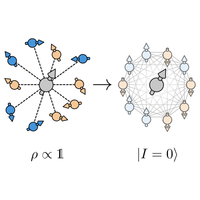
A proposed quantum control protocol uses a central spin to prepare two spin ensembles in a singlet state.
Xinyu Tan, Fang Zhang, Rui Chao, Yaoyun Shi, and Jianxin Chen
PRX Quantum 4, 040344 (2023) - Published 15 December, 2023
Leveraging parallelization in time, a scalable decoding paradigm for topological quantum error-correction codes effectively resolves the exponential backlog problem without compromising decoding accuracy.
Murali K. Kurmapu, V.V. Tiunova, E.S. Tiunov, Martin Ringbauer, Christine Maier, Rainer Blatt, Thomas Monz, Aleksey K. Fedorov, and A.I. Lvovsky
PRX Quantum 4, 040345 (2023) - Published 18 December, 2023
A new quantum tomography method inspired by variational matrix-product-state ansatze is introduced and benchmarked in a 20-qubit quantum simulator.
Ivan Vybornyi, Laura S. Dreissen, Dominik Kiesenhofer, Helene Hainzer, Matthias Bock, Tuomas Ollikainen, Daniel Vadlejch, Christian F. Roos, Tanja E. Mehlstäubler, and Klemens Hammerer
PRX Quantum 4, 040346 (2023) - Published 20 December, 2023
A new method for ion-trap thermometry is developed and tested, showing accuracy for large 1D and 2D ion crystals, accounting for quantum many-body effects.
Daniel T. Chen, Brian Doolittle, Jeffrey Larson, Zain H. Saleem, and Eric Chitambar
PRX Quantum 4, 040347 (2023) - Published 22 December, 2023
Statistical correlations generated across the nodes of a quantum network are used to infer the network topology using entropic quantities.
Patrice Kolb and Kiryl Pakrouski
PRX Quantum 4, 040348 (2023) - Published 26 December, 2023
Stability of quantum many-body scars in spin-1/2 fermionic systems under typical perturbations is investigated, revealing insights for experimental detection and theoretical and quantum computing applications.
Alexander Schmidhuber and Seth Lloyd
PRX Quantum 4, 040349 (2023) - Published 28 December, 2023
New insights on the hardness of topological data analysis and the possibility of quantum advantage.
Gilad Gour
PRX Quantum 4, 040901 (2023) - Published 2 October, 2023