Tamizhmalar Sundararajan, Matteo Boccalini, Roméo Suss, Sandrine Mariot, Emerson R. Da Silva, Fernando C. Giacomelli, Austin Hubley, Theyencheri Narayanan, Alessandro Barducci, and Guillaume Tresset
PRX Life 4, 043001 (2026) - Published 8 October, 2026
Time-resolved scattering uncovers how enzymatic activity redirects the assembly pathway of biomolecular condensates, creating distinct internal structures and dynamics.
Amit Jangid, Ohad Noy Feldheim, and Tamar Friedlander
PRX Life 4, 043005 (2026) - Published 26 October, 2026
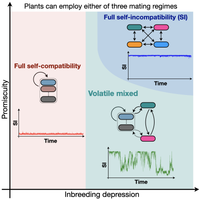
Plants may not have to choose between selfing and outcrossing: a biophysical evolutionary model reveals a persistent mixed-mating state whose composition continues to fluctuate without settling—even in an unchanging environment—and predicts, counterintuitively, that pollen scarcity can favor self-incompatibility.
Bernardo Gouveia, J. Pedro de Souza, Venecia A. Valdez, Joshua W. Shaevitz, Howard A. Stone, and Sabine Petry
PRX Life 4, 043006 (2026) - Published 27 October, 2026
By combining experiments and theory, this study establishes condensate-mediated capillary forces as a distinct mechanism for microtubule bundling.
Zhen Kang, Ramón Escobedo, Maud Combe, Stéphane Sanchez, Clément Sire, and Guy Theraulaz
PRX Life 4, 043007 (2026) - Published 29 October, 2026
Schooling fish coordinate their motion with a single dynamically selected neighbor—the one exerting the strongest influence, not necessarily the closest one.
Tamizhmalar Sundararajan, Matteo Boccalini, Roméo Suss, Sandrine Mariot, Emerson R. Da Silva, Fernando C. Giacomelli, Austin Hubley, Theyencheri Narayanan, Alessandro Barducci, and Guillaume Tresset
PRX Life 4, 043001 (2026) - Published 8 October, 2026
Time-resolved scattering uncovers how enzymatic activity redirects the assembly pathway of biomolecular condensates, creating distinct internal structures and dynamics.
Haina Wang, Marco A. Galvani Cunha, John C. Crocker, and Andrea J. Liu
PRX Life 4, 043002 (2026) - Published 15 October, 2026
The actin cortex stays rigid and retains elastic memory not by staying still but by continuously remodeling itself, recycling its components in response to mechanical forces.
N. J. López-Alamilla, A. L. Nord, F. Pedaci, J. Palmeri, and N.-O. Walliser
PRX Life 4, 043003 (2026) - Published 23 October, 2026
Fluctuations are more than noise—they provide a window into the energy landscape and friction governing the bacterial flagellar motor.
Roy Friedman, Noa Moriel, Matthew Ricci, Guy Pelc, Yair Weiss, and Mor Nitzan
PRX Life 4, 043004 (2026) - Published 26 October, 2026
By mapping sparse observations to prototypical behaviors, this equation-free framework identifies driving marker genes and traces cell-cycle trajectories directly from high-dimensional single-cell gene expression data.
Amit Jangid, Ohad Noy Feldheim, and Tamar Friedlander
PRX Life 4, 043005 (2026) - Published 26 October, 2026
Plants may not have to choose between selfing and outcrossing: a biophysical evolutionary model reveals a persistent mixed-mating state whose composition continues to fluctuate without settling—even in an unchanging environment—and predicts, counterintuitively, that pollen scarcity can favor self-incompatibility.
Bernardo Gouveia, J. Pedro de Souza, Venecia A. Valdez, Joshua W. Shaevitz, Howard A. Stone, and Sabine Petry
PRX Life 4, 043006 (2026) - Published 27 October, 2026
By combining experiments and theory, this study establishes condensate-mediated capillary forces as a distinct mechanism for microtubule bundling.
Zhen Kang, Ramón Escobedo, Maud Combe, Stéphane Sanchez, Clément Sire, and Guy Theraulaz
PRX Life 4, 043007 (2026) - Published 29 October, 2026
Schooling fish coordinate their motion with a single dynamically selected neighbor—the one exerting the strongest influence, not necessarily the closest one.
Zhouyi He (贺周易), Chi Fung Willis Chow, Agnes Toth-Petroczy, Jens-Uwe Sommer, and Tyler S. Harmon
PRX Life 4, 043008 (2026) - Published 30 October, 2026
Translation is more than making proteins—it can actively drive their localization to biomolecular condensates as they emerge from polysomes.
Ludovic Dumoulin, Carles Blanch-Mercader, and Karsten Kruse
PRX Life 4, 043009 (2026) - Published 3 November, 2026
Material renewal stabilizes defects that organize active stress in cells and tissues.
Marcos Lequerica-Mateos, Jonathan Martin, José N. Onuchic, Faruck Morcos, and Ivan Coluzza
PRX Life 4, 043010 (2026) - Published 4 November, 2026
A self-consistent training framework that learns residue-residue interactions in proteins bridges sequence statistics and physically modeled interaction energies.
Mattia Mattei, David Soriano-Paños, and Alex Arenas
PRX Life 4, 043011 (2026) - Published 5 November, 2026
By increasing their motility nonlinearly in response to competitor density, interacting microbial populations spontaneously segregate to form emergent spatial patterns that sustain long-term coexistence.
Arthur Hernandez, Cuncheng Zhu, and Luca Giomi
PRX Life 4, 043012 (2026) - Published 10 November, 2026
Mechanics plays a crucial role in the formation of the head-foot axis in Hydra, where contractile muscle fibers and the topology of nematic defects concentrate stress to generate the strain and pressure asymmetries needed for head and foot formation.