APC waived for all submissions and transfers received before 01 Jan 2027. Submit now!

General Learning of the Electric Response of Inorganic Materials

28 July, 2026

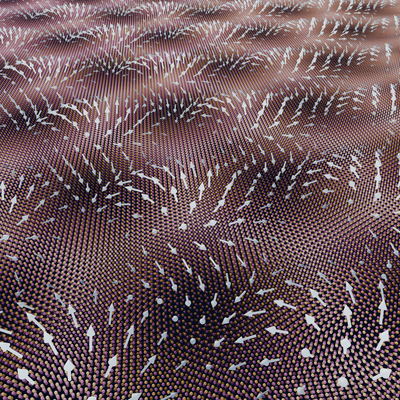
A field-aware equivariant interatomic potential integrates electric bias into foundation-model simulations across chemical space, learning a differentiable electric enthalpy for polarization, polarizability, and Born effective charges.

28 July, 2026

Chief Editor Anatole von Lilienfeld and the PRX Intelligence editorial team outline the newest APS journal’s vision, scope and philosophy in the context of the rapidly evolving landscape of AI and scientific discovery.

15 October, 2026

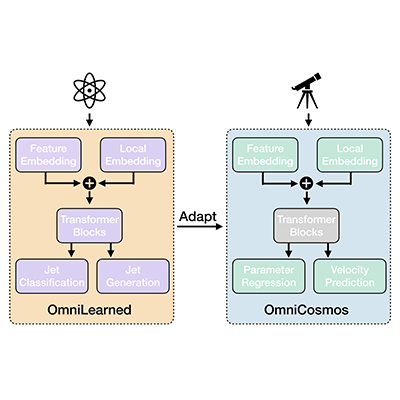
AI Foundation Models trained on collider data can translate to cosmology.

14 October, 2026

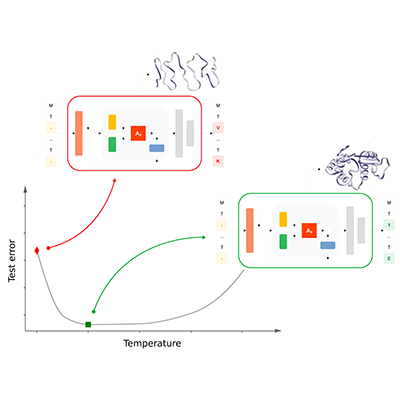
Transformer models trained for protein structure prediction are analyzed from a statistical mechanics perspective, leading to a better understanding of how they work and why they can efficiently retrieve spatial and chemical relationships between amino acids.

13 October, 2026

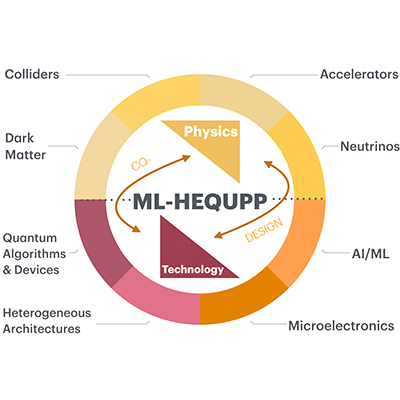
This Roadmap envisions how to prioritize research in hardware-based machine learning methods and more to adapt to challenging real-time data collection environments in the forthcoming era of particle physics experiments.

8 October, 2026

An approach that uses prediction-error methodology to train universal differential equations can learn unknown states in chaotic systems by removing the sensitive dependence of conventional methods on parameter choices.

6 October, 2026

Comprehensive benchmarking demonstrates the power and robustness of two convolutional backflow architectures for strongly correlated systems.

1 October, 2026

This Tutorial presents Denario, an AI multiagent system that can assist in the full scientific process, and provides examples and guidance for its application.

29 September, 2026

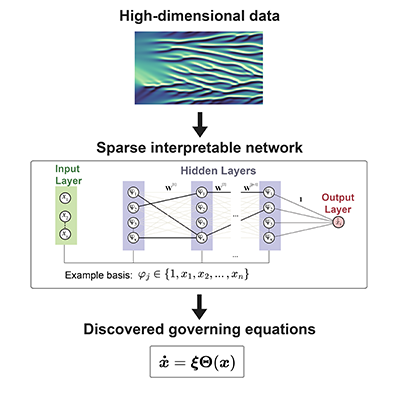
Sparse regression embedded interpretable networks serve as a scalable scientific machine-learning framework that discovers the governing equations of high-dimensional dynamical systems.

24 September, 2026

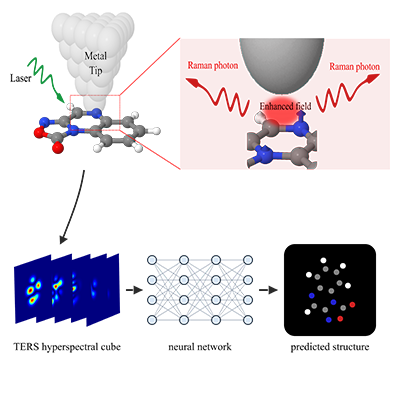
An encoder–decoder model trained and evaluated on simulated tip-enhanced Raman spectroscopy images of planar molecules enables direct, accurate prediction of molecular structures from spectral simulated data.

22 September, 2026

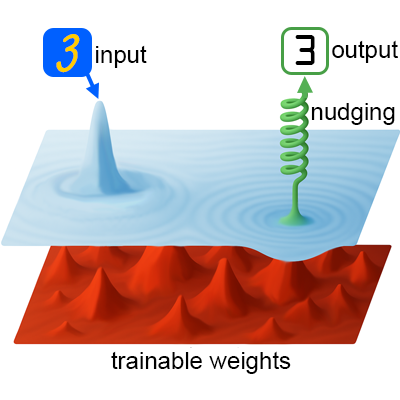
Equilibrium propagation learning is extended to both discrete and continuous complex-valued wave systems, providing a practical method for in situ learning in a wide range of physical systems.

17 September, 2026

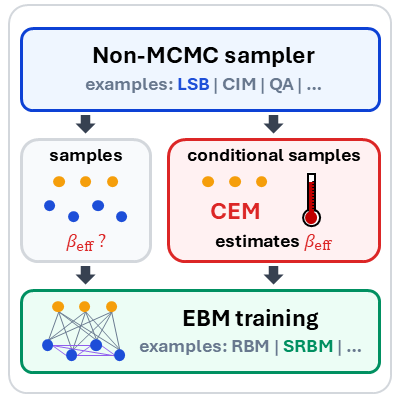
Langevin simulated bifurcation enables fast non-MCMC Boltzmann sampling, while conditional expectation matching makes it practical for training expressive energy-based models by efficiently estimating the effective temperature.

15 September, 2026

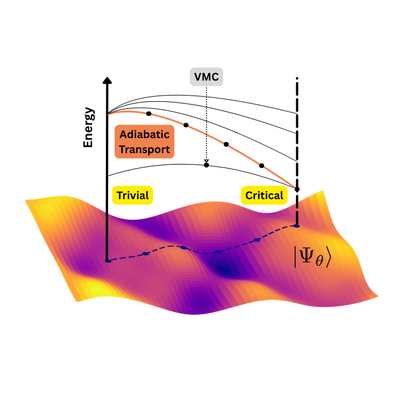
A first-principles method that builds neural network representations of many-body excited states provides an accurate and parallelizable tool for estimating critical exponents.

10 September, 2026

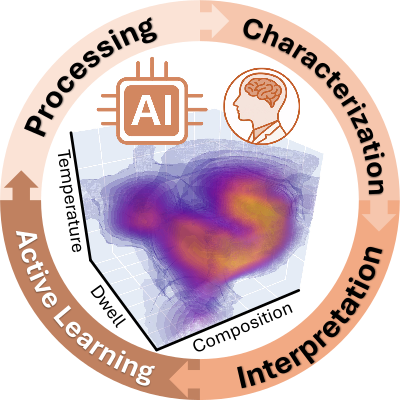
Augmenting autonomous experimentation with human-in-the-loop guidance significantly improves efficiency of AI-based materials exploration.

8 September, 2026

A neural-network variational Monte Carlo method is used to study the fractional quantum Hall effect on the torus, establishing neural-network wavefunctions as a powerful tool for investigating anyonic properties.

3 September, 2026

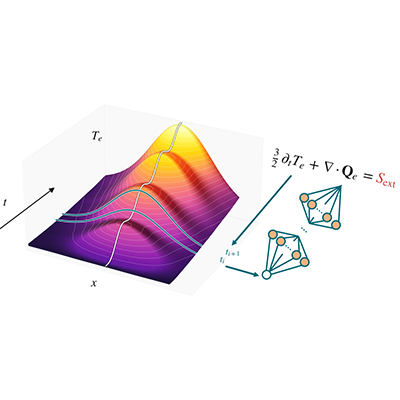
A resolution-robust data-driven closure for the electron heat flux bridges kinetic and fluid descriptions of inertial confinement fusion plasmas.

1 September, 2026

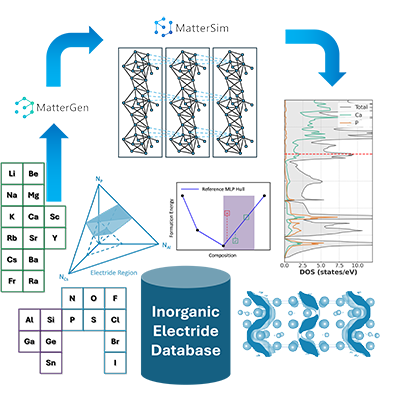
A framework that combines diffusion-based materials generation with hierarchical thermodynamic and electronic structure screening accelerates discovery of inorganic electrides.

27 August, 2026

A Symmetry-adapted Gaussian process regression model is employed for electronic structure prediction of twisted bilayer moiré materials, unraveling the impact of long-range interactions.

25 August, 2026

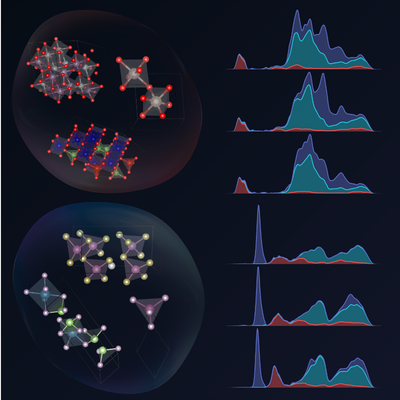
Graph neural networks enable efficient prediction of the electronic density of states, making it possible to identify application-specific, structurally diverse compounds with similar electronic properties across vast chemical spaces.

20 August, 2026

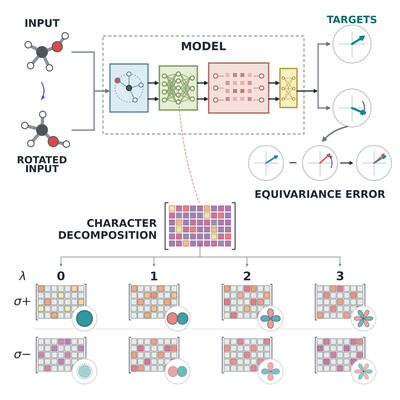
Resolving the angular content of internal representations, layer by layer, reveals how unconstrained machine-learning models learn near-exact equivariance, and which minimal inductive biases push symmetry breaking down to harmless levels.

18 August, 2026

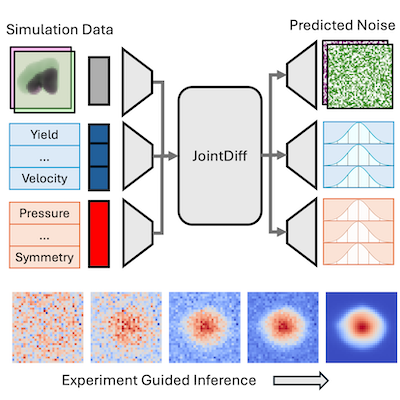
Joint diffusion is leveraged as a multimodal generative surrogate model for inertial confinement fusion (ICF), enabling post-shot inference, diagnostic optimization, and accelerated ICF design.

13 August, 2026

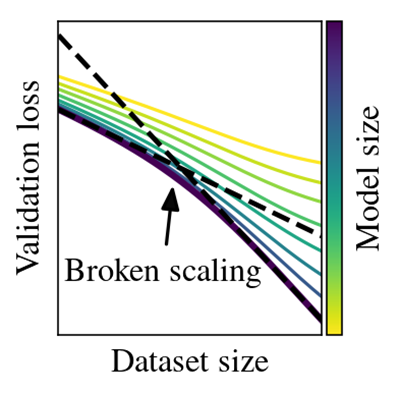
Broken scaling laws are observed across three multiobjective graph neural network architectures trained to predict the optical properties of solids.

11 August, 2026

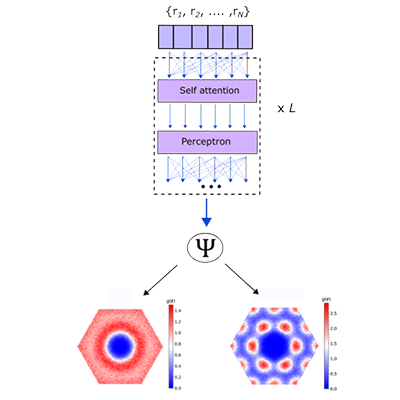
A self-attention neural-network variational wavefunction is capable of describing both fractional quantum Hall liquids and electron crystals within the same architecture.

6 August, 2026

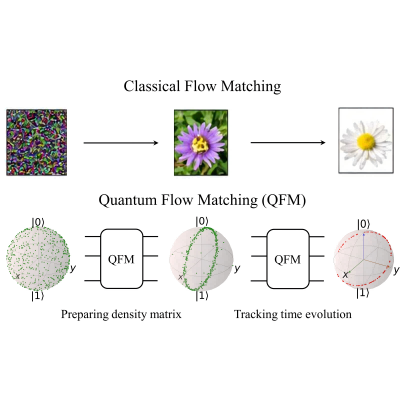
A quantum circuit realization of flow matching enables efficient interpolation between density matrices, and can be implemented in existing quantum computing architectures without costly redesigns.

4 August, 2026

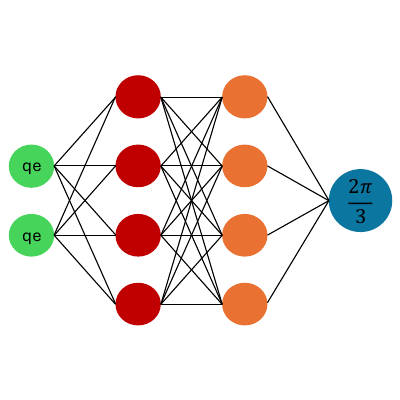
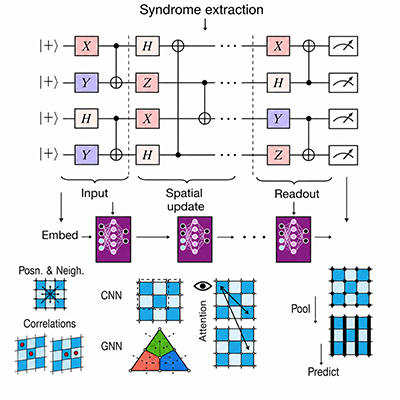
Neural decoders can serve as a robust and accurate foundation for fault-tolerant quantum algorithms under realistic conditions.

Efficient Predictions of Electric Response

28 July, 2026

An AI model accurately estimates quantities that determine a material’s response to electric fields—at a fraction of the usual computational cost.

Unpacking Particle Showers with Machine Learning

28 July, 2026

A new AI-powered event-processing algorithm is being readied to cope with the torrent of data that will stream from the Large Hadron Collider upgrade.

Sign In to Your Journals Account

Filter

Filter

Article Lookup

Enter a citation