Francisco Villaescusa-Navarro et al.
PRX Intelligence 1, 021001 (2026) - Published 1 October, 2026
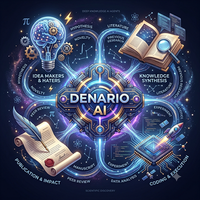
This Tutorial presents Denario, an AI multiagent system that can assist in the full scientific process, and provides examples and guidance for its application.
Julia Gonski et al.
PRX Intelligence 1, 021201 (2026) - Published 13 October, 2026
This Roadmap envisions how to prioritize research in hardware-based machine learning methods and more to adapt to challenging real-time data collection environments in the forthcoming era of particle physics experiments.
Yuntian Gu, Zeyao Han, Wenrui Li, Zhiyu Xiao, Tao Xiang, Mingpu Qin, Liwei Wang, and Dingshun Lv
PRX Intelligence 1, 023001 (2026) - Published 6 October, 2026
Comprehensive benchmarking demonstrates the power and robustness of two convolutional backflow architectures for strongly correlated systems.
Anthony G. Chesebro, David Hofmann, Vaibhav Dixit, Earl K. Miller, Richard H. Granger, Alan Edelman, Christopher V. Rackauckas, Lilianne R. Mujica-Parodi, and Helmut H. Strey
PRX Intelligence 1, 023002 (2026) - Published 8 October, 2026
An approach that uses prediction-error methodology to train universal differential equations can learn unknown states in chaotic systems by removing the sensitive dependence of conventional methods on parameter choices.
L. Ghiringhelli, A. Zambon, and G. Tiana
PRX Intelligence 1, 023003 (2026) - Published 14 October, 2026
Transformer models trained for protein structure prediction are analyzed from a statistical mechanics perspective, leading to a better understanding of how they work and why they can efficiently retrieve spatial and chemical relationships between amino acids.
Vinicius Mikuni, Ibrahim Elsharkawy, and Benjamin Nachman
PRX Intelligence 1, 023004 (2026) - Published 15 October, 2026
AI Foundation Models trained on collider data can translate to cosmology.
Younsik Kim and Changyoung Kim
PRX Intelligence 1, 023005 (2026) - Published 20 October, 2026
A denoising network that reports a calibrated uncertainty alongside every data point allows 12-second photoemission scans to yield superconducting gap values with meaningful error bars, turning deep learning from a visualization aid into a quantitative measurement tool.
Chen Qu, Paul L. Houston, Qi Yu, Apurba Nandi, Joel M. Bowman, Valerii Andreichev, Silvan Käser, and Markus Meuwly
PRX Intelligence 1, 023006 (2026) - Published 21 October, 2026
Several stress tests are utilized to assess the accuracy of two widely used machine-learned potential approaches.
Riccardo Rende, Alexander Nikolaenko, Luciano Loris Viteritti, Subir Sachdev, and Ya-Hui Zhang
PRX Intelligence 1, 023007 (2026) - Published 22 October, 2026
A Transformer-based neural quantum state unifies spin and fermionic degrees of freedom in a single variational framework, achieving high accuracy in one dimension and extending naturally to challenging two-dimensional systems.