

- Open Access
Collective Synchronization of Undulatory Movement through Contact
Phys. Rev. X 11, 031051 – Published 7 September, 2021
DOI: https://doi.org/10.1103/PhysRevX.11.031051
Abstract
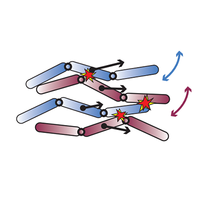
Many biological systems synchronize their movement through physical interactions. By far, the most well-studied examples concern physical interactions through a fluid: Beating cilia, swimming sperm and worms, and flapping wings all display synchronization behavior through fluid mechanical interactions. However, as the density of a collective increases, individuals may also interact with each other through physical contact. In the field of “active matter” systems, it is well known that inelastic contact between individuals can produce long-range correlations in position, orientation, and velocity. In this work, we demonstrate that contact interactions between undulating robots yield novel phase dynamics such as synchronized motions. We consider undulatory systems in which rhythmic motion emerges from time-independent oscillators that sense and respond to an undulatory bending angle and speed. In pair experiments, we demonstrate that robot joints will synchronize to in-phase and antiphase oscillations through collisions, and a phase-oscillator model describes the stability of these modes. To understand how contact interactions influence the phase dynamics of larger groups, we perform simulations and experiments of simple three-link undulatory robots that interact only through contact. Collectives synchronize their movements through contact as predicted by the theory, and when the robots can adjust their position in response to contact, we no longer observe antiphase synchronization. Lastly, we demonstrate that synchronization dramatically reduces the interaction forces within confined groups of undulatory robots, indicating significant energetic and safety benefits from group synchronization. The theory and experiments in this study illustrate how contact interactions in undulatory active matter can lead to novel collective motion and synchronization.
Physics Subject Headings (PhySH)
Popular Summary
Collective motion is a widely observed phenomenon across all scales of living systems, from bacteria to birds. When movement is oscillatory, for example in a beating flagellum or a swimming worm, forces between individuals can cause them to synchronize their movement. The physical interactions in these systems often occur through a fluid, which allows for long-range and continuous interactions. However, collective oscillatory systems are often tightly packed, so individuals can also collide with each other. The role of mechanical contact on the dynamics of synchronization is unknown and may yet present an important method by which active undulatory systems synchronize their movement. We present theory, simulation, and robotics experiments to study how such contact interactions generate novel phase dynamics such as synchronization.
We study this question at three levels of abstraction. First, we use simple models that represent the joints of robots to enumerate the phase dynamics. Second, we use numerical simulations to study larger groups of these simple oscillators. And third, we build three-link robots and study in experiment and simulation how undulatory gaits synchronize through contact. The undulatory motion in all cases is governed by a simple feedback equation, which enables the oscillator phase to change during contact. All these experiments are supported by a phase-oscillator theory of contact synchronization, which correctly predicts the onset and stability of the observed phenomenon.
Our work demonstrates that active, undulatory systems that interact through contact demonstrate a rich array of phase dynamics. This may help explain how undulatory biological systems, such as swimming worms, spermatozoa, and cilia, synchronize their movements when in close proximity.
Article Text
Supplemental Material
References (75)
- A. T. Winfree, The Geometry of Biological Time (Springer, New York, 2001).
- A. T. Winfree, Biological Rhythms and the Behavior of Populations of Coupled Oscillators, J. Theor. Biol. 16, 15 (1967).
- K. Y. Wan and R. E. Goldstein, Coordinated Beating of Algal Flagella is Mediated by Basal Coupling, Proc. Natl. Acad. Sci. U.S.A. 113, E2784 (2016).
- D. R. Brumley, K. Y. Wan, M. Polin, and R. E. Goldstein, Flagellar Synchronization through Direct Hydrodynamic Interactions, eLife 3, e02750 (2014).
- V. F. Geyer, F. Jülicher, J. Howard, and B. M. Friedrich, Cell-Body Rocking Is a Dominant Mechanism for Flagellar Synchronization in a Swimming Alga, Proc. Natl. Acad. Sci. U.S.A. 110, 18058 (2013).
- D. R. Brumley, M. Polin, T. J. Pedley, and R. E. Goldstein, Hydrodynamic Synchronization and Metachronal Waves on the Surface of the Colonial Alga Volvox Carteri, Phys. Rev. Lett. 109, 268102 (2012).
- J. Han and C. S. Peskin, Spontaneous Oscillation and Fluid-Structure Interaction of Cilia, Proc. Natl. Acad. Sci. U.S.A. 115, 4417 (2018).
- W. Gilpin, M. S. Bull, and M. Prakash, The Multiscale Physics of Cilia and Flagella, Nat. Rev. Phys. 2, 74 (2020).
- J. W. Newbolt, J. Zhang, and L. Ristroph, Flow Interactions between Uncoordinated Flapping Swimmers Give Rise to Group Cohesion, Proc. Natl. Acad. Sci. U.S.A. 116, 2419 (2019).
- A. U. Oza, L. Ristroph, and M. J. Shelley, Lattices of Hydrodynamically Interacting Flapping Swimmers, Phys. Rev. X 9, 041024 (2019).
- A. D. Becker, H. Masoud, J. W. Newbolt, M. Shelley, and L. Ristroph, Hydrodynamic Schooling of Flapping Swimmers, Nat. Commun. 6, 8514 (2015).
- N. Gravish, G. Gold, A. Zangwill, M. A. D. Goodisman, and D. I. Goldman, Glass-like Dynamics in Confined and Congested Ant Traffic, Soft Matter 11, 6552 (2015).
- J. Aguilar, D. Monaenkova, V. Linevich, W. Savoie, B. Dutta, H.-S. Kuan, M. D. Betterton, M. A. D. Goodisman, and D. I. Goldman, Collective Clog Control: Optimizing Traffic Flow in Confined Biological and Robophysical Excavation, Science 361, 672 (2018).
- J. Buhl, D. J. T. Sumpter, I. D. Couzin, J. J. Hale, E. Despland, E. R. Miller, and S. J. Simpson, From Disorder to Order in Marching Locusts, Science 312, 1402 (2006).
- Z. Csahok and T. Vicsek, Traffic Models with Disorder, J. Phys. A 27, L591 (1994).
- J. Yuan, D. M. Raizen, and H. H. Bau, Gait Synchronization in Caenorhabditis Elegans, Proc. Natl. Acad. Sci. U.S.A. 111, 6865 (2014).
- T. Danino, O. Mondragón-Palomino, L. Tsimring, and J. Hasty, A Synchronized Quorum of Genetic Clocks, Nature (London) 463, 326 (2010).
- A. M. Tayar, E. Karzbrun, V. Noireaux, and R. H. Bar-Ziv, Synchrony and Pattern Formation of Coupled Genetic Oscillators on a Chip of Artificial Cells, Proc. Natl. Acad. Sci. U.S.A. 114, 11609 (2017).
- R. E. Mirollo and S. H. Strogatz, Synchronization of Pulse-Coupled Biological Oscillators, SIAM J. Appl. Math. 50, 1645 (1990).
- R. Sarfati, J. C. Hayes, É. Sarfati, and O. Peleg, Spatio-temporal Reconstruction of Emergent Flash Synchronization in Firefly Swarms via Stereoscopic 360-Degree Cameras, J. R. Soc. Interface 17, 20200179 (2020).
- S. H. Strogatz, Nonlinear Dynamics and Chaos: With Applications to Physics, Biology, Chemistry and Engineering (Westview Press, Boulder, CO, 2000).
- A. Pikovsky, J. Kurths, M. Rosenblum, and J. Kurths, Synchronization: A Universal Concept in Nonlinear Sciences (Cambridge University Press, Cambridge, England, 2003).
- M. Bennett, M. F. Schatz, H. Rockwood, and K. Wiesenfeld, Huygens’s Clocks, Proc. R. Soc. A 458, 563 (2002).
- E. Marder and D. Bucher, Central Pattern Generators and the Control of Rhythmic Movements, Curr. Biol. 11, R986 (2001).
- A. J. Ijspeert, Central Pattern Generators for Locomotion Control in Animals and Robots: A Review, Neural Netw. 21, 642 (2008).
- K. Matsuoka, Sustained Oscillations Generated by Mutually Inhibiting Neurons with Adaptation, Biol. Cybern. 52, 367 (1985).
- N. Kopell and G. B. Ermentrout, Coupled Oscillators and the Design of Central Pattern Generators, Math. Biosci. 90, 87 (1988).
- N. Topic and T. Pöschel, Inelastic Collapse of Perfectly Inelastic Particles, Commun. Phys. 2, 85 (2019).
- S. McNamara and W. R. Young, Inelastic Collapse in Two Dimensions, Phys. Rev. E 50, R28 (1994).
- R. P. Behringer and B. Chakraborty, The Physics of Jamming for Granular Materials: A Review, Rep. Prog. Phys. 82, 012601 (2019).
- H. M. Jaeger, S. R. Nagel, and R. P. Behringer, Granular Solids, Liquids, and Gases, Rev. Mod. Phys. 68, 1259 (1996).
- S. Ramaswamy, The Mechanics and Statistics of Active Matter, Annu. Rev. Condens. Matter Phys. 1, 323 (2010).
- M. R. Shaebani, A. Wysocki, R. G. Winkler, G. Gompper, and H. Rieger, Computational Models for Active Matter, Nat. Rev. Phys. 2, 181 (2020).
- Y. Yang, J. Elgeti, and G. Gompper, Cooperation of Sperm in Two Dimensions: Synchronization, Attraction, and Aggregation through Hydrodynamic Interactions, Phys. Rev. E 78, 061903 (2008).
- Y. Yang, V. Marceau, and G. Gompper, Swarm Behavior of Self-Propelled Rods and Swimming Flagella, Phys. Rev. E 82, 031904 (2010).
- P. Chvykov, T. A. Berrueta, A. Vardhan, W. Savoie, A. Samland, T. D. Murphey, K. Wiesenfeld, D. I. Goldman, and J. L. England, Low Rattling: A Predictive Principle for Self-Organization in Active Collectives, Science 371, 90 (2021).
- W. Savoie, T. A. Berrueta, Z. Jackson, A. Pervan, R. Warkentin, S. Li, T. D. Murphey, K. Wiesenfeld, and D. I. Goldman, A Robot Made of Robots: Emergent Transport and Control of a Smarticle Ensemble, Sci. Robotics 4 (2019).
- R. Chelakkot, M. F. Hagan, and A. Gopinath, Synchronized Oscillations, Traveling Waves, and Jammed Clusters Induced by Steric Interactions in Active Filament Arrays, Soft Matter 17, 1091 (2020).
- J. Buchli, L. Righetti, and A. J. Ijspeert, Engineering Entrainment and Adaptation in Limit Cycle Systems: From Biological Inspiration to Applications in Robotics, Biol. Cybern. 95, 645 (2006).
- See Supplemental Material at http://link.aps.org/supplemental/10.1103/PhysRevX.11.031051 for Supplemental Videos 1–3 showing robot experiments.
- L. S. Tsimring, N. F. Rulkov, M. L. Larsen, and M. Gabbay, Repulsive Synchronization in an Array of Phase Oscillators, Phys. Rev. Lett. 95, 014101 (2005).
- E. M. Purcell, Life at Low Reynolds Number, Am. J. Phys. 45, 3 (1977).
- J. E. Avron and O. Raz, A Geometric Theory of Swimming: Purcell’s Swimmer and Its Symmetrized Cousin, New J. Phys. 10, 063016 (2008).
- D. Tam and A. E. Hosoi, Optimal Stroke Patterns for Purcell’s Three-Link Swimmer, Phys. Rev. Lett. 98, 068105 (2007).
- S. Alben, Efficient Sliding Locomotion of Three-Link Bodies, Phys. Rev. E 103, 042414 (2021).
- F. Jing and S. Alben, Optimization of Two- and Three-Link Snakelike Locomotion, Phys. Rev. E 87, 022711 (2013).
- R. L. Hatton, Y. Ding, H. Choset, and D. I. Goldman, Geometric Visualization of Self-Propulsion in a Complex Medium, Phys. Rev. Lett. 110, 078101 (2013).
- Y. Ozkan-Aydin, D. I. Goldman, and M. S. Bhamla, Collective Dynamics in Entangled Worm and Robot Blobs, Proc. Natl. Acad. Sci. U.S.A. 118, e2010542118 (2021).
- A. Tasora, R. Serban, H. Mazhar, A. Pazouki, D. Melanz, J. Fleischmann, M. Taylor, H. Sugiyama, and D. Negrut, Chrono: An Open Source Multi-physics Dynamics Engine, in High Performance Computing in Science and Engineering (Springer International Publishing, Cham, 2016), pp. 19–49, 10.1007/978-3-319-40361-8_2.
- R. L. Hatton and H. Choset, Geometric Swimming at Low and High Reynolds Numbers, IEEE Trans. Rob. 29, 615 (2013).
- F. Dörfler and F. Bullo, On the Critical Coupling for Kuramoto Oscillators, SIAM J. Appl. Dyn. Syst. 10, 1070 (2011).
- I. S. Aranson and L. S. Tsimring, Pattern Formation of Microtubules and Motors: Inelastic Interaction of Polar Rods, Phys. Rev. E 71, 050901(R) (2005).
- T. Shinbrot, Competition between Randomizing Impacts and Inelastic Collisions in Granular Pattern Formation, Nature (London) 389, 574 (1997).
- D. Goldman, M. D. Shattuck, C. Bizon, W. D. McCormick, J. B. Swift, and H. L. Swinney, Absence of Inelastic Collapse in a Realistic Three Ball Model, Phys. Rev. E 57, 4831 (1998).
- D. Grossman, I. S. Aranson, and E. B. Jacob, Emergence of Agent Swarm Migration and Vortex Formation through Inelastic Collisions, New J. Phys. 10, 023036 (2008).
- A. Kudrolli, G. Lumay, D. Volfson, and L. S. Tsimring, Swarming and Swirling in Self-Propelled Polar Granular Rods, Phys. Rev. Lett. 100, 058001 (2008).
- A. Peshkov, S. McGaffigan, and A. C. Quillen, Wiggling Droplets: Metachronal Waves in Populations of Turbatrix Aceti, arXiv:2104.10316.
- A. C. Quillen, A. Peshkov, E. Wright, and S. McGaffigan, Metachronal Waves in Concentrations of Swimming Turbatrix Aceti Nematodes and an Oscillator Chain Model for Their Coordinated Motions, Phys. Rev. E 104, 014412 (2021).
- G.-Z. Yang, J. Bellingham, P. E. Dupont, P. Fischer, L. Floridi, R. Full, N. Jacobstein, V. Kumar, M. McNutt, R. Merrifield, B. J. Nelson, B. Scassellati, M. Taddeo, R. Taylor, M. Veloso, Z. L. Wang, and R. Wood, The Grand Challenges of Science Robotics, Sci. Robotics 3, eaar7650 (2018).
- F. Mondada, L. M. Gambardella, D. Floreano, S. Nolfi, J.-L. Deneuborg, and M. Dorigo, The Cooperation of Swarm-Bots: Physical Interactions in Collective Robotics, IEEE Robot. Autom. Mag. 12, 21 (2005).
- M. P. Nemitz, E. Olson, and A. A. Stokes, HoverBots: Embracing and Detecting Collisions Using Robots Designed for Manufacturability, in ICRA 2018 Workshop: Swarms: From Biology to Robotics and Back (2018).
- S. Mayya, P. Pierpaoli, G. Nair, and M. Egerstedt, Localization in Densely Packed Swarms Using Interrobot Collisions as a Sensing Modality, IEEE Trans. Rob. 35, 21 (2019).
- S. Mayya, P. Pierpaoli, G. Nair, and M. Egerstedt, Collisions as Information Sources in Densely Packed Multi-Robot Systems under Mean-Field Approximations, in Proceedings of Robotics: Science and Systems (2017), Vol. 13, 10.15607/RSS.2017.XIII.044.
- S. Mayya, S. Wilson, and M. Egerstedt, Closed-Loop Task Allocation in Robot Swarms Using Inter-Robot Encounters, Swarm Intell. 13, 115 (2019).
- S. Mayya, G. Notomista, D. Shell, S. Hutchinson, and M. Egerstedt, Non-Uniform Robot Densities in Vibration Driven Swarms Using Phase Separation Theory, in 2019 IEEE/RSJ International Conference on Intelligent Robots and Systems (IROS) (2019), pp. 4106–4112, 10.1109/IROS40897.2019.8967985.
- T. Schmickl, R. Thenius, C. Moeslinger, G. Radspieler, S. Kernbach, M. Szymanski, and K. Crailsheim, Get in Touch: Cooperative Decision Making Based on Robot-to-Robot Collisions, Auton. Agent. Multi. Agent. Syst. 18, 133 (2009).
- C. Scholz, M. Engel, and T. Pöschel, Rotating Robots Move Collectively and Self-Organize, Nat. Commun. 9, 931 (2018).
- M. A. Karimi, V. Alizadehyazdi, B. Busque, H. M. Jaeger, and M. Spenko, A Boundary-Constrained Swarm Robot with Granular Jamming, in 2020 3rd IEEE International Conference on Soft Robotics (RoboSoft) (2020), pp. 291–296, 10.1109/RoboSoft48309.2020.9115996.
- Y. Mulgaonkar, A. Makineni, L. Guerrero-Bonilla, and V. Kumar, Robust Aerial Robot Swarms without Collision Avoidance, IEEE Robot. Autom. Lett. 3, 596 (2018).
- Z. Lu, Z. Liu, G. J. Correa, and K. Karydis, Motion Planning for Collision-Resilient Mobile Robots in Obstacle-Cluttered Unknown Environments with Risk Reward Trade-offs, arXiv:2009.01973.
- M. Mote, M. Egerstedt, E. Feron, A. Bylard, and M. Pavone, Collision-Inclusive Trajectory Optimization for Free-Flying Spacecraft, J. Guid. Control Dyn. 43, 1247 (2020).
- J. Zha and M. W. Mueller, Exploiting Collisions for Sampling-Based Multicopter Motion Planning, arXiv:2011.04091.
- K. P. O’Keeffe, H. Hong, and S. H. Strogatz, Oscillators that Sync and Swarm, Nat. Commun. 8, 1504 (2017).
- K. Uriu, S. Ares, A. C. Oates, and L. G. Morelli, Dynamics of Mobile Coupled Phase Oscillators, Phys. Rev. E 87, 032911 (2013).
- M. Frasca, A. Buscarino, A. Rizzo, L. Fortuna, and S. Boccaletti, Synchronization of Moving Chaotic Agents, Phys. Rev. Lett. 100, 044102 (2008).

