

- Open Access
On-Device Control of Electronic Friction
Phys. Rev. X 16, 011050 – Published 6 March, 2026
DOI: https://doi.org/10.1103/jlc2-qmr1
Abstract
Friction causes mechanical energy dissipation and material degradation in machinery and devices. While phononic friction is well understood via anharmonic lattice dynamics, the physics of electronic friction remains unclear due to challenges in separating electronic degrees of freedom from phononic ones in experiments and analyzing the nonequilibrium interactions between ionic movement and electronic dynamics in theory. To tackle this problem, we construct a sliding device featuring 2D crystalline interfaces that possess ultrasmooth and minimally interacting surfaces, achieving the state of structural superlubricity with no wear and minimal friction. Using electrical and mechanical controls, we tuned the nature of interfacial electronic coupling and charge densities in materials in an on-device manner, which allows us to disentangle the electron and phonon contributions to friction. Our experimental data and theoretical analysis supported by first-principles calculations demonstrate that electronic friction can well surpass phononic contributions and dominate energy dissipation at structural superlubricity contacts. These findings offer fresh insights into the mechanism of electronic friction and promising opportunities for friction control in device applications.
Physics Subject Headings (PhySH)
Popular Summary
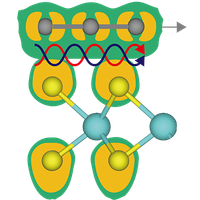
Friction at tiny sliding contacts wastes energy and limits the reliability of microscale devices. We use structurally superlubric contacts between graphite and molybdenum disulfide to strongly suppress lattice vibrations, allowing us to isolate and tune electronic friction in situ by adjusting pressure, gate voltage, and bias across the interface. We find that electronic friction is governed by a moving depletion zone whose reconstruction and relaxation in the semiconductor convert mechanical work into heat. By showing how this friction channel can both exceed and be nearly switched off relative to phononic losses, we demonstrate practical routes to control dissipation in on-device settings. Over the long term, this understanding of electronic friction creates new opportunities for designing durable, energy-efficient micro- and nanosystems.
Article Text
Supplemental Material
References (50)
- E. Rabinowicz, Friction and Wear of Materials, 2nd ed. (Wiley-Interscience, New York, 2008).
- O. Hod, E. Meyer, Q. Zheng, and M. Urbakh, Structural superlubricity and ultralow friction across the length scales, Nature (London) 563, 485 (2018).
- J. Wang, A. Khosravi, A. Vanossi, and E. Tosatti, Colloquium: Sliding and pinning in structurally lubric 2D material interfaces, Rev. Mod. Phys. 96, 011002 (2024).
- T. Li, D. Peng, Y. Wang, G. Li, D. Yang, K. Tian, W. Ouyang, M. Urbakh, and Q. Zheng, Towards zero static friction at the microscale, Phys. Rev. Lett. 133, 236202 (2024).
- Bo N. J. Persson, Sliding Friction: Physical Principles and Applications (Springer Science & Business Media, New York, 2013).
- M. Kisiel, E. Gnecco, U. Gysin, L. Marot, S. Rast, and E. Meyer, Suppression of electronic friction on Nb films in the superconducting state, Nat. Mater. 10, 119 (2011).
- W. Wang, D. Dietzel, and A. Schirmeisen, Single-asperity sliding friction across the superconducting phase transition, Sci. Adv. 6, eaay0165 (2020).
- I. Altfeder and J. Krim, Temperature dependence of nanoscale friction for Fe on YBCO, J. Appl. Phys. 111, 094916 (2012).
- M. Highland and J. Krim, Superconductivity dependent friction of water, nitrogen, and superheated he films adsorbed on Pb(111), Phys. Rev. Lett. 96, 226107 (2006).
- W. He, L. Zhai, C.-Y. Yam, and Z. Xu, Current transients in graphene electronics under single-particle irradiation, Small Sci. 3, 2300011 (2023).
- J. Yang, Z. Liu, F. Grey, Z. Xu, X. Li, Y. Liu, M. Urbakh, Y. Cheng, and Q. Zheng, Observation of high-speed microscale superlubricity in graphite, Phys. Rev. Lett. 110, 255504 (2013).
- D. Peng, Z. Wu, D. Shi, C. Qu, H. Jiang, Y. Song, M. Ma, G. Aeppli, M. Urbakh, and Q. Zheng, Load-induced dynamical transitions at graphene interfaces, Proc. Natl. Acad. Sci. U.S.A. 117, 12618 (2020).
- P. G. Sverdrup, Y. Sungtaek Ju, and Kenneth E. Goodson, Sub-continuum simulations of heat conduction in silicon-on-insulator transistors, J. Heat Transfer 123, 130 (2001).
- S. Arab, M. Yao, C. Zhou, P. Daniel Dapkus, and S. B. Cronin, Doping concentration dependence of the photoluminescence spectra of n-type GaAs nanowires, Appl. Phys. Lett. 108, 182106 (2016).
- X. Huang, Z. Yu, Z. Tan, X. Xiang, Y. Chen, J. Nie, Z. Xu, and Q. Zheng, Tuning electronic friction in structural superlubric Schottky junctions, ACS Nano 18, 32806 (2024).
- N. Kavokine, M.-L. Bocquet, and L. Bocquet, Fluctuation-induced quantum friction in nanoscale water flows, Nature (London) 602, 84 (2022).
- X. Huang, X. Xiang, J. Nie, D. Peng, F. Yang, Z. Wu, H. Jiang, Z. Xu, and Q. Zheng, Microscale Schottky superlubric generator with high direct-current density and ultralong life, Nat. Commun. 12, 2268 (2021).
- See Supplemental Material at http://link.aps.org/supplemental/10.1103/jlc2-qmr1 for additional experimental and simulation details, which includes Refs. [15,16,19–37].
- J. Bian and Z. Xu, Vertical strain engineering of van der Waals heterostructures, Nanotechnology 34, 285701 (2023).
- Z. Yu, X. Huang, J. Bian, Y. He, X. Lu, Q. Zheng, and Z. Xu, On-device pressure-tunable moving Schottky contacts, Nano Lett. 24, 12179 (2024).
- X. Lu, M. Yu, H. Huang, and R. S. Ruoff, Tailoring graphite with the goal of achieving single sheets, Nanotechnology 10, 269 (1999).
- Q. Zheng, B. Jiang, S. Liu, J. Zhu, Q. Jiang, Y. Weng, L. Lu, S. Wang, Q. Xue, and L. Peng, Self-retracting motion of graphite microflakes, Phys. Rev. Lett. 100, 067205 (2008).
- K. Wang, C. Qu, J. Wang, B. Quan, and Q. Zheng, Characterization of a microscale superlubric graphite interface, Phys. Rev. Lett. 125, 026101 (2020).
- J. E. Sader, I. Larson, P. Mulvaney, and L. R. White, Method for the calibration of atomic-force microscope cantilevers, Rev. Sci. Instrum. 66, 3789 (1995).
- J. E. Sader, J. W. M. Chon, and P. Mulvaney, Calibration of rectangular atomic force microscope cantilevers, Rev. Sci. Instrum. 70, 3967 (1999).
- Q. . Li, K. S. Kim, and A. Rydberg, Lateral force calibration of an atomic force microscope with a diamagnetic levitation spring system, Rev. Sci. Instrum. 77, 2209953 (2006).
- A. P. Thompson, H. M. Aktulga, R. Berger, D. S. Bolintineanu, W. M. Brown, P. S. Crozier, P. J. in ’t Veld, A. Kohlmeyer, S. G. Moore, T. D. Nguyen, R. Shan, M. J. Stevens, J. Tranchida, C. Trott, and S. J. Plimpton, LAMMPS: A flexible simulation tool for particle-based materials modeling at the atomic, meso, and continuum scales, Comput. Phys. Commun. 271, 108171 (2022).
- S. Plimpton, Fast parallel algorithms for short-range molecular dynamics, J. Comput. Phys. 117, 1 (1995).
- A. N. Kolmogorov and V. H. Crespi, Registry-dependent interlayer potential for graphitic systems, Phys. Rev. B 71, 235415 (2005).
- D. W. Brenner, O. A Shenderova, J. A. Harrison, S. J. Stuart, B. Ni, and S. B. Sinnott, A second-generation reactive empirical bond order (REBO) potential energy expression for hydrocarbons, J. Phys. Condens. Matter 14, 783 (2002).
- W. Ouyang, R. Sofer, X. Gao, J. Hermann, A. Tkatchenko, L. Kronik, M. Urbakh, and O. Hod, Anisotropic interlayer force field for transition metal dichalcogenides: The case of molybdenum disulfide, J. Chem. Theory Comput. 17, 7237 (2021).
- J.-W. Jiang, Misfit strain-induced buckling for transition-metal dichalcogenide lateral heterostructures: A molecular dynamics study, Acta Mech. Solida Sin. 32, 17 (2019).
- A. Silva, V. E. P. Claerbout, T. Polcar, D. Kramer, and P. Nicolini, Exploring the stability of twisted van der Waals heterostructures, ACS Appl. Mater. Interfaces 12, 45214 (2020).
- A. Castellanos-Gomez, E. Cappelluti, R. Roldán, N. Agraït, F. Guinea, and G. Rubio-Bollinger, Electric-field screening in atomically thin layers of : The role of interlayer coupling, Adv. Mater. 25, 899 (2013).
- L. Rogée, L. Wang, Y. Zhang, S. Cai, P. Wang, M. Chhowalla, W. Ji, and S. Ping Lau, Ferroelectricity in untwisted heterobilayers of transition metal dichalcogenides, Science 376, 973 (2022).
- Y. S. Ang, L. Cao, and L. K. Ang, Physics of electron emission and injection in two-dimensional materials: Theory and simulation, InfoMat 3, 502 (2021).
- T. Pandey, A. P. Nayak, J. Liu, S. T. Moran, J.-S. Kim, L.-J. Li, J.-F. Lin, D. Akinwande, and A. K. Singh, Pressure-induced charge transfer doping of monolayer heterostructure, Small 12, 4063 (2016).
- D. Wickramaratne, L. Weston, and C. G. Van de Walle, Monolayer to bulk properties of hexagonal boron nitride, J. Phys. Chem. C 122, 25524 (2018).
- K. S. Novoselov, E. McCann, S. V. Morozov, V. I. Fal’ko, M. I. Katsnelson, U. Zeitler, D. Jiang, F. Schedin, and A. K. Geim, Unconventional quantum Hall effect and Berry’s phase of in bilayer graphene, Nat. Phys. 2, 177 (2006).
- A. Byungwook, K. Yoonsok, K. Meeree, M. Y. Hyang, A. Jaehun, S. Eunji, J. Hyunjin, Z. G. Hamza, S. K. Keun, I. Kyuwook, L. Hyoyoung, K. K. Eun, and Chu L. Seong, One-step passivation of both sulfur vacancies and interface traps of device, Nano Lett. 23, 7927 (2023).
- M. C. Righi and M. Ferrario, Pressure induced friction collapse of rare gas boundary layers sliding over metal surfaces, Phys. Rev. Lett. 99, 176101 (2007).
- X.-Y. Li, X.-H. Lv, Y.-J. Zhang, Y.-M. Gao, H. Zhang, C.-D. Jin, R.-Q. Lian, R.-N. Wang, P.-L. Gong, X.-Q. Shi et al., Negative differential friction in van der Waals layered materials: The role of interlayer quasibonding repulsion, Phys. Rev. B 109, 075431 (2024).
- Z. Cheng, J. Sun, B. Zhang, Z. Lu, F. Ma, and Q.-C. He, Superlubricity enabled by load-driven redistribution of electrons, Adv. Mater. Interfaces 9, 2101589 (2022).
- B. Silvi and A. Savin, Classification of chemical bonds based on topological analysis of electron localization functions, Nature (London) 371, 683 (1994).
- T. Sun, E. Gao, X. Jia, J. Bian, Z. Wang, M. Ma, Q. Zheng, and Z. Xu, Robust structural superlubricity under gigapascal pressures, Nat. Commun. 15, 5952 (2024).
- Z. Wu, X. Li, D. Peng, and Q. Zheng, Positive-negative tunable coefficients of friction in superlubric contacts, Phys. Rev. Lett. 132, 156201 (2024).
- H. Hu, J. Wang, K. Tian, Q. Zheng, and M. Ma, The effects of disordered edge and vanishing friction in microscale structural superlubric graphite contact, Nat. Commun. 15, 10830 (2024).
- J. Kang, W. Liu, D. Sarkar, D. Jena, and K. Banerjee, Computational study of metal contacts to monolayer transition-metal dichalcogenide semiconductors, Phys. Rev. X 4, 031005 (2014).
- A. I. Volokitin and B. N. J. Persson, Quantum friction, Phys. Rev. Lett. 106, 094502 (2011).
- S. Selberherr, Analysis and Simulation of Semiconductor Devices (Springer-Verlag, New York, 1984).

