

- Open Access
Mechanochemical Nano-Writing of an Atomically Thin Metal
Phys. Rev. X 16, 031029 – Published 6 August, 2026
DOI: https://doi.org/10.1103/g2rj-jt2f
Abstract
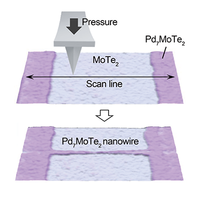
Mechanical energy accelerates many physicochemical processes, including materials syntheses that are hard to produce with thermal energy alone. However, physical understanding connecting applied mechanical forces with internal stresses and ensuing reaction mechanisms is lacking. Here we demonstrate mechanical force-enabled synthesis and nanoscale patterning to metallize a two-dimensional (2D) material, producing an atomically thin superconductor. Localized force applied by atomic force microscope tips to van der Waals (vdW) encapsulated stacks of 2D bilayer and adjacent source Pd guides 2D growth with 50 nm lateral resolution. Force accelerates reaction kinetics exponentially per Eyring’s stress-assisted thermal activation model, reducing synthesis temperatures from to near-room temperature. Finite element simulations, density functional theory, and ab initio grand canonical Monte Carlo calculations show that tip-induced compression facilitates Pd chemisorption to tensile-strained that then converts to uniform . This demonstrates a new, generalizable paradigm for nanoscale synthesis of quantum materials, and high-precision engineering of superconductivity.
Physics Subject Headings (PhySH)
Popular Summary
Creating new materials usually requires getting atoms from the different starting materials to bond with each other. Overcoming the necessary energy barriers often involves increasing temperature, but another method is to apply a force. We used an atomic force microscope (AFM) to synthesize a new compound, , by applying force across an extremely small area nearby a stack of 2D and metallic Pd. The forms only where we pressed on the material stack with an AFM tip, allowing us to write patterns as small as 50 nm ( the width of a human hair), all encapsulated within a 2D stack of van der Waals layered materials. The crystalline , synthesized directly inside a van der Waals stack, conducts electricity like a metal at room temperature (unlike ), and becomes a superconductor at lower temperatures. The distinct material properties and ability to tightly pattern makes it attractive for use in various applications, including for advanced transistors or quantum information devices.
Article Text
Supplemental Material
References (66)
- W. Cao, H. Bu, M. Vinet, M. Cao, S. Takagi, S. Hwang, T. Ghani, and K. Banerjee, The future transistors, Nature (London) 620, 501 (2023).
- Y. Liu, X. Duan, H.-J. Shin, S. Park, Y. Huang, and X. Duan, Promises and prospects of two-dimensional transistors, Nature (London) 591, 43 (2021).
- M. Turunen, M. Brotons-Gisbert, Y. Dai, Y. Wang, E. Scerri, C. Bonato, K. D. Jöns, Z. Sun, and B. D. Gerardot, Quantum photonics with layered 2D materials. Nat. Rev. Phys. 4, 219 (2022).
- P. Nagpal, N. C. Lindquist, S.-H. Oh, and D. J. Norris, Ultrasmooth patterned metals for plasmonics and metamaterials, Science 325, 594 (2009).
- O. Breunig and Y. Ando, Opportunities in topological insulator devices, Nat. Rev. Phys. 4, 184 (2022).
- K. Flensberg, F. von Oppen, and A. Stern, Engineered platforms for topological superconductivity and Majorana zero modes, Nat. Rev. Mater. 6, 944 (2021).
- S. De Franceschi, L. Kouwenhoven, C. Schönenberger, and W. Wernsdorfer, Hybrid superconductor–quantum dot devices, Nat. Nanotechnol. 5, 703 (2010).
- Y. Liu, N. O. Weiss, X. Duan, H.-C. Cheng, Y. Huang, and X. Duan, Van der Waals heterostructures and devices, Nat. Rev. Mater. 1, 16042 (2016).
- F.-F. Zhu, W.-J. Chen, Y. Xu, C.-L. Gao, D.-D. Guan, C.-H. Liu, D. Qian, S.-C. Zhang, and J.-F. Jia, Epitaxial growth of two-dimensional stanene, Nat. Mater. 14, 1020 (2015).
- J. Yuhara, B. He, N. Matsunami, M. Nakatake, and G. Le Lay, Graphene’s Latest Cousin: Plumbene Epitaxial Growth on a “Nano WaterCube”, Adv. Mater. 31, 1901017 (2019).
- T. Zhang, P. Cheng, W.-J. Li, Y.-J. Sun, G. Wang, X.-G. Zhu, K. He, L. Wang, X. Ma, X. Chen, Y. Wang, Y. Liu, H.-Q. Lin, J.-F. Jia, and Q.-K. Xue, Superconductivity in one-atomic-layer metal films grown on Si(111), Nat. Phys. 6, 104 (2010).
- J. Zhao, Q. Deng, A. Bachmatiuk, G. Sandeep, A. Popov, J. Eckert, and M. H. Rümmeli, Free-standing single-atom-thick iron membranes suspended in graphene pores, Science 343, 1228 (2014).
- H. Q. Ta, Q. X. Yang, S. Liu, A. Bachmatiuk, R. G. Mendes, T. Gemming, Y. Liu, L. Liu, K. Tokarska, R. B. Patel, J.-H. Choi, and M. H. Rümmeli, In situ formation of free-standing single-atom-thick antiferromagnetic chromium membranes, Nano Lett. 20, 4354 (2020).
- S. Kashiwaya, Y. Shi, J. Lu, D. G. Sangiovanni, G. Greczynski, M. Magnuson, M. Andersson, J. Rosen, and L. Hultman, Synthesis of goldene comprising single-atom layer gold, Nat. Synth. 3, 744 (2024).
- Y. Jia, F. Yuan, G. Cheng, Y. Tang, G. Yu, T. Song, P. Wang, R. Singha, A. J. Uzan-Narovlansky, M. Onyszczak, K. Watanabe, T. Taniguchi, N. Yao, L. M. Schoop, and S. Wu, Surface-confined two-dimensional mass transport and crystal growth on monolayer materials, Nat. Synth. 3, 386 (2024).
- Y. Jia, G. Yu, T. Song, F. Yuan, A. J. Uzan, Y. Tang, P. Wang, R. Singha, M. Onyszczak, Z. J. Zheng, K. Watanabe, T. Taniguchi, L. M. Schoop, and S. Wu, Superconductivity from on-chip metallization on 2D topological chalcogenides, Phys. Rev. X 14, 021051 (2024).
- Y. Jia, T. Song, Z. J. Zheng, G. Cheng, A. J. Uzan, G. Yu, Y. Tang, C. J. Pollak, F. Yuan, M. Onyszczak, K. Watanabe, T. Taniguchi, S. Lei, N. Yao, L. M. Schoop, N. P. Ong, and S. Wu, Anomalous superconductivity in twisted nanojunctions, Sci. Adv. 11, eadq5712 (2025).
- L. Chen, A. X. Wu, N. Tulu, J. Wang, A. Juanson, K. Watanabe, T. Taniguchi, M. T. Pettes, M. A. Campbell, M. Xu, C. A. Gadre, Y. Zhou, H. Chen, P. Cao, L. A. Jauregui, R. Wu, X. Pan, and J. D. Sanchez-Yamagishi, Exceptional electronic transport and quantum oscillations in thin bismuth crystals grown inside van der Waals materials, Nat. Mater. 23, 741 (2024).
- J. Zhao et al., Realization of 2D metals at the Ångström thickness limit, Nature (London) 639, 354 (2025).
- N. N. Gosvami, J. A. Bares, F. Mangolini, A. R. Konicek, D. G. Yablon, and R. W. Carpick, Mechanisms of antiwear tribofilm growth revealed in situ by single-asperity sliding contacts, Science 348, 102 (2015).
- H. S. Khare, N. N. Gosvami, I. Lahouij, Z. B. Milne, J. B. McClimon, and R. W. Carpick, Nanotribological printing: A nanoscale additive manufacturing method, Nano Lett. 18, 6756 (2018).
- Y. S. Zholdassov, L. Yuan, S. R. Garcia, R. W. Kwok, A. Boscoboinik, D. J. Valles, M. Marianski, A. Martini, R. W. Carpick, and A. B. Braunschweig, Acceleration of Diels-Alder reactions by mechanical distortion, Science 380, 1053 (2023).
- S. Raghuraman, M. B. Elinski, J. D. Batteas, and J. R. Felts, Driving surface chemistry at the nanometer scale using localized heat and stress, Nano Lett. 17, 2111 (2017).
- J. R. Felts, A. J. Oyer, S. C. Hernández, K. E. Whitener Jr, J. T. Robinson, S. G. Walton, and P. E. Sheehan, Direct mechanochemical cleavage of functional groups from grapheme, Nat. Commun. 6, 6467 (2015).
- T. D. B. Jacobs and R. W. Carpick, Nanoscale wear as a stress-assisted chemical reaction, Nat. Nanotechnol. 8, 108 (2013).
- Z. Wei, D. Wang, S. Kim, S.-Y. Kim, Y. Hu, M. K. Yakes, A. R. Laracuente, Z. Dai, S. R. Marder, C. Berger, W. P. King, W. A. de Heer, P. E. Sheehan, and E. Riedo, Nanoscale tunable reduction of graphene oxide for graphene electronics, Science 328, 1373 (2010).
- A. R. Sulkanen, J. Sung, M. J. Robb, J. S. Moore, N. R. Sottos, and G.-y. Liu, Spatially selective and density-controlled activation of interfacial mechanophores, J. Am. Chem. Soc. 141, 4080 (2019).
- S. Song, D. H. Keum, S. Cho, D. Perello, Y. Kim, and Y. H. Lee, Room temperature semiconductor–metal transition of thin films engineered by strain, Nano Lett. 16, 188 (2016).
- A. Dorgham, P. Parsaeian, A. Azam, C. Wang, A. Morina, and A. Neville, Single-asperity study of the reaction kinetics of P-based triboreactive films, Tribol. Int. 133, 288 (2019).
- See Supplemental Material at http://link.aps.org/supplemental/10.1103/g2rj-jt2f for additional experimental and calculation details and supporting figures, which includes Refs. [31–49].
- G. Kresse and J. Hafner, Ab initio molecular dynamics for liquid metals, Phys. Rev. B 47, 558 (1993).
- P. E. Blöchl, Projector augmented-wave method, Phys. Rev. B 50, 17953 (1994).
- G. Kresse and D. Joubert, From ultrasoft pseudopotentials to the projector augmented-wave method, Phys. Rev. B 59, 1758 (1999).
- J. P. Perdew, K. Burke, and M. Ernzerhof, Generalized gradient approximation made simple, Phys. Rev. Lett. 77, 3865 (1996).
- H. J. Monkhorst and J. D. Pack, Special points for Brillouin-zone integrations, Phys. Rev. B 13, 5188 (1976).
- V. r. Lachet, A. Boutin, B. Tavitian, and A. H. Fuchs, Grand canonical Monte Carlo simulations of adsorption of mixtures of xylene molecules in faujasite zeolites, Faraday Discuss. 106, 307 (1997).
- T. P. Senftle, R. J. Meyer, M. J. Janik, and A. C. T. van Duin, Development of a ReaxFF potential for Pd/O and application to palladium oxide formation, J. Chem. Phys. 139 (2013).
- D. Fantauzzi, S. Krick Calderón, J. E. Mueller, M. Grabau, C. Papp, H.-P. Steinrück, T. P. Senftle, A. C. T. van Duin, and T. Jacob, Growth of stable surface oxides on Pt(111) at near-ambient pressures, Angew. Chem., Int. Ed. 56, 2594 (2017).
- J. Madsen and T. Susi, abTEM: A fast and flexible python-based multislice simulation package for transmission electron microscopy, Microsc. Microanal. 29, 680 (2023).
- M. S. Colla, B. Wang, H. Idrissi, D. Schryvers, J. P. Raskin, and T. Pardoen, High strength-ductility of thin nanocrystalline palladium films with nanoscale twins: On-chip testing and grain aggregate model, Acta Mater. 60, 1795 (2012).
- D. Çak𝚤r, F. M. Peeters, and C. Sevik, Mechanical and thermal properties of h-MX2 (, Mo, W; , S, Se, Te) monolayers: A comparative study, Appl. Phys. Lett. 104 (2014).
- A. Bosak, J. Serrano, M. Krisch, K. Watanabe, T. Taniguchi, and H. Kanda, Elasticity of hexagonal boron nitride: Inelastic X-ray scattering measurements, Phys. Rev. B 73, 041402(R) (2006).
- S. Woo, H. C. Park, and Y.-W. Son, Poisson’s ratio in layered two-dimensional crystals, Phys. Rev. B 93, 075420 (2016).
- A. Falin, Q. Cai, E. J. G. Santos, D. Scullion, D. Qian, R. Zhang, Z. Yang, S. Huang, K. Watanabe, T. Taniguchi, M. R. Barnett, Y. Chen, R. S. Ruoff, and L. H. Li, Mechanical properties of atomically thin boron nitride and the role of interlayer interactions, Nat. Commun. 8, 15815 (2017).
- A. S. M. R. Haider, A. F. A. M. Hezam, M. A. Islam, Y. Arafat, M. T. Ferdaous, S. Salehin, and M. R. Karim, Temperature-dependent failure of atomically thin , J. Mol. Model. 30, 86 (2024).
- B. R. Rano, I. M. Syed, and S. H. Naqib, Ab initio approach to the elastic, electronic, and optical properties of topological Weyl semimetal, J. Alloys Compd. 829, 154522 (2020).
- N. K. Nepal, L. Yu, Q. Yan, and A. Ruzsinszky, First-principles study of mechanical and electronic properties of bent monolayer transition metal dichalcogenides, Phys. Rev. Mater. 3, 073601 (2019).
- J. A. Rayne, Elastic constants of Palladium from 4.2-300 K. Phys. Rev. 118, 1545 (1960).
- F. V. Grigoriev, V. B. Sulimov, and A. V. Tikhonravov, Differences in the properties of fused silica and silicon dioxide films: Results of the atomistic simulation, J. Phys. Conf. Ser. 1391, 012022 (2019).
- B. Chen, R. Hoffmann, and R. Cammi, The effect of pressure on organic reactions in fluids—a new theoretical perspective, Angew. Chem., Int. Ed. 56, 11126 (2017).
- J.-L. Do and T. Friščić, Mechanochemistry: A force of synthesis, ACS Cent. Sci. 3, 13 (2017).
- T. D. B. Jacobs, B. Gotsmann, M. A. Lantz, and R. W. Carpick, On the application of transition state theory to atomic-scale wear, Tribol. Lett. 39, 257 (2010).
- H. Spikes, Stress-augmented thermal activation: Tribology feels the force, Friction 6, 1 (2018).
- A. Martini and S. H. Kim, Activation volume in shear-driven chemical reactions, Tribol. Lett. 69, 150 (2021).
- N. Hopper, R. Rana, F. Sidoroff, J. Cayer-Barrioz, D. Mazuyer, and W. T. Tysoe, Activation volumes in tribochemistry; What do they mean and how to calculate them?, Tribol. Lett. 73, 40 (2025).
- R. B. Wexler, T. Qiu, and A. M. Rappe, Automatic prediction of surface phase diagrams using Ab initio grand canonical Monte Carlo, J. Phys. Chem. C 123, 2321 (2019).
- S. Qin, S. Banerjee, M. G. Sensoy, and A. M. Rappe, Unveiling the electrocatalytic hydrogen evolution reaction pathway on RuP2 through Ab initio grand canonical Monte Carlo, ACS Catal. 14, 17253 (2024).
- J. Xu, W. Xie, Y. Han, and P. Hu, Atomistic insights into the oxidation of flat and stepped platinum surfaces using large-scale machine learning potential-based grand-canonical Monte Carlo, ACS Catal. 12, 14812 (2022).
- D. Levy, J. P. Ponpon, A. Grob, J. J. Grob, and P. Siffert, Formation of palladium and titanium silicides by rapid thermal annealing, Physica B+C (Amsterdam) 129, 205 (1985).
- J. Madsen and T. Susi, abTEM: A fast and flexible python-based multislice simulation package for transmission electron microscopy, Microsc. Microanal. 29, 680 (2023).
- K. P. Nuckolls and A. Yazdani, A microscopic perspective on moiré materials, Nat. Rev. Mater. 9, 460 (2024).
- P. Wang, G. Yu, Y. H. Kwan, Y. Jia, S. Lei, S. Klemenz, F. A. Cevallos, R. Singha, T. Devakul, K. Watanabe, T. Taniguchi, S. L. Sondhi, R. J. Cava, L. M. Schoop, S. A. Parameswaran, and S. Wu, One-dimensional Luttinger liquids in a two-dimensional moiré lattice, Nature (London) 605, 57 (2022).
- E. Anderson, F.-R. Fan, J. Cai, W. Holtzmann, T. Taniguchi, K. Watanabe, D. Xiao, W. Yao, and X. Xu, Programming correlated magnetic states with gate-controlled moiré geometry, Science 381, 325 (2023).
- H. Park et al., Observation of fractionally quantized anomalous Hall effect, Nature (London) 622, 74 (2023).
- F. Xu, Z. Sun, T. Jia, C. Liu, C. Xu, C. Li, Y. Gu, K. Watanabe, T. Taniguchi, B. Tong, J. Jia, Z. Shi, S. Jiang, Y. Zhang, X. Liu, and T. Li, Observation of integer and fractional quantum anomalous Hall effects in twisted bilayer , Phys. Rev. X 13, 031037 (2023).
- S. Zhang, Y. Jia, A. Samanta, Y. Bao, H. Guan, Z. J. Zheng, G. Cheng, T. Liu, C. Qu, K. Watanabe, T. Taniguchi, N. Yao, A. Martini, L. Schoop, S. Wu, and R. W. Carpick, Dataset: Mechanochemical nano-writing of an atomically thin metal, https://repository.upenn.edu/handle/20.500.14332/62966 (2026).

