

- Open Access
Time Irreversibility, Entropy Production, and Effective Temperature Are Independently Regulated in the Actin Cortex of Living Cells
Phys. Rev. X 16, 011007 – Published 8 January, 2026
DOI: https://doi.org/10.1103/5zyn-kgs3
Abstract
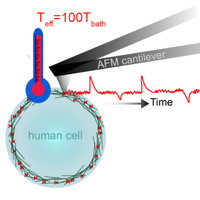
Living cells exhibit nonequilibrium dynamics emergent from the intricate interplay between molecular motor activity and the viscoelastic cytoskeletal matrix. The deviation from thermal equilibrium can be quantified through frequency-dependent effective temperature or time-reversal symmetry breaking quantified, e.g., through the Kullback-Leibler divergence. Here, we investigate the fluctuations of an AFM tip embedded within the active cortex of mitotic human cells with and without perturbations that reduce cortex activity through inhibition of material turnover or motor proteins. While inhibition of motor activity significantly reduces both effective temperature and time irreversibility, inhibited material turnover leaves the effective temperature largely unchanged but lowers the time irreversibility and entropy production rate associated with the fluctuation-dissipation theorem violation of tip dynamics. Our experimental findings in combination with a minimal model highlight that time irreversibility, effective temperature, and entropy production rate can follow opposite trends in active living systems, challenging, in particular, the validity of effective temperature as a proxy for the distance from thermal equilibrium, particularly in the presence of mechanical changes. Furthermore, we propose that biological activity regulates the occurrence of time-asymmetric deflection spikes in the dynamics of observables, providing a previously unrecognized link between entropy production and time irreversibility.
Physics Subject Headings (PhySH)
- Complex systems
- Fluctuation-dissipation theorem
- Irreversible processes
- Living matter & active matter
- Nonequilibrium & irreversible thermodynamics
- Stochastic processes
- Stochastic thermodynamics
- Thermodynamics
- Biological materials
- Cells
- Cytoskeleton
- Nonequilibrium systems
- Atomic force microscopy
- Brownian dynamics
- Langevin equation
- Linear response theory
- Optical microscopy
- Stochastic analysis
- Time series analysis
Popular Summary
Even when a cell is stationary, its interior is busy: Proteins build up and break down in never-ending cycles, and molecular motors pull on internal structures. This ceaseless activity keeps cells far from physical equilibrium, yet measuring just how far has remained a challenge. In this study, we quantify the degree of nonequilibrium behavior in dividing human cells by tracking their minute surface movements using an atomic force microscope. From these fluctuations, we extract three key indicators: entropy production rate (the energy dissipated by the system), effective temperature (the intensity of fluctuations), and time irreversibility (the extent to which behavior differs when time is reversed).
By systematically altering cellular activity, we find that these measures do not always change in unison. When we inhibit molecular motors, all three indicators—entropy production, effective temperature, and time irreversibility—decline together. But when we block the ongoing renewal of cellular components without disrupting motor activity, only entropy production and time irreversibility decrease, while the effective temperature remains high. This discrepancy shows that a system can appear equally noisy in its fluctuations even as its internal dynamics become more or less directional over time. Our analysis further reveals that sharp, spikelike deflections in the motion data play a major role in breaking time symmetry.
These findings suggest that effective temperature alone cannot reliably gauge how far a living system is from equilibrium, especially when its mechanical properties vary. Instead, we propose that time irreversibility provides a more robust indicator of nonequilibrium behavior, particularly in systems with inherently asymmetric dynamics such as biological pulses, repair cycles, or other excitable events.
Article Text
Supplemental Material
References (64)
- L. F. Cugliandolo, The effective temperature, J. Phys. A 44, 483001 (2011).
- G. Geva, T. Admon, M. Levin, and Y. Roichman, Diffusive contact between randomly driven colloidal suspensions, Phys. Rev. Lett. 134, 218201 (2025).
- F. Juelicher, K. Kruse, J. Prost, and J.-F. Joanny, Active behavior of the cytoskeleton, Phys. Rep. 449, 3 (2007).
- L. Dinis, P. Martin, J. Barral, J. Prost, and J. Joanny, Fluctuation-response theorem for the active noisy oscillator of the hair-cell bundle, Phys. Rev. Lett. 109, 160602 (2012).
- D. Mizuno, C. Tardin, C. F. Schmidt, and F. C. MacKintosh, Nonequilibrium mechanics of active cytoskeletal networks, Science 315, 370 (2007).
- S.-W. Wang, Inferring energy dissipation from violation of the fluctuation-dissipation theorem, Phys. Rev. E 97, 052125 (2018).
- É. Roldán, J. Barral, P. Martin, J. M. Parrondo, and F. Jülicher, Quantifying entropy production in active fluctuations of the hair-cell bundle from time irreversibility and uncertainty relations, New J. Phys. 23, 083013 (2021).
- É. Roldán and J. M. Parrondo, Estimating dissipation from single stationary trajectories, Phys. Rev. Lett. 105, 150607 (2010).
- A. Ghosal and G. Bisker, Inferring entropy production rate from partially observed Langevin dynamics under coarse graining, Phys. Chem. Chem. Phys. 24, 24021 (2022).
- J. van der Meer, B. Ertel, and U. Seifert, Thermodynamic inference in partially accessible Markov networks: A unifying perspective from transition-based waiting time distributions, Phys. Rev. X 12, 031025 (2022).
- E. Meyberg, J. Degünther, and U. Seifert, Entropy production from waiting-time distributions for overdamped Langevin dynamics, J. Phys. A 57, 25LT01 (2024).
- J. Degünther, J. van der Meer, and U. Seifert, Fluctuating entropy production on the coarse-grained level: Inference and localization of irreversibility, Phys. Rev. Res. 6, 023175 (2024).
- J. H. Fritz, B. Ertel, and U. Seifert, Entropy estimation for partially accessible Markov networks based on imperfect observations: Role of finite resolution and finite statistics, Phys. Rev. E 111, 044106 (2025).
- E. Ben-Isaac, Y. Park, G. Popescu, F. L. H. Brown, N. S. Gov, and Y. Shokef, Effective temperature of red-blood-cell membrane fluctuations, Phys. Rev. Lett. 106, 238103 (2011).
- P. Bohec, J. Tailleur, F. v. Wijland, A. Richert, and F. Gallet, Distribution of active forces in the cell cortex, Soft Matter 15, 6952 (2019).
- F. Schlosser, F. Rehfeldt, and C. F. Schmidt, Force fluctuations in three-dimensional suspended fibroblasts, Phil. Trans. R. Soc. B 370, 20140028 (2015).
- S. Hurst, B. E. Vos, M. Brandt, and T. Betz, Intracellular softening and increased viscoelastic fluidity during division, Nat. Phys. 17, 1270 (2021).
- I. A. Martínez, G. Bisker, J. M. Horowitz, and J. M. R. Parrondo, Inferring broken detailed balance in the absence of observable currents, Nat. Commun. 10, 3542 (2019).
- P. Martin, A. J. Hudspeth, and F. Jülicher, Comparison of a hair bundle’s spontaneous oscillations with its response to mechanical stimulation reveals the underlying active process, Proc. Natl. Acad. Sci. U.S.A. 98, 14380 (2001).
- T. M. Muenker, G. Knotz, M. Kröger, and T. Betz, Accessing activity and viscoelastic properties of artificial and living systems from passive measurement, Nat. Mater. 23, 1283 (2024).
- E. Fischer-Friedrich, A. A. Hyman, F. Jülicher, D. J. Müller, and J. Helenius, Quantification of surface tension and internal pressure generated by single mitotic cells, Sci. Rep. 4, 6213 (2014).
- P. Chugh, A. G. Clark, M. B. Smith, D. A. D. Cassani, K. Dierkes, A. Ragab, P. P. Roux, G. Charras, G. Salbreux, and E. K. Paluch, Actin cortex architecture regulates cell surface tension, Nat. Cell Biol. 19, 689 (2017).
- N. Khalilgharibi, J. Fouchard, N. Asadipour, R. Barrientos, M. Duda, A. Bonfanti, A. Yonis, A. Harris, P. Mosaffa, Y. Fujita et al., Stress relaxation in epithelial monolayers is controlled by the actomyosin cortex, Nat. Phys. 15, 839 (2019).
- See Supplemental Material at http://link.aps.org/supplemental/10.1103/5zyn-kgs3 for further details and discussions of extended models citing Refs. [25–27].
- D. Villamaina, A. Baldassarri, A. Puglisi, and A. Vulpiani, The fluctuation-dissipation relation: How does one compare correlation functions and responses?, J. Stat. Mech. (2009) P07024.
- L. Jawerth, E. Fischer-Friedrich, S. Saha, J. Wang, T. Franzmann, X. Zhang, J. Sachweh, M. Ruer, M. Ijavi, S. Saha, J. Mahamid, A. A. Hyman, and F. Jülicher, Protein condensates as aging Maxwell fluids, Science 370, 1317 (2020).
- B. Alberts, R. Heald, A. D. Johnson, D. Morgan, and M. Raff, Molecular Biology of the Cell, 7th ed. (W W Norton & Co Inc, New York, 2022).
- E. Ben-Isaac, E. Fodor, P. Visco, F. van Wijland, and N. S. Gov, Modeling the dynamics of a tracer particle in an elastic active gel, Phys. Rev. E 92, 012716 (2015).
- N. Fakhri, A. D. Wessel, C. Willms, M. Pasquali, D. R. Klopfenstein, F. C. MacKintosh, and C. F. Schmidt, High-resolution mapping of intracellular fluctuations using carbon nanotubes, Science 344, 1031 (2014).
- L. Bruno, V. Levi, M. Brunstein, and M. A. Despósito, Transition to superdiffusive behavior in intracellular actin-based transport mediated by molecular motors, Phys. Rev. E 80, 011912 (2009).
- A. Ghosh and N. S. Gov, Dynamics of active semiflexible polymers, Biophys. J. 107, 1065 (2014).
- G. Salbreux, G. Charras, and E. Paluch, Actin cortex mechanics and cellular morphogenesis, Trends Cell Biol. 22, 536 (2012).
- J. Limouze, A. F. Straight, T. Mitchison, and J. R. Sellers, Specificity of blebbistatin, an inhibitor of myosin II., J. Muscle Res. Cell Motil. 25, 337 (2004).
- E. Fischer-Friedrich, Y. Toyoda, C. J. Cattin, D. J. Müller, A. A. Hyman, and F. Jülicher, Rheology of the active cell cortex in mitosis, Biophys. J. 111, 589 (2016).
- H. Turlier, D. A. Fedosov, B. Audoly, T. Auth, N. S. Gov, C. Sykes, J.-F. Joanny, G. Gompper, and T. Betz, Equilibrium physics breakdown reveals the active nature of red blood cell flickering, Nat. Phys. 12, 513 (2016).
- L. D. Landau, Statistical Physics 1 edited by E. M. Lifshitz and L. P. Pitaevskii, 3. ed. (Elsevier Butterworth Heinemann, Amsterdam, 2011), rep. ed.
- G. T. Charras, C.-K. Hu, M. Coughlin, and T. J. Mitchison, Reassembly of contractile actin cortex in cell blebs, J. Cell Biol. 175, 477 (2006).
- M. Fritzsche, A. Lewalle, T. Duke, K. Kruse, and G. Charras, Analysis of turnover dynamics of the submembranous actin cortex, Mol. Biol. Cell 24, 757 (2013).
- V. Ruffine, A. Hartmann, A. Frenzel, M. Schlierf, and E. Fischer-Friedrich, Twofold mechanosensitivity ensures actin cortex reinforcement upon peaks in mechanical tension, Adv. Phys. Res. 2, 2300046 (2023).
- M. Kovács, F. Wang, A. Hu, Y. Zhang, and J. R. Sellers, Functional divergence of human cytoplasmic myosin II: Kinetic characterization of the non-muscle IIA isoform, J. Biol. Chem. 278, 38132 (2003).
- T. Harada and S.-i. Sasa, Equality connecting energy dissipation with a violation of the fluctuation-response relation, Phys. Rev. Lett. 95, 130602 (2005).
- J. M. Deutsch and O. Narayan, Energy dissipation and fluctuation response for particles in fluids, Phys. Rev. E 74, 026112 (2006).
- É. Fodor, W. W. Ahmed, M. Almonacid, M. Bussonnier, N. S. Gov, M.-H. Verlhac, T. Betz, P. Visco, and F. van Wijland, Nonequilibrium dissipation in living oocytes, Europhys. Lett. 116, 30008 (2016).
- É. Roldán and J. M. Parrondo, Entropy production and Kullback-Leibler divergence between stationary trajectories of discrete systems, Phys. Rev. E 85, 031129 (2012).
- B. Al Beattie, P. Feketa, K. Ochs, and H. Kohlstedt, Criticality in FitzHugh-Nagumo oscillator ensembles: Design, robustness, and spatial invariance, Commun. Phys. 7, 46 (2024).
- M. Suzuki and M. E. Larkum, Dendritic calcium spikes are clearly detectable at the cortical surface, Nat. Commun. 8, 276 (2017).
- A. Zhou, X. Liu, and P. Yu, Bifurcation analysis on the effect of store-operated and receptor-operated calcium channels for calcium oscillations in astrocytes, Nonlinear Dyn. 97, 733 (2019).
- J. Hui, M. Nakamura, J. Dubrulle, and S. M. Parkhurst, Coordinated efforts of different actin filament populations are needed for optimal cell wound repair, Mol. Biol. Cell 34, ar15 (2023).
- M. Vicente-Manzanares, X. Ma, R. S. Adelstein, and A. R. Horwitz, Non-muscle myosin II takes centre stage in cell adhesion and migration, Nat. Rev. Mol. Cell Biol. 10, 778 (2009).
- D. Jaeger and R. Jung, Encyclopedia of Computational Neuroscience (Springer, New York, 2022), 10.1007/978-1-0716-1006-0.
- W. W. Ahmed, E. Fodor, M. Almonacid, M. Bussonnier, M.-H. Verlhac, N. Gov, P. Visco, F. van Wijland, and T. Betz, Active mechanics reveal molecular-scale force kinetics in living oocytes, Biophys. J. 114, 1667 (2018).
- J. Prost, F. Jülicher, and J.-F. Joanny, Active gel physics, Nat. Phys. 11, 111 (2015).
- E. Fischer-Friedrich, Active prestress leads to an apparent stiffening of cells through geometrical effects, Biophys. J. 114, 419 (2018).
- G. H. Koenderink, Z. Dogic, F. Nakamura, P. M. Bendix, F. C. MacKintosh, J. H. Hartwig, T. P. Stossel, and D. A. Weitz, An active biopolymer network controlled by molecular motors, Proc. Natl. Acad. Sci. U.S.A. 106, 15192 (2009).
- P. Fernández, P. A. Pullarkat, and A. Ott, A master relation defines the nonlinear viscoelasticity of single fibroblasts, Biophys. J. 90, 3796 (2006).
- D. Humphrey, C. Duggan, D. Saha, D. Smith, and J. Käs, Active fluidization of polymer networks through molecular motors, Nature (London) 416, 413 (2002).
- D. Oriola, R. Alert, and J. Casademunt, Fluidization and active thinning by molecular kinetics in active gels, Phys. Rev. Lett. 118, 088002 (2017).
- A. Mongera, P. Rowghanian, H. J. Gustafson, E. Shelton, D. A. Kealhofer, E. K. Carn, F. Serwane, A. A. Lucio, J. Giammona, and O. Campàs, A fluid-to-solid jamming transition underlies vertebrate body axis elongation, Nature (London) 561, 401 (2018).
- S. Kim, M. Pochitaloff, G. A. Stooke-Vaughan, and O. Campàs, Embryonic tissues as active foams, Nat. Phys. 17, 859 (2021).
- J. Alcaraz, L. Buscemi, M. Grabulosa, X. Trepat, B. Fabry, R. Farré, and D. Navajas, Microrheology of human lung epithelial cells measured by atomic force microscopy, Biophys. J. 84, 2071 (2003).
- J. Rother, H. Nöding, I. Mey, and A. Janshoff, Atomic force microscopy-based microrheology reveals significant differences in the viscoelastic response between malign and benign cell lines, Open Biol. 4, 140046 (2014).
- T. Schneider and A. Neumaier, Algorithm 808: ARfit—A Matlab package for the estimation of parameters and eigenmodes of multivariate autoregressive models, ACM Trans. Math. Softw. 27, 58 (2001).
- T. H. Tan, G. A. Watson, Y.-C. Chao, J. Li, T. R. Gingrich, J. M. Horowitz, and N. Fakhri, Scale-dependent irreversibility in living matter, arXiv:2107.05701.
- Supporting raw data for our findings is available at 10.25532/OPARA-792.

