

- Featured in Physics
- Open Access
Autonomous Stabilization of Remote Entanglement in a Cascaded Quantum Network
Phys. Rev. X 16, 031004 – Published 13 July, 2026
DOI: https://doi.org/10.1103/z6zz-vw5q
Abstract
Remote entanglement between widely separated qubits is a fundamental quantum phenomenon and a critical resource for quantum information applications. Generating entanglement between independent qubits separated by arbitrary, potentially large distances requires propagating quantum states and is typically achieved using pulsed protocols combining distinct steps of local entanglement generation followed by distribution. This necessity raises an intriguing question: Can remote entanglement be stabilized indefinitely, instead of periodically regenerated and redistributed only after decay? Here, we demonstrate that this is indeed possible, reporting autonomous stabilization of entanglement between two separate superconducting-qubit devices. Combining nonreciprocal waveguide coupling and local driving, we experimentally realize a symmetry-based coherent quantum-absorber scheme in a cascaded network. We quantify the degree of entanglement through quantum state tomography, finding that the protocol’s entangling power is severely limited by imperfections that break the required symmetry. We show, however, that a modified protocol based on an alternate symmetry is far more robust, enabling us to achieve a concurrence approaching 0.5, a limit set by only local loss in the network. Our results enable on-demand delivery of high-fidelity entanglement in modular quantum processors and networks and pave the way for autonomously protecting distributed quantum information.
Physics Subject Headings (PhySH)
 Viewpoint

Entanglement Goes Steady
Two independent groups have demonstrated ways to entangle quantum bits without the need for precisely timed control pulses.
See more in Physics
Popular Summary
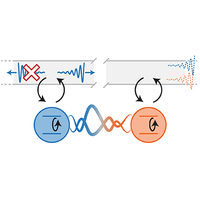
Remote entanglement between widely separated qubits is a fundamental requirement for large-scale quantum networks, but it is typically fragile and requires complex, periodic re-preparation. We demonstrate that remote entanglement can be stabilized by reporting the autonomous stabilization of two independent superconducting qubit devices connected via a unidirectional waveguide. While initial efforts using a standard coherent quantum-absorber scheme were limited by physical imbalances between the devices, we show that a modified protocol based on synthetic squeezing symmetry is far more robust. By matching local drive parameters to compensate for network imperfections, we achieve a steady-state concurrence competitive with traditional pulsed generation methods. These results enable the on-demand delivery of high-fidelity entanglement and provide a practical foundation for autonomously protecting distributed quantum information in modular processors.
See Also
Distributing Stationary Qubit Entanglement through a Nonlocal Squeezed Reservoir
Article Text
References (63)
- A. Einstein, B. Podolsky, and N. Rosen, Can quantum-mechanical description of physical reality be considered complete?, Phys. Rev. 47, 777 (1935).
- A. K. Ekert, Quantum cryptography based on Bell’s theorem, Phys. Rev. Lett. 67, 661 (1991).
- C. H. Bennett, G. Brassard, C. Crépeau, R. Jozsa, A. Peres, and W. K. Wootters, Teleporting an unknown quantum state via dual classical and Einstein-Podolsky-Rosen channels, Phys. Rev. Lett. 70, 1895 (1993).
- D. Gottesman and I. L. Chuang, Demonstrating the viability of universal quantum computation using teleportation and single-qubit operations, Nature (London) 402, 390 (1999).
- B. Julsgaard, A. Kozhekin, and E. S. Polzik, Experimental long-lived entanglement of two macroscopic objects, Nature (London) 413, 400 (2001).
- C. W. Chou, H. De Riedmatten, D. Felinto, S. V. Polyakov, S. J. Van Enk, and H. J. Kimble, Measurement-induced entanglement for excitation stored in remote atomic ensembles, Nature (London) 438, 828 (2005).
- D. L. Moehring, P. Maunz, S. Olmschenk, K. C. Younge, D. N. Matsukevich, L.-M. Duan, and C. Monroe, Entanglement of single-atom quantum bits at a distance, Nature (London) 449, 68 (2007).
- H. Bernien, B. Hensen, W. Pfaff, G. Koolstra, M. S. Blok, L. Robledo, T. H. Taminiau, M. Markham, D. J. Twitchen, L. Childress, and R. Hanson, Heralded entanglement between solid-state qubits separated by three metres, Nature (London) 497, 86 (2013).
- J. Hofmann, M. Krug, N. Ortegel, L. Gérard, M. Weber, W. Rosenfeld, and H. Weinfurter, Heralded entanglement between widely separated atoms, Science 337, 72 (2012).
- N. Roch, M. E. Schwartz, F. Motzoi, C. Macklin, R. Vijay, A. W. Eddins, A. N. Korotkov, K. B. Whaley, M. Sarovar, and I. Siddiqi, Observation of measurement-induced entanglement and quantum trajectories of remote superconducting qubits, Phys. Rev. Lett. 112, 170501 (2014).
- R. Riedinger, A. Wallucks, I. Marinković, C. Löschnauer, M. Aspelmeyer, S. Hong, and S. Gröblacher, Remote quantum entanglement between two micromechanical oscillators, Nature (London) 556, 473 (2018).
- L.-M. Duan, M. D. Lukin, J. I. Cirac, and P. Zoller, Long-distance quantum communication with atomic ensembles and linear optics, Nature (London) 414, 413 (2001).
- J. I. Cirac, P. Zoller, H. J. Kimble, and H. Mabuchi, Quantum state transfer and entanglement distribution among distant nodes in a quantum network, Phys. Rev. Lett. 78, 3221 (1997).
- P. C. Humphreys, N. Kalb, J. P. J. Morits, R. N. Schouten, R. F. L. Vermeulen, D. J. Twitchen, M. Markham, and R. Hanson, Deterministic delivery of remote entanglement on a quantum network, Nature (London) 558, 268 (2018).
- K. S. Chou, J. Z. Blumoff, C. S. Wang, P. C. Reinhold, C. J. Axline, Y. Y. Gao, L. Frunzio, M. H. Devoret, L. Jiang, and R. J. Schoelkopf, Deterministic teleportation of a quantum gate between two logical qubits, Nature (London) 561, 368 (2018).
- J. F. Poyatos, J. I. Cirac, and P. Zoller, Quantum reservoir engineering with laser cooled trapped ions, Phys. Rev. Lett. 77, 4728 (1996).
- Y. Lin, J. P. Gaebler, F. Reiter, T. R. Tan, R. Bowler, A. S. Sørensen, D. Leibfried, and D. J. Wineland, Dissipative production of a maximally entangled steady state of two quantum bits, Nature (London) 504, 415 (2013).
- S. Shankar, M. Hatridge, Z. Leghtas, K. M. Sliwa, A. Narla, U. Vool, S. M. Girvin, L. Frunzio, M. Mirrahimi, and M. H. Devoret, Autonomously stabilized entanglement between two superconducting quantum bits, Nature (London) 504, 419 (2013).
- M. E. Kimchi-Schwartz, L. Martin, E. Flurin, C. Aron, M. Kulkarni, H. E. Tureci, and I. Siddiqi, Stabilizing entanglement via symmetry-selective bath engineering in superconducting qubits, Phys. Rev. Lett. 116, 240503 (2016).
- T. Brown, E. Doucet, D. Ristè, G. Ribeill, K. Cicak, J. Aumentado, R. Simmonds, L. Govia, A. Kamal, and L. Ranzani, Trade off-free entanglement stabilization in a superconducting qutrit-qubit system, Nat. Commun. 13, 3994 (2022).
- P. S. Shah, F. Yang, C. Joshi, and M. Mirhosseini, Stabilizing remote entanglement via waveguide dissipation, PRX Quantum 5, 030346 (2024).
- B. Kraus and J. I. Cirac, Discrete entanglement distribution with squeezed light, Phys. Rev. Lett. 92, 013602 (2004).
- H. Krauter, C. A. Muschik, K. Jensen, W. Wasilewski, J. M. Petersen, J. I. Cirac, and E. S. Polzik, Entanglement generated by dissipation and steady state entanglement of two macroscopic objects, Phys. Rev. Lett. 107, 080503 (2011).
- K. Stannigel, P. Rabl, and P. Zoller, Driven-dissipative preparation of entangled states in cascaded quantum-optical networks, New J. Phys. 14, 063014 (2012).
- H. Pichler, T. Ramos, A. J. Daley, and P. Zoller, Quantum optics of chiral spin networks, Phys. Rev. A 91, 042116 (2015).
- C. W. Gardiner, Driving a quantum system with the output field from another driven quantum system, Phys. Rev. Lett. 70, 2269 (1993).
- H. J. Carmichael, Quantum trajectory theory for cascaded open systems, Phys. Rev. Lett. 70, 2273 (1993).
- S. A. Gunin, A. Y. Dmitriev, A. V. Vasenin, K. S. Tikhonov, G. P. Fedorov, and O. V. Astafiev, Quantum and classical field scattered on a single two-level system, Phys. Rev. A 108, 033723 (2023).
- A. Y. Dmitriev, A. V. Vasenin, S. A. Gunin, S. V. Remizov, A. A. Elistratov, W. V. Pogosov, and O. V. Astafiev, Direct experimental observation of sub-Poissonian photon statistics by means of multiphoton scattering on a two-level system, Phys. Rev. A 111, 043715 (2025).
- A. Irfan, M. Yao, A. Lingenfelter, X. Cao, A. A. Clerk, and W. Pfaff, Loss resilience of driven-dissipative remote entanglement in chiral waveguide quantum electrodynamics, Phys. Rev. Res. 6, 033212 (2024).
- A. Pocklington and A. A. Clerk, Accelerating dissipative state preparation with adaptive open quantum dynamics, Phys. Rev. Lett. 134, 050603 (2025).
- O. Astafiev, A. M. Zagoskin, A. A. Abdumalikov, Yu. A. Pashkin, T. Yamamoto, K. Inomata, Y. Nakamura, and J. S. Tsai, Resonance fluorescence of a single artificial atom, Science 327, 840 (2010).
- A. F. van Loo, A. Fedorov, K. Lalumière, B. C. Sanders, A. Blais, and A. Wallraff, Photon-mediated interactions between distant artificial atoms, Science 342, 1494 (2013).
- C. Axline, M. Reagor, R. Heeres, P. Reinhold, C. Wang, K. Shain, W. Pfaff, Y. Chu, L. Frunzio, and R. J. Schoelkopf, An architecture for integrating planar and 3D cQED devices, Appl. Phys. Lett. 109, 042601 (2016).
- M. Mollenhauer, A. Irfan, X. Cao, S. Mandal, and W. Pfaff, A high-efficiency elementary network of interchangeable superconducting qubit devices, Natl. Electron. Rev. 8, 610 (2025).
- C. J. Axline, L. D. Burkhart, W. Pfaff, M. Zhang, K. Chou, P. Campagne-Ibarcq, P. Reinhold, L. Frunzio, S. M. Girvin, L. Jiang, M. H. Devoret, and R. J. Schoelkopf, On-demand quantum state transfer and entanglement between remote microwave cavity memories, Nat. Phys. 14, 705 (2018).
- P. Campagne-Ibarcq, E. Zalys-Geller, A. Narla, S. Shankar, P. Reinhold, L. Burkhart, C. Axline, W. Pfaff, L. Frunzio, R. J. Schoelkopf, and M. H. Devoret, Deterministic remote entanglement of superconducting circuits through microwave two-photon transitions, Phys. Rev. Lett. 120, 200501 (2018).
- P. Kurpiers, P. Magnard, T. Walter, B. Royer, M. Pechal, J. Heinsoo, Y. Salathé, A. Akin, S. Storz, J.-C. Besse, S. Gasparinetti, A. Blais, and A. Wallraff, Deterministic quantum state transfer and remote entanglement using microwave photons, Nature (London) 558, 264 (2018).
- A. Blais, R.-S. Huang, A. Wallraff, S. M. Girvin, and R. J. Schoelkopf, Cavity quantum electrodynamics for superconducting electrical circuits: An architecture for quantum computation, Phys. Rev. A 69, 062320 (2004).
- T. Walter, P. Kurpiers, S. Gasparinetti, P. Magnard, A. Potočnik, Y. Salathé, M. Pechal, M. Mondal, M. Oppliger, C. Eichler, and A. Wallraff, Rapid high-fidelity single-shot dispersive readout of superconducting qubits, Phys. Rev. Appl. 7, 054020 (2017).
- Y. Sunada, S. Kono, J. Ilves, S. Tamate, T. Sugiyama, Y. Tabuchi, and Y. Nakamura, Fast readout and reset of a superconducting qubit coupled to a resonator with an intrinsic purcell filter, Phys. Rev. Appl. 17, 044016 (2022).
- J. S. Lundeen, A. Feito, H. Coldenstrodt-Ronge, K. L. Pregnell, Ch. Silberhorn, T. C. Ralph, J. Eisert, M. B. Plenio, and I. A. Walmsley, Tomography of quantum detectors, Nat. Phys. 5, 27 (2009).
- D. Roberts, A. Lingenfelter, and A. A. Clerk, Hidden time-reversal symmetry, quantum detailed balance and exact solutions of driven-dissipative quantum systems, PRX Quantum 2, 020336 (2021).
- L. C. G. Govia, A. Lingenfelter, and A. A. Clerk, Stabilizing two-qubit entanglement by mimicking a squeezed environment, Phys. Rev. Res. 4, 023010 (2022).
- A. Andrés-Juanes, J. Agustí, R. Sett, E. S. Redchenko, L. N. Kapoor, S. Hawaldar, P. Rabl, and J. M. Fink, following paper, Distributing Stationary Qubit Entanglement through a Nonlocal Squeezed Reservoir, Phys. Rev. X 16, 031005 (2026).
- A. Lingenfelter, M. Yao, A. Pocklington, Y.-X. Wang, A. Irfan, W. Pfaff, and A. A. Clerk, Exact results for a boundary-driven double spin chain and resource-efficient remote entanglement stabilization, Phys. Rev. X 14, 021028 (2024).
- B. Kannan, A. Almanakly, Y. Sung, A. Di Paolo, D. A. Rower, J. Braumüller, A. Melville, B. M. Niedzielski, A. Karamlou, K. Serniak et al., On-demand directional microwave photon emission using waveguide quantum electrodynamics, Nat. Phys. 19, 394 (2023).
- C. Joshi, F. Yang, and M. Mirhosseini, Resonance fluorescence of a chiral artificial atom, Phys. Rev. X 13, 021039 (2023).
- X. Cao, A. Irfan, M. Mollenhauer, K. Singirikonda, and W. Pfaff, Parametrically controlled chiral interface for superconducting quantum devices, Phys. Rev. Appl. 22, 064023 (2024).
- Karl Gerd H. Vollbrecht, C. A. Muschik, and J. I. Cirac, Entanglement distillation by dissipation and continuous quantum repeaters, Phys. Rev. Lett. 107, 120502 (2011).
- J. Kerckhoff, H. I. Nurdin, D. S. Pavlichin, and H. Mabuchi, Designing quantum memories with embedded control: photonic circuits for autonomous quantum error correction, Phys. Rev. Lett. 105, 040502 (2010).
- A. Irfan, K. Singirikonda, M. Yao, A. Lingenfelter, M. Mollenhauer, X. Cao, A. A. Clerk, and W. Pfaff, Data for Autonomous stabilization of remote entanglement in a cascaded quantum network, Zenodo, 2026, 10.5281/zenodo.19688681.
- S. Krinner, S. Storz, P. Kurpiers, P. Magnard, J. Heinsoo, R. Keller, J. Lütolf, C. Eichler, and A. Wallraff, Engineering cryogenic setups for 100-qubit scale superconducting circuit systems, Eur. Phys. J. Quantum Technol. 6, 2 (2019).
- M. D. Reed, Entanglement and quantum error correction with superconducting qubits, Ph.D. thesis, Yale University, 2013.
- J. Gambetta, W. A. Braff, A. Wallraff, S. M. Girvin, and R. J. Schoelkopf, Protocols for optimal readout of qubits using a continuous quantum nondemolition measurement, Phys. Rev. A 76, 012325 (2007).
- Quantum State Estimation, edited by M. Paris and J. Řeháček, Lecture Notes in Physics Vol. 649 (Springer, Berlin, Heidelberg, 2004).
- J. Z. Blumoff, K. Chou, C. Shen, M. Reagor, C. Axline, R. T. Brierley, M. P. Silveri, C. Wang, B. Vlastakis, S. E. Nigg, L. Frunzio, M. H. Devoret, L. Jiang, S. M. Girvin, and R. J. Schoelkopf, Implementing and characterizing precise multiqubit measurements, Phys. Rev. X 6, 031041 (2016).
- S. Diamond and S. Boyd, cvxpy: A python-embedded modeling language for convex optimization, J. Mach. Learn. Res. 17, 1 (2016), https://www.jmlr.org/papers/volume17/15-408/15-408.pdf.
- D. Willsch et al., Observation of Josephson harmonics in tunnel junctions, Nat. Phys. 20, 815 (2024).
- D. I. Schuster, A. Wallraff, A. Blais, L. Frunzio, R.-S. Huang, J. Majer, S. M. Girvin, and R. J. Schoelkopf, AC Stark shift and dephasing of a superconducting qubit strongly coupled to a cavity field, Phys. Rev. Lett. 94, 123602 (2005).
- J. Combes, J. Kerckhoff, and M. Sarovar, The SLH framework for modeling quantum input-output networks, Adv. Phys. 2, 784 (2017).
- F. Motzoi, E. Halperin, X. Wang, K. B. Whaley, and S. Schirmer, Backaction-driven, robust, steady-state long-distance qubit entanglement over lossy channels, Phys. Rev. A 94, 032313 (2016).
- S. Ganjam, Y. Wang, Y. Lu, A. Banerjee, C. U. Lei, L. Krayzman, K. Kisslinger, C. Zhou, R. Li, Y. Jia, M. Liu, L. Frunzio, and R. J. Schoelkopf, Surpassing millisecond coherence in on chip superconducting quantum memories by optimizing materials and circuit design, Nat. Commun. 15, 3687 (2024).

