

- Open Access
Moving Heterointerface with Robustly High Thermal Conductance
Phys. Rev. X 16, 041005 – Published 5 October, 2026
DOI: https://doi.org/10.1103/yzn5-723b
Abstract
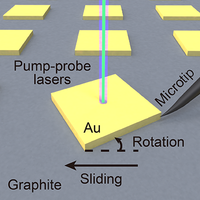
Heat generation and conduction at moving interfaces are ubiquitous and fundamentally important. However, despite decades of progress on thermal transport across static interfaces, insights into moving interfaces remain rare due to the complex and ever-changing nature of most sliding contacts. Here, we take advantage of structural superlubricity and achieve simultaneous mechanical manipulation and thermal measurement of the heterointerface between gold micromesas and single-crystal graphite. We uncover a robustly high thermal conductance which is orders of magnitude higher than that in conventional moving contacts and remarkably insensitive to arbitrary interfacial rotation and thousands of cycles of sliding. In conjunction with atomistic simulations, we reveal the critical role of full atomic contact associated with the interfacial superlubricity and the stacking-insensitive out-of-plane phonon modes that dominate heat transfer. Altogether, our findings highlight diverse superlubric heterointerfaces as a pristine platform for exploring phonon dynamics in moving systems and managing heat in emerging devices including twistronics and slidetronics.
Physics Subject Headings (PhySH)
Popular Summary
Managing thermal transport across dynamic mechanical contacts remains challenging because moving interfaces suffer from microscale surface roughness and material wear that severely throttle heat transfer. We addressed this limitation by leveraging structural superlubricity—a state of vanishing friction and zero wear—between gold micromesas and single-crystalline graphite.
We discovered an exceptionally high interfacial thermal conductance that surpasses conventional sliding contacts by orders of magnitude and remains stable under arbitrary rotation angles or repeated sliding cycles. Our analysis reveals that this thermal stability originates from full atomic-scale contact and out-of-plane lattice vibrations whose phonon coupling is inherently insensitive to interfacial stacking alignment. Our work establishes superlubric heterointerfaces as a robust platform for thermal management in moving microdevices and provides foundational principles for emerging fields such as twistronics and slidetronics.
Article Text
Supplemental Material
References (109)
- G.-Z. Yang, J. Bellingham, P. E. Dupont, P. Fischer, L. Floridi, R. Full, N. Jacobstein, V. Kumar, M. McNutt, R. Merrifield et al., The grand challenges of science robotics, Sci. Rob. 3, eaar7650 (2018).
- P. Rothemund, Y. Kim, R. H. Heisser, X. Zhao, R. F. Shepherd, and C. Keplinger, Shaping the future of robotics through materials innovation, Nat. Mater. 20, 1582 (2021).
- Z. An, X. Yu, C. Wang, Y. Zhang, and C. Song, Embodied intelligence: Recent advances and future perspectives, Innovation Inf. 1, 100008 (2025).
- E. Sevinchan, I. Dincer, and H. Lang, A review on thermal management methods for robots, Appl. Therm. Eng. 140, 799 (2018).
- X. Du, Y. Ye, B. Jiao, Y. Kong, L. Yu, R. Liu, S. Yun, D. Lu, J. Qiao, Z. Liu et al., A flexible thermal management method for high-power chips in humanoid robots, Device 3, 100576 (2025).
- B. C. Rumford, An inquiry concerning the source of the heat which is excited by friction, Phil. Trans. R. Soc. London 88, 80 (1798).
- J. F. Archard, The temperature of rubbing surfaces, Wear 2, 438 (1959).
- R. A. Burton, Heat, Bearings, and Lubrication: Engineering Analysis of Thermally Coupled Shear Flows and Elastic Solid Boundaries (Springer, New York, NY, 2000).
- M. Braunovic, N. K. Myshkin, and V. V. Konchits, Electrical Contacts: Fundamentals, Applications and Technology (CRC Press, Boca Raton, 2017).
- A. Majumdar, Scanning thermal microscopy, Annu. Rev. Mater. Sci. 29, 505 (1999).
- E. Albisetti, A. Calò, A. Zanut, X. Zheng, G. M. de Peppo, and E. Riedo, Thermal scanning probe lithography, Nat. Rev. Methods Primers 2, 32 (2022).
- J. Lang, editor, Multi-Wafer Rotating MEMS Machines: Turbines, Generators, and Engines (Springer, Boston, MA, 2009).
- J. Chen, X. Xu, J. Zhou, and B. Li, Interfacial thermal resistance: Past, present, and future, Rev. Mod. Phys. 94, 025002 (2022).
- W. Ouyang, H. Qin, M. Urbakh, and O. Hod, Controllable thermal conductivity in twisted homogeneous interfaces of graphene and hexagonal boron nitride, Nano Lett. 20, 7513 (2020).
- F. Yang and B. Song, Near-field thermal transport between two identical twisted bilayer graphene sheets separated by a vacuum gap, Phys. Rev. B 103, 235415 (2021).
- Y. Cheng, Z. Fan, T. Zhang, M. Nomura, S. Volz, G. Zhu, B. Li, and S. Xiong, Magic angle in thermal conductivity of twisted bilayer graphene, Mater. Today Phys. 35, 101093 (2023).
- S. E. Kim, F. Mujid, A. Rai, F. Eriksson, J. Suh, P. Poddar, A. Ray, C. Park, E. Fransson, Y. Zhong et al., Extremely anisotropic van der Waals thermal conductors, Nature (London) 597, 660 (2021).
- A. K. Paul, A. Ghosh, S. Chakraborty, U. Roy, R. Dutta, K. Watanabe, T. Taniguchi, A. Panda, A. Agarwala, S. Mukerjee et al., Interaction-driven giant thermopower in magic-angle twisted bilayer graphene, Nat. Phys. 18, 691 (2022).
- F. Yang and B. Song, Strong suppression of near-field thermal transport between twisted bilayer graphene near the magic angle, Mater. Today Phys. 24, 100692 (2022).
- L. Zhang, Y. Zhong, X. Li, J.-H. Park, Q. Song, L. Li, L. Guo, J. Kong, and G. Chen, Effect of twist angle on interfacial thermal transport in two-dimensional bilayers, Nano Lett. 23, 7790 (2023).
- Y. Wang, N. Liang, X. Zhang, W. Yan, H. He, A. Fiorentino, X. Tao, A. Li, F. Yang, B. Li et al., Thermal transport in a 2D amorphous material, Phys. Rev. X 15, 031077 (2025).
- Z. He, A.-A. Sun, and S.-P. Gao, Electron-phonon scattering and stacking sequences in hexagonal boron nitride: An ab initio study, Phys. Rev. B 108, 165108 (2023).
- Y.-M. Zhao, C. Zhang, S. Shin, and L. Shen, Thermal conductivity of sliding bilayer h-BN and its manipulation with strain and layer confinement, J. Mater. Chem. C 11, 11082 (2023).
- S. G. Wang, H. F. Feng, and Z.-X. Guo, Stacking and thickness effects on cross-plane thermal conductivity of hexagonal boron nitride, Comput. Mater. Sci. 228, 112345 (2023).
- F. Yang, W. Zhou, T. Gu, Z. Zhang, K. Zhang, W. Yan, Y. Wang, K. Liu, and B. Song, Thermal transport in rhombohedral boron nitride, Phys. Rev. B 112, 115422 (2025).
- E. T. Swartz and R. O. Pohl, Thermal boundary resistance, Rev. Mod. Phys. 61, 605 (1989).
- M. M. Yovanovich, Four decades of research on thermal contact, gap, and joint resistance in microelectronics, IEEE Trans. Comput. Packag. Technol. 28, 182 (2005).
- R. S. Prasher and P. E. Phelan, Microscopic and macroscopic thermal contact resistances of pressed mechanical contacts, J. Appl. Phys. 100, 063538 (2006).
- C. V. Madhusudana, Thermal Contact Conductance (Springer Science & Business Media, New York, 2013).
- D. Sun, E. You, T. Zhang, J. Xu, X. Wang, X. Ren, and W. Tao, A review of thermal contact conductance research of conforming contact surfaces, Int. Commun. Heat Mass Transf. 159, 108065 (2024).
- O. Hod, E. Meyer, Q. Zheng, and M. Urbakh, Structural superlubricity and ultralow friction across the length scales, Nature (London) 563, 485 (2018).
- Y. Song, D. Mandelli, O. Hod, M. Urbakh, M. Ma, and Q. Zheng, Robust microscale superlubricity in graphite/hexagonal boron nitride layered heterojunctions, Nat. Mater. 17, 894 (2018).
- J. Wang, A. Khosravi, A. Vanossi, and E. Tosatti, Colloquium: Sliding and pinning in structurally lubric 2D material interfaces, Rev. Mod. Phys. 96, 011002 (2024).
- F. Yang, W. Zhou, Z. Zhang, X. Huang, J. Zhang, N. Liang, W. Yan, Y. Wang, M. Ding, Q. Guo et al., Ultrahigh thermal conductance across superlubric interfaces in twisted graphite, Phys. Rev. Lett. 134, 146302 (2025).
- X. Huang, X. Xiang, J. Nie, D. Peng, F. Yang, Z. Wu, H. Jiang, Z. Xu, and Q. Zheng, Microscale Schottky superlubric generator with high direct-current density and ultralong life, Nat. Commun. 12, 2268 (2021).
- T. Wu, W. Chen, L. Wangye, Y. Wang, Z. Wu, M. Ma, and Q. Zheng, Ultrahigh critical current density across sliding electrical contacts in structural superlubric state, Phys. Rev. Lett. 132, 096201 (2024).
- Z. Wu, Y. Wang, T. Wu, Y. Wang, W. Chen, C. Zhou, M. Ma, and Q. Zheng, Wear-free sliding electrical contacts with ultralow electrical resistivity, Proc. Natl. Acad. Sci. U.S.A. 121, e2406800121 (2024).
- X. Huang, X. Xiang, C. Li, J. Nie, Y. Shao, Z. Xu, and Q. Zheng, Electrostatic in-plane structural superlubric actuator, Nat. Commun. 16, 493 (2025).
- A. S. de Wijn, (In)commensurability, scaling, and multiplicity of friction in nanocrystals, and application to gold nanocrystals on graphite, Phys. Rev. B 86, 085429 (2012).
- D. Dietzel, M. Feldmann, U. D. Schwarz, H. Fuchs, and A. Schirmeisen, Scaling laws of structural lubricity, Phys. Rev. Lett. 111, 235502 (2013).
- S. Kawai, A. Benassi, E. Gnecco, H. Söde, R. Pawlak, X. Feng, K. Müllen, D. Passerone, C. A. Pignedoli, P. Ruffieux et al., Superlubricity of graphene nanoribbons on gold surfaces, Science 351, 957 (2016).
- R. Yaniv and E. Koren, Robust superlubricity of gold–graphite heterointerfaces, Adv. Funct. Mater. 30, 1901138 (2020).
- Y. Wang, J. Wang, T. Wu, W. Chen, D. Peng, Z. Wu, M. Ma, and Q. Zheng, The anomalous effect of electric field on friction for microscale structural superlubric graphite/Au contact, Natl. Sci. Rev. 11, nwae019 (2024).
- A. Z. Barabas, I. Sequeira, Y. Yang, A. H. Barajas-Aguilar, T. Taniguchi, K. Watanabe, and J. D. Sanchez-Yamagishi, Mechanically reconfigurable van der Waals devices via low-friction gold sliding, Sci. Adv. 9, eadf9558 (2023).
- Z. Wu, T. Wu, X. Xiang, W. Chen, Y. Wang, D. Yang, D. Tang, Y. Liu, J. An, J. Nie et al., Ultralow resistivity of the graphite/Au van der Waals heterostructure in the structural superlubric state, Nano Lett. 24, 15481 (2024).
- F. Tian, B. Song, X. Chen, N. K. Ravichandran, Y. Lv, K. Chen, S. Sullivan, J. Kim, Y. Zhou, T.-H. Liu et al., Unusual high thermal conductivity in boron arsenide bulk crystals, Science 361, 582 (2018).
- K. Chen, B. Song, N. K. Ravichandran, Q. Zheng, X. Chen, H. Lee, H. Sun, S. Li, G. A. G. Udalamatta Gamage, F. Tian et al., Ultrahigh thermal conductivity in isotope-enriched cubic boron nitride, Science 367, 555 (2020).
- A. J. Schmidt, R. Cheaito, and M. Chiesa, A frequency-domain thermoreflectance method for the characterization of thermal properties, Rev. Sci. Instrum. 80, 094901 (2009).
- Z. Zhang, M. Ding, T. Cheng, R. Qiao, M. Zhao, M. Luo, E. Wang, Y. Sun, S. Zhang, X. Li et al., Continuous epitaxy of single-crystal graphite films by isothermal carbon diffusion through nickel, Nat. Nanotechnol. 17, 1258 (2022).
- See Supplemental Material at http://link.aps.org/supplemental/10.1103/yzn5-723b for sample preparation and characterization, details of experimental measurement, sensitivity and uncertainty analysis, and simulation details, which includes Refs. [51–79].
- J. L. Hutter and J. Bechhoefer, Calibration of atomic-force microscope tips, Rev. Sci. Instrum. 64, 1868 (1993).
- Q. Li, K.-S. Kim, and A. Rydberg, Lateral force calibration of an atomic force microscope with a diamagnetic levitation spring system, Rev. Sci. Instrum. 77, 065105 (2006).
- C. Qu, B. Liu, M. Ma, and Q. Zheng, Design and optimization of the diamagnetic lateral force calibration method, Rev. Sci. Instrum. 89, 113704 (2018).
- M. Goni, M. Patelka, S. Ikeda, T. Sato, and A. J. Schmidt, Frequency domain thermoreflectance technique for measuring the thermal conductivity of individual micro-particles, Rev. Sci. Instrum. 89, 074901 (2018).
- J. Yang, E. Ziade, and A. J. Schmidt, Uncertainty analysis of thermoreflectance measurements, Rev. Sci. Instrum. 87, 014901 (2016).
- A. Jain and A. J. H. McGaughey, Thermal transport by phonons and electrons in aluminum, silver, and gold from first principles, Phys. Rev. B 93, 081206(R) (2016).
- J. L. Hostetler, A. N. Smith, D. M. Czajkowsky, and P. M. Norris, Measurement of the electron-phonon coupling factor dependence on film thickness and grain size in Au, Cr, and Al, Appl. Opt. 38, 3614 (1999).
- Z. Fan, Z. Zeng, C. Zhang, Y. Wang, K. Song, H. Dong, Y. Chen, and T. Ala-Nissila, Neuroevolution machine learning potentials: Combining high accuracy and low cost in atomistic simulations and application to heat transport, Phys. Rev. B 104, 104309 (2021).
- Z. Fan, W. Chen, V. Vierimaa, and A. Harju, Efficient molecular dynamics simulations with many-body potentials on graphics processing units, Comput. Phys. Commun. 218, 10 (2017).
- K. Song, R. Zhao, J. Liu, Y. Wang, E. Lindgren, Y. Wang, S. Chen, K. Xu, T. Liang, P. Ying et al., General-purpose machine-learned potential for 16 elemental metals and their alloys, Nat. Commun. 15, 10208 (2024).
- T. Liang, K. Xu, E. Lindgren, Z. Chen, R. Zhao, J. Liu, E. Berger, B. Tang, B. Zhang, Y. Wang et al., NEP89: Universal neuroevolution potential for inorganic and organic materials across 89 elements, Nat. Comput. Sci. 6, 789 (2026).
- P. E. Blöchl, Projector augmented-wave method, Phys. Rev. B 50, 17953 (1994).
- J. P. Perdew, K. Burke, and M. Ernzerhof, Generalized gradient approximation made simple, Phys. Rev. Lett. 77, 3865 (1996).
- S. Grimme, S. Ehrlich, and L. Goerigk, Effect of the damping function in dispersion corrected density functional theory, J. Comput. Chem. 32, 1456 (2011).
- S. Namsani and J. K. Singh, Enhancement of thermal energy transport across the gold-graphene interface using nanoscale defects: A molecular dynamics study, J. Phys. Chem. C 122, 2113 (2018).
- W. Ouyang, O. Hod, and R. Guerra, Registry-dependent potential for interfaces of gold with graphitic systems, J. Chem. Theory Comput. 17, 7215 (2021).
- R. Mao, B. D. Kong, C. Gong, S. Xu, T. Jayasekera, K. Cho, and K. W. Kim, First-principles calculation of thermal transport in metal/graphene systems, Phys. Rev. B 87, 165410 (2013).
- K. Sääskilahti, J. Oksanen, J. Tulkki, and S. Volz, Role of anharmonic phonon scattering in the spectrally decomposed thermal conductance at planar interfaces, Phys. Rev. B 90, 134312 (2014).
- Z. Fan, H. Dong, A. Harju, and T. Ala-Nissila, Homogeneous nonequilibrium molecular dynamics method for heat transport and spectral decomposition with many-body potentials, Phys. Rev. B 99, 064308 (2019).
- P. Ying, O. Hod, and M. Urbakh, Superlubric graphullerene, Nano Lett. 24, 10599 (2024).
- M. Chang, Z. Yuan, N. Liang, X. Fan, Y. Wang, J. Li, Y. Deng, X.-J. Yan, M.-H. Lu, B. Song et al., Interfacial thermal transport suppression by hydrogen insertion in an epitaxial Al/Si heterostructure, Appl. Phys. Lett. 126, 212201 (2025).
- M. Malakoutian, D. E. Field, N. J. Hines, S. Pasayat, S. Graham, M. Kuball, and S. Chowdhury, Record-low thermal boundary resistance between diamond and GaN-on-SiC for enabling radiofrequency device cooling, ACS Appl. Mater. Interfaces 13, 60553 (2021).
- T. Moussa, B. Garnier, U. Pelay, Y. Favennec, and H. Peerhossaini, Heat transfer at the grinding interface between glass plate and sintered diamond wheel, Int. J. Therm. Sci. 107, 89 (2016).
- M.-B. Cherikh, J.-G. Bauzin, and N. Laraqi, Experimental estimation of transient evolution of three thermal parameters characterizing a dry friction interface, Int. J. Heat Mass Transfer 169, 120986 (2021).
- S. Vaziri, E. Yalon, M. Muñoz Rojo, S. V. Suryavanshi, H. Zhang, C. J. McClellan, C. S. Bailey, K. K. H. Smithe, A. J. Gabourie, V. Chen et al., Ultrahigh thermal isolation across heterogeneously layered two-dimensional materials, Sci. Adv. 5, eaax1325 (2019).
- Y. Liu, Z.-Y. Ong, J. Wu, Y. Zhao, K. Watanabe, T. Taniguchi, D. Chi, G. Zhang, J. T. L. Thong, C.-W. Qiu et al., Thermal conductance of the 2D and graphene/ interfaces, Sci. Rep. 7, 43886 (2017).
- A. Sood, C. Sievers, Y. C. Shin, V. Chen, S. Chen, K. K. H. Smithe, S. Chatterjee, D. Donadio, K. E. Goodson, and E. Pop, Engineering thermal transport across layered graphene- superlattices, ACS Nano 15, 19503 (2021).
- D. B. Brown, T. L. Bougher, X. Zhang, P. M. Ajayan, B. A. Cola, and S. Kumar, Thermal boundary conductance and phonon transmission in hexagonal boron nitride/graphene heterostructures, Phys. Status Solidi (a) 216, 1900446 (2019).
- D. Kim, H. Kim, W. S. Yun, K. Watanabe, T. Taniguchi, H. Rho, and M.-H. Bae, Energy dissipation mechanism revealed by spatially resolved Raman thermometry of graphene/hexagonal boron nitride heterostructure devices, 2D Mater. 5, 025009 (2018).
- C. Lee, Q. Li, W. Kalb, X.-Z. Liu, H. Berger, R. W. Carpick, and J. Hone, Frictional characteristics of atomically thin sheets, Science 328, 76 (2010).
- Y. Zhang, Y. Du, X. Wan, M. An, A. Fan, F. Li, W. Ma, and X. Zhang, Anomalous enhancement of thermal conduction across twisted van der Waals heterointerfaces, Proc. Natl. Acad. Sci. U.S.A. 123, e2531049123 (2026).
- H. Wang, H. Zhu, G. Xue, H. Yang, Q. Guo, Z. Liu, K. Liu, and B. Cao, Asymmetric thermal transport in a trilayer van der Waals heterostructure, Nat. Electron. 9, 747 (2026).
- Q. V. Yu, K. Watanabe, T. Taniguchi, and L. H. Li, Interfacial thermal conductance between atomically thin boron nitride and graphene, Nanoscale 15, 122 (2022).
- C.-C. Chen, Z. Li, L. Shi, and S. B. Cronin, Thermal interface conductance across a graphene/hexagonal boron nitride heterojunction, Appl. Phys. Lett. 104, 081908 (2014).
- W. Yuan, K. Ueji, T. Yagi, T. Endo, H. E. Lim, Y. Miyata, Y. Yomogida, and K. Yanagi, Control of thermal conductance across vertically stacked two-dimensional van der Waals materials via interfacial engineering, ACS Nano 15, 15902 (2021).
- P. Ying, X. Gao, D. Berman, O. Hod, and M. Urbakh, Scaling-up of structural superlubricity: Challenges and opportunities, Adv. Funct. Mater. 35, 2423024 (2025).
- D. Peng, J. Wang, H. Jiang, S. Zhao, Z. Wu, K. Tian, M. Ma, and Q. Zheng, 100 km wear-free sliding achieved by microscale superlubric graphite/DLC heterojunctions under ambient conditions, Natl. Sci. Rev. 9, nwab109 (2022).
- R. Ribeiro-Palau, C. Zhang, K. Watanabe, T. Taniguchi, J. Hone, and C. R. Dean, Twistable electronics with dynamically rotatable heterostructures, Science 361, 690 (2018).
- J. Liu, X. Yang, H. Fang, W. Yan, W. Ouyang, and Z. Liu, In situ twistronics: A new platform based on superlubricity, Adv. Mater. 37, 2305072 (2025).
- Y. Yeo, Y. Sharaby, N. Roy, N. Raab, K. Watanabe, T. Taniguchi, and M. B. Shalom, Polytype switching by super-lubricant van der Waals cavity arrays, Nature (London) 638, 389 (2025).
- N. Roy, P. Ying, S. S. Atri, Y. Sharaby, N. Raab, Y. Yeo, K. Watanable, T. Taniguchi, M. Urbakh, O. Hod et al., Switching graphitic polytypes in elastically coupled cavities, Nat. Nanotechnol. 21, 530 (2026).
- R. J. Stoner and H. J. Maris, Kapitza conductance and heat flow between solids at temperatures from 50 to 300 K, Phys. Rev. B 48, 16373 (1993).
- A. Majumdar and P. Reddy, Role of electron–phonon coupling in thermal conductance of metal–nonmetal interfaces, Appl. Phys. Lett. 84, 4768 (2004).
- B. C. Gundrum, D. G. Cahill, and R. S. Averback, Thermal conductance of metal-metal interfaces, Phys. Rev. B 72, 245426 (2005).
- H. Subramanyan, K. Kim, T. Lu, J. Zhou, and J. Liu, On the importance of using exact full phonon dispersions for predicting interfacial thermal conductance of layered materials using diffuse mismatch model, AIP Adv. 9, 115116 (2019).
- K. Xu, H. Bu, S. Pan, E. Lindgren, Y. Wu, Y. Wang, J. Liu, K. Song, B. Xu, Y. Li et al., GPUMD 4.0: a high-performance molecular dynamics package for versatile materials simulations with machine-learned potentials, Mater. Genome. Eng. Adv. 3, e70028 (2025).
- P. Ying and Z. Fan, Combining the D3 dispersion correction with the neuroevolution machine-learned potential, J. Phys. Condens. Matter 36, 125901 (2023).
- H. Dong, Y. Shi, P. Ying, K. Xu, T. Liang, Y. Wang, Z. Zeng, X. Wu, W. Zhou, S. Xiong et al., Molecular dynamics simulations of heat transport using machine-learned potentials: a mini-review and tutorial on GPUMD with neuroevolution potentials, J. Appl. Phys. 135, 161101 (2024).
- J. V. Barth, H. Brune, G. Ertl, and R. J. Behm, Scanning tunneling microscopy observations on the reconstructed Au(111) surface: Atomic structure, long-range superstructure, rotational domains, and surface defects, Phys. Rev. B 42, 9307 (1990).
- S. Nie, N. C. Bartelt, J. M. Wofford, O. D. Dubon, K. F. McCarty, and K. Thürmer, Scanning tunneling microscopy study of graphene on Au(111): Growth mechanisms and substrate interactions, Phys. Rev. B 85, 205406 (2012).
- J. Tesch, P. Leicht, F. Blumenschein, L. Gragnaniello, M. Fonin, L. E. Marsoner Steinkasserer, B. Paulus, E. Voloshina, and Y. Dedkov, Structural and electronic properties of graphene nanoflakes on Au(111) and Ag(111), Sci. Rep. 6, 23439 (2016).
- P. Li and F. Ding, Origin of the herringbone reconstruction of Au(111) surface at the atomic scale, Sci. Adv. 8, eabq2900 (2022).
- K. Z. Adnan, M. R. Neupane, and T. Feng, Thermal boundary conductance of metal–diamond interfaces predicted by machine learning interatomic potentials, Int. J. Heat Mass Transfer 235, 126227 (2024).
- Z. Li, S. Xiong, C. Sievers, Y. Hu, Z. Fan, N. Wei, H. Bao, S. Chen, D. Donadio, and T. Ala-Nissila, Influence of thermostatting on nonequilibrium molecular dynamics simulations of heat conduction in solids, J. Chem. Phys. 151, 234105 (2019).
- A. J. Gabourie, Z. Fan, T. Ala-Nissila, and E. Pop, Spectral decomposition of thermal conductivity: Comparing velocity decomposition methods in homogeneous molecular dynamics simulations, Phys. Rev. B 103, 205421 (2021).
- W. Zhou, N. Liang, W. Xiao, Z. Tong, F. Tian, and B. Song, Ultrahigh interfacial thermal conductance for cooling gallium oxide electronics using cubic boron arsenide, Phys. Rev. Appl. 24, L031005 (2025).
- T. Liang, W. Jiang, K. Xu, H. Bu, Z. Fan, W. Ouyang, and J. Xu, PYSED: A tool for extracting kinetic-energy-weighted phonon dispersion and lifetime from molecular dynamics simulations, J. Appl. Phys. 138, 075101 (2025).
- R. Li, X. Yang, J. Li, Y. Wang, and M. Ma, Macroscale, humidity-insensitive, and stable structural superlubricity achieved with hydrogen-free graphene nanoflakes, Nat. Commun. 15, 9197 (2024).
- M. Han, D. Peng, D. Yang, J. Wang, Y. Zheng, G. Hu, M. Qi, Y. Shao, J. Li, F. Ding et al., Observation of robust macroscale structural superlubricity, Phys. Rev. Lett. 136, 076201 (2026).

