

- Featured in Physics
- Open Access
Particle Sweeping and Collection by Active and Living Filaments
Phys. Rev. X 16, 011003 – Published 5 January, 2026
DOI: https://doi.org/10.1103/yxp1-t43g
Abstract
Biological and robotic systems often operate in confined environments where materials must be gathered without centralized control. Inspired by the effective collection strategies of aquatic worms (Lumbriculus variegatus and Tubifex tubifex), we investigate how active filaments autonomously aggregate dispersed non-Brownian passive particles. We study this process across four platforms: living worms, a robotic chain, Brownian dynamics simulations of active polymers, and a coarse-grained toy model. We show that aggregation emerges from repeated contact and body deformation—effectively, a sweeping or brooming motion—and demonstrate that clustering dynamics are governed by filament length and bending stiffness. Across systems, particle gathering follows a shared aggregation-fragmentation process, where the steady-state cluster size approximately follows a quadratic increase with the effective width of the path cleared by the filament relative to the domain size . This scaling provides a minimal geometric baseline for comparison across active filamentous systems. We find that filament flexibility modulates , enabling more flexible filaments to sweep larger areas and collect more particles. These results establish a unifying framework for understanding how shape and flexibility influence transport and organization in active filament systems and filamentous robots.
Physics Subject Headings (PhySH)
 Viewpoint

Worm-Inspired Active Filaments Sweep Disorder into Order
The ability of single active filaments to cluster smaller particles could inspire new materials for building soft robots that perform biological functions.
See more in Physics
Popular Summary
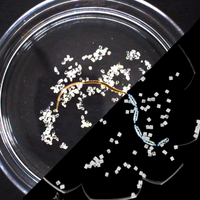
Many living systems can gather scattered particles without external control, yet how they do so remains unclear. We investigate this self-organized aggregation using active filaments—flexible, moving filaments—that interact with passive particles. Across living, robotic, and simulated systems, we find that particle gathering happens through repeated contact and body bending, which sweep particles together much like a broom. The resulting cluster size depends mainly on the filament’s length and flexibility, revealing a simple geometric rule that connects all these systems.
To uncover this rule, we study three kinds of active filaments: living worms, a meter-scale robotic chain, and computer simulations. In confined circular arenas, we track how a single filament sweeps passive particles along its path, driving cycles of gathering and breakup until a steady pattern forms. By systematically varying filament flexibility and length, we find that longer and more flexible filaments collect larger clusters. Despite their differences in scale and composition, all three systems follow the same overall trend, showing that a common physical mechanism underlies the aggregation process.
This unified framework shows that the geometry of a filament’s motion controls how efficiently it can gather surrounding particles. Understanding this relationship not only clarifies how organisms such as aquatic worms reshape their environments but also points the way toward new designs in soft robotics. By tuning flexibility or body shape, engineers could create robotic systems that autonomously collect, organize, or manipulate materials in complex environments.
Article Text
Supplemental Material
References (79)
- A. Deblais, K. R. Prathyusha, R. Sinaasappel, H. Tuazon, I. Tiwari, V. P. Patil, and M. S. Bhamla, Worm blobs as entangled living polymers: From topological active matter to flexible soft robot collectives, Soft Matter 19, 7057 (2023).
- R. G. Winkler and G. Gompper, The physics of active polymers and filaments, J. Chem. Phys. 153 (2020).
- S. Ganguly, L. S. Williams, I. M. Palacios, and R. E. Goldstein, Cytoplasmic streaming in Drosophila oocytes varies with kinesin activity and correlates with the microtubule cytoskeleton architecture, Proc. Natl. Acad. Sci. U.S.A. 109, 15109 (2012).
- F. Nédélec, T. Surrey, A. C. Maggs, and S. Leibler, Self-organization of microtubules and motors, Nature (London) 389, 305 (1997).
- Y. Sumino, K. H. Nagai, Y. Shitaka, D. Tanaka, K. Yoshikawa, H. Chaté, and K. Oiwa, Large-scale vortex lattice emerging from collectively moving microtubules, Nature (London) 483, 448 (2012).
- L. Le Goff, F. Amblard, and E. M. Furs, Motor-driven dynamics in actin-myosin networks, Phys. Rev. Lett. 88, 018101 (2001).
- T. Sanchez, D. T. Chen, S. J. DeCamp, M. Heymann, and Z. Dogic, Spontaneous motion in hierarchically assembled active matter, Nature (London) 491, 431 (2012).
- I. Kirchenbuechler, D. Guu, N. A. Kurniawan, G. H. Koenderink, and M. P. Lettinga, Direct visualization of flow-induced conformational transitions of single actin filaments in entangled solutions, Nat. Commun. 5, 5060 (2014).
- M. A. Sleigh, The Biology of Cilia and Flagella (Macmillan, New York, 1962).
- A. S. Shah, Y. Ben-Shahar, T. O. Moninger, J. N. Kline, and M. J. Welsh, Motile cilia of human airway epithelia are chemosensory, Science 325, 1131 (2009).
- S. L. Bardy, S. Y. Ng, and K. F. Jarrell, Prokaryotic motility structures, Microbiology 149, 295 (2003).
- C. I. Mayfield and W. E. Inniss, A rapid, simple method for staining bacterial flagella, Can. J. Microbiol. 23, 1311 (1977).
- B. M. Friedrich, I. H. Riedel-Kruse, J. Howard, and F. Jülicher, High-precision tracking of sperm swimming fine structure provides strong test of resistive force theory, J. Exp. Biol. 213, 1226 (2010).
- V. P. Patil, H. Tuazon, E. Kaufman, T. Chakrabortty, D. Qin, J. Dunkel, and M. S. Bhamla, Ultrafast reversible self-assembly of living tangled matter, Science 380, 392 (2023).
- J. Gray, The mechanism of locomotion in snakes, J. Exp. Biol. 23, 101 (1946).
- C. Hernández-López, P. Baconnier, C. Coulais, O. Dauchot, and G. Düring, Model of active solids: Rigid body motion and shape-changing mechanisms, Phys. Rev. Lett. 132, 238303 (2024).
- E. Zheng, M. Brandenbourger, L. Robinet, P. Schall, E. Lerner, and C. Coulais, Self-oscillation and synchronization transitions in elastoactive structures, Phys. Rev. Lett. 130, 178202 (2023).
- Y. Xi, T. Marzin, R. B. Huang, T. J. Jones, and P.-T. Brun, Emergent behaviors of buckling-driven elasto-active structures, Proc. Natl. Acad. Sci. U.S.A. 121, e2410654121 (2024).
- H. Tuazon, C. Nguyen, E. Kaufman, I. Tiwari, J. Bermudez, D. Chudasama, O. Peleg, and M. Bhamla, Collecting–gathering biophysics of the blackworm lumbriculus variegatus, Integr. Comp. Biol. 63, 1474 (2023).
- K. W. Cummins and M. J. Klug, Feeding ecology of stream invertebrates, Annu. Rev. Ecol. Evol. Syst. 10, 147 (1979).
- B. P. Ilyashuk, Littoral oligochaete (annelida: Oligochaeta) communities in neutral and acidic lakes in the Republic of Karelia, Russia, Boreal Env. Res. 4, 277 (1999).
- D. G. Cook, Observations on the life history and ecology of some lumbriculidae (annelida, oligochaeta), Hydrobiologia 34, 561 (1969).
- R. S. Wotton, The Biology of Particles in Aquatic Systems (CRC Press, Boca Raton, 1994).
- E. Kristensen, G. Penha-Lopes, M. Delefosse, T. Valdemarsen, C. O. Quintana, and G. T. Banta, What is bioturbation? The need for a precise definition for fauna in aquatic sciences, Mar. Ecol. Prog. Ser. 446, 285 (2012).
- K. R. Roche, A. F. Aubeneau, M. Xie, T. Aquino, D. Bolster, and A. I. Packman, An integrated experimental and modeling approach to predict sediment mixing from benthic burrowing behavior, Environ. Sci. Technol. 50, 10047 (2016).
- S. Gokhale, J. Li, A. Solon, J. Gore, and N. Fakhri, Dynamic clustering of passive colloids in dense suspensions of motile bacteria, Phys. Rev. E 105, 054605 (2022).
- P. Dolai, A. Simha, and S. Mishra, Phase separation in binary mixtures of active and passive particles, Soft Matter 14, 6137 (2018).
- J. Stenhammar, R. Wittkowski, D. Marenduzzo, and M. E. Cates, Activity-induced phase separation and self-assembly in mixtures of active and passive particles, Phys. Rev. Lett. 114, 018301 (2015).
- S. R. McCandlish, A. Baskaran, and M. F. Hagan, Spontaneous segregation of self-propelled particles with different motilities, Soft Matter 8, 2527 (2012).
- A. W. Visser, Biomixing of the oceans?, Science 316, 838 (2007).
- K. R. Prathyusha, Passive particle transport using a transversely propelling polymer “sweeper”, Soft Matter 19, 4001 (2023).
- B. Zhang, T. Lei, and N. Zhao, Comparative study of polymer looping kinetics in passive and active environments, Phys. Chem. Chem. Phys. 23, 12171 (2021).
- J. Smrek and K. Kremer, Small activity differences drive phase separation in active-passive polymer mixtures, Phys. Rev. Lett. 118, 098002 (2017).
- A. Deblais, T. Barois, T. Guerin, P.-H. Delville, R. Vaudaine, J. S. Lintuvuori, J.-F. Boudet, J.-C. Baret, and H. Kellay, Boundaries control collective dynamics of inertial self-propelled robots, Phys. Rev. Lett. 120, 188002 (2018).
- K. R. Prathyusha, S. Henkes, and R. Sknepnek, Dynamically generated patterns in dense suspensions of active filaments, Phys. Rev. E 97, 022606 (2018).
- R. E. Isele-Holder, J. Elgeti, and G. Gompper, Self-propelled worm-like filaments: Spontaneous spiral formation, structure, and dynamics, Soft Matter 11, 7181 (2015).
- M. Fazelzadeh, Q. Di, E. Irani, Z. Mokhtari, and S. Jabbari-Farouji, Active motion of tangentially driven polymers in periodic array of obstacles, J. Chem. Phys. 159, 224903 (2023).
- Y. Ozkan-Aydin, D. I. Goldman, and M. S. Bhamla, Collective dynamics in entangled worm and robot blobs, Proc. Natl. Acad. Sci. U.S.A. 118, e2010542118 (2021).
- See Supplemental Material at http://link.aps.org/supplemental/10.1103/yxp1-t43g for more details on the experimental methods, setup, simulations, and Supplemental Videos. It includes Refs. [1,17,19,40–47].
- V. Smoluchowski and I. D. im unbegrenzten Raum, Zusammenfassende bearbeitungen, Ann. Phys. (N.Y.) 21, 756 (1906).
- A. Deblais, S. Woutersen, and D. Bonn, Rheology of entangled active polymer-like T. Tubifex worms, Phys. Rev. Lett. 124, 188002 (2020).
- A. Deblais, A. C. Maggs, D. Bonn, and S. Woutersen, Phase separation by entanglement of active polymerlike worms, Phys. Rev. Lett. 124, 208006 (2020).
- T. Heeremans, A. Deblais, D. Bonn, and S. Woutersen, Chromatographic separation of active polymer like worm mixtures by contour length and activity, Sci. Adv. 8, eabj7918 (2022).
- H. Tuazon, E. Kaufman, D. I. Goldman, and M. Bhamla, Oxygenation-controlled collective dynamics in aquatic worm blobs, Integr. Comp. Biol. 62, 890 (2022).
- H. Tuazon, S. David, K. Ma, and S. Bhamla, Leeches predate on fast-escaping and entangling blackworms by spiral entombment, Integr. Comp. Biol. 64, 1408 (2024).
- J. D. Weeks, D. Chandler, and H. C. Andersen, Role of repulsive forces in determining the equilibrium structure of simple liquids, J. Chem. Phys. 54, 5237 (1971).
- K. Kremer and G. S. Grest, Dynamics of entangled linear polymer melts: A molecular-dynamics simulation, J. Chem. Phys. 92, 5057 (1990).
- F. Ginot, I. Theurkauff, F. Detcheverry, C. Ybert, and C. Cottin-Bizonne, Aggregation-fragmentation and individual dynamics of active clusters, Nat. Commun. 9, 696 (2018).
- G. S. Redner, C. G. Wagner, A. Baskaran, and M. F. Hagan, Classical nucleation theory description of active colloid assembly, Phys. Rev. Lett. 117, 148002 (2016).
- J. Martín-Roca, E. Locatelli, V. Bianco, P. Malgaretti, and C. Valeriani, Tangentially active polymers in cylindrical channels, SciPost Phys. 17, 107 (2024).
- R. Sinaasappel, M. Fazelzadeh, T. Hooijschuur, Q. Di, S. Jabbari-Farouji, and A. Deblais, Locomotion of active polymerlike worms in porous media, Phys. Rev. Lett. 134, 128303 (2025).
- J. Deseigne, O. Dauchot, and H. Chaté, Collective motion of vibrated polar disks, Phys. Rev. Lett. 105, 098001 (2010).
- J. Deseigne, S. Léonard, O. Dauchot, and H. Chaté, Vibrated polar disks: Spontaneous motion, binary collisions, and collective dynamics, Soft Matter 8, 5629 (2012).
- G. A. Patterson, P. I. Fierens, F. Sangiuliano Jimka, P. G. König, Á. Garcimartín, I. Zuriguel, L. A. Pugnaloni, and D. R. Parisi, Clogging transition of vibration-driven vehicles passing through constrictions, Phys. Rev. Lett. 119, 248301 (2017).
- O. Dauchot and V. Démery, Dynamics of a self-propelled particle in a harmonic trap, Phys. Rev. Lett. 122, 068002 (2019).
- P. L. Krapivsky, S. Redner, and E. Ben-Naim, A Kinetic View of Statistical Physics (Cambridge University Press, Cambridge, England, 2010).
- R. M. Ziff, Kinetics of polymerization, J. Stat. Phys. 23, 241 (1980).
- J. Bouvard, F. Moisy, and H. Auradou, Ostwald-like ripening in the two-dimensional clustering of passive particles induced by swimming bacteria, Phys. Rev. E 107, 044607 (2023).
- https://github.com/deb-lab/Supplementary-Movies-collecting.
- C. Darwin, The Formation of Vegetable Mould through the Action of Worms (D. Appleton, London, 1898), Vol. 16.
- B. Seleb, A. Chatterjee, and S. Bhamla, Moving mountains: Grazing agents drive terracette formation on steep hillslopes, arXiv:2504.17496.
- J.-C. Menaut and B. Walker, Banded Vegetation Patterning in Arid and Semiarid Environments: Ecological Processes and Consequences for Management (Springer Science & Business Media, New York, 2001), Vol. 149.
- M. Louw, P. Le Roux, E. Meyer-Milne, and N. Haussmann, Mammal burrowing in discrete landscape patches further increases soil and vegetation heterogeneity in an arid environment, J. Arid Environ. 141, 68 (2017).
- R. M. Pringle and C. E. Tarnita, Spatial self-organization of ecosystems: Integrating multiple mechanisms of regular-pattern formation, Annu. Rev. Entomol. 62, 359 (2017).
- A. Kudrolli and B. Ramirez, Burrowing dynamics of aquatic worms in soft sediments, Proc. Natl. Acad. Sci. U.S.A. 116, 25569 (2019).
- S. Grill and K. M. Dorgan, Burrowing by small polychaetes–mechanics, behavior and muscle structure of capitella sp., J. Exp. Biol. 218, 1527 (2015).
- H. Marvi, C. Gong, N. Gravish, H. Astley, M. Travers, R. L. Hatton, J. R. Mendelson III, H. Choset, D. L. Hu, and D. I. Goldman, Sidewinding with minimal slip: Snake and robot ascent of sandy slopes, Science 346, 224 (2014).
- G. Juarez, K. Lu, J. Sznitman, and P. E. Arratia, Motility of small nematodes in wet granular media, Euro. Phys. Lett. 92, 44002 (2010).
- M. C. Pedersen, S. Mukherjee, A. Doostmohammadi, C. Mondal, and K. Thijssen, Active particles knead three-dimensional gels into porous structures, Phys. Rev. Lett. 133, 228301 (2024).
- D. Grober, I. Palaia, M. C. Uçar, E. Hannezo, A. Šarić, and J. Palacci, Unconventional colloidal aggregation in chiral bacterial baths, Nat. Phys. 19, 1680 (2023).
- M. S. Peterson, A. Baskaran, and M. F. Hagan, Vesicle shape transformations driven by confined active filaments, Nat. Commun. 12, 7247 (2021).
- K. R. Prathyusha, F. Ziebert, and R. Golestanian, Emergent conformational properties of end-tailored transversely propelling polymers, Soft Matter 18, 2928 (2022).
- L. Theeyancheri, S. Chaki, T. Bhattacharjee, and R. Chakrabarti, Migration of active rings in porous media, Phys. Rev. E 106, 014504 (2022).
- H. Wen, Y. Zhu, C. Peng, P. S. Kumar, and M. Laradji, Collective motion of cells modeled as ring polymers, Soft Matter 18, 1228 (2022).
- Z. Mokhtari and A. Zippelius, Dynamics of active filaments in porous media, Phys. Rev. Lett. 123, 028001 (2019).
- C. Kurzthaler, S. Mandal, T. Bhattacharjee, H. Löwen, S. S. Datta, and H. A. Stone, A geometric criterion for the optimal spreading of active polymers in porous media, Nat. Commun. 12, 7088 (2021).
- L. Theeyancheri, S. Chaki, T. Bhattacharjee, and R. Chakrabarti, Active dynamics of linear chains and rings in porous media, J. Chem. Phys. 159, 014902 (2023).
- J.-F. Boudet, J. Lintuvuori, C. Lacouture, T. Barois, A. Deblais, K. Xie, S. Cassagnere, B. Tregon, D. B. Brückner, J.-C. Baret et al., From collections of independent, mindless robots to flexible, mobile, and directional superstructures, Sci. Rob. 6, eabd0272 (2021).
- J. Veenstra, C. Scheibner, M. Brandenbourger, J. Binysh, A. Souslov, V. Vitelli, and C. Coulais, Adaptive locomotion of active solids, Nature (London) 639, 935 (2025).

