

- Open Access
Anderson Localization: A Density Matrix Approach
Phys. Rev. X 16, 011043 – Published 2 March, 2026
DOI: https://doi.org/10.1103/y5kd-7prs
Abstract
Anderson localization is a quantum phenomenon in which disorder localizes electronic wave functions. In this work, we propose a new approach to study Anderson localization based on the density matrix formalism. Drawing an analogy to the standard transfer matrix method, we extract the localization length from the modular density matrix in quasi-one-dimensional systems. This approach successfully captures the metal-insulator transition in the three-dimensional Anderson model and in the two-dimensional Anderson model with spin-orbit coupling. It can be also readily extended to multi-orbital systems. We further generalize the formalism to interacting systems, showing that the one-dimensional spinless attractive model exhibits the expected metallic phase, consistent with previous studies. More importantly, we demonstrate the existence of a two-dimensional metallic tendency in the presence of Hubbard interactions and disorder. This method offers a new perspective on Anderson localization and its interplay with interactions.
Physics Subject Headings (PhySH)
Popular Summary
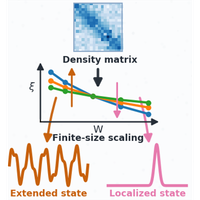
Distinguishing between metallic and insulating behavior in the presence of both disorder and electronic interactions remains a significant challenge because the standard criteria for Anderson localization are often difficult to apply to many-body systems. We addressed this by developing a framework to extract the localization length directly from the one-body density matrix, a fundamental object in quantum mechanics. Combined with finite-size scaling, our approach identifies metal-insulator transitions across different dimensions and naturally extends to interacting systems by using many-body ground-state wave functions. We used this method to show how attractive interactions can promote metallic behavior in disordered one-dimensional systems and to recover a metallic tendency in disordered two-dimensional Hubbard models. These findings establish the density matrix as a versatile tool for characterizing the localization properties of complex quantum matter. Our work offers a practical path for investigating the interplay between disorder and interactions in a wide variety of strongly correlated materials.
Article Text
References (121)
- D. J. Thouless, Electrons in disordered systems and the theory of localization, Phys. Rep. 13, 93 (1974).
- Patrick A. Lee and T. V. Ramakrishnan, Disordered electronic systems, Rev. Mod. Phys. 57, 287 (1985).
- B. L. Altshuler and A. G. Aronov, Electron-Electron Interactions in Disordered Systems, edited by A. L. Efros and M. Pollak (North Holland, Amsterdam, 1985), Vol. 1, p. 155.
- B. Kramer and A. MacKinnon, Localization: Theory and experiment, Rep. Prog. Phys. 56, 1469 (1993).
- Elihu Abrahams, 50 years of Anderson Localization (World Scientific, Singapore, 2010).
- P. W. Anderson, Absence of diffusion in certain random lattices, Phys. Rev. 109, 1492 (1958).
- E. Abrahams, P. W. Anderson, D. C. Licciardello, and T. V. Ramakrishnan, Scaling theory of localization: Absence of quantum diffusion in two dimensions, Phys. Rev. Lett. 42, 673 (1979).
- D. C. Licciardello and D. J. Thouless, Constancy of minimum metallic conductivity in two dimensions, Phys. Rev. Lett. 35, 1475 (1975).
- Franz J. Wegner, Electrons in disordered systems. scaling near the mobility edge, Z. Phys. B Condens. Matter 25, 327 (1976).
- H. G. Schuster, On a relation between the mobility edge problem and an isotropicxy model, Z. Phys. B Condens. Matter 31, 99 (1978).
- B. L. Altshuler and A. G. Aronov, Zero bias anomaly in tunnel resistance and electron-electron interaction, Solid State Commun. 30, 115 (1979).
- Boris L. Altshuler and Andrey Aronov, Contribution to the theory of disordered metals in strongly doped semiconductors, J. Exp. Theor. Phys. (1979), https://www.semanticscholar.org/paper/Contribution-to-the-theory-of-disordered-metals-in-Altshuler-Aronov/86ee0dfe43c40cc19e904348c6858f0d88c632a4.
- B. L. Altshuler, A. G. Aronov, and P. A. Lee, Interaction effects in disordered Fermi systems in two dimensions, Phys. Rev. Lett. 44, 1288 (1980).
- A. MacKinnon and B. Kramer, One-parameter scaling of localization length and conductance in disordered systems, Phys. Rev. Lett. 47, 1546 (1981).
- Paul Soven, Coherent-potential model of substitutional disordered alloys, Phys. Rev. 156, 809 (1967).
- V. Dobrosavljević, A. A. Pastor, and B. K. Nikolić, Typical medium theory of Anderson localization: A local order parameter approach to strong-disorder effects, Europhys. Lett. 62, 76 (2003).
- Hanna Terletska, Yi Zhang, Ka-Ming Tam, Tom Berlijn, Liviu Chioncel, N. S. Vidhyadhiraja, and Mark Jarrell, Systematic quantum cluster typical medium method for the study of localization in strongly disordered electronic systems, Appl. Sci. 8, 2401 (2018).
- Konstantin Efetov, Supersymmetry in Disorder and Chaos (Cambridge University Press, Cambridge, England, 1999).
- A. M. Finkel’shtein, Influence of Coulomb interaction on the properties of disordered metals, Sov. J. Exp. Theor. Phys. 57, 97 (1983), https://ui.adsabs.harvard.edu/abs/1983JETP...57...97F/abstract.
- Dmitry A. Abanin, Ehud Altman, Immanuel Bloch, and Maksym Serbyn, Colloquium: Many-body localization, thermalization, and entanglement, Rev. Mod. Phys. 91, 021001 (2019).
- A. MacKinnon and B. Kramer, The scaling theory of electrons in disordered solids: Additional numerical results, Z. Phys. B Condens. Matter 53, 1 (1983).
- J. L. Pichard and G. Sarma, Finite size scaling approach to Anderson localisation, J. Phys. C 14, L127 (1981).
- A. MacKinnon, Critical exponents for the metal-insulator transition, J. Phys. Condens. Matter 6, 2511 (1994).
- B. Velický, S. Kirkpatrick, and H. Ehrenreich, Single-site approximations in the electronic theory of simple binary alloys, Phys. Rev. 175, 747 (1968).
- J. T. Edwards and D. J. Thouless, Numerical studies of localization in disordered systems, J. Phys. C 5, 807 (1972).
- K. B. Efetov, A. I. Larkin, and D. E. Kheml’Nitskiĭ, Interaction of diffusion modes in the theory of localization, Sov. J. Exp. Theor. Phys. 52, 568 (1980), https://ui.adsabs.harvard.edu/abs/1980JETP...52..568E/abstract.
- Franz Wegner, The mobility edge problem: Continuous symmetry and a conjecture, Z. Phys. B Condens. Matter 35, 207 (1979).
- Ferdinand Evers and Alexander D. Mirlin, Anderson transitions, Rev. Mod. Phys. 80, 1355 (2008).
- D. Vollhardt and P. Wölfle, Anderson localization in dimensions: A self-consistent diagrammatic theory, Phys. Rev. Lett. 45, 842 (1980).
- Olaf Schenk, Matthias Bollhöfer, and Rudolf A. Römer, On large-scale diagonalization techniques for the Anderson model of localization, SIAM J. Sci. Comput. 28, 963 (2006).
- F. Wegner, Inverse participation ratio in dimensions, Z. Phys. B Condens. Matter 36, 209 (1980).
- Shinobu Hikami, Localization length and inverse participation ratio of two dimensional electron in the quantized hall effect, Prog. Theor. Phys. 76, 1210 (1986).
- Alexander D. Mirlin, Statistics of energy levels and eigenfunctions in disordered systems, Phys. Rep. 326, 259 (2000).
- E. Hofstetter and M. Schreiber, Statistical properties of the eigenvalue spectrum of the three-dimensional Anderson Hamiltonian, Phys. Rev. B 48, 16979 (1993).
- B. I. Shklovskii, B. Shapiro, B. R. Sears, P. Lambrianides, and H. B. Shore, Statistics of spectra of disordered systems near the metal-insulator transition, Phys. Rev. B 47, 11487 (1993).
- J. Šuntajs, T. Prosen, and L. Vidmar, Spectral properties of three-dimensional Anderson model, Ann. Phys. (Amsterdam) 435, 168469 (2021).
- Martin Janssen, Statistics and scaling in disordered mesoscopic electron systems, Phys. Rep. 295, 1 (1998).
- A. D. Mirlin and F. Evers, Multifractality and critical fluctuations at the Anderson transition, Phys. Rev. B 62, 7920 (2000).
- Alberto Rodriguez, Louella J. Vasquez, Keith Slevin, and Rudolf A. Römer, Multifractal finite-size scaling and universality at the Anderson transition, Phys. Rev. B 84, 134209 (2011).
- Gil Refael and Joel E. Moore, Entanglement entropy of random quantum critical points in one dimension, Phys. Rev. Lett. 93, 260602 (2004).
- Nicolas Laflorencie, Scaling of entanglement entropy in the random singlet phase, Phys. Rev. B 72, 140408(R) (2005).
- Jens H. Bardarson, Frank Pollmann, and Joel E. Moore, Unbounded growth of entanglement in models of many-body localization, Phys. Rev. Lett. 109, 017202 (2012).
- Richard Berkovits, Entanglement entropy in a one-dimensional disordered interacting system: The role of localization, Phys. Rev. Lett. 108, 176803 (2012).
- Bela Bauer and Chetan Nayak, Area laws in a many-body localized state and its implications for topological order, J. Stat. Mech. (2013) P09005.
- An Zhao, Rui-Lin Chu, and Shun-Qing Shen, Finite-size scaling of entanglement entropy at the Anderson transition with interactions, Phys. Rev. B 87, 205140 (2013).
- Mohammad Pouranvari, Yuhui Zhang, and Kun Yang, Entanglement area law in disordered free fermion Anderson model in one, two, and three dimensions, Adv. Condens. Matter Phys. 2015, 397630 (2015).
- Raffaele Resta and Sandro Sorella, Electron localization in the insulating state, Phys. Rev. Lett. 82, 370 (1999).
- R. Resta, The insulating state of matter: A geometrical theory, Eur. Phys. J. B 79, 121 (2011).
- Nicola Marzari, Arash A. Mostofi, Jonathan R. Yates, Ivo Souza, and David Vanderbilt, Maximally localized Wannier functions: Theory and applications, Rev. Mod. Phys. 84, 1419 (2012).
- Balázs Hetényi, Sel çuk Parlak, and Mohammad Yahyavi, Scaling and renormalization in the modern theory of polarization: Application to disordered systems, Phys. Rev. B 104, 214207 (2021).
- L. D. Landau and E. M. Lifshitz, Quantum Mechanics: Non-Relativistic Theory (Elsevier, New York, 2013), Vol. 3.
- Steven R. White, Density matrix formulation for quantum renormalization groups, Phys. Rev. Lett. 69, 2863 (1992).
- U. Schollwöck, The density-matrix renormalization group, Rev. Mod. Phys. 77, 259 (2005).
- Cornelius Lanczos, An iteration method for the solution of the eigenvalue problem of linear differential and integral operators, J. Res. Natl. Bur. Stand. 45, 255 (1950).
- Yousef Saad, Numerical Methods for Large Eigenvalue Problems, 2nd ed. (SIAM, Philadelphia, 2011).
- Keith Slevin and Tomi Ohtsuki, Corrections to scaling at the Anderson transition, Phys. Rev. Lett. 82, 382 (1999).
- Keith Slevin and Tomi Ohtsuki, Critical exponent for the Anderson transition in the three-dimensional orthogonal universality class, New J. Phys. 16, 015012 (2014).
- N. F. Mott, Electrons in disordered structures, Adv. Phys. 16, 49 (1967).
- N. Mott, The mobility edge since 1967, J. Phys. C 20, 3075 (1987).
- B. R. Bulka, B. Kramer, and A. MacKinnon, Mobility edge in the three dimensional Anderson model, Z. Phys. B Condens. Matter 60, 13 (1985).
- B. Bulka, M. Schreiber, and B. Kramer, Localization, quantum interference, and the metal-insulator transition, Z. Phys. B Condens. Matter 66, 21 (1987).
- Shinobu Hikami, Anatoly I. Larkin, and Yosuke Nagaoka, Spin-orbit interaction and magnetoresistance in the two dimensional random system, Prog. Theor. Phys. 63, 707 (1980).
- Gerd Bergmann, Weak localization in thin films: A time-of-flight experiment with conduction electrons, Phys. Rep. 107, 1 (1984).
- Alexander Altland and Martin R. Zirnbauer, Nonstandard symmetry classes in mesoscopic normal-superconducting hybrid structures, Phys. Rev. B 55, 1142 (1997).
- Yoichi Asada, Keith Slevin, and Tomi Ohtsuki, Anderson transition in two-dimensional systems with spin-orbit coupling, Phys. Rev. Lett. 89, 256601 (2002).
- Ying Su and X. R. Wang, Role of spin degrees of freedom in Anderson localization of two-dimensional particle gases with random spin-orbit interactions, Phys. Rev. B 98, 224204 (2018).
- Krzysztof Byczuk, Walter Hofstetter, and Dieter Vollhardt, Anderson localization vs. Mott–Hubbard metal–insulator transition in disordered, interacting lattice fermion systems, Int. J. Mod. Phys. B 24, 1727 (2010).
- H. Terletska, C. E. Ekuma, C. Moore, K.-M. Tam, J. Moreno, and M. Jarrell, Study of off-diagonal disorder using the typical medium dynamical cluster approximation, Phys. Rev. B 90, 094208 (2014).
- Yi Zhang, Hanna Terletska, C. Moore, Chinedu Ekuma, Ka-Ming Tam, Tom Berlijn, Wei Ku, Juana Moreno, and Mark Jarrell, Study of multiband disordered systems using the typical medium dynamical cluster approximation, Phys. Rev. B 92, 205111 (2015).
- C. E. Ekuma, S.-X. Yang, H. Terletska, K.-M. Tam, N. S. Vidhyadhiraja, J. Moreno, and M. Jarrell, Metal-insulator transition in a weakly interacting disordered electron system, Phys. Rev. B 92, 201114(R) (2015).
- Yi Zhang, R. Nelson, Elisha Siddiqui, K.-M. Tam, U. Yu, T. Berlijn, W. Ku, N. S. Vidhyadhiraja, J. Moreno, and M. Jarrell, Generalized multiband typical medium dynamical cluster approximation: Application to , Phys. Rev. B 94, 224208 (2016).
- Yi Zhang, R. Nelson, K.-M. Tam, W. Ku, U. Yu, N. S. Vidhyadhiraja, H. Terletska, J. Moreno, M. Jarrell, and T. Berlijn, Origin of localization in -doped , Phys. Rev. B 98, 174204 (2018).
- Krzysztof Byczuk, Walter Hofstetter, and Dieter Vollhardt, Mott-Hubbard transition versus Anderson localization in correlated electron systems with disorder, Phys. Rev. Lett. 94, 056404 (2005).
- T. H. Y. Nguyen, D. A. Le, and A. T. Hoang, Anderson localization in the Anderson–Hubbard model with site-dependent interactions, New J. Phys. 24, 053054 (2022).
- Gerald Knizia and Garnet Kin-Lic Chan, Density matrix embedding: A simple alternative to dynamical mean-field theory, Phys. Rev. Lett. 109, 186404 (2012).
- Sebastian Wouters, Carlos A. Jiménez-Hoyos, Qiming Sun, and Garnet K. L. Chan, A practical guide to density matrix embedding theory in quantum chemistry, J. Chem. Theory Comput. 12, 2706 (2016).
- C. Castellani, C. Di Castro, P. A. Lee, and M. Ma, Interaction-driven metal-insulator transitions in disordered fermion systems, Phys. Rev. B 30, 527 (1984).
- L. Fleishman and P. W. Anderson, Interactions and the Anderson transition, Phys. Rev. B 21, 2366 (1980).
- D. M. Basko, I. L. Aleiner, and B. L. Altshuler, Metal–insulator transition in a weakly interacting many-electron system with localized single-particle states, Ann. Phys. (Amsterdam) 321, 1126 (2006).
- Soumya Bera, Henning Schomerus, Fabian Heidrich-Meisner, and Jens H. Bardarson, Many-body localization characterized from a one-particle perspective, Phys. Rev. Lett. 115, 046603 (2015).
- Talía L. M. Lezama, S. Bera, H. Schomerus, F. Heidrich-Meisner, and J. H. Bardarson, One-particle density matrix occupation spectrum of many-body localized states after a global quench, Phys. Rev. B 96, 060202(R) (2017).
- Takahiro Orito and Ken-Ichiro Imura, Multifractality and Fock-space localization in many-body localized states: One-particle density matrix perspective, Phys. Rev. B 103, 214206 (2021).
- S. V. Kravchenko and M. P. Sarachik, Metal–insulator transition in two-dimensional electron systems, Rep. Prog. Phys. 67, 1 (2003).
- S. V. Kravchenko, G. V. Kravchenko, J. E. Furneaux, V. M. Pudalov, and M. D’Iorio, Possible metal-insulator transition at in two dimensions, Phys. Rev. B 50, 8039 (1994).
- S. V. Kravchenko, Whitney E. Mason, G. E. Bowker, J. E. Furneaux, V. M. Pudalov, and M. D’Iorio, Scaling of an anomalous metal-insulator transition in a two-dimensional system in silicon at , Phys. Rev. B 51, 7038 (1995).
- S. V. Kravchenko, D. Simonian, M. P. Sarachik, W. Mason, and J. E. Furneaux, Electric field scaling at a metal-insulator transition in two dimensions, Phys. Rev. Lett. 77, 4938 (1996).
- S. Anissimova, S. V. Kravchenko, A. Punnoose, A. M. Finkel’stein, and T. M. Klapwijk, Flow diagram of the metal-insulator transition in two dimensions, Nat. Phys. 3, 707 (2007).
- Elihu Abrahams, Sergey V. Kravchenko, and Myriam P. Sarachik, Metallic behavior and related phenomena in two dimensions, Rev. Mod. Phys. 73, 251 (2001).
- P. J. H. Denteneer, R. T. Scalettar, and N. Trivedi, Conducting phase in the two-dimensional disordered Hubbard model, Phys. Rev. Lett. 83, 4610 (1999).
- P. J. H. Denteneer, R. T. Scalettar, and N. Trivedi, Particle-hole symmetry and the effect of disorder on the Mott-Hubbard insulator, Phys. Rev. Lett. 87, 146401 (2001).
- Dariush Heidarian and Nandini Trivedi, Inhomogeneous metallic phase in a disordered Mott insulator in two dimensions, Phys. Rev. Lett. 93, 126401 (2004).
- Prabuddha B. Chakraborty, Krzysztof Byczuk, and Dieter Vollhardt, Interacting lattice electrons with disorder in two dimensions: Numerical evidence for a metal-insulator transition with a universal critical conductivity, Phys. Rev. B 84, 035121 (2011).
- Geneviève Fleury and Xavier Waintal, Many-body localization study in low-density electron gases: Do metals exist in two dimensions?, Phys. Rev. Lett. 101, 226803 (2008).
- Bhargavi Srinivasan, Giuliano Benenti, and Dima L. Shepelyansky, Delocalizing effect of the Hubbard repulsion for electrons on a two-dimensional disordered lattice, Phys. Rev. B 67, 205112 (2003).
- Alexander Punnoose and Alexander M. Finkel’stein, Metal-insulator transition in disordered two-dimensional electron systems, Science 310, 289 (2005).
- Thomas Vojta, Frank Epperlein, and Michael Schreiber, Do interactions increase or reduce the conductance of disordered electrons? it depends!, Phys. Rev. Lett. 81, 4212 (1998).
- Dariush Heidarian and Nandini Trivedi, Inhomogeneous metallic phase in a disordered Mott insulator in two dimensions, Phys. Rev. Lett. 93, 126401 (2004).
- Patrick Bultinck, Dorien Clarisse, Paul W. Ayers, and Ramon Carbo-Dorca, The Fukui matrix: A simple approach to the analysis of the Fukui function and its positive character, Phys. Chem. Chem. Phys. 13, 6110 (2011).
- Miguel Gonçalves, J. H. Pixley, B. Amorim, Eduardo V. Castro, and Pedro Ribeiro, Short-range interactions are irrelevant at the quasiperiodicity-driven Luttinger liquid to Anderson glass transition, Phys. Rev. B 109, 014211 (2024).
- Jonathan M. Carter and Angus MacKinnon, Disorder and interactions in one-dimensional systems, Phys. Rev. B 72, 024208 (2005).
- P. Schmitteckert, T. Schulze, C. Schuster, P. Schwab, and U. Eckern, Anderson localization versus delocalization of interacting fermions in one dimension, Phys. Rev. Lett. 80, 560 (1998).
- Matthew Fishman, Steven R. White, and E. Miles Stoudenmire, The itensor software library for tensor network calculations, SciPost Phys. Codebases 4 (2022).
- Matthew Fishman, Steven R. White, and E. Miles Stoudenmire, Codebase release 0.3 for itensor, SciPost Phys. Codebases 4 (2022).
- Thierry Giamarchi, Quantum Physics in One Dimension (Clarendon Press, New York, 2003), Vol. 121.
- Daniel C. Mattis, New wave-operator identity applied to the study of persistent currents in 1D, J. Math. Phys. (N.Y.) 15, 609 (1974).
- A. Luther and I. Peschel, Fluctuation conductivity and lattice stability in one dimension, Phys. Rev. Lett. 32, 992 (1974).
- A. Luther and V. J. Emery, Backward scattering in the one-dimensional electron gas, Phys. Rev. Lett. 33, 589 (1974).
- W. Apel, Conductivity of a one-dimensional system of interacting fermions in a random potential, J. Phys. C 15, 1973 (1982).
- W. Apel and T. M. Rice, Combined effect of disorder and interaction on the conductance of a one-dimensional fermion system, Phys. Rev. B 26, 7063 (1982).
- T. Giamarchi and H. J. Schulz, Anderson localization and interactions in one-dimensional metals, Phys. Rev. B 37, 325 (1988).
- T. Giamarchi and H. J. Schulz, Localization and interaction in one-dimensional quantum fluids, Europhys. Lett. 3, 1287 (1987).
- Y. Weiss, M. Goldstein, and R. Berkovits, Friedel oscillations in disordered quantum wires: Influence of electron-electron interactions on the localization length, Phys. Rev. B 75, 064209 (2007).
- An Zhao, Rui-Lin Chu, and Shun-Qing Shen, Finite-size scaling of entanglement entropy at the Anderson transition with interactions, Phys. Rev. B 87, 205140 (2013).
- Richard Berkovits, Entanglement properties and quantum phases for a fermionic disordered one-dimensional wire with attractive interactions, Phys. Rev. Lett. 115, 206401 (2015).
- J. I. Cirac, D. Pérez-García, N. Schuch, and F. Verstraete, Matrix product states and projected entangled pair states: Concepts, symmetries, theorems, Rev. Mod. Phys. 93, 045003 (2021).
- Tao Xiang, Density Matrix and Tensor Network Renormalization (Cambridge University Press, Cambridge, England, 2023).
- Z. Qi, Y. Zhang, M. Qin, H. Weng, and K. Jiang, Code and data for: Anderson Localization: A Density Matrix Approach, Github v1.0 (2026), https://github.com/ZiyueQi-phys/Density-Matrix-for-Anderson-Localization.
- Harry Furstenberg and Harry Kesten, Products of random matrices, Ann. Math. Stat. 31, 457 (1960).
- Andrea Crisanti, Giovanni Paladin, and Angelo Vulpiani, Products of Random Matrices, in Statistical Physics (Springer Berlin, Heidelberg, 1993).
- Emile Le Page, Theoremes limites pour les produits de matrices aleatoires, in Probability Measures on Groups, edited by Herbert Heyer (Springer, Berlin, Heidelberg, 1982), pp. 258–303.
- C. W. J. Beenakker, Random-matrix theory of quantum transport, Rev. Mod. Phys. 69, 731 (1997).

