

- Open Access
Fluctuation-Response Theory of Nonequilibrium Complex Fluids
Phys. Rev. X 16, 041047 – Published 18 November, 2026
DOI: https://doi.org/10.1103/xdzr-m12q
Abstract
A fundamental challenge in soft matter physics is to describe materials, such as the living cytoplasm and tissues, that are simultaneously active, chemically driven, and exhibit long-lasting memory of mechanical stresses. Here, we construct a generalized hydrodynamic framework at finite wave vectors and frequencies that is applicable to nonequilibrium fluids with memory. By leveraging stationary correlation identities, we derive a generalized linear response theory for nonequilibrium steady states. This framework serves as a formal extension of Onsager’s regression hypothesis beyond thermal equilibrium. Our approach provides a direct pathway to derive transport coefficients from steady-state fluctuations without the traditional Mori-Zwanzig projection-operator formalism, generalizing the Green-Kubo relations to nonequilibrium systems. As a corollary, we derive two model-free variants of the nonequilibrium fluctuation-response relation for non-Markovian dynamics. These generalized relations explicitly capture the nonequilibrium circulating currents—an out-of-equilibrium signature that is invisible to conventional scalar formulations or frameworks that treat degrees of freedom independently. Applying our theory to chemically driven active fluids reveals the emergence of active viscoelastic memory, wherein chemical reaction cycles dynamically renormalize the macroscopic viscous response. Strikingly, this active memory can induce negative storage modulus at finite frequencies, a behavior absent in ordinary viscoelastic fluids. Our first-principles framework rigorously extends linear rheology to nonequilibrium systems and provides a foundation for understanding non-Markovian dynamics across a broad range of biological and synthetic active matter.
Physics Subject Headings (PhySH)
Popular Summary
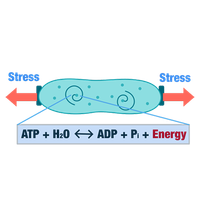
Many living and soft materials, such as protein condensates, epithelial cell layers, and bacterial colonies exhibit behavior that lies between that of liquids and solids. They flow, yet retain a memory of past deformations, while ongoing chemical activity continually drives them out of equilibrium. We developed a fluctuation response theory for nonequilibrium steady states with memory, providing a general framework to describe how such materials store and dissipate stress across time and length scales. Our theory predicts a phenomenon we term active viscoelastic memory, in which chemical reaction cycles dynamically modify the viscous response and can transiently generate a negative storage modulus, a feature absent in ordinary fluids. Beyond active fluids, the framework provides a foundation for understanding complex relaxation in a wide range of nonequilibrium materials, from molecular assemblies to cellular tissues, offering a bridge between hydrodynamics and modern nonequilibrium thermodynamics.
Article Text
References (95)
- M. C. Marchetti, J.-F. Joanny, S. Ramaswamy, T. B. Liverpool, J. Prost, M. Rao, and R. A. Simha, Hydrodynamics of soft active matter, Rev. Mod. Phys. 85, 1143 (2013).
- M. J. Bowick, N. Fakhri, M. C. Marchetti, and S. Ramaswamy, Symmetry, thermodynamics, and topology in active matter, Phys. Rev. X 12, 010501 (2022).
- F. Jülicher, A. Ajdari, and J. Prost, Modeling molecular motors, Rev. Mod. Phys. 69, 1269 (1997).
- R. Iino, K. Kinbara, and Z. Bryant, Introduction: Molecular motors, Chem. Rev. 120, 1 (2020).
- A. B. Kolomeisky and M. E. Fisher, Molecular motors: A theorist’s perspective, Annu. Rev. Phys. Chem. 58, 675 (2007).
- M. L. Mugnai, C. Hyeon, M. Hinczewski, and D. Thirumalai, Theoretical perspectives on biological machines, Rev. Mod. Phys. 92, 025001 (2020).
- R. Lipowsky and S. Liepelt, Chemomechanical coupling of molecular motors: Thermodynamics, network representations, and balance conditions, J. Stat. Phys. 130, 39 (2008).
- R. Lipowsky, Universal aspects of the chemomechanical coupling for molecular motors, Phys. Rev. Lett. 85, 4401 (2000).
- S. Toyabe, T. Watanabe-Nakayama, T. Okamoto, S. Kudo, and E. Muneyuki, Thermodynamic efficiency and mechanochemical coupling of -ATPase, Proc. Natl. Acad. Sci. U.S.A. 108, 17951 (2011).
- R. Takaki, M. L. Mugnai, Y. Goldtzvik, and D. Thirumalai, How kinesin waits for ATP affects the nucleotide and load dependence of the stepping kinetics, Proc. Natl. Acad. Sci. U.S.A. 116, 23091 (2019).
- R. Takaki, M. L. Mugnai, and D. Thirumalai, Information flow, gating, and energetics in dimeric molecular motors, Proc. Natl. Acad. Sci. U.S.A. 119, e2208083119 (2022).
- P. Recho, A. Hallou, and E. Hannezo, Theory of mechanochemical patterning in biphasic biological tissues, Proc. Natl. Acad. Sci. U.S.A. 116, 5344 (2019).
- S. R. Naganathan and A. C. Oates, Mechanochemical coupling and developmental pattern formation, Curr. Opin. Syst. Biol. 5, 104 (2017).
- D. Mizuno, C. Tardin, C. F. Schmidt, and F. C. MacKintosh, Nonequilibrium mechanics of active cytoskeletal networks, Science 315, 370 (2007).
- R. Kubo, The fluctuation-dissipation theorem, Rep. Prog. Phys. 29, 255 (1966).
- R. Kubo, M. Toda, and N. Hashitsume, Statistical Physics II: Nonequilibrium Statistical Mechanics (Springer Science & Business Media, New York, 2012), Vol. 31.
- G. S. Agarwal, Fluctuation-dissipation theorems for systems in non-thermal equilibrium and applications, Z. Phys. A Hadrons Nucl. 252, 25 (1972).
- P. Hänggi and H. Thomas, Time evolution, correlations, and linear response of non-Markov processes, Z. Phys. B 26, 85 (1977).
- T. Harada and S.-i. Sasa, Equality connecting energy dissipation with a violation of the fluctuation-response relation, Phys. Rev. Lett. 95, 130602 (2005).
- T. Harada and S.-i. Sasa, Energy dissipation and violation of the fluctuation-response relation in nonequilibrium Langevin systems, Phys. Rev. E 73, 026131 (2006).
- H.-M. Chun, E. Kwon, H. Park, and J. S. Lee, Fluctuation-response theory for nonequilibrium Langevin dynamics, arXiv:2601.16387.
- U. Seifert and T. Speck, Fluctuation-dissipation theorem in nonequilibrium steady states, Europhys. Lett. 89, 10007 (2010).
- M. Baiesi, C. Maes, and B. Wynants, Fluctuations and response of nonequilibrium states, Phys. Rev. Lett. 103, 010602 (2009).
- M. Baiesi, C. Maes, and B. Wynants, Nonequilibrium linear response for Markov dynamics, I: Jump processes and overdamped diffusions, J. Stat. Phys. 137, 1094 (2009).
- J. Zheng and Z. Lu, Unified linear fluctuation-response theory arbitrarily far from equilibrium, Phys. Rev. E 112, 064103 (2025).
- T. Hatano and S.-i. Sasa, Steady-state thermodynamics of Langevin systems, Phys. Rev. Lett. 86, 3463 (2001).
- J. Prost, J.-F. Joanny, and J. M. R. Parrondo, Generalized fluctuation-dissipation theorem for steady-state systems, Phys. Rev. Lett. 103, 090601 (2009).
- T. Aslyamov, K. Ptaszyński, and M. Esposito, Nonequilibrium fluctuation-response relations: From identities to bounds, Phys. Rev. Lett. 134, 157101 (2025).
- R. Bao and S. Liang, Nonlinear response identities and bounds for nonequilibrium steady states, arXiv:2412.19602.
- E. Kwon, H.-M. Chun, H. Park, and J. S. Lee, Fluctuation-response inequalities for kinetic and entropic perturbations, Phys. Rev. Lett. 135, 097101 (2025).
- C. Nardini, E. Fodor, E. Tjhung, F. van Wijland, J. Tailleur, and M. E. Cates, Entropy production in field theories without time-reversal symmetry: Quantifying the non-equilibrium character of active matter, Phys. Rev. X 7, 021007 (2017).
- M. K. Johnsrud and R. Golestanian, Fluctuation dissipation relations for active field theories, Phys. Rev. Res. 7, L032053 (2025).
- R. Golestanian, Hydrodynamically consistent many-body Harada-Sasa relation, Phys. Rev. Lett. 134, 207101 (2025).
- M. Han, M. Fruchart, C. Scheibner, S. Vaikuntanathan, J. J. De Pablo, and V. Vitelli, Fluctuating hydrodynamics of chiral active fluids, Nat. Phys. 17, 1260 (2021).
- H.-M. Chun, Q. Gao, and J. M. Horowitz, Nonequilibrium Green-Kubo relations for hydrodynamic transport from an equilibrium-like fluctuation-response equality, Phys. Rev. Res. 3, 043172 (2021).
- T. R. Kirkpatrick and D. Belitz, Fluctuation-response relation in nonequilibrium systems and active matter, Phys. Rev. E 111, 014102 (2025).
- A. Dechant and S.-i. Sasa, Fluctuation–response inequality out of equilibrium, Proc. Natl. Acad. Sci. U.S.A. 117, 6430 (2020).
- A. Dechant, Finite-frequency fluctuation-response inequality, Phys. Rev. Lett. 136, 207101 (2026).
- M. Fuchs and M. E. Cates, Theory of nonlinear rheology and yielding of dense colloidal suspensions, Phys. Rev. Lett. 89, 248304 (2002).
- M. Fuchs and M. E. Cates, A mode coupling theory for Brownian particles in homogeneous steady shear flow, J. Rheol. 53, 957 (2009).
- S. Dal Cengio, D. Levis, and I. Pagonabarraga, Linear response theory and Green-Kubo relations for active matter, Phys. Rev. Lett. 123, 238003 (2019).
- L. Onsager, Reciprocal relations in irreversible processes. I., Phys. Rev. 37, 405 (1931).
- L. Onsager, Reciprocal relations in irreversible processes. II., Phys. Rev. 38, 2265 (1931).
- J. Prost, F. Jülicher, and J.-F. Joanny, Active gel physics, Nat. Phys. 11, 111 (2015).
- F. Jülicher, S. W. Grill, and G. Salbreux, Hydrodynamic theory of active matter, Rep. Prog. Phys. 81, 076601 (2018).
- M. Mayer, M. Depken, J. S. Bois, F. Jülicher, and S. W. Grill, Anisotropies in cortical tension reveal the physical basis of polarizing cortical flows, Nature (London) 467, 617 (2010).
- R. Alert and X. Trepat, Physical models of collective cell migration, Annu. Rev. Condens. Matter Phys. 11, 77 (2020).
- T. R. Kirkpatrick and D. Thirumalai, Colloquium: Random first order transition theory concepts in biology and physics, Rev. Mod. Phys. 87, 183 (2015).
- M. Maier, A. Zippelius, and M. Fuchs, Stress auto-correlation tensor in glass-forming isothermal fluids: From viscous to elastic response, J. Chem. Phys. 149 (2018).
- D. Bi, X. Yang, M. C. Marchetti, and M. L. Manning, Motility-driven glass and jamming transitions in biological tissues, Phys. Rev. X 6, 021011 (2016).
- T. E. Angelini, E. Hannezo, X. Trepat, M. Marquez, J. J. Fredberg, and D. A. Weitz, Glass-like dynamics of collective cell migration, Proc. Natl. Acad. Sci. U.S.A. 108, 4714 (2011).
- L. Jawerth, E. Fischer-Friedrich, S. Saha, J. Wang, T. Franzmann, X. Zhang, J. Sachweh, M. Ruer, M. Ijavi, S. Saha et al., Protein condensates as aging Maxwell fluids, Science 370, 1317 (2020).
- R. Takaki, Y. Savich, J. Brugués, and F. Jülicher, Active loop extrusion guides DNA-protein condensation, Phys. Rev. Lett. 134, 128401 (2025).
- R. Takaki, L. Jawerth, M. Popović, and F. Jülicher, Theory of rheology and aging of protein condensates, PRX Life 1, 013006 (2023).
- R. Takaki and D. Thirumalai, Sequence complexity and monomer rigidity control the morphologies and aging dynamics of protein aggregates, Proc. Natl. Acad. Sci. U.S.A. 121, e2409973121 (2024).
- L. M. Janssen, Active glasses, J. Phys. Condens. Matter 31, 503002 (2019).
- S. Sadhukhan, S. Dey, S. Karmakar, and S. K. Nandi, A perspective on active glassy dynamics in biological systems, Eur. Phys. J. Special Topics 233, 3193 (2024).
- L. Berthier, E. Flenner, and G. Szamel, Glassy dynamics in dense systems of active particles, J. Chem. Phys. 150 (2019).
- S. Henkes, K. Kostanjevec, J. M. Collinson, R. Sknepnek, and E. Bertin, Dense active matter model of motion patterns in confluent cell monolayers, Nat. Commun. 11, 1405 (2020).
- M. Paoluzzi, D. Levis, and I. Pagonabarraga, From flocking to glassiness in dense disordered polar active matter, Commun. Phys. 7, 57 (2024).
- E. Flenner, G. Szamel, and L. Berthier, The nonequilibrium glassy dynamics of self-propelled particles, Soft Matter 12, 7136 (2016).
- R. Mandal, P. J. Bhuyan, P. Chaudhuri, C. Dasgupta, and M. Rao, Extreme active matter at high densities, Nat. Commun. 11, 2581 (2020).
- A. Liluashvili, J. Ónody, and T. Voigtmann, Mode-coupling theory for active Brownian particles, Phys. Rev. E 96, 062608 (2017).
- S. K. Nandi, R. Mandal, P. J. Bhuyan, C. Dasgupta, M. Rao, and N. S. Gov, A random first-order transition theory for an active glass, Proc. Natl. Acad. Sci. U.S.A. 115, 7688 (2018).
- K. Paul, A. Mutneja, S. K. Nandi, and S. Karmakar, Dynamical heterogeneity in active glasses is inherently different from its equilibrium behavior, Proc. Natl. Acad. Sci. U.S.A. 120, e2217073120 (2023).
- B. J. Berne, J. P. Boon, and S. A. Rice, On the calculation of autocorrelation functions of dynamical variables, J. Chem. Phys. 45, 1086 (1966).
- J. S. Toll, Causality and the dispersion relation: Logical foundations, Phys. Rev. 104, 1760 (1956).
- R. De L. Kronig, On the theory of dispersion of x-rays, J. Opt. Soc. Am. 12, 547 (1926).
- J. Irving and J. G. Kirkwood, The statistical mechanical theory of transport processes. IV. The equations of hydrodynamics, J. Chem. Phys. 18, 817 (1950).
- A. Semenov and J. Baschnagel, General relations between stress fluctuations and viscoelasticity in amorphous polymer and glass-forming systems, Polymers 16, 2336 (2024).
- N. Grimm, J. Baschnagel, A. N. Semenov, A. Zippelius, and M. Fuchs, Stress correlations and stress memory kernels in viscoelastic fluids, Soft Matter 21, 4256 (2025).
- D. J Evans and G. P Morriss, Statistical Mechanics of Nonequilibrium Liquids, 2nd ed. (Cambridge University Press, Cambridge, 2008).
- D. J. Evans, Equilibrium fluctuation expressions for the wave-vector-and frequency-dependent shear viscosity, Phys. Rev. A 23, 2622 (1981).
- W. Götze, Complex Dynamics of Glass-Forming Liquids: A Mode-Coupling Theory (Oxford University Press, USA, 2009), Vol. 143.
- J. P. Wittmer, A. N. Semenov, and J. Baschnagel, Correlations of tensor field components in isotropic systems with an application to stress correlations in elastic bodies, Phys. Rev. E 108, 015002 (2023).
- L. Klochko, J. Baschnagel, J. Wittmer, and A. Semenov, Long-range stress correlations in viscoelastic and glass-forming fluids, Soft Matter 14, 6835 (2018).
- M. Maier, A. Zippelius, and M. Fuchs, Emergence of long-ranged stress correlations at the liquid to glass transition, Phys. Rev. Lett. 119, 265701 (2017).
- R. Zwanzig, Nonequilibrium Statistical Mechanics (Oxford University Press, New York, 2001).
- S. Ramaswamy, The mechanics and statistics of active matter, Annu. Rev. Condens. Matter Phys. 1, 323 (2010).
- J. Toner and Y. Tu, Long-range order in a two-dimensional dynamical XY model: How birds fly together, Phys. Rev. Lett. 75, 4326 (1995).
- J. Toner and Y. Tu, Flocks, herds, and schools: A quantitative theory of flocking, Phys. Rev. E 58, 4828 (1998).
- D. Banerjee, A. Souslov, A. G. Abanov, and V. Vitelli, Odd viscosity in chiral active fluids, Nat. Commun. 8, 1573 (2017).
- M. Fruchart, C. Scheibner, and V. Vitelli, Odd viscosity and odd elasticity, Annu. Rev. Condens. Matter Phys. 14, 471 (2023).
- C. Scheibner, A. Souslov, D. Banerjee, P. Surówka, W. T. Irvine, and V. Vitelli, Odd elasticity, Nat. Phys. 16, 475 (2020).
- G. Falasco and M. Esposito, Macroscopic stochastic thermodynamics, Rev. Mod. Phys. 97, 015002 (2025).
- U. Seifert, Stochastic thermodynamics, fluctuation theorems and molecular machines, Rep. Prog. Phys. 75, 126001 (2012).
- L. Peliti and S. Pigolotti, Stochastic Thermodynamics: An Introduction (Princeton University Press, Princeton, NJ, 2021).
- N. Shiraishi, An introduction to Stochastic Thermodynamics, Fundamental Theories of Physics (Springer, Singapore, 2023).
- Y. Hidaka, Counting rule for Nambu-Goldstone modes in nonrelativistic systems, Phys. Rev. Lett. 110, 091601 (2013).
- Y. Minami and Y. Hidaka, Spontaneous symmetry breaking and Nambu-Goldstone modes in dissipative systems, Phys. Rev. E 97, 012130 (2018).
- R. Takaki, Fluctuation-Response Theory of Nonequilibrium Complex Fluids: python scripts, GitHub, https://github.com/kibidanngo/Fluctuation_Response_PRX (2026).
- J.-P. Hansen and I. R. McDonald, Theory of Simple Liquids: With Applications to Soft Matter (Academic Press, New York, 2013).
- F. J. Belinfante, On the current and the density of the electric charge, the energy, the linear momentum and the angular momentum of arbitrary fields, Physica 7, 449 (1940).
- L. Rosenfeld, Sur le tenseur d’impulsion-énergie, Mém. Acad. R. Belg. Cl. Sci. 18, 1 (1940).
- P. C. Martin, O. Parodi, and P. S. Pershan, Unified hydrodynamic theory for crystals, liquid crystals, and normal fluids, Phys. Rev. A 6, 2401 (1972).

