

- Open Access
Rapid Quantum Ground State Preparation via Dissipative Dynamics
Phys. Rev. X 16, 011004 – Published 6 January, 2026
DOI: https://doi.org/10.1103/wzb3-dbg9
Abstract
Inspired by natural cooling processes, dissipation has become a promising approach for preparing low-energy states of quantum systems. However, the potential of dissipative protocols remains unclear beyond certain commuting Hamiltonians. This work provides significant analytical and numerical insights into the power of dissipation for preparing the ground state of noncommuting Hamiltonians. For quasi-free dissipative dynamics, including certain 1D spin systems with boundary dissipation, our results reveal a new connection between the mixing time in trace distance and the spectral properties of a non-Hermitian Hamiltonian, leading to an explicit and sharp bound on the mixing time that scales polynomially with system size. For more general spin systems, we develop a tensor network-based algorithm for constructing the Lindblad jump operator and for simulating the dynamics. Using this algorithm, we demonstrate numerically that dissipative ground state preparation protocols can achieve rapid mixing for certain 1D local Hamiltonians under bulk dissipation, with a mixing time that scales logarithmically with the system size. We then prove the rapid mixing result for certain weakly interacting spin and fermionic systems in arbitrary dimensions, extending recent results for high-temperature quantum Gibbs samplers to the zero-temperature regime. Together, these results show that dissipation can be a powerful tool for ground state preparation, with potential applications across condensed matter physics, quantum materials science, and beyond.
Physics Subject Headings (PhySH)
Popular Summary
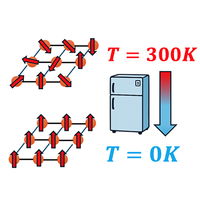
The search for the ground state and other low-energy states is critical in physics and chemistry because these states determine the behavior of materials and molecules. We study engineered dissipation, a technique inspired by natural cooling, to prepare these challenging quantum states, particularly in systems where different parts of the Hamiltonian do not commute. We develop new analytical methods and a tensor-network simulation algorithm to evaluate the efficiency of this cooling process for complex systems. Our findings show that this dissipative method is highly effective, as the cooling time scales either polynomially or, in some cases, even logarithmically with the system size for many physical systems. These results establish dissipation as a powerful and robust strategy for preparing quantum states, making it attractive for implementation on early fault-tolerant quantum devices.
Article Text
References (105)
- T. Albash and D. A. Lidar, Adiabatic quantum computation, Rev. Mod. Phys. 90, 015002 (2018).
- E. Farhi, J. Goldstone, S. Gutmann, and M. Sipser, Quantum computation by adiabatic evolution, arXiv:quant-ph/0001106.
- Y. Ge, J. Tura, and J. I. Cirac, Faster ground state preparation and high-precision ground energy estimation with fewer qubits, J. Math. Phys. (N.Y.) 60, 022202 (2019).
- A. Gilyén, Y. Su, G. H. Low, and N. Wiebe, Quantum singular value transformation and beyond: Exponential improvements for quantum matrix arithmetics, In Proceedings of the 51st Annual ACM SIGACT Symposium on Theory of Computing (Association for Computing Machinery (ACM), Vancouver, Canada, 2019), pp. 19–204.
- L. Lin and Y. Tong, Near-optimal ground state preparation, Quantum 4, 372 (2020).
- L. Lin and Y. Tong, Heisenberg-limited ground state energy estimation for early fault-tolerant quantum computers, PRX Quantum 3, 010318 (2022).
- T. E. O’Brien, B. Tarasinski, and B. M. Terhal, Quantum phase estimation of multiple eigenvalues for small-scale (noisy) experiments, New J. Phys. 21, 023022 (2019).
- K. Wan, M. Berta, and E. T. Campbell, Randomized quantum algorithm for statistical phase estimation, Phys. Rev. Lett. 129, 030503 (2022).
- T. S. Cubitt, Dissipative ground state preparation and the dissipative quantum eigensolver, arXiv:2303.11962.
- M. Foss-Feig, A. Tikku, T.-C. Lu, K. Mayer, M. Iqbal, T. M. Gatterman, J. A. Gerber, K. Gilmore, D. Gresh, A. Hankin et al., Experimental demonstration of the advantage of adaptive quantum circuits, arXiv:2302.03029.
- M. Kalinowski, N. Maskara, and M. D. Lukin, Non-Abelian Floquet spin liquids in a digital Rydberg simulator, Phys. Rev. X 13, 031008 (2023).
- B. Kraus, H. P. Büchler, S. Diehl, A. Kantian, A. Micheli, and P. Zoller, Preparation of entangled states by quantum Markov processes, Phys. Rev. A 78, 042307 (2008).
- J. Langbehn, K. Snizhko, I. Gornyi, G. Morigi, Y. Gefen, and C. P. Koch, Dilute measurement-induced cooling into many-body ground states, PRX Quantum 5, 030301 (2024).
- T.-C. Lu, L. A. Lessa, I. H. Kim, and T. H. Hsieh, Measurement as a shortcut to long-range entangled quantum matter, PRX Quantum 3, 040337 (2022).
- S. Roy, J. T. Chalker, I. V. Gornyi, and Y. Gefen, Measurement induced steering of quantum systems, Phys. Rev. Res. 2, 033347 (2020).
- B. M. Terhal and D. P. DiVincenzo, Problem of equilibration and the computation of correlation functions on a quantum computer, Phys. Rev. A 61, 022301 (2000).
- F. Verstraete, M. M. Wolf, and I. Cirac, Quantum computation and quantum-state engineering driven by dissipation, Nat. Phys. 5, 633 (2009).
- Y. Wang, K. Snizhko, A. Romito, Y. Gefen, and K. Murch, Dissipative preparation and stabilization of many-body quantum states in a superconducting qutrit array, Phys. Rev. A 108, 013712 (2023).
- L. Zhou, S. Choi, and M. D. Lukin, Symmetry-protected dissipative preparation of matrix product states, Phys. Rev. A 104, 032418 (2021).
- T. S. Cubitt, A. Lucia, S. Michalakis, and D. Perez-Garcia, Stability of local quantum dissipative systems, Commun. Math. Phys. 337, 1275 (2015).
- R. Trivedi, A. Franco Rubio, and J. I. Cirac, Quantum advantage and stability to errors in analogue quantum simulators, Nat. Commun. 15, 6507 (2024).
- L. C. Venuti, T. Albash, M. Marvian, D. Lidar, and P. Zanardi, Relaxation versus adiabatic quantum steady-state preparation, Phys. Rev. A 95, 042302 (2017).
- C.-F. Chen and F. G. S. L. Brandão, Fast thermalization from the eigenstate thermalization hypothesis, arXiv:2112.07646.
- C.-F. Chen, M. J. Kastoryano, F. G. Brandão, and A. Gilyén, Quantum thermal state preparation, arXiv:2303.18224.
- C.-F. Chen, M. J. Kastoryano, and A. Gilyén, An efficient and exact noncommutative quantum Gibbs sampler, arXiv:2311.09207.
- Z. Ding, B. Li, and L. Lin, Efficient quantum Gibbs samplers with Kubo–Martin–Schwinger detailed balance condition, Commun. Math. Phys. 406, 67 (2025).
- A. Gilyén, C.-F. Chen, J. F. Doriguello, and M. J. Kastoryano, Quantum generalizations of Glauber and Metropolis dynamics, arXiv:2405.20322.
- J. Jiang and S. Irani, Quantum Metropolis sampling via weak measurement, arXiv:2406.16023.
- E. Mozgunov and D. Lidar, Completely positive master equation for arbitrary driving and small level spacing, Quantum 4, 1 (2020).
- P. Rall, C. Wang, and P. Wocjan, Thermal state preparation via rounding promises, Quantum 7, 1132 (2023).
- O. Shtanko and R. Movassagh, Preparing thermal states on noiseless and noisy programmable quantum processors, arXiv:2112.14688.
- K. Temme, T. J. Osborne, K. G. Vollbrecht, D. Poulin, and F. Verstraete, Quantum Metropolis sampling, Nature (London) 471, 87 (2011).
- I. Bardet, Á. Capel, L. Gao, A. Lucia, D. Pérez-García, and C. Rouzé, Rapid thermalization of spin chain commuting Hamiltonians, Phys. Rev. Lett. 130, 060401 (2023).
- Z. Ding, B. Li, L. Lin, and R. Zhang, Polynomial-time preparation of low-temperature Gibbs states for 2D toric code, arXiv:2410.01206.
- D. Gamarnik, B. T. Kiani, and A. Zlokapa, Slow mixing of quantum Gibbs samplers, arXiv:2411.04300.
- M. J. Kastoryano and K. Temme, Quantum logarithmic Sobolev inequalities and rapid mixing, J. Math. Phys. (N.Y.) 54, 1 (2013).
- J. Kochanowski, A. M. Alhambra, A. Capel, and C. Rouzé, Rapid thermalization of dissipative many-body dynamics of commuting Hamiltonians, Commun. Math. Phys. 406, 176 (2025).
- C. Rouzé, D. S. Franca, and A. M. Alhambra, Efficient thermalization and universal quantum computing with quantum Gibbs samplers, arXiv:2403.12691.
- C. Rouzé, D. S. França, and Á. M. Alhambra, Optimal quantum algorithm for Gibbs state preparation, arXiv:2411.04885.
- K. Temme, M. J. Kastoryano, M. B. Ruskai, M. M. Wolf, and F. Verstraete, The -divergence and mixing times of quantum Markov processes, J. Math. Phys. (N.Y.) 51, 122201 (2010).
- Y. Tong and Y. Zhan, Fast mixing of weakly interacting fermionic systems at any temperature, PRX Quantum 6, 030301 (2025).
- C.-F. Chen, H.-Y. Huang, J. Preskill, and L. Zhou, Local minima in quantum systems, in Proceedings of the 56th Annual ACM Symposium on Theory of Computing (Association for Computing Machinery (ACM), Phoenix, AZ, USA, 2024), pp. 1323–1330.
- Z. Ding, C.-F. Chen, and L. Lin, Single-ancilla ground state preparation via Lindbladians, Phys. Rev. Res. 6, 033147 (2024).
- P. J. Eder, J. R. Finžgar, S. Braun, and C. B. Mendl, Quantum dissipative search via Lindbladians, Phys. Rev. A 111, 042430 (2025).
- N. Lambert, M. Cirio, J.-D. Lin, P. Menczel, P. Liang, and F. Nori, Fixing detailed balance in ancilla-based dissipative state engineering, Phys. Rev. Res. 6, 043229 (2024).
- H.-E. Li, Y. Zhan, and L. Lin, Dissipative ground state preparation in ab initio electronic structure theory, npj Quantum Inf. 11, 183 (2025).
- J. Lloyd, A. A. Michailidis, X. Mi, V. Smelyanskiy, and D. A. Abanin, Quasiparticle cooling algorithms for quantum many-body state preparation, PRX Quantum 6, 010361 (2025).
- X. Mi et al., Stable quantum-correlated many-body states through engineered dissipation, Science 383, 1332 (2024).
- D. Motlagh, M. S. Zini, J. M. Arrazola, and N. Wiebe, Ground state preparation via dynamical cooling, arXiv:2404.05810.
- R. Alicki, On the detailed balance condition for non-Hamiltonian systems, Rep. Math. Phys. 10, 249 (1976).
- E. A. Carlen and J. Maas, Gradient flow and entropy inequalities for quantum markov semigroups with detailed balance, J. Funct. Anal. 273, 1810 (2017).
- F. Fagnola and V. Umanità, Generators of KMS symmetric Markov semigroups on symmetry and quantum detailed balance, Commun. Math. Phys. 298, 523 (2010).
- F. Ticozzi and L. Viola, Stabilizing entangled states with quasi-local quantum dynamical semigroups, Phil. Trans. R. Soc. A, 370, 5259 (2012).
- F. Ticozzi and L. Viola, Steady-state entanglement by engineered quasi-local Markovian dissipation, Quantum Inf. Comput. 14, 265 (2014).
- R. Cleve and C. Wang, Efficient quantum algorithms for simulating Lindblad evolution, in International Colloquium on Automata, Languages and Programming 2017 (Dagstuhl Publishing, Warsaw, Poland, 2017).
- Z. Ding, X. Li, and L. Lin, Simulating open quantum systems using Hamiltonian simulations, PRX Quantum 5, 020332 (2024).
- X. Li and C. Wang, Simulating Markovian open quantum systems using higher-order series expansion, In International Colloquium on Automata, Languages and Programming 2023 (Dagstuhl Publishing, Paderborn, Germany, 2023), Vol. 261, pp. 187.
- T. Barthel and Y. Zhang, Solving quasi-free and quadratic Lindblad master equations for open fermionic and bosonic systems, J. Stat. Mech. (2022) 113101.
- T. Prosen, Third quantization: A general method to solve master equations for quadratic open Fermi systems, New J. Phys. 10, 043026 (2008).
- S. Polla, Y. Herasymenko, and T. E. O’Brien, Quantum digital cooling, Phys. Rev. A 104, 012414 (2021).
- M. Raghunandan, F. Wolf, C. Ospelkaus, P. O. Schmidt, and H. Weimer, Initialization of quantum simulators by sympathetic cooling, Sci. Adv. 6, eaaw9268 (2020).
- H. Nakano, T. Shirai, and T. Mori, Tensor network approach to thermalization in open quantum many-body systems, Phys. Rev. E 103, L040102 (2021).
- A. Sander, M. Fröhlich, M. Eigel, J. Eisert, P. Gelß, M. Hintermüller, R. M. Milbradt, R. Wille, and C. B. Mendl, Large-scale stochastic simulation of open quantum systems, arXiv:2501.17913.
- K. Temme, F. Pastawski, and M. J. Kastoryano, Hypercontractivity of quasi-free quantum semigroups, J. Phys. A 47, 405303 (2014).
- F. Verstraete, J. J. García-Ripoll, and J. I. Cirac, Matrix product density operators: Simulation of finite-temperature and dissipative systems, Phys. Rev. Lett. 93, 207204 (2004).
- G. Vidal, Efficient simulation of one-dimensional quantum many-body systems, Phys. Rev. Lett. 93, 040502 (2004).
- H. Weimer, A. Kshetrimayum, and R. Orús, Simulation methods for open quantum many-body systems, Rev. Mod. Phys. 93, 015008 (2021).
- F. Verstraete and J. I. Cirac, Renormalization algorithms for quantum-many body systems in two and higher dimensions, arXiv:cond-mat/0407066.
- E. Stoudenmire and S. R. White, Minimally entangled typical thermal state algorithms, New J. Phys. 12, 055026 (2010).
- J. Surace and L. Tagliacozzo, Fermionic Gaussian states: An introduction to numerical approaches, SciPost Phys. Lect. Notes 54, 1 (2022).
- T. Prosen, Spectral theorem for the Lindblad equation for quadratic open fermionic systems, J. Stat. Mech. (2010) P07020.
- H. J. Briegel, D. E. Browne, W. Dür, R. Raussendorf, and M. Van den Nest, Measurement-based quantum computation, Nat. Phys. 5, 19 (2009).
- R. Raussendorf, D. E. Browne, and H. J. Briegel, Measurement-based quantum computation on cluster states, Phys. Rev. A 68, 022312 (2003).
- I. Cong, S. Choi, and M. D. Lukin, Quantum convolutional neural networks, Nat. Phys. 15, 1273 (2019).
- W. Son, L. Amico, R. Fazio, A. Hamma, S. Pascazio, and V. Vedral, Quantum phase transition between cluster and antiferromagnetic states, Europhys. Lett. 95, 50001 (2011).
- W. Selke, The ANNNI model-theoretical analysis and experimental application, Phys. Rep. 170, 213 (1988).
- Z.-Y. Zheng, X. Wang, and S. Chen, Exact solution of the boundary-dissipated transverse field Ising model: Structure of the Liouvillian spectrum and dynamical duality, Phys. Rev. B 108, 024404 (2023).
- W. J. Huggins, B. A. O’Gorman, N. C. Rubin, D. R. Reichman, R. Babbush, and J. Lee, Unbiasing fermionic quantum Monte Carlo with a quantum computer, Nature (London) 603, 416 (2022).
- S. McArdle, T. Jones, S. Endo, Y. Li, S. C. Benjamin, and X. Yuan, Variational ansatz-based quantum simulation of imaginary time evolution, npj Quantum Inf. 5, 75 (2019).
- M. Motta, C. Sun, A. T. Tan, M. J. O’Rourke, E. Ye, A. J. Minnich, F. G. Brandão, and G. K.-L. Chan, Determining eigenstates and thermal states on a quantum computer using quantum imaginary time evolution, Nat. Phys. 16, 205 (2020).
- Š. Šmíd, R. Meister, M. Berta, and R. Bondesan, Polynomial time quantum Gibbs sampling for Fermi-Hubbard model at any temperature, arXiv:2501.01412.
- M. Hagan and N. Wiebe, The thermodynamic cost of ignorance: Thermal state preparation with one ancilla qubit, arXiv:2502.03410.
- D. Hahn, S. A. Parameswaran, and B. Placke, Provably efficient quantum thermal state preparation via local driving, arXiv:2505.22816.
- J. Langbehn, G. Mouloudakis, E. King, R. Menu, I. Gornyi, G. Morigi, Y. Gefen, and C. P. Koch, Universal cooling of quantum systems via randomized measurements, arXiv:2506.11964.
- J. Lloyd and D. A. Abanin, Quantum thermal state preparation for near-term quantum processors, arXiv:2506.21318.
- D. Molpeceres, S. Lu, J. I. Cirac, and B. Kraus, Quantum algorithms for cooling: A simple case study, Phys. Rev. Res. 7, 033162 (2025).
- M. Scandi and Álvaro M. Alhambra, Thermalization in open many-body systems and KMS detailed balance, arXiv:2505.20064.
- M. Raghunandan, F. Wolf, C. Ospelkaus, P. O. Schmidt, and H. Weimer, Initialization of quantum simulators by sympathetic cooling, Sci. Adv. 6, eaaw9268 (2020).
- L. Del Re, B. Rost, M. Foss-Feig, A. Kemper, and J. K. Freericks, Robust measurements of n-point correlation functions of driven-dissipative quantum systems on a digital quantum computer, Phys. Rev. Lett. 132, 100601 (2024).
- X. Mi, A. Michailidis, S. Shabani, K. Miao, P. Klimov, J. Lloyd, E. Rosenberg, R. Acharya, I. Aleiner, T. Andersen et al., Stable quantum-correlated many-body states through engineered dissipation, Science 383, 1332 (2024).
- Y. Zhan, J. Huhn, Z. Ding, and L. Lin, Repository name: oneancillaground (2025), https://github.com/lin-lin/oneancillaground.
- M. B. Hastings, The stability of free Fermi Hamiltonians, J. Math. Phys. (N.Y.) 60, 042201 (2019).
- C. A. Fuchs and J. Van De Graaf, Cryptographic distinguishability measures for quantum-mechanical states, IEEE Trans. Inf. Theory 45, 1216 (2002).
- M. A. Nielsen and I. Chuang, Quantum Computation and Quantum Information (Cambridge University Press, Cambridge, England, 2000.
- P. Pfeuty, The one-dimensional Ising model with a transverse field, Ann. Phys. (N.Y.) 57, 79 (1970).
- J.-P. Blaizot and G. Ripka, Quantum Theory of Finite Systems (MIT Press, Cambridge, MA, 1985).
- D. J. Thouless, Stability conditions and nuclear rotations in the Hartree-Fock theory, Nucl. Phys. 21, 225 (1960).
- J. Gray, Quimb: A python package for quantum information and many-body calculations, J. Open Source Software 3, 819 (2018).
- C. Villani, Hypocoercive diffusion operators, Bollettino dell’Unione Matematica Italiana 10-B, 257 (2007), http://eudml.org/doc/290402.
- D. Fang, J. Lu, and Y. Tong, Mixing time of open quantum systems via hypocoercivity, Phys. Rev. Lett. 134, 140405 (2025).
- E. Lieb, T. Schultz, and D. Mattis, Two soluble models of an antiferromagnetic chain, Ann. Phys. (N.Y.) 16, 407 (1961).
- G. Hoepfner and A. Raich, Global Gevrey functions, Paley-Weiner theorems, and the FBI transform, Indiana University mathematics Journal 68, 967 (2019).
- Z. Adwan, G. Hoepfner, and A. Raich, Global -Gevrey functions and their applications, J. Geomet. Anal. 27, 1874 (2017).
- M. Cirio, P.-C. Kuo, Y.-N. Chen, F. Nori, and N. Lambert, Canonical derivation of the fermionic influence superoperator, Phys. Rev. B 105, 035121 (2022).
- N. T. Vidal, M. L. Bera, A. Riera, M. Lewenstein, and M. N. Bera, Quantum operations in an information theory for fermions, Phys. Rev. A 104, 032411 (2021).

