

- Open Access
General Framework Enabling Polarity-Tunable Time-Reversal Symmetric Superconducting Diode Effects in Gate-Defined Homojunctions
Phys. Rev. X 16, 021046 – Published 29 May, 2026
DOI: https://doi.org/10.1103/wm2k-vlvc
Abstract
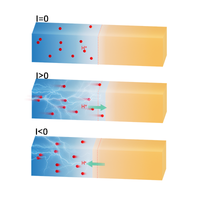
Symmetry breaking underlies various nonreciprocal transport phenomena. A well-known example is the semiconductor junction diode, a cornerstone of modern electronics. Its superconducting counterpart—the superconducting diode effect (SDE)—has recently attracted intense interest due to its potential in ultra-low-power superconducting circuits. While most SDEs reported so far involve either explicit or spontaneous breaking of time-reversal symmetry (TRS), a comprehensive theoretical framework remains elusive. Moreover, a general mechanism enabling TRS-preserving SDEs with minimal dependence on material or device architecture has yet to be established. Here, we report polarity-tunable SDEs without breaking TRS, realized in superconducting , , and homojunctions defined via local protonic gates in multilayer . The local gates induce partial proton intercalation, generating a built-in proton concentration gradient across the transition zone between the gated and ungated regions—closely resembling the depletion layer in conventional semiconductor diodes. We find that the observed SDE arises from electric-field-driven variation of the proton concentration gradient in the transition region, which asymmetrically modulates the critical current: suppressing it in one direction and enhancing it in the other. This local-gate-driven, TRS-preserving mechanism offers a general and scalable strategy for realizing nonreciprocal superconducting transport. Our findings establish a material-agnostic platform for SDEs, broadly applicable across two-dimensional (2D) superconductors.
Physics Subject Headings (PhySH)
Corrections
1 July, 2026
Correction: The author contribution statement was missing and has been added. A statement of thanks was missing from the Acknowledgments section and has been inserted.
Popular Summary
Developing efficient superconducting diodes usually requires the breaking of time-reversal symmetry via external magnetic fields or magnetic proximity effects, which can complicate the integration of these components into scalable electronic architectures. We addressed this challenge by demonstrating a time-reversal symmetric superconducting diode effect in homojunctions defined by local protonic gates. Our study shows that a built-in proton concentration gradient across the junction allows for electric-field-driven proton displacement, which asymmetrically modulates the critical current in opposite directions. We successfully implemented this mechanism in , , and junction configurations, confirming that the diode behavior persists without the need for magnetic field bias. These results establish a platform for creating nonreciprocal superconducting components using ionic gating. Our work provides a scalable pathway for developing dissipationless logic and memory devices based on two-dimensional superconductors.
Article Text
Supplemental Material
References (46)
- Y. Tokura and N. Nagaosa, Nonreciprocal responses from non-centrosymmetric quantum materials, Nat. Commun. 9, 3740 (2018).
- N. Nagaosa and Y. Yanase, Nonreciprocal transport and optical phenomena in quantum materials, Annu. Rev. Condens. Matter Phys. 15, 63 (2024).
- R. Kubo, Statistical-mechanical theory of irreversible processes. I. General theory and simple applications to magnetic and conduction problems, J. Phys. Soc. Jpn. 12, 570 (1957).
- A. Daido, Y. Ikeda, and Y. Yanase, Intrinsic superconducting diode effect, Phys. Rev. Lett. 128, 037001 (2022).
- N. F. Q. Yuan and L. Fu, Supercurrent diode effect and finite-momentum superconductors, Proc. Natl. Acad. Sci. U.S.A. 119, e2119548119 (2022).
- J. J. He, Y. Tanaka, and N. Nagaosa, A phenomenological theory of superconductor diodes, New J. Phys. 24, 053014 (2022).
- J. Hu, C. Wu, and X. Dai, Proposed design of a Josephson diode, Phys. Rev. Lett. 99, 067004 (2007).
- C.-Z. Chen, J. J. He, M. N. Ali, G. H. Lee, K. C. Fong, and K. T. Law,Asymmetric Josephson effect in inversion symmetry breaking topological materials, Phys. Rev. B 98, 075430 (2018).
- K. Misaki and N. Nagaosa, Theory of the nonreciprocal Josephson effect, Phys. Rev. B 103, 245302 (2021).
- Y. Zhang, Y. Gu, P. Li, J. Hu, and K. Jiang, General theory of Josephson diodes, Phys. Rev. X 12, 041013 (2022).
- M. Davydova, S. Prembabu, and L. Fu, Universal Josephson diode effect, Sci. Adv. 8, eabo0309 (2022).
- F. Ando et al., Observation of superconducting diode effect, Nature (London) 584, 373 (2020).
- R. Wakatsuki et al., Nonreciprocal charge transport in noncentrosymmetric superconductors, Sci. Adv. 3, e1602390 (2017).
- E. Zhang et al., Nonreciprocal superconducting antenna, Nat. Commun. 11, 5634 (2020).
- F. Liu et al., Superconducting diode effect under time-reversal symmetry, Sci. Adv. 10, eado1502 (2024).
- H. Wu et al., The field-free Josephson diode in a van der Waals heterostructure, Nature (London) 604, 653 (2022).
- C. Baumgartner et al., Supercurrent rectification and magnetochiral effects in symmetric Josephson junctions, Nat. Nanotechnol. 17, 39 (2022).
- K.-R. Jeon et al., Zero-field polarity-reversible Josephson supercurrent diodes enabled by a proximity- magnetized Pt barrier, Nat. Mater. 21, 1008 (2022).
- B. Pal et al., Josephson diode effect from Cooper pair momentum in a topological semimetal, Nat. Phys. 18, 1228 (2022).
- M. Trahms et al., Diode effect in Josephson junctions with a single magnetic atom, Nature (London) 615, 628 (2023).
- M. Gupta et al., Gate-tunable superconducting diode effect in a three-terminal Josephson device, Nat. Commun. 14, 3078 (2023).
- G. Qiu et al., Emergent ferromagnetism with superconductivity in Fe(Te,Se) van der Waals Josephson junctions, Nat. Commun. 14, 6691 (2023).
- M. Valentini et al., Parity-conserving Cooper-pair transport and ideal superconducting diode in planar germanium, Nat. Commun. 15, 169 (2024).
- J.-K. Kim et al., Intrinsic supercurrent non-reciprocity coupled to the crystal structure of a van der Waals Josephson barrier, Nat. Commun. 15, 1120 (2024).
- Y. Li et al., Interfering Josephson diode effect in asymmetric edge interferometer, Nat. Commun. 15, 9031 (2024).
- H. Su et al., Microwave-assisted unidirectional superconductivity in Al-InAs nanowire-Al junctions under magnetic fields, Phys. Rev. Lett. 133, 087001 (2024).
- H. Narita et al., Field-free superconducting diode effect in noncentrosymmetric superconductor/ferromagnet multilayers, Nat. Nanotechnol. 17, 823 (2022).
- A. Gutfreund et al., Direct observation of a superconducting vortex diode, Nat. Commun. 14, 1630 (2023).
- J. Xiong et al., Electrical switching of Ising-superconducting nonreciprocity for quantum neuronal transistor, Nat. Commun. 15, 4953 (2024).
- J.-X. Lin et al., Zero-field superconducting diode effect in small-twist-angle trilayer graphene, Nat. Phys. 18, 1221 (2022).
- J. Díez-Mérida et al., Symmetry-broken Josephson junctions and superconducting diodes in magic-angle twisted bilayer graphene, Nat. Commun. 14, 2396 (2023).
- S. Y. F. Zhao et al., Time-reversal symmetry breaking superconductivity between twisted cuprate superconductors, Science 382, 1422 (2023).
- S. Ghosh et al., High-temperature Josephson diode, Nat. Mater. 23, 612 (2024).
- Y. Hou et al., Ubiquitous superconducting diode effect in superconductor thin Films, Phys. Rev. Lett. 131, 027001 (2023).
- R. Kealhofer, H. Jeong, A. Rashidi, L. Balents, and S. Stemmer, Anomalous superconducting diode effect in a polar superconductor, Phys. Rev. B 107, L100504 (2023).
- Y.-Y Lyu et al., Superconducting diode effect via conformal-mapped nanoholes, Nat. Commun. 12, 2703 (2021).
- L. Bauriedl et al., Supercurrent diode effect and magnetochiral anisotropy in few-layer , Nat. Commun. 13, 4266 (2022).
- T. Golod and V. M. Krasnov, Demonstration of a superconducting diode-with-memory, operational at zero magnetic field with switchable nonreciprocity, Nat. Commun. 13, 3658 (2022).
- A. Sundaresh et al., Diamagnetic mechanism of critical current non-reciprocity in multilayered superconductors, Nat. Commun. 14, 1628 (2023).
- T. Le et al., Superconducting diode effect and interference patterns in kagome , Nature (London) 630, 64 (2024).
- S. Qi et al., High-temperature field-free superconducting diode effect in high-Tc cuprates, Nat. Commun. 16, 531 (2025).
- See Supplemental Material at http://link.aps.org/supplemental/10.1103/wm2k-vlvc for detailed gate-dependent and , theoretical analysis of the electronic structures of under proton intercalations, the magnetic-field-dependent diode effect, half-wave rectification, and additional data on the mechanism’s universality.
- H. Zhang et al., Tailored Ising superconductivity in intercalated bulk , Nat. Phys. 18, 1425 (2022).
- M. Marezio, P. D. Dernier, A. Menth, and G. W. Hull, The crystal structure of at , J. Solid State Chem. 4, 425 (1972).
- G. L. Zheng and W. Q Xie, S. Albarakati, M. Algarni, C. Tan, Y. Wang, J. Peng, J. Partridge, L. Farrar, J. Yi, Y. Xiong, M. Tian, Y. J. Zhao, and L. Wang, Gate-tuned interlayer coupling in van der Waals ferromagnet nanoflakes, Phys. Rev. Lett. 125, 047202 (2020).
- https://cstr.cn/31125.02.SHMFF.WM5.

