

- Open Access
Limits of Inference in Complex Systems: When Stochastic Models Become Indistinguishable
Phys. Rev. X 16, 031015 – Published 23 July, 2026
DOI: https://doi.org/10.1103/tmkr-9kl2
Abstract
Robust inference for stochastic dynamical systems is often hampered by sparse sampling and the absence of closed-form likelihoods. We introduce a Monte Carlo path-inference framework that leverages full-path statistics and bridge processes to deliver reliable parameter estimation and model selection from coarsely sampled time series, without requiring analytical solutions. Crucially, we couple mechanistic stochastic models with their inference procedures to quantify how experimental design—specifically, sampling frequency and dataset size—governs estimator precision and model distinguishability. This analysis reveals optimal sampling regimes and sharp, resolution-dependent limits beyond which competing models become empirically indistinguishable. We validate the approach across four disparate systems—trajectories of optically trapped particles, human microbiome dynamics, social-media topic mentions, and forest population time series—recovering parameters and identifying when inference is fundamentally constrained by measurement resolution, thereby clarifying ongoing debates about dominant noise sources in these systems. Together, these results establish path-based Monte Carlo as a practical, general tool for inference and model discrimination in complex systems and provide principled guidelines for designing measurements that maximize information under real-world constraints.
Physics Subject Headings (PhySH)
Popular Summary
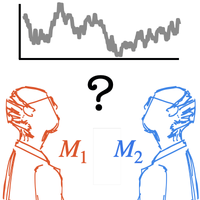
From the diffusion of particles to the growth of forests, capturing the randomness of complex systems often relies on simple, interpretable mathematical models. We introduce a path-inference framework combining Monte Carlo sampling with information-theoretic tools to establish how data collection protocols govern parameter precision and model discrimination. Our approach reveals sharp, resolution-dependent limits beyond which mathematically distinct models become empirically indistinguishable. Testing this framework across data from optically trapped particles, human microbiome dynamics, social-media topic mentions, and forest population datasets allows us to identify optimal sampling regimes and clarify ongoing debates regarding dominant noise sources. Ultimately, these results establish principled limits of inference in complex systems and provide guidelines for experimental design to maximize the information retrieved from real-world data.
Article Text
References (118)
- M. S. Boyce, Population viability analysis, Annu. Rev. Ecol. Syst. 23, 481 (1992).
- R. Lande, S. Engen, and B.-E. Saether, Stochastic Population Dynamics in Ecology and Conservation (Oxford University Press, New York, 2003).
- S. Azaele, S. Suweis, J. Grilli, I. Volkov, J. R. Banavar, and A. Maritan, Statistical mechanics of ecological systems: Neutral theory and beyond, Rev. Mod. Phys. 88, 035003 (2016).
- I. Akjouj, M. Barbier, M. Clenet, W. Hachem, M. Maïda, F. Massol, J. Najim, and V. C. Tran, Complex systems in ecology: A guided tour with large Lotka–Volterra models and random matrices, Proc. R. Soc. A 480, 20230284 (2024).
- M. E. J. Newman, Spread of epidemic disease on networks, Phys. Rev. E 66, 016128 (2002).
- N. M. Ferguson, D. A. T. Cummings, S. Cauchemez, C. Fraser, S. Riley, A. Meeyai, S. Iamsirithaworn, and D. S. Burke, Strategies for containing an emerging influenza pandemic in southeast asia, Nature (London) 437, 209 (2005).
- R. Pastor-Satorras, C. Castellano, P. Van Mieghem, and A. Vespignani, Epidemic processes in complex networks, Rev. Mod. Phys. 87, 925 (2015).
- K. C. Chan, G. A. Karolyi, F. A. Longstaff, and A. B. Sanders, An empirical comparison of alternative models of the short-term interest rate, J. Finance 47, 1209 (1992).
- Stochastic Processes for Insurance & Finance, edited by T. Rolski, H. Schmidli, V. Schmidt, and J. Teugels (John Wiley & Sons, Inc., New York, 1999).
- S. Manabe and R. T. Wetherald, Thermal equilibrium of the atmosphere with a given distribution of relative humidity, J. Atmos. Sci. 24, 241 (1967).
- K. Hasselmann, Stochastic climate models: Part I. Theory, Tellus A 28, 473 (1976).
- V. Lucarini and T. Bódai, Transitions across melancholia states in a climate model: Reconciling the deterministic and stochastic points of view, Phys. Rev. Lett. 122, 158701 (2019).
- A. R. Ravishankara, D. A. Randall, and J. W. Hurrell, Complex and yet predictable: The message of the 2021 nobel prize in physics, Proc. Natl. Acad. Sci. U.S.A. 119, e2120669119 (2022).
- G. Bianconi, A. Arenas, J. Biamonte, L. D. Carr, B. Kahng, J. Kertesz, J. Kurths, L. Lü, C. Masoller, A. E. Motter, M. Perc, F. Radicchi, R. Ramaswamy, F. A. Rodrigues, M. Sales-Pardo, M. San Miguel, S. Thurner, and T. Yasseri, Complex systems in the spotlight: Next steps after the 2021 nobel prize in physics, J. Phys. 4, 010201 (2023).
- J. L. McClelland, Profile of John Hopfield and Geoffrey Hinton: 2024 nobel laureates in physics, Proc. Natl. Acad. Sci. U.S.A. 122, e2423094122 (2025).
- S. Cocco, S. Leibler, and R. Monasson, Neuronal couplings between retinal ganglion cells inferred by efficient inverse statistical physics methods, Proc. Natl. Acad. Sci. U.S.A. 106, 14058 (2009).
- S. Cocco, R. Monasson, and F. Zamponi, From Statistical Physics to Data-Driven Modelling (Oxford University Press, Oxford, 2022).
- L. Arola-Fernández and L. Lacasa, Effective theory of collective deep learning, Phys. Rev. Res. 6, L042040 (2024).
- B. Harris, L. L. Gollo, and B. D. Fulcher, Tracking the distance to criticality in systems with unknown noise, Phys. Rev. X 14, 031021 (2024).
- H. Sørensen, Parametric inference for diffusion processes observed at discrete points in time: A survey, Int. Stat. Rev. 72, 337 (2004).
- S. M. Iacus, Simulation and Inference for Stochastic Differential Equations (Springer, New York, 2008), Vol. 1.
- P. Craigmile, R. Herbei, G. Liu, and G. Schneider, Statistical inference for stochastic differential equations, WIREs Comput. Stat. 15, e1585 (2023).
- R. Guimerà, I. Reichardt, A. Aguilar-Mogas, F. A. Massucci, M. Miranda, J. Pallarès, and M. Sales-Pardo, A Bayesian machine scientist to aid in the solution of challenging scientific problems, Sci. Adv. 6, eaav6971 (2020).
- A. Frishman and P. Ronceray, Learning force fields from stochastic trajectories, Phys. Rev. X 10, 021009 (2020).
- A. Picot, S. Shibasaki, O. J. Meacock, and S. Mitri, Microbial interactions in theory and practice: When are measurements compatible with models?, Curr. Opin. Microbiol. 75, 102354 (2023).
- K. Z. Coyte, J. Schluter, and K. R. Foster, The ecology of the microbiome: Networks, competition, and stability, Science 350, 663 (2015).
- T. Hoshino, H. Doi, G.-I. Uramoto, L. Wörmer, R. R. Adhikari, N. Xiao, Y. Morono, S. D’Hondt, K.-U. Hinrichs, and F. Inagaki, Global diversity of microbial communities in marine sediment, Proc. Natl. Acad. Sci. U.S.A. 117, 27587 (2020).
- J. Pasqualini, A. Maritan, A. Rinaldo, S. Facchin, E. Savarino, A. Altieri, and S. Suweis, complex microbial interactions and dysbiosis through a disordered Lotka–Volterra model, eLife 14, RP105948 (2025).
- E. Ser-Giacomi, L. Zinger, S. Malviya, C. D. Vargas, E. Karsenti, C. Bowler, and S. D. Monte, Ubiquitous abundance distribution of non-dominant plankton across the global ocean, Nat. Ecol. Evol. 2, 1243 (2018).
- J. Grilli, Macroecological laws describe variation and diversity in microbial communities, Nat. Commun. 11, 4743 (2020).
- L. Descheemaeker and S. De Buyl, Stochastic logistic models reproduce experimental time series of microbial communities, eLife 9, e55650 (2020).
- M. Sireci, M. A. Muñoz, and J. Grilli, Environmental fluctuations explain the universal decay of species-abundance correlations with phylogenetic distance, Proc. Natl. Acad. Sci. U.S.A. 120, e2217144120 (2023).
- E. Brigatti and S. Azaele, Growth-rate distributions of gut microbiota time series, Sci. Rep. 15, 2789 (2025).
- M. A. Muñoz, Nature of different types of absorbing states, Phys. Rev. E 57, 1377 (1998).
- E.-L. Florin, A. Pralle, E. H. K. Stelzer, and J. K. H. Hörber, Photonic force microscope calibration by thermal noise analysis, Appl. Phys. A 66, S75 (1998).
- K. Berg-Sørensen and H. Flyvbjerg, Power spectrum analysis for optical tweezers, Rev. Sci. Instrum. 75, 594 (2004).
- T. Franosch, M. Grimm, M. Belushkin, F. M. Mor, G. Foffi, L. Forró, and S. Jeney, Resonances arising from hydrodynamic memory in Brownian motion, Nature (London) 478, 85 (2011).
- G. Volpe and D. Petrov, Torque detection using Brownian fluctuations, Phys. Rev. Lett. 97, 210603 (2006).
- G. Volpe, G. Volpe, and D. Petrov, Brownian motion in a nonhomogeneous force field and photonic force microscope, Phys. Rev. E 76, 061118 (2007).
- S. Morita, Six susceptible-infected-susceptible models on scale-free networks, Sci. Rep. 6, 22506 (2016).
- A. B. George and J. O’Dwyer, Universal abundance fluctuations across microbial communities, tropical forests, and urban populations, Proc. Natl. Acad. Sci. U.S.A. 120, e2215832120 (2023).
- J. Aguilar, B. A. García, R. Toral, S. Meloni, and J. J. Ramasco, Endemic infectious states below the epidemic threshold and beyond herd immunity, Commun. Phys. 6, 187 (2023).
- L. Di Domenico, E. Valdano, and V. Colizza, Limited data on infectious disease distribution exposes ambiguity in epidemic modeling choices, Phys. Rev. Res. 6, 023265 (2024).
- B. D. Fulcher, M. A. Little, and N. S. Jones, Highly comparative time-series analysis: The empirical structure of time series and their methods, J. R. Soc. Interface 10, 20130048 (2013).
- B. D. Fulcher and N. S. Jones, hctsa: A computational framework for automated time-series phenotyping using massive feature extraction, Cell Syst. 5, 527 (2017).
- K. P. Burnham and D. R. Anderson, Model Selection and Multimodel Inference: A Practical Information-Theoretic Approach, 2nd ed. (Springer, New York, 2010).
- S. Asmussen and P. W. Glynn, Stochastic Simulation: Algorithms and Analysis, Vol. 57 (Springer, New York, 2007), p. 476.
- F. C. Klebaner, Introduction to Stochastic Calculus with Applications (Imperial College Press, London, 2012).
- S. N. Majumdar and H. Orland, Effective Langevin equations for constrained stochastic processes, J. Stat. Mech. (2015) P06039.
- J. Aguilar, J. W. Baron, T. Galla, and R. Toral, Sampling rare trajectories using stochastic bridges, Phys. Rev. E 105, 064138 (2022).
- J. Aguilar and R. Gatto, Unified perspective on exponential tilt and bridge algorithms for rare trajectories of discrete Markov processes, Phys. Rev. E 109, 034113 (2024).
- L. Lacasa, I. P. Mariño, J. Míguez, V. Nicosia, E. Roldán, A. Lisica, S. W. Grill, and J. Gómez-Gardeñes, Multiplex decomposition of non-Markovian dynamics and the hidden layer reconstruction problem, Phys. Rev. X 8, 031038 (2018).
- V. Martínez, F. Berzal, and J.-C. Cubero, A survey of link prediction in complex networks, ACM Comput. Surv. 49, 1 (2017).
- M. Scanagatta, A. Salmerón, and F. Stella, A survey on Bayesian network structure learning from data, Prog. Artif. Intell. 8, 425 (2019).
- M. B. Hastings, Community detection as an inference problem, Phys. Rev. E 74, 035102(R) (2006).
- T. P. Peixoto, Network reconstruction and community detection from dynamics, Phys. Rev. Lett. 123, 128301 (2019).
- A. Gerardos and P. Ronceray, Principled model selection for stochastic dynamics, Phys. Rev. Lett. 135, 167401 (2025).
- P. E. Harunari, A. Dutta, M. Polettini, and É. Roldán, What to learn from a few visible transitions’ statistics?, Phys. Rev. X 12, 041026 (2022).
- J. H. Lawton, Are there general laws in ecology?, Oikos 84, 177 (1999).
- J. Aguilar, J. J. Ramasco, and R. Toral, Biased versus unbiased numerical methods for stochastic simulations, Commun. Phys. 7, 155 (2024).
- J. G. Caporaso, C. L. Lauber, E. K. Costello, D. Berg-Lyons, A. Gonzalez, J. Stombaugh, D. Knights, P. Gajer, J. Ravel, N. Fierer et al., Moving pictures of the human microbiome, Genome Biol. 12, 1 (2011).
- N. G. van Kampen, Itô versus Stratonovich, J. Stat. Phys. 24, 175 (1981).
- C. W. Gardiner and, C. W. Gardiner, Handbook of Stochastic Methods for Physics, Chemistry and the Natural Sciences, Springer-Verlag, Berlin, Heidelberg, New York, Tokyo 1983. 442 Seiten, Preis: DM 115,-, Ber. Bunsengesellschaft Phys. Chem. 89, 721 (1985).
- H. Risken and T. K. Caugheyz, The Fokker-Planck equation: Methods of solution and application, 2nd ed., J. Appl. Mech. 58, 860 (1991).
- N. V. Kampen, Stochastic Processes in Physics and Chemistry (North-Holland, Amsterdam, 2007).
- J. Ross, T. Taimre, and P. Pollett, On parameter estimation in population models, Theor. Popul. Biol. 70, 498 (2006).
We adopt Itô calculus to derive Eq. (2), but any interpretation of the noise could be used; the Stratonovich-Itô conversion [62] is absorbed into the definition of .
- W. Paul and J. Baschnagel, Stochastic Processes (Springer International Publishing, New York, 2013), pp. 258–278.
- J. E. Goldford, N. Lu, D. Bajić, S. Estrela, M. Tikhonov, A. Sanchez-Gorostiaga, D. Segrè, P. Mehta, and A. Sanchez, Emergent simplicity in microbial community assembly, Science 361, 469 (2018).
- Y. Cai, J. Jiao, Z. Gui, Y. Liu, and W. Wang, Environmental variability in a stochastic epidemic model, Appl. Math. Comput. 329, 210 (2018).
- W. Feller, Two singular diffusion problems, Ann. Math. 54, 173 (1951).
- S. di Santo, P. Villegas, R. Burioni, and M. A. Muñoz, Simple unified view of branching process statistics: Random walks in balanced logarithmic potentials, Phys. Rev. E 95, 032115 (2017).
- M. Henkel, H. Hinrichsen, and S. Lübeck, Non-Equilibrium Phase Transitions, Vol. 53 (Springer, Netherlands, 2008).
- S. Azaele, S. Pigolotti, J. R. Banavar, and A. Maritan, Dynamical evolution of ecosystems, Nature (London) 444, 926 (2006).
- I. Dornic, H. Chaté, and M. A. Muñoz, Integration of Langevin equations with multiplicative noise and the viability of field theories for absorbing phase transitions, Phys. Rev. Lett. 94, 100601 (2005).
- T. Kiorboe, A mechanistic approach to plankton ecology, ASLO Web Lect. 1, 1 (2009).
- I. A. Hatton, O. Mazzarisi, A. Altieri, and M. Smerlak, Diversity begets stability: Sublinear growth and competitive coexistence across ecosystems, Science 383, eadg8488 (2024).
- G. Aguadé-Gorgorió, I. Lajaaiti, J. Arnoldi, and S. Kéfi, Unpacking sublinear growth: Diversity, stability and coexistence, Oikos 2025, e10980 (2025).
- J. Camacho-Mateu, A. Lampo, M. Castro, and J. A. Cuesta, Microbial populations hardly ever grow logistically and never sublinearly, Phys. Rev. E 111, 044404 (2025).
Throughout the text, denotes the sampling interval, i.e., the time between consecutive observations. This should not be confused with the temporal discretization used to generate sample paths from Eq. (2).
- G. A. Pavliotis, Stochastic Processes and Applications (Springer, New York, 2014), Vol. 60.
- D. Bernardi and B. Lindner, Receiver operating characteristic curves for a simple stochastic process that carries a static signal, Phys. Rev. E 101, 062132 (2020).
- O. Fajardo-Fontiveros, I. Reichardt, H. R. De Los Ríos, J. Duch, M. Sales-Pardo, and R. Guimerà, Fundamental limits to learning closed-form mathematical models from data, Nat. Commun. 14, 1043 (2023).
- M. Unser, Sampling-50 years after Shannon, Proc. IEEE 88, 569 (2000).
- A. V. Oppenheim and R. W. Schafer, Discrete-Time Signal Processing, 3rd ed., Pearson New International Edition, Always Learning (Pearson, Harlow, 2014).
- A. Gelman, J. B. Carlin, H. S. Stern, and D. B. Rubin, Bayesian Data Analysis (Chapman and Hall/CRC, London, 1995).
- R. Bassett and J. Deride, Maximum a posteriori estimators as a limit of Bayes estimators, Math. Program. 174, 129 (2019).
- S. Van Dongen, Prior specification in Bayesian statistics: Three cautionary tales, J. Theor. Biol. 242, 90 (2006).
- G. D. Rossi, Maximum likelihood estimation of the cox–ingersoll–ross model using particle filters, Comput. Econ. 36, 1 (2010).
- F. Langouche, D. Roekaerts, and E. Tirapegui, Functional Integration and Semiclassical Expansions (Springer, Netherlands, 1982).
- H. S. Wio, Path Integrals for Stochastic Processes (World Scientific, Singapore, 2013), Vol. 13, pp. 15–38.
- F. Ferretti, V. Chardès, T. Mora, A. M. Walczak, and I. Giardina, Building general Langevin models from discrete datasets, Phys. Rev. X 10, 031018 (2020).
- R. Toral and P. Colet, Stochastic Numerical Methods, edited by R. Toral and P. Colet (Wiley, New York, 2014), Vol. 111, pp. 1009–1010.
Mathematically, needs to be absolutely continuous with respect to , which implies that the support of the process includes (or coincides with) that of the process [47, 51, 68].
In particular, the absolute-continuity constraint can be relaxed at the cost of introducing bias [51]. Moreover, the auxiliary process need not belong to any particular class [22].
- R. Chetrite and H. Touchette, Nonequilibrium microcanonical and canonical ensembles and their equivalence, Phys. Rev. Lett. 111, 120601 (2013).
- R. Chetrite and H. Touchette, Nonequilibrium Markov processes conditioned on large deviations, Ann. Henri Poincaré 16, 2005 (2015).
- C. Dellago, P. G. Bolhuis, F. S. Csajka, and D. Chandler, Transition path sampling and the calculation of rate constants, J. Chem. Phys. 108, 1964 (1998).
- H. Orland, Generating transition paths by Langevin bridges, J. Chem. Phys. 134, 174114 (2011).
- L. Causer, K. Sfairopoulos, J. F. Mair, and J. P. Garrahan, Rejection-free quantum Monte Carlo in continuous time from transition path sampling, Phys. Rev. B 109, 024307 (2024).
- M. Ibáñez, C. Dieball, A. Lasanta, A. Godec, and R. A. Rica, Heating and cooling are fundamentally asymmetric and evolve along distinct pathways, Nat. Phys. 20, 135 (2024).
- X. Chen, K. Crocker, S. Kuehn, A. M. Walczak, and T. Mora, Inferring resource competition in microbial communities from time series, PRX Life 3, 023019 (2025).
- A. Zubiaga, A longitudinal assessment of the persistence of twitter datasets, J. Assoc. Inf. Sci. Technol. 69, 974 (2018).
- C. A. Plata, E. Pigani, S. Azaele, V. Calleja-Solanas, M. J. Palazzi, A. Solé-Ribalta, J. Borge-Holthoefer, S. Meloni, and S. Suweis, Neutral theory for competing attention in social networks, Phys. Rev. Res. 3, 013070 (2021).
- R. Condit, R. Pérez, S. Aguilar, S. Lao, R. Foster, and S. Hubbell, Complete data from the barro colorado 50-ha plot: 423617 trees, 35 years (2019), 10.15146/5xcp-0d46.
- Y. Ait-Sahalia, Maximum likelihood estimation of discretely sampled diffusions: A closed-form approximation approach, Econometrica 70, 223 (2002).
- Y. Aït-Sahalia and R. L. Kimmel, Estimating affine multifactor term structure models using closed-form likelihood expansions, J. Financ. Econom. 98, 113 (2010).
- C. Albert, S. Ulzega, and R. Stoop, Boosting Bayesian parameter inference of nonlinear stochastic differential equation models by Hamiltonian scale separation, Phys. Rev. E 93, 043313 (2016).
- P. Maragakis, F. Ritort, C. Bustamante, M. Karplus, and G. E. Crooks, Bayesian estimates of free energies from nonequilibrium work data in the presence of instrument noise, J. Chem. Phys. 129, 024102 (2008).
- T. Toni, D. Welch, N. Strelkowa, A. Ipsen, and M. P. Stumpf, Approximate Bayesian computation scheme for parameter inference and model selection in dynamical systems, J. R. Soc. Interface 6, 187 (2009).
- R. N. Gutenkunst, J. J. Waterfall, F. P. Casey, K. S. Brown, C. R. Myers, and J. P. Sethna, Universally sloppy parameter sensitivities in systems biology models, PLoS Comput. Biol. 3, 1871 (2007).
- M. Castro, S. U. Ares, J. José, J. A. Cuesta, and S. Manrubia, The turning point and end of an expanding epidemic cannot be precisely forecast, Proc. Natl. Acad. Sci. U.S.A. 117, 26190 (2020).
- J. Aguilar, The limits of inference in complex systems: When stochastic models become indistinguishable, https://github.com/jvrglr/The_Limits_of_Inference_in_Complex_Systems-When_Stochastic_Models_Become_Indistinguishable (2025), gitHub repository.
- S. R. S. Varadhan, M. I. Freidlin, and A. D. Wentzell, Random perturbations of dynamical systems., J. Am. Stat. Assoc. 80, 490 (1985).
- E. Roldán, I. Neri, R. Chetrite, S. Gupta, S. Pigolotti, F. Jülicher, and K. Sekimoto, Martingales for physicists: A treatise on stochastic thermodynamics and beyond, Adv. Phys. 72, 1 (2023).
- L. Onsager and S. Machlup, Fluctuations and irreversible processes, Phys. Rev. 91, 1505 (1953).
- P. Arnold, Symmetric path integrals for stochastic equations with multiplicative noise, Phys. Rev. E 61, 6099 (2000).
- A. A. Dubkov, A. N. Malakhov, and A. I. Saichev, Correlation time and structure of the correlation function of nonlinear equilibrium Brownian motion in arbitrary-shaped potential wells, Radiophys. Quantum Electron. 43, 335 (2000).

