

- Open Access
Revealing Electron-Ytterbium Interactions through Rydberg Molecular Spectroscopy
Phys. Rev. X 16, 031045 – Published 20 August, 2026
DOI: https://doi.org/10.1103/tjv3-485v
Abstract
Divalent atoms have emerged as powerful alternatives to alkalis in ultracold atom platforms, offering unique advantages arising from their two-electron structure. Among these species, ytterbium (Yb) is especially promising, yet its anionic properties and its Rydberg spectrum remain comparatively unexplored. In this work, we perform a comprehensive experimental and theoretical investigation of ultralong-range Rydberg molecules (ULRMs) of in Rydberg states across nearly two decades in principal quantum number and 3 orders of magnitude in molecular binding energy. Using the Coulomb Green’s function formalism, we compute Born-Oppenheimer molecular potentials describing the Rydberg atom in the presence of a ground-state perturber and achieve quantitative agreement with high-resolution molecular spectra. This enables the extraction of low-energy electron-Yb scattering phase shifts, including the zero-energy -wave scattering length and the positions of two spin-orbit split -wave shape resonances. Our results provide strong evidence that the anion exists only as a metastable resonance. We additionally show the sensitivity of ULRM spectra to the atomic quantum defects, using this to determine the quantum defect of the state. Together, these findings establish Yb ULRMs as a powerful probe of electron-Yb interactions and lay essential groundwork for future Rydberg experiments with divalent atoms.
Physics Subject Headings (PhySH)
Popular Summary
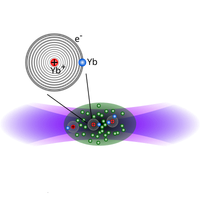
Ultralong-range Rydberg molecules are giant bound states formed when a highly excited atom weakly attracts a ground-state atom, creating a system whose vibrational states are extremely sensitive to fundamental atomic properties. By combining precision molecular spectroscopy of ytterbium Rydberg molecules across a broad range of binding energies with theoretical modeling, we determine foundational properties of this multivalent atom. We extract previously inaccessible low-energy electron scattering phase shifts and demonstrate that the negative ytterbium ion exists as a short-lived metastable resonance rather than a stable bound state. Furthermore, we leverage the extreme sensitivity of these weakly bound molecules to atomic energy levels to refine the precise energy of an atomic state that resists conventional laser spectroscopy. We establish such molecular systems as powerful probes of electron interactions and atomic structure, providing essential groundwork for future experiments with divalent atoms.
Article Text
References (115)
- C. S. Adams, J. D. Pritchard, and J. P. Shaffer, Rydberg atom quantum technologies, J. Phys. B 53, 012002 (2019).
- F. B. Dunning, T. C. Killian, S. Yoshida, and J. Burgdörfer, Recent advances in Rydberg physics using alkaline-earth atoms, J. Phys. B 49, 112003 (2016).
- E. Ibarra-García-Padilla and S. Choudhury, Many-body physics of ultracold alkaline-earth atoms with SU(N)-symmetric interactions, J. Phys. Condens. Matter 37, 083003 (2024).
- H. Katori, Optical lattice clocks and quantum metrology, Nat. Photonics 5, 203 (2011).
- A. D. Ludlow, M. M. Boyd, J. Ye, E. Peik, and P. O. Schmidt, Optical atomic clocks, Rev. Mod. Phys. 87, 637 (2015).
- N. Hinkley, J. A. Sherman, N. B. Phillips, M. Schioppo, N. D. Lemke, K. Beloy, M. Pizzocaro, C. W. Oates, and A. D. Ludlow, An atomic clock with instability, Science 341, 1215 (2013).
- B. J. Bloom, T. L. Nicholson, J. R. Williams, S. L. Campbell, M. Bishof, X. Zhang, W. Zhang, S. L. Bromley, and J. Ye, An optical lattice clock with accuracy and stability at the level, Nature (London) 506, 71 (2014).
- I. S. Madjarov, A. Cooper, A. L. Shaw, J. P. Covey, V. Schkolnik, T. H. Yoon, J. R. Williams, and M. Endres, An atomic-array optical clock with single-atom readout, Phys. Rev. X 9, 041052 (2019).
- A. J. Daley, M. M. Boyd, J. Ye, and P. Zoller, Quantum computing with alkaline-earth-metal atoms, Phys. Rev. Lett. 101, 170504 (2008).
- I. S. Madjarov, J. P. Covey, A. L. Shaw, J. Choi, A. Kale, A. Cooper, H. Pichler, V. Schkolnik, J. R. Williams, and M. Endres, High-fidelity entanglement and detection of alkaline-earth Rydberg atoms, Nat. Phys. 16, 857 (2020).
- A. P. Burgers, S. Ma, S. Saskin, J. Wilson, M. A. Alarcón, C. H. Greene, and J. D. Thompson, Controlling Rydberg excitations using ion-core transitions in alkaline-earth atom-tweezer arrays, PRX Quantum 3, 020326 (2022).
- Z. Jia, W. Huie, L. Li, W. K. C. Sun, X. Hu, Aakash, H. Kogan, A. Karve, J. Y. Lee, and J. P. Covey, An architecture for two-qubit encoding in neutral ytterbium-171 atoms, npj Quantum Inf. 10, 106 (2024).
- K.-L. Pham, T. F. Gallagher, P. Pillet, S. Lepoutre, and P. Cheinet, Coherent light shift on alkaline-earth Rydberg atoms from isolated core excitation without autoionization, PRX Quantum 3, 020327 (2022).
- M. Wirth, C. Hölzl, A. Götzelmann, E. Pultinevicius, and F. Meinert, Quadrupole coupling of circular Rydberg qubits to inner shell excitations, Phys. Rev. Lett. 133, 123403 (2024).
- C. Hölzl, A. Götzelmann, E. Pultinevicius, M. Wirth, and F. Meinert, Long-lived circular Rydberg qubits of alkaline-earth atoms in optical tweezers, Phys. Rev. X 14, 021024 (2024).
- A. Bouillon, E. Marin-Bujedo, and M. Génévriez, Direct laser cooling of Rydberg atoms with an isolated-core transition, Phys. Rev. Lett. 132, 193402 (2024).
- S. N. Pisharody and R. R. Jones, Probing two-electron dynamics of an atom, Science 303, 813 (2004).
- J. Millen, G. Lochead, G. R. Corbett, R. M. Potvliege, and M. P. A. Jones, Spectroscopy of a cold strontium Rydberg gas, J. Phys. B 44, 184001 (2011).
- G. Lochead, D. Boddy, D. P. Sadler, C. S. Adams, and M. P. A. Jones, Number-resolved imaging of excited-state atoms using a scanning autoionization microscope, Phys. Rev. A 87, 053409 (2013).
- F. Hummel, S. Weber, J. Mögerle, H. Menke, J. King, B. Bloom, S. Hofferberth, and M. Li, Engineering Rydberg-pair interactions in divalent atoms with hyperfine-split ionization thresholds, Phys. Rev. A 110, 042821 (2024).
- G. Pagano, F. Scazza, and M. Foss-Feig, Fast and scalable quantum information processing with two-electron atoms in optical tweezer arrays, Adv. Quantum Technol. 2, 1800067 (2019).
- A. Pagano, S. Weber, D. Jaschke, T. Pfau, F. Meinert, S. Montangero, and H. P. Büchler, Error budgeting for a controlled-phase gate with strontium-88 Rydberg atoms, Phys. Rev. Res. 4, 033019 (2022).
- M. Aymar, C. H. Greene, and E. Luc-Koenig, Multichannel Rydberg spectroscopy of complex atoms, Rev. Mod. Phys. 68, 1015 (1996).
- M. Aymar, A. Debarre, and O. Robaux, Highly excited levels of neutral ytterbium. II. Multichannel quantum defect analysis of odd- and even-parity spectra, J. Phys. B 13, 1089 (1980).
- H. Lehec, A. Zuliani, W. Maineult, E. Luc-Koenig, P. Pillet, P. Cheinet, F. Niyaz, and T. F. Gallagher, Laser and microwave spectroscopy of even-parity Rydberg states of neutral ytterbium and multichannel-quantum-defect-theory analysis, Phys. Rev. A 98, 062506 (2018).
- M. Peper, Y. Li, D. Y. Knapp, M. Bileska, S. Ma, G. Liu, P. Peng, B. Zhang, S. P. Horvath, A. P. Burgers, and J. D. Thompson, Spectroscopy and modeling of Rydberg states for high-fidelity two-qubit gates, Phys. Rev. X 15, 011009 (2025).
- R. Kuroda, V. M. Hughes, M. Poitrinal, M. Peper, and J. D. Thompson, Microwave spectroscopy and multichannel quantum defect analysis of ytterbium , , and Rydberg states, Phys. Rev. A 112, 042817 (2025).
- T. Andersen, Atomic negative ions: Structure, dynamics and collisions, Phys. Rep. 394, 157 (2004).
- J. Mitroy, M. S. Safronova, and C. W. Clark, Theory and applications of atomic and ionic polarizabilities, J. Phys. B 43, 202001 (2010).
- M. K. Kristiansson, K. Chartkunchand, G. Eklund, O. M. Hole, E. K. Anderson, N. de Ruette, M. Kamińska, N. Punnakayathil, J. E. Navarro-Navarrete, S. Sigurdsson et al., High-precision electron affinity of oxygen, Nat. Commun. 13, 5906 (2022).
- A. O. Lindahl, J. Rohlén, H. Hultgren, I. Y. Kiyan, D. J. Pegg, C. W. Walter, and D. Hanstorp, Threshold photodetachment in a repulsive potential, Phys. Rev. Lett. 108, 033004 (2012).
- H. Saßmannshausen, F. Merkt, and J. Deiglmayr, Experimental Characterization of singlet scattering channels in long-range Rydberg molecules, Phys. Rev. Lett. 114, 133201 (2015).
- F. Engel, T. Dieterle, T. Schmid, C. Tomschitz, C. Veit, N. Zuber, R. Löw, T. Pfau, and F. Meinert, Observation of Rydberg blockade induced by a single ion, Phys. Rev. Lett. 121, 193401 (2018).
- M. Peper and J. Deiglmayr, Heteronuclear long-range Rydberg molecules, Phys. Rev. Lett. 126, 013001 (2021).
- M. Exner, R. Srikumar, R. Blättner, M. T. Eiles, P. Schmelcher, and H. Ott, High precision spectroscopy of trilobite Rydberg molecules, Phys. Rev. Lett. 134, 223401 (2025).
- P. Giannakeas, M. T. Eiles, F. Robicheaux, and J. M. Rost, Dressed ion-pair states of an ultralong-range Rydberg molecule, Phys. Rev. Lett. 125, 123401 (2020).
- C. H. Greene, A. S. Dickinson, and H. R. Sadeghpour, Creation of polar and nonpolar ultra-long-range Rydberg molecules, Phys. Rev. Lett. 85, 2458 (2000).
- E. L. Hamilton, C. H. Greene, and H. Sadeghpour, Shape-resonance-induced long-range molecular Rydberg states, J. Phys. B 35, L199 (2002).
- M. Chibisov, A. Khuskivadze, and I. Fabrikant, Energies and dipole moments of long-range molecular Rydberg states, J. Phys. B 35, L193 (2002).
- V. Bendkowsky, B. Butscher, J. Nipper, J. P. Shaffer, R. Löw, and T. Pfau, Observation of ultralong-range Rydberg molecules, Nature (London) 458, 1005 (2009).
- V. Bendkowsky, B. Butscher, J. Nipper, J. B. Balewski, J. P. Shaffer, R. Löw, T. Pfau, W. Li, J. Stanojevic, T. Pohl, and J. M. Rost, Rydberg trimers and excited dimers bound by internal quantum reflection, Phys. Rev. Lett. 105, 163201 (2010).
- B. Butscher, J. Nipper, J. B. Balewski, L. Kukota, V. Bendkowsky, R. Löw, and T. Pfau, Atom–molecule coherence for ultralong-range Rydberg dimers, Nat. Phys. 6, 970 (2010).
- D. Booth, S. T. Rittenhouse, J. Yang, H. R. Sadeghpour, and J. P. Shaffer, Production of trilobite Rydberg molecule dimers with kilo-Debye permanent electric dipole moments, Science 348, 99 (2015).
- J. P. Shaffer, S. T. Rittenhouse, and H. R. Sadeghpour, Ultracold Rydberg molecules, Nat. Commun. 9, 1965 (2018).
- M. T. Eiles, Trilobites, butterflies, and other exotic specimens of long-range Rydberg molecules, J. Phys. B 52, 113001 (2019).
- C. Fey, F. Hummel, and P. Schmelcher, Ultralong-range Rydberg molecules, Mol. Phys. 118, e1679401 (2020).
- F. B. Dunning, S. K. Kanungo, and S. Yoshida, Ultralong-range Rydberg molecules, J. Phys. B 57, 212002 (2024).
- T. Niederprüm, O. Thomas, T. Eichert, C. Lippe, J. Pérez-Ríos, C. H. Greene, and H. Ott, Observation of pendular butterfly Rydberg molecules, Nat. Commun. 7, 12820 (2016).
- M. Deiß, S. Haze, J. Wolf, L. Wang, F. Meinert, C. Fey, F. Hummel, P. Schmelcher, and J. Hecker Denschlag, Observation of spin-orbit-dependent electron scattering using long-range Rydberg molecules, Phys. Rev. Res. 2, 013047 (2020).
- B. J. DeSalvo, J. A. Aman, F. B. Dunning, T. C. Killian, H. R. Sadeghpour, S. Yoshida, and J. Burgdörfer, Ultra-long-range Rydberg molecules in a divalent atomic system, Phys. Rev. A 92, 031403(R) (2015).
- T. Manthey, T. Niederprüm, O. Thomas, and H. Ott, Dynamically probing ultracold lattice gases via Rydberg molecules, New J. Phys. 17, 103024 (2015).
- A. Guttridge, T. R. Hepworth, D. K. Ruttley, Aileen A. Durst, M. T. Eiles, and S. L. Cornish, Individual assembly of two-species Rydberg molecules using optical tweezers, Phys. Rev. Lett. 134, 133401 (2025).
- I. I. Fabrikant and V. S. Lebedev, Quenching of Rydberg states by atoms with small electron affinities, J. Phys. B 33, 1521 (2000).
- M. Reicherts, T. Roth, A. Gopalan, M.-W. Ruf, H. Hotop, C. Desfrançois, and I. I. Fabrikant, Controlled formation of weakly bound atomic negative ions by electron transfer from state-selected Rydberg atoms, Europhys. Lett. 40, 129 (1997).
- C. Desfrancois, B. Baillon, J. P. Schermann, S. T. Arnold, J. H. Hendricks, and K. H. Bowen, Prediction and observation of a new, ground state, dipole-bound dimer anion: The mixed water/ammonia system, Phys. Rev. Lett. 72, 48 (1994).
- C. Desfrançois, H. Abdoul-Carime, N. Khelifa, and J. P. Schermann, From to potentials: Electron exchange between Rydberg atoms and polar molecules, Phys. Rev. Lett. 73, 2436 (1994).
- M. Schlagmüller, T. C. Liebisch, F. Engel, K. S. Kleinbach, F. Böttcher, U. Hermann, K. M. Westphal, A. Gaj, R. Löw, S. Hofferberth, T. Pfau, J. Pérez-Ríos, and C. H. Greene, Ultracold chemical reactions of a single Rydberg atom in a dense gas, Phys. Rev. X 6, 031020 (2016).
- R. Srikumar, M. Exner, R. Blättner, P. Schmelcher, M. T. Eiles, and H. Ott, Vibrationally highly excited trilobite molecules stabilized by nonadiabatic coupling, Phys. Rev. Res. 7, 043103 (2025).
- M. Deiß, S. Haze, and J. Hecker Denschlag, Long-range atom–ion Rydberg molecule: A novel molecular binding mechanism, Atoms 9, 34 (2021).
- A. Duspayev, X. Han, M. A. Viray, L. Ma, J. Zhao, and G. Raithel, Long-range Rydberg-atom–ion molecules of Rb and Cs, Phys. Rev. Res. 3, 023114 (2021).
- N. Zuber, V. S. V. Anasuri, M. Berngruber, Y.-Q. Zou, F. Meinert, R. Löw, and T. Pfau, Observation of a molecular bond between ions and Rydberg atoms, Nature (London) 605, 453 (2022).
- E. Fermi, Sopra lo spostamento per pressione delle righe elevate delle serie spettrali, Nuovo Cimento 11, 157 (1934).
- A. Omont, On the theory of collisions of atoms in Rydberg states with neutral particles, J. Phys. 38, 1343 (1977).
- Z. Idziaszek and T. Calarco, Pseudopotential method for higher partial wave scattering, Phys. Rev. Lett. 96, 013201 (2006).
- R. McEachran and M. Elford, The momentum transfer cross section and transport coefficients for low energy electrons in mercury, J. Phys. B 36, 427 (2003).
- K. Bartschat and H. Sadeghpour, Ultralow-energy electron scattering from alkaline-earth atoms: the scattering-length limit, J. Phys. B 36, L9 (2002).
- V. A. Dzuba and G. F. Gribakin, Correlation-potential method for negative ions and electron scattering, Phys. Rev. A 49, 2483 (1994).
- A. Gribakina, G. Gribakin, and V. Ivanov, The structure and photodetachment of the negative ion, Phys. Lett. A 168, 280 (1992).
- S. Vosko, J. Chevary, and I. Mayer, Predictions of stable in the state: The importance of spin-orbit coupling, J. Phys. B 24, L225 (1991).
- Z. Felfli, A. Z. Msezane, and D. Sokolovski, Resonances in low-energy electron elastic cross sections for lanthanide atoms, Phys. Rev. A 79, 012714 (2009).
- Z. Felfli and A. Z. Msezane, Low-energy electron elastic total cross sections for Ho, Er, Tm, Yb, Lu, and Hf atoms, Atoms 8, 17 (2020).
- A. Litherland, L. Kilius, M. Garwan, M.-J. Nadeau, and X.-L. Zhao, Observation of by accelerator mass spectrometry, J. Phys. B 24, L233 (1991).
- T. Andersen, H. Haugen, and H. Hotop, Binding energies in atomic negative ions: III, J. Phys. Chem. Ref. Data 28, 1511 (1999).
- V. A. Dzuba and G. F. Gribakin, low-lying shape resonance rather than a bound state, J. Phys. B 31, L483 (1998).
- S. M. O’Malley and D. R. Beck, Valence calculations of lanthanide anion binding energies: attachments to thresholds, Phys. Rev. A 78, 012510 (2008).
- H. Andersen, T. Andersen, and U. Pedersen, Search for stable or metastable negative Yb ions, J. Phys. B 31, 2239 (1998).
- M. Reicherts, Bildung Schwachgebundener Atomarer Negativer Ionen in Stößen Mit Zustandsselektierten Rydberg-Atomen, Doctoral thesis, Technische Universität Kaiserslautern, 2000.
- R. Ali, M. Yaseen, A. Nadeem, S. A. Bhatti, and M. A. Baig, Two-colour three-photon excitation of the and , Rydberg levels of Yb I, J. Phys. B 32, 953 (1999).
- M. Peper, Precision spectroscopy of ultracold Rydberg atoms and molecules, Doctoral thesis, ETH Zurich, 2020.
- P. Giannakeas, M. T. Eiles, F. Robicheaux, and J. M. Rost, Generalized local frame-transformation theory for ultralong-range Rydberg molecules, Phys. Rev. A 102, 033315 (2020).
- M. Tarana and R. Čurík, Adiabatic potential-energy curves of long-range Rydberg molecules: Two-electron R-matrix approach, Phys. Rev. A 93, 012515 (2016).
- D. A. Anderson, S. A. Miller, and G. Raithel, Photoassociation of long-range Rydberg molecules, Phys. Rev. Lett. 112, 163201 (2014).
- M. T. Eiles and C. H. Greene, Hamiltonian for the inclusion of spin effects in long-range Rydberg molecules, Phys. Rev. A 95, 042515 (2017).
- C. Fey, M. Kurz, P. Schmelcher, S. T. Rittenhouse, and H. R. Sadeghpour, A comparative analysis of binding in ultralong-range Rydberg molecules, New J. Phys. 17, 055010 (2015).
- C. H. Greene and M. T. Eiles, Green’s-function treatment of Rydberg molecules with spins, Phys. Rev. A 108, 042805 (2023).
- F. Engel, T. Dieterle, F. Hummel, C. Fey, P. Schmelcher, R. Löw, T. Pfau, and F. Meinert, Precision spectroscopy of negative-ion resonances in ultralong-range Rydberg molecules, Phys. Rev. Lett. 123, 073003 (2019).
- A. Wojciechowska, M. Tomza, and M. T. Eiles, Ultralong-range Rydberg molecules of Hg atoms, Phys. Rev. A 111, 042816 (2025).
- E. L. Hamilton, Photoionization, photodissociation, and long-range bond formation in molecular Rydberg states, Doctoral thesis, University of Colorado, 2003.
- Aileen A. T. Durst, M. Simić, N. Abraham, and M. T. Eiles, Nonadiabatic couplings as a stabilization mechanism in long-range Rydberg molecules, Phys. Rev. A 111, 032811 (2025).
- X. Wang, T. Muthu-Arachchige, T. Legrand, L. Müller, W. Alt, S. Hofferberth, and E. Uruñuela, Two-color ytterbium magneto-optical trap in a compact dual-chamber setup, Phys. Rev. Appl. 23, 014004 (2025).
- M. Kitagawa, K. Enomoto, K. Kasa, Y. Takahashi, R. Ciuryło, P. Naidon, and P. S. Julienne, Two-color photoassociation spectroscopy of ytterbium atoms and the precise determinations of -wave scattering lengths, Phys. Rev. A 77, 012719 (2008).
- A. Gaj, A. T. Krupp, J. B. Balewski, R. Löw, S. Hofferberth, and T. Pfau, From molecular spectra to a density shift in dense Rydberg gases, Nat. Commun. 5, 4546 (2014).
- F. Camargo, R. Schmidt, J. D. Whalen, R. Ding, G. Woehl, S. Yoshida, J. Burgdörfer, F. B. Dunning, H. R. Sadeghpour, E. Demler, and T. C. Killian, Creation of Rydberg Polarons in a Bose Gas, Phys. Rev. Lett. 120, 083401 (2018).
- C. Bahrim, I. I. Fabrikant, and U. Thumm, Boundary conditions for the Pauli equation: Application to photodetachment of , Phys. Rev. Lett. 87, 123003 (2001).
- C. Bahrim, U. Thumm, A. A. Khuskivadze, and I. I. Fabrikant, Near-threshold photodetachment of heavy alkali-metal anions, Phys. Rev. A 66, 052712 (2002).
These labels should not to be confused with and from Eq. (4).
- T. F. O’Malley, L. Rosenberg, and L. Spruch, Low-energy scattering of a charged particle by a neutral polarizable system, Phys. Rev. 125, 1300 (1962).
- T. F. O’Malley, Low-energy expansion of the scattering amplitude for long-range quadrupole potentials, Phys. Rev. 134, A1188 (1964).
- V. Dzuba and A. Derevianko, Dynamic polarizabilities and related properties of clock states of the ytterbium atom, J. Phys. B 43, 074011 (2010).
- S. Weber, C. Tresp, H. Menke, A. Urvoy, O. Firstenberg, H. P. Büchler, and S. Hofferberth, Calculation of Rydberg interaction potentials, J. Phys. B 50, 133001 (2017).
- M. Aymar, R. J. Champeau, C. Delsart, and O. Robaux, Three-step laser spectroscopy and multichannel quantum defect analysis of odd-parity Rydberg states of neutral ytterbium, J. Phys. B 17, 3645 (1984).
- M. T. Eiles and C. H. Greene, Ultracold long-range Rydberg molecules with complex multichannel spectra, Phys. Rev. Lett. 115, 193201 (2015).
- S. K. Kanungo, J. D. Whalen, Y. Lu, T. C. Killian, F. B. Dunning, S. Yoshida, and J. Burgdörfer, Loss rates for high- () Rydberg atoms excited in an Bose-Einstein condensate, Phys. Rev. A 102, 063317 (2020).
- M. Schlagmüller, T. C. Liebisch, H. Nguyen, G. Lochead, F. Engel, F. Böttcher, K. M. Westphal, K. S. Kleinbach, R. Löw, S. Hofferberth et al., Probing an electron scattering resonance using Rydberg molecules within a dense and ultracold gas, Phys. Rev. Lett. 116, 053001 (2016).
- S. T. Rittenhouse and H. R. Sadeghpour, Ultracold giant polyatomic Rydberg molecules: coherent control of molecular orientation, Phys. Rev. Lett. 104, 243002 (2010).
- R. González-Férez, H. Sadeghpour, and P. Schmelcher, Rotational hybridization, and control of alignment and orientation in triatomic ultralong-range Rydberg molecules, New J. Phys. 17, 013021 (2015).
- A. Guttridge, D. K. Ruttley, A. C. Baldock, R. González-Férez, H. Sadeghpour, C. S. Adams, and S. L. Cornish, Observation of Rydberg Blockade due to the charge-dipole interaction between an atom and a polar molecule, Phys. Rev. Lett. 131, 013401 (2023).
- R. González-Férez, J. Shertzer, and H. R. Sadeghpour, Ultralong-range Rydberg bimolecules, Phys. Rev. Lett. 126, 043401 (2021).
- S. Hollerith, J. Zeiher, J. Rui, A. Rubio-Abadal, V. Walther, T. Pohl, D. M. Stamper-Kurn, I. Bloch, and C. Gross, Quantum gas microscopy of Rydberg macrodimers, Science 364, 664 (2019).
- H. Saßmannshausen, J. Deiglmayr, and F. Merkt, Long-range Rydberg molecules, Rydberg macrodimers and Rydberg aggregates in an ultracold Cs gas, Eur. Phys. J. Special Topics 225, 2891 (2016).
- C. Boisseau, I. Simbotin, and R. Côté, Macrodimers: Ultralong range Rydberg molecules, Phys. Rev. Lett. 88, 133004 (2002).
- T. Legrand and E. Uruñuela, 10.5281/zenodo.17940715 (2025).
- A. R. Edmonds, Angular Momentum in Quantum Mechanics (Princeton University Press, Princeton, NJ, 1996).
- L. Hostler and R. Pratt, Coulomb Green’s function in closed form, Phys. Rev. Lett. 10, 469 (1963).
- O. I. Tolstikhin, V. N. Ostrovsky, and H. Nakamura, Siegert pseudo-states as a universal tool: Resonances, S matrix, Green function, Phys. Rev. Lett. 79, 2026 (1997).

