

- Open Access
Cooperative Charge Ordering Signature of Trimer Molecules in Infinite-Layer
Phys. Rev. X 16, 011064 – Published 24 March, 2026
DOI: https://doi.org/10.1103/scdr-tmq4
Abstract
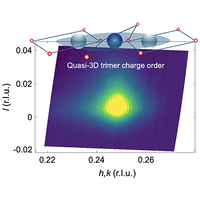
The infinite-layer compound provides a compelling platform to explore how local orbital distortions evolve into collective electronic order. Using resonant soft x-ray scattering (RSXS) and its time-resolved counterpart (tr-RSXS), we reveal a cooperative coupling between two intertwined orders at the same in-plane wave vector, , comprising a quasi-two-dimensional orbital order associated with the distorted sites and a quasi-three-dimensional trimerlike charge order stabilized through Co-O-Ca hybridization. The charge-sensitive component exhibits a uniform relaxation time of () across multiple Co resonances, evidencing a collective charge response. A comparable timescale observed in the orbital order associated with the highly distorted sites indicates that this collective behavior naturally originates from the same orbital framework that mediates both charge and orbital degrees of freedom. Together, these findings establish as a model system in which Jahn-Teller distortions, orbital hybridization, and geometric frustration cooperate to form molecular trimer units that dictate the macroscopic electronic behavior.
Physics Subject Headings (PhySH)
Popular Summary
Characterizing the fundamental structural units in complex oxides is a central challenge for understanding how local atomic arrangements drive macroscopic electronic properties. We addressed this by investigating infinite-layer using comprehensive resonant x-ray scattering under both equilibrium and nonequilibrium conditions. Our measurements identified a quasi-three-dimensional trimer-based charge order supported by orbital hybridization between the cobalt and calcium layers. We found that these trimer molecular units act as coherent building blocks of a collective electronic state throughout the material. These results provide evidence that molecular-scale units can govern the large-scale functionalities of complex oxides. Our work establishes trimer-based order as a framework for designing quantum materials with tailored structural and electronic functionalities.
Article Text
Supplemental Material
References (59)
- J. Kanamori, Theory of the magnetic properties of ferrous and cobaltous oxides, J. Phys. Chem. Solids 10, 87 (1960).
- D. I. Khomskii, Basic Aspects of the Quantum Theory of Solids: Order and Elementary Excitations (Cambridge University Press, Cambridge, England, 2010).
- D. I. Khomskii, Transition Metal Compounds (Cambridge University Press, Cambridge, England, 2014).
- K. I. Kugel and D. I. Khomskii, The Jahn-Teller effect and magnetism: Transition metal compounds, Sov. Phys. Usp. 25, 231 (1982).
- S. V. Streltsov and D. I. Khomskii, Orbital physics in transition metal compounds: New trends, Phys. Usp. 60, 1121 (2017).
- G. A. Gehring and K. A. Gehring, Co-operative Jahn-Teller effects, Rep. Prog. Phys. 38, 1 (1975).
- M. Imada, A. Fujimori, and Y. Tokura, Metal-insulator transitions, Rev. Mod. Phys. 70, 1039 (1998).
- M. D. Kaplan and B. G. Vekhter, Cooperative Phenomena in Jahn-Teller Crystals; Modern Inorganic Chemistry (Plenum Press, New York, 1995).
- A. J. Millis, Lattice effects in magnetoresistive manganese perovskites, Nature (London) 392, 147 (1998).
- D. I. Khomskii and S. V. Streltsov, Orbital effects in solids: Basics, recent progress, and opportunities, Chem. Rev. 121, 2992 (2021).
- X. Li et al., Exceptional oxygen evolution reactivities on and , Sci. Adv. 5, eaav6262 (2019).
- S. V. Streltsov and D. I. Khomskii, Jahn-Teller effect and spin-orbit coupling: Friends or foes?, Phys. Rev. X 10, 031043 (2020).
- L. T. Nguyen, T. Halloran, W. Xie, T. Kong, C. L. Broholm, and R. J. Cava, Geometrically frustrated trimer-based Mott insulator, Phys. Rev. Mater. 2, 054414 (2018).
- P. G. Radaelli et al., Formation of isomorphic and octamers and spin dimerization in the spinel , Nature (London) 416, 155 (2002).
- W. J. Kim et al., Geometric Frustration of Jahn–Teller order in the infinite-layer lattice, Nature (London) 615, 237 (2023).
- J. H. Williams, The molecular electric quadrupole moment and solid-state architecture, Acc. Chem. Res. 26, 593 (1993).
- See Supplemental Material at http://link.aps.org/supplemental/10.1103/scdr-tmq4 for the details of multiplet calculation, experimental configurations, polarization extinction, and data analysis.
- D. Jost et al., Orbital inversion and emergent lattice dynamics in infinite layer , npj Quantum Mater. 10, 60 (2025).
- Y. Tokura and N. Nagaosa, Orbital physics in transition-metal oxides, Science 288, 462 (2000).
- M. Schmidt, W. Ratcliff, P. G. Radaelli, K. Refson, N. M. Harrison, and S. W. Cheong, Spin singlet formation in : Evidence of a helical dimerization pattern, Phys. Rev. Lett. 92, 056402 (2004).
- J. P. Sheckelton et al., Possible valence-bond condensation in the frustrated cluster magnet , Nat. Mater. 11, 493 (2012).
- Y. Haraguchi, C. Michioka, M. Imai, H. Ueda, and K. Yoshimura, Spin-liquid behavior in the spin-frustrated cluster magnet , Phys. Rev. B 92, 014409 (2015).
- L. T. Nguyen, T. Kong, and R. Cava, Trimers of octahedra and ferrimagnetism of , Mater. Res. Express 6, 056108 (2019).
- J.-S. Lee et al., Titanium ferromagnetism at the interface, Nat. Mater. 12, 703 (2013).
The charge-transfer and Coulomb parameters used in the ligand-field Hamiltonian represent effective intracluster energy scales and are not directly comparable to the optical gap, which reflects the lowest-energy excitation of the solid. These parameters are not uniquely determined by the present data and are used to illustrate qualitative trends rather than to extract quantitative interaction energies.
The parameter values used here fall within the typical range employed in Co -edge cluster-model calculations for correlated cobalt oxides and are consistent with prior spectroscopic study [18].
- J.-S. Lee et al., Fragile magnetic ground state in half-doped , Phys. Rev. Lett. 107, 037206 (2011).
- A. Cavalleri, M. Rini, H. H. W. Chong, S. Fourmaux, T. E. Glover, P. A. Heimann, J. C. Kieffer, and R. W. Schoenlein., Band-selective measurements of electron dynamics in using femtosecond near-edge X-ray absorption, Phys. Rev. Lett. 95, 067405 (2005).
- M. Mitrano and Y. Wang, Probing light-driven quantum materials with ultrafast resonant inelastic x-ray scattering, Commun. Phys. 3, 184 (2020).
- H. Jang et al., Time-resolved resonant elastic soft X-ray scattering at Pohang accelerator laboratory X-ray free electron laser, Rev. Sci. Instrum. 91, 083904 (2020).
- C.-T. Kuo et al., Introducing new resonant soft X-ray scattering capability in SSRL, Rev. Sci. Instrum. 96, 063902 (2025).
- D. H. Templeton and L. K. Templeton, X-ray dichroism and polarized anomalous scattering of the uranyl ion, Acta Crystallogr. Sect. A 38, 62 (1982).
- J. P. Hannon, G. T. Trammell, M. Blume, and D. Gibbs, X-ray resonance exchange scattering, Phys. Rev. Lett. 61, 1245 (1988).
- J. P. Hill and D. F. McMorrow, Resonant exchange scattering: Polarization dependence and correlation function, Acta Crystallogr. Sect. A 52, 236 (1996).
- H. Jang, B. Y. Kang, B. K. Cho, M. Hashimoto, D. Lu, C. A. Burns, C. C. Kao, and J. S. Lee, Observation of orbital order in the half-filled Gd compound, Phys. Rev. Lett. 117, 216404 (2016).
- V. E. Dmitrienko, Forbidden reflections due to anisotropic X-ray susceptibility of crystals, Acta Crystallogr. Sect. A 39, 29 (1983).
- M. T. Lovesey and S. P. Collins, X-Ray Scattering and Absorption by Magnetic Materials (Oxford University Press, Oxford, 1996).
- F. M. F. de Groot, J. C. Fuggle, B. T. Thole, and G. A. Sawatzky, X-ray absorption of transition-metal compounds: An atomic multiplet description including the crystal field, Phys. Rev. B 42, 5459 (1990).
- H. F. Pen, J. van den Brink, D. I. Khomskii, and G. A. Sawatzky, Orbital ordering in a two-dimensional triangular lattice, Phys. Rev. Lett. 78, 1323 (1997).
- D. Meyers et al., Zhang-Rice physics and anomalous Copper states in a-site ordered perovskites, Sci. Rep. 3, 1834 (2013).
is proportional to the XAS spectrum, while is obtained via the Kramers-Kronig transform. This notation refers to the complex form factor as a whole and should not be confused with the tensor decomposition in Eq. (1).
- M. Imada, A. Fujimori, and Y. Tokura, Metal-insulator transitions, Rev. Mod. Phys. 70, 1039 (1998).
- M. Rini et al., Control of the electronic phase of a manganite by mode-selective vibrational excitation, Nature (London) 449, 72 (2007).
- H. Ichikawa et al., Transient photoinduced hidden phase in a manganite, Nat. Mater. 10, 101 (2011).
- E. J. Sie et al., An ultrafast symmetry switch in a Weyl semimetal, Nature (London) 565, 61 (2019).
- T. F. Nova et al., Metastable ferroelectricity in optically strained , Science 364, 1075 (2019).
- X. Li et al., Terahertz field-induced ferroelectricity in quantum paraelectric , Science 364, 1079 (2019).
- T. Lojewski et al., Photoinduced charge transfer renormalization in , Phys. Rev. B 110, 245120 (2024).
- N. Katayama et al., Anomalous metallic state in the vicinity of metal to valence-bond solid insulator transition in , Phys. Rev. Lett. 103, 146405 (2009).
- S. V. Streltsov and D. I. Khomskii, Cluster magnetism of : Localized electrons or molecular orbitals?, JETP Lett. 108, 686 (2018).
- L. T. Nguyen, T. Kong, and R. Cava, Trimers of octahedra and ferrimagnetism of , Mater. Res. Express 6, 056108 (2019).
- D. I. Khomskii and T. Mizokawa, Orbitally induced Peierls state in spinels, Phys. Rev. Lett. 94, 156402 (2005).
- S. Di Matteo, G. Jackeli, C. Lacroix, and N. B. Perkins, Valence-bond crystal in a pyrochlore antiferromagnet with orbital degeneracy, Phys. Rev. Lett. 93, 077208 (2004).
- O. A. Starykh, M. E. Zhitomirsky, D. I. Khomskii, R. R. P. Singh, and K. Ueda, Origin of spin gap in : Effects of frustration and lattice distortions, Phys. Rev. Lett. 77, 2558 (1996).
- M. Korotin, I. S. Elfimov, V. I. Anisimov, M. Troyer, and D. I. Khomskii,Exchange interactions and magnetic properties of the layered vanadates , , , and , Phys. Rev. Lett. 83, 1387 (1999).
- M. Isobe et al., Novel phase transition in spin- linear chain systems: and , J. Phys. Soc. Jpn. 71, 1423 (2002).
- S. V. Streltsov and D. I. Khomskii, Electronic structure and magnetic properties of pyroxenes : Low-dimensional magnets with 90° bonds, Phys. Rev. B 77, 064405 (2008).
- A. Seidel, C. A. Marianetti, F. C. Chou, G. Ceder, and P. A. Lee, Chains and spin-Peierls transition in , Phys. Rev. B 67, 020405(R) (2003).
- M. W. Haverkort, M. Zwierzycki, and O. K. Andersen, Multiplet ligand-field theory using Wannier orbitals, Phys. Rev. B 85, 165113 (2012).

