

- Open Access
Tracking Ultrafast Ion Diffusion Dynamics in Superionic Conductor
Phys. Rev. X 16, 021024 – Published 1 May, 2026
DOI: https://doi.org/10.1103/s6rh-7219
Abstract
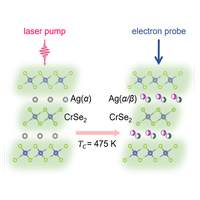
Superionic conductors (SICs) exhibit liquidlike ionic diffusivities while maintaining a periodic crystalline lattice, making them promising candidates for applications in fuel cells, solid-state electrolytes, and thermoelectric materials. The transient local structures of mobile ions and their cooperative interactions with the host lattice are of pivotal importance regarding both the ion and heat conduction in SICs. However, accurately capturing the structural evolution of mobile ions remains a significant challenge due to the inherent complexities involved. Here, we employed ultrafast electron diffraction (UED) with femtosecond-temporal and angstrom-spatial resolution to resolve the structural evolution of mobile ions in . Our experiments identify a critical process originating from localized vibrations at the long-range-ordered lattice sites to a formation of short-range-correlated trimer structures through a drastic contraction of the bond from approximately 3.68 to approximately 3.00 Å in 1.97 ps. Combining real-time time-dependent density-functional-theory and molecular dynamics simulation, we further reveal the crucial role of these contracted trimer structures in enabling fast diffusion by opening up excess free volume and reducing local energy barriers. Such an intimate relation between fast diffusion and local lattice variations is not exclusive and can be extended beyond to materials such as (, Ge, Sn). The ability to track ion diffusion with UED also provides new avenues for exploring the atomistic mechanisms of fast ion diffusion in next-generation solid-state electrolytes, fuel cells, and ion transport membranes.
Physics Subject Headings (PhySH)
Popular Summary
Superionic conductors are unusual materials that are structurally solid yet allow ions to move almost as freely as in liquids, offering great promise for safer and more efficient energy technologies. However, the atomic processes responsible for this extraordinary mobility have remained elusive. Using ultrafast electron diffraction with femtosecond temporal resolution and atomic spatial resolution, we captured the motion of ions in the superionic conductor in real time. We find that the mobile ions do not migrate independently, but briefly assemble into small clusters with profoundly shortened bonds. This transient clustering creates additional free volume in the lattice and lowers the energy barriers for ion transport. These findings provide direct atomic-scale insight into liquidlike ion transport in a solid and suggest strategies for designing high-performance solid-state energy materials.
Article Text
Supplemental Material
References (130)
- A. J. E. Rettie, J. Ding, X. Zhou, M. J. Johnson, C. D. Malliakas, N. C. Osti, D. Y. Chung, R. Osborn, O. Delaire, S. Rosenkranz, and M. G. Kanatzidis, A two-dimensional type I superionic conductor, Nat. Mater. 20, 1683 (2021).
- W. Zhang, J. Cui, S. Wang, H. Cao, A. Wu, Y. Xia, Q. Jiang, J. Guo, T. He, and P. Chen, Deforming lanthanum trihydride for superionic conduction, Nature (London) 616, 73 (2023).
- J. Zhi, S. Zhao, M. Zhou, R. Wang, and F. Huang, A zinc-conducting chalcogenide electrolyte, Sci. Adv. 9, eade2217 (2023).
- M. R. Lukatskaya, O. Mashtalir, C. E. Ren, Y. Dall’Agnese, P. Rozier, P. L. Taberna, M. Naguib, P. Simon, M. W. Barsoum, and Y. Gogotsi, Cation intercalation and high volumetric capacitance of two-dimensional titanium carbide, Science 341, 1502 (2013).
- K. Jun, Y. Chen, G. Wei, X. Yang, and G. Ceder, Diffusion mechanisms of fast lithium-ion conductors, Nat. Rev. Mater. 9, 887 (2024).
- Y.-C. Yin et al., A -based lithium superionic conductor compatible with lithium metal, Nature (London) 616, 77 (2023).
- Y. Kato, S. Hori, T. Saito, K. Suzuki, M. Hirayama, A. Mitsui, M. Yonemura, H. Iba, and R. Kanno, High-power all-solid-state batteries using sulfide superionic conductors, Nat. Energy 1, 16030 (2016).
- P. Boolchand and W. J. Bresser, Mobile silver ions and glass formation in solid electrolytes, Nature (London) 410, 1070 (2001).
- H. Liu, X. Shi, F. Xu, L. Zhang, W. Zhang, L. Chen, Q. Li, C. Uher, T. Day, and G. J. Snyder, Copper ion liquid-like thermoelectrics, Nat. Mater. 11, 422 (2012).
- K. Zhao, P. Qiu, X. Shi, and L. Chen, Recent advances in liquid-like thermoelectric materials, Adv. Funct. Mater. 30, 1903867 (2020).
- D. J. Voneshen, H. C. Walker, K. Refson, and J. P. Goff, Hopping time scales and the phonon-liquid electron-crystal picture in thermoelectric copper selenide, Phys. Rev. Lett. 118, 145901 (2017).
- J. L. Niedziela, D. Bansal, A. F. May, J. Ding, T. Lanigan-Atkins, G. Ehlers, D. L. Abernathy, A. Said, and O. Delaire, Selective breakdown of phonon quasiparticles across superionic transition in , Nat. Phys. 15, 73 (2019).
- T. Famprikis, P. Canepa, J. A. Dawson, M. S. Islam, and C. Masquelier, Fundamentals of inorganic solid-state electrolytes for batteries, Nat. Mater. 18, 1278 (2019).
- L. Wang, T. Liu, A. Dai, V. De Andrade, Y. Ren, W. Xu, S. Lee, Q. Zhang, L. Gu, S. Wang, T. Wu, H. Jin, and J. Lu, Reaction inhomogeneity coupling with metal rearrangement triggers electrochemical degradation in lithium-rich layered cathode, Nat. Commun. 12, 5370 (2021).
- X. He, Y. Zhu, and Y. Mo, Origin of fast ion diffusion in super-ionic conductors, Nat. Commun. 8, 15893 (2017).
- L. Xie, D. Wu, H. Yang, Y. Yu, Y. Wang, and J. He, Direct atomic-scale observation of diffusion structure in the quasi-2D “Liquid-like” state of superionic thermoelectric , J. Mater. Chem. C 7, 9263 (2019).
- M. A. Kraft, S. P. Culver, M. Calderon, F. Böcher, T. Krauskopf, A. Senyshyn, C. Dietrich, A. Zevalkink, J. Janek, and W. G. Zeier, Influence of lattice polarizability on the ionic conductivity in the lithium superionic argyrodites (), J. Am. Chem. Soc. 139, 10909 (2017).
- D. Voneshen, K. Refson, E. Borissenko, M. Krisch, A. Bosak, A. Piovano, E. Cemal, M. Enderle, M. Gutmann, M. Hoesch, M. Roger, L. Gannon, A. Boothroyd, S. Uthayakumar, D. Porter, and J. Goff, Suppression of thermal conductivity by rattling modes in thermoelectric sodium cobaltate, Nat. Mater. 12, 1028 (2013).
- A. D. Poletayev, M. C. Hoffmann, J. A. Dawson, S. W. Teitelbaum, M. Trigo, M. S. Islam, and A. M. Lindenberg, The persistence of memory in ionic conduction probed by nonlinear optics, Nature (London) 625, 691 (2024).
- Q. Ren, M. K. Gupta, M. Jin, J. Ding, J. Wu, Z. Chen, S. Lin, O. Fabelo, J. A. Rodríguez-Velamazán, M. Kofu, K. Nakajima, M. Wolf, F. Zhu, J. Wang, Z. Cheng, G. Wang, X. Tong, Y. Pei, O. Delaire, and J. Ma, Extreme phonon anharmonicity underpins superionic diffusion and ultralow thermal conductivity in argyrodite , Nat. Mater. 22, 999 (2023).
- J. Ding, J. Niedziela, D. Bansal, J. Wang, X. He, A. May, G. Ehlers, D. Abernathy, A. Said, A. Alatas, Y. Ren, G. Arya, and O. Delaire, Anharmonic lattice dynamics and superionic transition in , Proc. Natl. Acad. Sci. U.S.A. 117, 3930 (2020).
- J. Ding, M. K. Gupta, C. Rosenbach, H.-M. Lin, N. C. Osti, D. L. Abernathy, W. G. Zeier, and O. Delaire, Liquid-like dynamics in a solid-state lithium electrolyte, Nat. Phys. 21, 118 (2025).
- E. J. Sie et al., An ultrafast symmetry switch in a Weyl semimetal, Nature (London) 565, 61 (2019).
- Y. Cheng, A. Zong, L. Wu, Q. Meng, W. Xia, F. Qi, P. Zhu, X. Zou, T. Jiang, Y. Guo, J. van Wezel, A. Kogar, M. W. Zuerch, J. Zhang, Y. Zhu, and D. Xiang, Ultrafast formation of topological defects in a two-dimensional charge density wave, Nat. Phys. 20, 54 (2024).
- B. Li, H. Wang, Y. Kawakita, Q. Zhang, M. Feygenson, H. L. Yu, D. Wu, K. Ohara, T. Kikuchi, K. Shibata, T. Yamada, X. K. Ning, Y. Chen, J. Q. He, D. Vaknin, R. Q. Wu, K. Nakajima, and M. G. Kanatzidis, Liquid-like thermal conduction in intercalated layered crystalline solids, Nat. Mater. 17, 226 (2018).
- See Supplemental Material at http://link.aps.org/supplemental/10.1103/s6rh-7219 for detailed information on the experiment details, data analysis, as well as theoretical calculation approaches, which includes Refs. [27–105].
- J. Li, Y. Qi, Q. Yang, L. Yue, C. Yao, Z. Chen, S. Meng, D. Xiang, and J. Cao, Femtosecond electron diffraction reveals local disorder and local anharmonicity in thermoelectric , Adv. Mater. 36, 2313742 (2024).
- J. Groefsema, X. Feng, C. Morice, Y. Huang, and E. Van Heumen, Optical phonons and magneto-elastic coupling in the ionic conductor , Phys. Rev. Mater. 6, 115402 (2022).
- A. Krishnamoorthy et al., Optical control of non-equilibrium phonon dynamics, Nano Lett. 19, 4981 (2019).
- Z. Lin, L. V. Zhigilei, and V. Celli, Electron-phonon coupling and electron heat capacity of metals under conditions of strong electron-phonon nonequilibrium, Phys. Rev. B 77, 075133 (2008).
- Q. Zeng, B. Chen, S. Zhang, D. Kang, H. Wang, X. Yu, and J. Dai, Full-scale ab initio simulations of laser-driven atomistic dynamics, npj Comput. Mater. 9, 213 (2023).
- P. Srinivasan, D. Demuriya, B. Grabowski, and A. Shapeev, Electronic moment tensor potentials include both electronic and vibrational degrees of freedom, npj Comput. Mater. 10, 41 (2024).
- W.-H. Liu, J.-W. Luo, S.-S. Li, and L.-W. Wang, Microscopic force driving the photoinduced ultrafast phase transition: Time-dependent density functional theory simulations of , Phys. Rev. B 102, 184308 (2020).
- P. M. Zeiger and J. Rusz, Frequency-resolved frozen phonon multislice method and its application to vibrational electron energy loss spectroscopy using parallel illumination, Phys. Rev. B 104, 104301 (2021).
- J. P. Langmore and M. F. Smith, Quantitative energy-filtered electron microscopy of biological molecules in ice, Ultramicroscopy 46, 349 (1992).
- R. F. Egerton, Electron Energy-Loss Spectroscopy in the Electron Microscope (Springer Science & Business Media, New York, 2011).
- Y. Seto and M. Ohtsuka, ReciPro: Free and open-source multipurpose crystallographic software integrating a crystal model database and viewer, diffraction and microscopy simulators, and diffraction data analysis tools, J. Appl. Crystallogr. 55, 397 (2022).
- C. R. Hall and P. B. Hirsch, Effect of thermal diffuse scattering on propagation of high energy electrons through crystals, Proc. R. Soc. A 286, 158 (1997).
- A. Stukowski, Visualization and analysis of atomistic simulation data with OVITO–the Open Visualization Tool, Model. Simul. Mater. Sci. Eng. 18, 015012 (2010).
- D. Frenkel and B. Smit, Understanding Molecular Simulation: From Algorithms to Applications (Elsevier, New York, 2023).
- R. Wang, M. Guo, Y. Gao, X. Wang, Y. Zhang, B. Deng, X. Chen, M. Shi, L. Zhang, and Z. Zhong, A pre-trained deep potential model for sulfide solid electrolytes with broad coverage and high accuracy, arXiv:2406.18263.
- N. Kamaya, K. Homma, Y. Yamakawa, M. Hirayama, R. Kanno, M. Yonemura, T. Kamiyama, Y. Kato, S. Hama, K. Kawamoto, and A. Mitsui, A lithium superionic conductor, Nat. Mater. 10, 682 (2011).
- M. Baenitz et al., Planar triangular magnet : Magnetic frustration, short range correlations, and field-tuned anisotropic cycloidal magnetic order, Phys. Rev. B 104, 134410 (2021).
- Y. Mo, S. P. Ong, and G. Ceder, First principles study of the lithium super ionic conductor material, Chem. Mater. 24, 15 (2012).
- A. Kuhn, V. Duppel, and B. V. Lotsch, Tetragonal and —exploring the Li ion dynamics in LGPS Li electrolytes, Energy Environ. Sci. 6, 3548 (2013).
- D. W. Murphy, H. S. Chen, and B. Tell, Superionic conduction in and , J. Electrochem. Soc. 124, 1268 (1977).
- V. Antropov, V. Konev, V. Pleshchev, and N. Rogal’, Ionic conductivity of in the region of phase transition, Phys. Solid State 26, 2545 (1984), https://sciencedata.urfu.ru/portal/en/publications/ionicconductivity-of-agcrse2-in-the-region-of-phasetransition(e577f504-8908-4aa5-b8f9-bb33cca4a201).html.
- J. Peng, Y. Liu, Y. Pan, J. Wu, Y. Su, Y. Guo, X. Wu, C. Wu, and Y. Xie, Fast lithium ion conductivity in layered , J. Am. Chem. Soc. 142, 18645 (2020).
- T. Hibma, The mixed conductor properties of , Solid State Commun. 33, 445 (1980).
- F. Shimojo, T. Inoue, M. Aniya, T. Sugahara, and Y. Miyata, Ab initio molecular-dynamics study of static structure and bonding properties of molten , J. Phys. Soc. Jpn. 75, 114602 (2006).
- K. Shahi, Transport studies on superionic conductors, Phys. Status Solidi A 41, 11 (1977).
- Tallon, Molecular-dynamics simulation of the phase behavior of , Phys. Rev. Lett. 57, 2427 (1986).
- Y. Tsuchiya, S. Tamaki, Y. Waseda, and J. M. Toguri, The structure of , J. Phys. C 11, 651 (1978).
- O. Alekperov, O. Samedov, R. Paucar, N. Abdulzade, E. Nakhmedov, A. Nadjafov, K. Wakita, and N. Mamedov, Impedance spectroscopy study of phase transitions to ionic and superionic conductivity states in and , Phys. Status Solidi C 12, 610 (2015).
- H. Okazaki, Deviation from the Einstein relation in average crystals self-diffusion of ions in and , J. Phys. Soc. Jpn. 23, 355 (1967).
- P. Simonnin, M. Sassi, B. Gilbert, L. Charlet, and K. M. Rosso, Phase transition and liquid-like superionic conduction in , J. Phys. Chem. C 124, 10150 (2020).
- A. Smith, R. Ravelo, and N. Pingitore, Mobility of atoms in the binary system : A molecular dynamics study, MRS Online Proc. Libr. 481, 279 (1997).
- S. Fukushima, M. Misawa, A. Koura, and F. Shimojo, molecular dynamics study of structural and dynamic properties of superionic conductor , J. Phys. Soc. Jpn. 88, 115002 (2019).
- S.-y. Miyatani, Ionic conductivity in silver chalcogenides, J. Phys. Soc. Jpn. 50, 3415 (1981).
- J. E. Enderby and A. C. Barnes, Liquid semiconductors, Rep. Prog. Phys. 53, 85 (1990).
- H. Okazaki, Deviation from the Einstein relation in average crystals. II. Self-diffusion of ions in , J. Phys. Soc. Jpn. 43, 213 (1977).
- M. Kobayashi, K. Ishikawa, F. Tachibana, and H. Okazaki, Diffusion path and Haven’s ratio of mobile ions in , Phys. Rev. B 38, 3050 (1988).
- R. Hoeven, Modelling and Simulation of Thermoelectric Materials with a Superionic Phase Transition Using on-the-Fly Machine Learning Force Fields (University of Twente, 2022), https://essay.utwente.nl/fileshare/file/92459/vanderHoeven_BA_EEMCS_TNW.pdf.
- H. Kim, S. Ballikaya, H. Chi, J.-P. Ahn, K. Ahn, C. Uher, and M. Kaviany, Ultralow thermal conductivity of by atomic fluidity and structure distortion, Acta Mater. 86, 247 (2015).
- T. Kanashiro, T. Ohno, M. Satoh, K. Okamoto, A. Kojima, and F. Akao, Nuclear magnetic resonance and electrical conduction of copper chalcogenides, Solid State Ionics 3–4, 327 (1981).
- M. K. Balapanov, R. A. Yakshibaev, and U. K. Mukhamed’yanov, Ion transfer in solid solutions of and superionic conductors, Phys. Solid State 45, 634 (2003).
- S. Kumar, M. K. Gupta, P. Goel, R. Mittal, O. Delaire, A. Thamizhavel, S. Rols, and S. L. Chaplot, Solidlike to liquidlike behavior of Cu diffusion in superionic (, Se): An inelastic neutron scattering and ab initio molecular dynamics investigation, Phys. Rev. Mater. 6, 055403 (2022).
- S. M. K. Nazrul Islam, P. Mayank, Y. Ouyang, J. Chen, A. K. Sagotra, M. Li, M. B. Cortie, R. Mole, C. Cazorla, D. Yu, X. Wang, R. A. Robinson, and D. L. Cortie, Copper diffusion rates and hopping pathways in superionic , Acta Mater. 215, 117026 (2021).
- K. Tsumuraya, T. Ohtsuka, H. Oshihara, H. Tomono, and M. Tsumuraya, Dynamic Correlation between Superionic Coppers in , J. Phys. Soc. Jpn. 81, 044603 (2012).
- J. B. Boyce and B. A. Huberman, Dynamical evidence for sublattice melting in a superionic conductor: NMR on , Solid State Commun. 21, 31 (1977).
- B. K. Verma, V. Pratap, and H. B. Lal, Transport studies of copper iodide, Jpn. J. Appl. Phys. 20, 1665 (1981).
- Y. Yang, Z. Xu, C. Guan, R. Ouyang, H. Jing, and H. Zhu, Activating the paddle-wheel effect towards lower temperature in a new sodium-ion solid electrolyte, , J. Mater. Chem. A 11, 9555 (2023).
- F. Kamm, F. Pielnhofer, M. Schlosser, and A. Pfitzner, Synthesis and characterization of and , two polymorphs with different anionic structures, Inorg. Chem. 62, 11064 (2023).
- H. Tang, Z. Deng, Z. Lin, Z. Wang, I.-H. Chu, C. Chen, Z. Zhu, C. Zheng, and S. P. Ong, Probing solid-solid interfacial reactions in all-solid-state sodium-ion batteries with first-principles calculations, Chem. Mater. 30, 163 (2018).
- T. Shibata, W. Kobayashi, and Y. Moritomo, Sodium ion diffusion in layered , Appl. Phys. Express 6, 9 (2013).
- N. Gómez-Garduño, D. G. Araiza, C. A. Celaya, J. Muñiz, and H. Pfeiffer, Unveiling the different physicochemical properties of M-doped (where or ) materials evaluated as sorbents: A combined experimental and theoretical analysis, J. Mater. Chem. A 11, 10938 (2023).
- N. V. Proskurnina, V. I. Voronin, G. S. Shekhtman, and N. A. Kabanova, Crystal structure of and and their correlation with ionic conductivity, Ionics 26, 2917 (2020).
- T. Miyagawa, N. Krishnan, M. Grumet, C. R. Baecker, W. Kaiser, and D. A. Egger, Accurate description of ion migration in solid-state ion conductors from machine-learning molecular dynamics, J. Mater. Chem. A 12, 11344 (2024).
- O. Maus, M. T. Agne, T. Fuchs, P. S. Till, B. Wankmiller, J. M. Gerdes, R. Sharma, M. Heere, N. Jalarvo, O. Yaffe, M. R. Hansen, and W. G. Zeier, On the discrepancy between local and average structure in the fast ionic conductor , J. Am. Chem. Soc. 145, 7147 (2023).
- D. Zhang, X. Cao, D. Xu, N. Wang, C. Yu, W. Hu, X. Yan, J. Mi, B. Wen, L.-M. Wang, and L. Zhang, Synthesis of cubic solid electrolyte with enhanced ion transport for all-solid-state sodium-ion batteries, Electrochim. Acta 259, 100 (2018).
- Q. Zhang, C. Zhang, Z. D. Hood, M. Chi, C. Liang, N. H. Jalarvo, M. Yu, and H. Wang, Abnormally low activation energy in cubic superionic conductors, Chem. Mater. 32, 2264 (2020).
- J. A. Dawson, P. Canepa, M. J. Clarke, T. Famprikis, D. Ghosh, and M. S. Islam, Toward understanding the different influences of grain boundaries on ion transport in sulfide and oxide solid electrolytes, Chem. Mater. 31, 5296 (2019).
- C. Yu, S. Ganapathy, N. J. J. de Klerk, E. R. H. van Eck, and M. Wagemaker, -ion dynamics in tetragonal and cubic , a -ion conductor for solid state -ion batteries, J. Mater. Chem. A 4, 15095 (2016).
- A. Hayashi, K. Noi, A. Sakuda, and M. Tatsumisago, Superionic glass-ceramic electrolytes for room-temperature rechargeable sodium batteries, Nat. Commun. 3, 856 (2012).
- N. J. J. d. Klerk and M. Wagemaker, Diffusion mechanism of the sodium-ion solid electrolyte and potential improvements of halogen doping, Chem. Mater. 28, 3122 (2016).
- M. Kassem, T. Bounazef, A. Sokolov, M. Bokova, D. Fontanari, A. C. Hannon, I. Alekseev, and E. Bychkov, Deciphering fast ion transport in glasses: A case study of sodium and silver vitreous sulfides, Inorg. Chem. 61, 12870 (2022).
- M. Ribes, B. Barrau, and J. L. Souquet, Sulfide glasses: Glass forming region, structure and ionic conduction of glasses in (; ), and systems, J. Non-Cryst. Solids 38–39, 271 (1980).
- Z. Zhang, H. Li, K. Kaup, L. Zhou, P.-N. Roy, and L. F. Nazar, Targeting superionic conductivity by turning on anion rotation at room temperature in fast ion conductors, Matter Radiat. Extremes 2, 1667 (2020).
- H. Stöffler, T. Zinkevich, M. Yavuz, A. Senyshyn, J. Kulisch, P. Hartmann, T. Adermann, S. Randau, F. H. Richter, J. Janek, S. Indris, and H. Ehrenberg, -ion dynamics in observed by NMR: Local hopping and long-range transport, J. Phys. Chem. C 122, 15954 (2018).
- M. Tachez, J.-P. Malugani, R. Mercier, and G. Robert, Ionic conductivity of and phase transition in lithium thiophosphate , Solid State Ionics 14, 181 (1984).
- S. Teragawa, K. Aso, K. Tadanaga, A. Hayashi, and M. Tatsumisago, Liquid-phase synthesis of a solid electrolyte using N-methylformamide for all-solid-state lithium batteries, J. Mater. Chem. A 2, 5095 (2014).
- N. H. H. Phuc, M. Totani, K. Morikawa, H. Muto, and A. Matsuda, Preparation of solid electrolyte using ethyl acetate as synthetic medium, Solid State Ionics 288, 240 (2016).
- L. Gigli, D. Tisi, F. Grasselli, and M. Ceriotti, Mechanism of charge transport in lithium thiophosphate, Chem. Mater. 36, 1482 (2024).
- F. Forrester and J. Quirk, Disentangling cation and anion dynamics in solid electrolytes, Chem. Mater. 34, 10561 (2022).
- N. J. J. de Klerk, E. van der Maas, and M. Wagemaker, Analysis of diffusion in solid-state electrolytes through MD simulations, Improvement of the -ion conductivity in as an example, ACS Appl. Energy Mater. 1, 3230 (2018).
- J.-H. Chung, T. Proffen, S. Shamoto, A. M. Ghorayeb, L. Croguennec, W. Tian, B. C. Sales, R. Jin, D. Mandrus, and T. Egami, Local structure of studied by neutron diffraction, Phys. Rev. B 71, 064410 (2005).
- K. Nakamura, H. Ohno, K. Okamura, Y. Michihiro, I. Nakabayashi, and T. Kanashiro, On the diffusion of defects in and , Solid State Ionics 135, 143 (2000).
- Y. Zhang and C. Wang, Cycle-life characterization of automotive lithium-ion batteries with Cathode, J. Electrochem. Soc. 156, A527 (2009).
- G. Luo, J. Zhao, X. Ke, P. Zhang, H. Sun, and B. Wang, Structure, electrode voltage and activation energy of solid solutions as cathode materials for batteries from first-principles, J. Electrochem. Soc. 159, A1203 (2012).
- K. Kang, Y. S. Meng, J. Bréger, C. P. Grey, and G. Ceder, Electrodes with high power and high capacity for rechargeable lithium batteries, Science 311, 977 (2006).
- D. Adipranoto, M. Yonemura, Y. Ishikawa, A. Hoshikawa, T. Ishigaki, K. Takashi, Y. Uchimoto, and Z. Ogumi, Crystal-local structure analyses for cathode LIBs () by neutron diffraction, J. Phys. Soc. Jpn. Conf. Proc. 8, 031017 (2015).
- D. Zeng, J. Cabana, J. Bréger, W.-S. Yoon, and C. Grey, Cation ordering in cathode materials: A nuclear magnetic resonance (NMR), pair distribution function, X-ray absorption spectroscopy, and electrochemical study, Chem. Mater. 19, 6289 (2007).
- R. Amin and Y.-M. Chiang, Characterization of electronic and ionic transport in () and () as a function of content, J. Electrochem. Soc. 163, A1512 (2016).
- X. Liang, Y. Jiang, W. Cai, S. Wu, L. Wang, Z. Lei, J. Chen, Y. Lei, L. Yang, and J. Feng, New structure ordering and Li-ion dynamics unveiled in superionic conductors: A solid-state nuclear magnetic resonance study, ACS Appl. Mater. Interfaces 12, 27029 (2020).
- Z.-H. Fu, X. Chen, N. Yao, X. Shen, X.-X. Ma, S. Feng, S. Wang, R. Zhang, L. Zhang, and Q. Zhang, The chemical origin of temperature-dependent lithium-ion concerted diffusion in sulfide solid electrolyte , J. Energy Chem. 70, 59 (2022).
- T. Hibma, Diffuse x-ray scattering of the two-dimensional solid ionic conductor , Phys. Rev. B 28, 568 (1983).
- J. D. Fan, O. A. Karim, G. Reiter, and S. C. Moss, Molecular-dynamics study of the temperature-dependent two-dimensional Rb liquid in graphite, Phys. Rev. B 39, 6111 (1989).
- I. Hamley, Diffuse scattering from lamellar structures, Soft Matter 18, 711 (2022).
- M. J. Krogstad, S. Rosenkranz, J. M. Wozniak, G. Jennings, J. P. C. Ruff, J. T. Vaughey, and R. Osborn, Reciprocal space imaging of ionic correlations in intercalation compounds, Nat. Mater. 19, 63 (2020).
- W. Liu, H. Liu, Z. Wang, S. Li, L. Wang, and J. Luo, Inverse design of light manipulating structural phase transition in solids, J. Phys. Chem. Lett. 14, 6647 (2023).
- Z. Wang, S.-S. Li, and L.-W. Wang, Efficient real-time time-dependent density functional theory method and its application to a collision of an ion with a 2D material, Phys. Rev. Lett. 114, 063004 (2015).
- R. Dettori, M. Ceriotti, J. Hunger, C. Melis, L. Colombo, and D. Donadio, Simulating energy relaxation in pump-probe vibrational spectroscopy of hydrogen-bonded liquids, J. Chem. Theory Comput. 13, 1284 (2017).
- R. Dettori, M. Ceriotti, J. Hunger, L. Colombo, and D. Donadio, Energy relaxation and thermal diffusion in infrared pump-probe spectroscopy of hydrogen-bonded liquids, J. Phys. Chem. Lett. 10, 3447 (2019).
- F. Damay, S. Petit, S. Rols, M. Braendlein, R. Daou, E. Elkaïm, F. Fauth, F. Gascoin, C. Martin, and A. Maignan, Localised vibrations at the origin of ultralow thermal conductivity in layered thermoelectric , Sci. Rep. 6, 23415 (2016).
- J. Wang, J. Ding, O. Delaire, and G. Arya, Atomistic mechanisms underlying non-Arrhenius ion transport in superionic conductor , ACS Appl. Energy Mater. 4, 7157 (2021).
- X. Shen, M. M. Koza, Y.-H. Tung, N. Ouyang, C.-C. Yang, C. Wang, Y. Chen, K. Willa, R. Heid, X. Zhou, and F. Weber, Soft phonon mode triggering fast diffusion in superionic argyrodite , Small 19, 2305048 (2023).
- B. A. Boukamp and G. A. Wiegers, Ionic and electronic processes in , Solid State Ionics 9–10, 1193 (1983).
- F. Qi, Z. Ma, L. Zhao, Y. Cheng, W. Jiang, C. Lu, T. Jiang, D. Qian, Z. Wang, W. Zhang, P. Zhu, X. Zou, W. Wan, D. Xiang, and J. Zhang, Breaking 50 femtosecond resolution barrier in MeV ultrafast electron diffraction with a double bend achromat compressor, Phys. Rev. Lett. 124, 134803 (2020).
- W.-H. Liu, J.-W. Luo, S.-S. Li, and L.-W. Wang, The critical role of hot carrier cooling in optically excited structural transitions, npj Comput. Mater. 7, 117 (2021).
- G. Kresse and J. Hafner, Ab initio molecular dynamics for liquid metals, Phys. Rev. B 47, 558 (1993).
- G. Kresse and D. Joubert, From ultrasoft pseudopotentials to the projector augmented-wave method, Phys. Rev. B 59, 1758 (1999).
- J. P. Perdew, K. Burke, and M. Ernzerhof, Generalized gradient approximation made simple, Phys. Rev. Lett. 77, 3865 (1996).
- S. Grimme, S. Ehrlich, and L. Goerigk, Effect of the damping function in dispersion corrected density functional theory, J. Comput. Chem. 32, 1456 (2011).
- A. Togo, L. Chaput, T. Tadano, and I. Tanaka, Implementation strategies in phonopy and phono3py, J. Phys. Condens. Matter 35, 353001 (2023).
- Z. Fan, W. Chen, V. Vierimaa, and A. Harju, Efficient molecular dynamics simulations with many-body potentials on graphics processing units, Comput. Phys. Commun. 218, 10 (2017).
- A. Van Der Lee and G. A. Wiegers, Anharmonic thermal motion of in : A high-temperature single-crystal X-ray diffraction study, J. Solid State Chem. 82, 216 (1989).
- A. P. Thompson, H. M. Aktulga, R. Berger, D. S. Bolintineanu, W. M. Brown, P. S. Crozier, P. J. in ‘t Veld, A. Kohlmeyer, S. G. Moore, T. D. Nguyen, R. Shan, M. J. Stevens, J. Tranchida, C. Trott, and S. J. Plimpton, lammps—a flexible simulation tool for particle-based materials modeling at the atomic, meso, and continuum scales, Comput. Phys. Commun. 271, 108171 (2022).
- J. Madsen and T. Susi, The abtem code: Transmission electron microscopy from first principles, Open Res. Eur. 1, 24 (2021).
- I. Lobato and D. Van Dyck, An accurate parameterization for scattering factors, electron densities and electrostatic potentials for neutral atoms that obey all physical constraints, Acta Crystallogr. Sect. A 70, 636 (2014).
- B. D. Forbes, A. V. Martin, S. D. Findlay, A. J. D’Alfonso, and L. J. Allen, Quantum mechanical model for phonon excitation in electron diffraction and imaging using a Born-Oppenheimer approximation, Phys. Rev. B 82, 104103 (2010).

