

- Featured in Physics
- Open Access
Hybrid Oscillator-Qubit Quantum Processors: Simulating Fermions, Bosons, and Gauge Fields
Phys. Rev. X 16, 041008 – Published 7 October, 2026
DOI: https://doi.org/10.1103/s5bn-z4jq
Abstract
Key to solving many societally relevant problems in materials science, quantum chemistry, and nuclear physics is understanding their fundamental microscopic quantum behavior. All of these problems can be phrased as fermionic (e.g., electrons, quarks) and bosonic particles (e.g., lattice vibrations, photons) interacting with each other. However, solving these systems of strongly interacting fermions and bosons is out of reach for classical computers and also non-error-corrected qubit-only quantum computers. In this paper, we introduce a hybrid qubit and bosonic-oscillator quantum-simulation framework, which is so efficient that it could simulate some of these strongly correlated problems even without error correction. Specifically, we leverage the available universal bosonic gate set with operations per gate as a function of the bosonic cutoff. This enables our framework to provide exact decompositions of higher-order fermion-boson interactions, including notoriously challenging terms such as gauge theories. We show how to compile dynamics, ancilla-free partial error detection, nonlocal observable measurements, and ground-state energy estimation using both qubit-boson variational quantum eigensolvers and quantum signal processing. We introduce a “post-qubit quantum advantage” experiment which is out of reach for both near-term qubit-only quantum computers and classical computers. We justify this proposal by estimating bosonic gate fidelities through high–boson-occupation Lindblad simulation and by comparing to qubit-only algorithms. For the latter, we develop a new qubit-based algorithm for simulating a beam splitter with a boson number cutoff , which scales as , asymptotically outperforming previously known qubit methods. However, to reach the same circuit fidelity as qubit-boson hardware with 99.9% per-gate fidelity, a qubit quantum computer using the best-known method would still need fidelities of at least 99.9999%, likely requiring substantial error correction. Our framework can be used in superconducting hardware, which we focus on, as well as trapped-ion and neutral-atom hardware. This work establishes digital hybrid qubit-boson quantum simulation as a promising and advantageous method for solving the many challenging, strongly correlated, fermion-boson models of relevance to science and technology.
Physics Subject Headings (PhySH)
 Viewpoint

Hybrid Quantum Computer Could Simulate Both Fermions and Bosons
Pairing superconducting qubits with microwave cavities could reduce the hardware requirements for quantum simulations of fundamental physics.
See more in Physics
Popular Summary
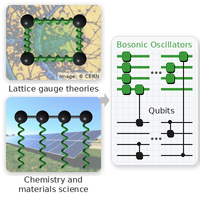
Understanding how plants transport sunlight to turn it into energy, how some materials carry electricity without loss, or how drugs bind to their targets could bring better solar cells, power grids, and medicines. All are quantum problems too hard for any classical supercomputer, and all involve bosons: vibrations or particles of light. Huge developments in quantum computing provide hope for this area, but the “qubit” unit of information is wasteful when simulating bosons. Existing quantum computers, though, already contain bosons natively, for example the microwaves used in superconducting circuits are in fact particles of light. Rethinking how we use and control these devices therefore could provide us with an immense speedup for simulating these problems. We give the instructions that turn such a chip into a fully programmable, digital simulator, rather than an analog device wired up for one problem at a time. Because this cuts the work a thousandfold, chemistry and materials problems of practical value could come within reach of machines being built today, long before large error-corrected computers arrive.
Article Text
References (341)
- A. Di Meglio et al., Quantum computing for high-energy physics: State of the art and challenges, PRX Quantum 5, 037001 (2024).
- M. Greiner, O. Mandel, T. Esslinger, T. W. Hänsch, and I. Bloch, Quantum phase transition from a superfluid to a Mott insulator in a gas of ultracold atoms, Nature (London) 415, 39 (2002).
- R. Blatt, I. Bloch, I. Cirac, and P. Zoller, Quantum simulation—an exciting adventure, Ann. Phys. (Amsterdam) 525, A153 (2013).
- I. M. Georgescu, S. Ashhab, and F. Nori, Quantum simulation, Rev. Mod. Phys. 86, 153 (2014).
- A. Mazurenko, C. S. Chiu, G. Ji, M. F. Parsons, M. Kanász-Nagy, R. Schmidt, F. Grusdt, E. Demler, D. Greif, and M. Greiner, A cold-atom Fermi-Hubbard antiferromagnet, Nature (London) 545, 462 (2017).
- G. Semeghini, H. Levine, A. Keesling, S. Ebadi, T. T. Wang, D. Bluvstein, R. Verresen, H. Pichler, M. Kalinowski, R. Samajdar, A. Omran, S. Sachdev, A. Vishwanath, M. Greiner, V. Vuletić, and M. D. Lukin, Probing topological spin liquids on a programmable quantum simulator, Science 374, 1242 (2021).
- A. L. Shaw, Z. Chen, J. Choi, D. K. Mark, P. Scholl, R. Finkelstein, A. Elben, S. Choi, and M. Endres, Benchmarking highly entangled states on a 60-atom analogue quantum simulator, Nature (London) 628, 71 (2024).
- P. T. Brown, E. Guardado-Sanchez, B. M. Spar, E. W. Huang, T. P. Devereaux, and W. S. Bakr, Angle-resolved photoemission spectroscopy of a Fermi–Hubbard system, Nat. Phys. 16, 26 (2019).
- M. K. Joshi, F. Kranzl, A. Schuckert, I. Lovas, C. Maier, R. Blatt, M. Knap, and C. F. Roos, Observing emergent hydrodynamics in a long-range quantum magnet, Science 376, 720 (2022).
- D. Wei, A. Rubio-Abadal, B. Ye, F. Machado, J. Kemp, K. Srakaew, S. Hollerith, J. Rui, S. Gopalakrishnan, N. Y. Yao, I. Bloch, and J. Zeiher, Quantum gas microscopy of Kardar-Parisi-Zhang superdiffusion, Science 376, 716 (2022).
- S. Trotzky, Y.-A. Chen, A. Flesch, I. P. McCulloch, U. Schollwöck, J. Eisert, and I. Bloch, Probing the relaxation towards equilibrium in an isolated strongly correlated one-dimensional Bose gas, Nat. Phys. 8, 325 (2012).
- M. Schreiber, S. S. Hodgman, P. Bordia, H. P. Lüschen, M. H. Fischer, R. Vosk, E. Altman, U. Schneider, and I. Bloch, Observation of many-body localization of interacting fermions in a quasirandom optical lattice, Science 349, 842 (2015).
- H. Bernien, S. Schwartz, A. Keesling, H. Levine, A. Omran, H. Pichler, S. Choi, A. S. Zibrov, M. Endres, M. Greiner, V. Vuletić, and M. D. Lukin, Probing many-body dynamics on a 51-atom quantum simulator, Nature (London) 551, 579 (2017).
- F. J. Vivanco, A. Schuckert, S. Huang, G. L. Schumacher, G. G. T. Assumpção, Y. Ji, J. Chen, M. Knap, and N. Navon, The strongly driven Fermi polaron, Nat. Phys. 21, 564 (2025).
- D. Marcos, P. Rabl, E. Rico, and P. Zoller, Superconducting circuits for quantum simulation of dynamical gauge fields, Phys. Rev. Lett. 111, 110504 (2013).
- L. Tagliacozzo, A. Celi, P. Orland, M. W. Mitchell, and M. Lewenstein, Simulation of non-Abelian gauge theories with optical lattices, Nat. Commun. 4, 2615 (2013).
- D. Marcos, P. Widmer, E. Rico, M. Hafezi, P. Rabl, U.-J. Wiese, and P. Zoller, Two-dimensional lattice gauge theories with superconducting quantum circuits, Ann. Phys. (Amsterdam) 351, 634 (2014).
- E. Zohar and M. Burrello, Formulation of lattice gauge theories for quantum simulations, Phys. Rev. D 91, 054506 (2015).
- V. Kasper, F. Hebenstreit, F. Jendrzejewski, M. K. Oberthaler, and J. Berges, Implementing quantum electrodynamics with ultracold atomic systems, New J. Phys. 19, 023030 (2017).
- Z. Davoudi, N. M. Linke, and G. Pagano, Toward simulating quantum field theories with controlled phonon-ion dynamics: A hybrid analog-digital approach, Phys. Rev. Res. 3, 043072 (2021).
- M. Aidelsburger et al., Cold atoms meet lattice gauge theory, Phil. Trans. R. Soc. A 380, 20210064 (2021).
- B. Andrade, Z. Davoudi, T. Graß, M. Hafezi, G. Pagano, and A. Seif, Engineering an effective three-spin Hamiltonian in trapped-ion systems for applications in quantum simulation, Quantum Sci. Technol. 7, 034001 (2022).
- J. Feldmeier, N. Maskara, N. U. Köylüoğlu, and M. D. Lukin, Quantum simulation of dynamical gauge theories in periodically driven Rydberg atom arrays, arXiv:2408.02733.
- A. Rad, A. Schuckert, E. Crane, G. Nambiar, F. Fei, J. Wyrick, R. M. Silver, M. Hafezi, Z. Davoudi, and M. J. Gullans, Analog quantum simulator of a quantum field theory with fermion-spin systems in silicon, Phys. Rev. D 113, 094510 (2026).
- F. M. Surace, A. Lerose, O. Katz, E. R. Bennewitz, A. Schuckert, D. Luo, A. De, B. Ware, W. Morong, K. Collins, C. Monroe, Z. Davoudi, and A. V. Gorshkov, String-breaking dynamics in quantum adiabatic and diabatic processes, PRX Quantum 7, 020331 (2026).
- E. R. Bennewitz, B. Ware, A. Schuckert, A. Lerose, F. M. Surace, R. Belyansky, W. Morong, D. Luo, A. De, K. S. Collins, O. Katz, C. Monroe, Z. Davoudi, and A. V. Gorshkov, Simulating meson scattering on spin quantum simulators, Quantum 9, 1773 (2025).
- C. Schweizer, F. Grusdt, M. Berngruber, L. Barbiero, E. Demler, N. Goldman, I. Bloch, and M. Aidelsburger, Floquet approach to z2 lattice gauge theories with ultracold atoms in optical lattices, Nat. Phys. 15, 1168 (2019).
- A. Mil, T. V. Zache, A. Hegde, A. Xia, R. P. Bhatt, M. K. Oberthaler, P. Hauke, J. Berges, and F. Jendrzejewski, A scalable realization of local u(1) gauge invariance in cold atomic mixtures, Science 367, 1128 (2020).
- B. Yang, H. Sun, R. Ott, H.-Y. Wang, T. V. Zache, J. C. Halimeh, Z.-S. Yuan, P. Hauke, and J.-W. Pan, Observation of gauge invariance in a 71-site Bose–Hubbard quantum simulator, Nature (London) 587, 392 (2020).
- Z.-Y. Zhou, G.-X. Su, J. C. Halimeh, R. Ott, H. Sun, P. Hauke, B. Yang, Z.-S. Yuan, J. Berges, and J.-W. Pan, Thermalization dynamics of a gauge theory on a quantum simulator, Science 377, 311 (2022).
- D. González-Cuadra, M. Hamdan, T. V. Zache, B. Braverman, M. Kornjača, A. Lukin, S. H. Cantú, F. Liu, S.-T. Wang, A. Keesling, M. D. Lukin, P. Zoller, and A. Bylinskii, Observation of string breaking on a Rydberg quantum simulator, Nature (London) 642, 321 (2025).
- A. De, A. Lerose, D. Luo, F. M. Surace, A. Schuckert, E. R. Bennewitz, B. Ware, W. Morong, K. S. Collins, Z. Davoudi, A. V. Gorshkov, O. Katz, and C. Monroe, Observation of string-breaking dynamics in a quantum simulator, arXiv:2410.13815.
- D. Luo, F. M. Surace, A. De, A. Lerose, E. R. Bennewitz, B. Ware, A. Schuckert, Z. Davoudi, A. V. Gorshkov, O. Katz, and C. Monroe, Quantum simulation of bubble nucleation across a quantum phase transition, arXiv:2505.09607.
- J. H. Busnaina, Z. Shi, J. M. Alcaine-Cuervo, C. X. Yang, I. Nsanzineza, E. Rico, and C. M. Wilson, Native three-body interactions in a superconducting lattice gauge quantum simulator, Phys. Rev. B 112, 134514 (2025).
- T. A. Cochran et al., Visualizing dynamics of charges and strings in lattice gauge theories, Nature (London) 642, 315 (2025).
- O. Katz, A. Schuckert, T. Wang, E. Crane, A. V. Gorshkov, and M. Cetina, Hybrid digital-analog protocols for simulating quantum multi-body interactions, arXiv:2512.21385.
- O. Katz, L. Feng, A. Risinger, C. Monroe, and M. Cetina, Demonstration of three- and four-body interactions between trapped-ion spins, Nat. Phys. 19, 1452 (2023).
- S. Stein, C. Liu, S. Kan, E. Crane, Y. Ding, Y. Mao, A. Schuckert, and A. Li, Multi-target Rydberg gates via spatial blockade engineering, Phys. Rev. Res. 8, 013254 (2026).
- E. A. Martinez, C. A. Muschik, P. Schindler, D. Nigg, A. Erhard, M. Heyl, P. Hauke, M. Dalmonte, T. Monz, P. Zoller, and R. Blatt, Real-time dynamics of lattice gauge theories with a few-qubit quantum computer, Nature (London) 534, 516 (2016).
- C. Kokail, C. Maier, R. van Bijnen, T. Brydges, M. K. Joshi, P. Jurcevic, C. A. Muschik, P. Silvi, R. Blatt, C. F. Roos, and P. Zoller, Self-verifying variational quantum simulation of lattice models, Nature (London) 569, 355 (2019).
- N. H. Nguyen, M. C. Tran, Y. Zhu, A. M. Green, C. H. Alderete, Z. Davoudi, and N. M. Linke, Digital quantum simulation of the Schwinger model and symmetry protection with trapped ions, PRX Quantum 3, 020324 (2022).
- M. Meth, J. F. Haase, J. Zhang, C. Edmunds, L. Postler, A. Steiner, A. J. Jena, L. Dellantonio, R. Blatt, P. Zoller, T. Monz, P. Schindler, C. Muschik, and M. Ringbauer, Simulating 2D lattice gauge theories on a qudit quantum computer, Nat. Phys. 21, 570 (2025).
- C. W. Bauer, Z. Davoudi, N. Klco, and M. J. Savage, Quantum simulation of fundamental particles and forces, Nat. Rev. Phys. 5, 420 (2023).
- A. N. Ciavarella and I. A. Chernyshev, Preparation of the SU(3) lattice Yang-Mills vacuum with variational quantum methods, Phys. Rev. D 105, 074504 (2022).
- A. Ciavarella, N. Klco, and M. J. Savage, Trailhead for quantum simulation of SU(3) Yang-Mills lattice gauge theory in the local multiplet basis, Phys. Rev. D 103, 094501 (2021).
- N. Klco, M. J. Savage, and J. R. Stryker, SU(2) non-Abelian gauge field theory in one dimension on digital quantum computers, Phys. Rev. D 101, 074512 (2020).
- N. Klco, E. F. Dumitrescu, A. J. McCaskey, T. D. Morris, R. C. Pooser, M. Sanz, E. Solano, P. Lougovski, and M. J. Savage, Quantum-classical computation of Schwinger model dynamics using quantum computers, Phys. Rev. A 98, 032331 (2018).
- W. A. de Jong, K. Lee, J. Mulligan, M. Płoskoń, F. Ringer, and X. Yao, Quantum simulation of nonequilibrium dynamics and thermalization in the Schwinger model, Phys. Rev. D 106, 054508 (2022).
- J. Mildenberger, W. Mruczkiewicz, J. C. Halimeh, Z. Jiang, and P. Hauke, Probing confinement in a lattice gauge theory on a quantum computer, Nat. Phys. 21, 312 (2025).
- M. Tudorovskaya and D. Muñoz Ramo, Quantum computing simulation of a mixed spin-boson Hamiltonian and its performance for a cavity quantum electrodynamics problem, Phys. Rev. A 109, 032612 (2024).
- R. C. Farrell, M. Illa, A. N. Ciavarella, and M. J. Savage, Quantum simulations of hadron dynamics in the Schwinger model using 112 qubits, Phys. Rev. D 109, 114510 (2024).
- D. Gonzalez-Cuadra, T. V. Zache, J. Carrasco, B. Kraus, and P. Zoller, Hardware efficient quantum simulation of non-Abelian gauge theories with qudits on Rydberg platforms, Phys. Rev. Lett. 129, 160501 (2022).
- T. V. Zache, D. González-Cuadra, and P. Zoller, Fermion-qudit quantum processors for simulating lattice gauge theories with matter, Quantum 7, 1140 (2023).
- M. Illa, C. E. P. Robin, and M. J. Savage, Qu8its for quantum simulations of lattice quantum chromodynamics, Phys. Rev. D 110, 014507 (2024).
- P. Gokhale, J. M. Baker, C. Duckering, F. T. Chong, N. C. Brown, and K. R. Brown, Extending the frontier of quantum computers with qutrits, IEEE Micro 40, 64 (2020).
- N. P. D. Sawaya, T. Menke, T. H. Kyaw, S. Johri, A. Aspuru-Guzik, and G. G. Guerreschi, Resource-efficient digital quantum simulation of d-level systems for photonic, vibrational, and spin-s Hamiltonians, npj Quantum Inf. 6, 49 (2020).
- Y. Liu, S. Singh, K. C. Smith, E. Crane, J. M. Martyn, A. Eickbusch, A. Schuckert, R. D. Li, J. Sinanan-Singh, M. B. Soley, T. Tsunoda, I. L. Chuang, N. Wiebe, and S. M. Girvin, Hybrid oscillator-qubit quantum processors: Instruction set architectures, abstract machine models, and applications, PRX Quantum 7, 010201 (2026).
- S. Lloyd and S. L. Braunstein, Quantum computation over continuous variables, Phys. Rev. Lett. 82, 1784 (1999).
- J. Zhang, R. Ferguson, S. Kühn, J. F. Haase, C. Wilson, K. Jansen, and C. A. Muschik, Simulating gauge theories with variational quantum eigensolvers in superconducting microwave cavities, Quantum 7, 1148 (2023).
- R. Belyansky, S. Whitsitt, N. Mueller, A. Fahimniya, E. R. Bennewitz, Z. Davoudi, and A. V. Gorshkov, High-energy collision of quarks and mesons in the Schwinger model: From tensor networks to circuit QED, Phys. Rev. Lett. 132, 091903 (2024).
- R. G. Jha, F. Ringer, G. Siopsis, and S. Thompson, Continuous-variable quantum computation of the o(3) model in dimensions, Phys. Rev. A 109, 052412 (2024).
- S. Lloyd, Hybrid quantum computing, in Quantum Information with Continuous Variables (Springer, Netherlands, 2003), pp. 37–45.
- U. Chabaud, D. Markham, and F. Grosshans, Stellar representation of non-Gaussian quantum states, Phys. Rev. Lett. 124, 063605 (2020).
- M. Walschaers, Non-Gaussian quantum states and where to find them, PRX Quantum 2, 030204 (2021).
- D. M. Meekhof, C. Monroe, B. E. King, W. M. Itano, and D. J. Wineland, Generation of nonclassical motional states of a trapped atom, Phys. Rev. Lett. 76, 1796 (1996).
- C. Flühmann, T. L. Nguyen, M. Marinelli, V. Negnevitsky, K. Mehta, and J. P. Home, Encoding a qubit in a trapped-ion mechanical oscillator, Nature (London) 566, 513 (2019).
- Y. Liu, J. Sinanan-Singh, M. T. Kearney, G. Mintzer, and I. L. Chuang, Constructing qudits from infinite-dimensional oscillators by coupling to qubits, Phys. Rev. A 104, 032605 (2021).
- O. Katz and C. Monroe, Programmable quantum simulations of bosonic systems with trapped ions, Phys. Rev. Lett. 131, 033604 (2023).
- J. Whitlow, Z. Jia, Y. Wang, C. Fang, J. Kim, and K. R. Brown, Quantum simulation of conical intersections using trapped ions, Nat. Chem. 15, 1509 (2023).
- T. Navickas, R. J. MacDonell, C. H. Valahu, V. C. Olaya-Agudelo, F. Scuccimarra, M. J. Millican, V. G. Matsos, H. L. Nourse, A. D. Rao, M. J. Biercuk, C. Hempel, I. Kassal, and T. R. Tan, Experimental quantum simulation of chemical dynamics, J. Am. Chem. Soc. 147, 23566 (2025).
- Z. Davoudi, M. Hafezi, C. Monroe, G. Pagano, A. Seif, and A. Shaw, Towards analog quantum simulations of lattice gauge theories with trapped ions, Phys. Rev. Res. 2, 023015 (2020).
- N. Schlosser, G. Reymond, I. Protsenko, and P. Grangier, Sub-Poissonian loading of single atoms in a microscopic dipole trap, Nature (London) 411, 1024 (2001).
- A. L. Shaw, P. Scholl, R. Finkelstein, R. B.-S. Tsai, J. Choi, and M. Endres, Erasure cooling, control, and hyperentanglement of motion in optical tweezers, Science 388, 845 (2025).
- A. Schuckert, E. Crane, A. V. Gorshkov, M. Hafezi, and M. J. Gullans, Fault-tolerant fermionic quantum computing, arXiv:2411.08955.
- J. M. Martyn, Z. M. Rossi, A. K. Tan, and I. L. Chuang, Grand unification of quantum algorithms, PRX Quantum 2, 040203 (2021).
- U.-J. Wiese, Ultracold quantum gases and lattice systems: Quantum simulation of lattice gauge theories, Ann. Phys. (Amsterdam) 525, 777 (2013).
- T. J. Stavenger, E. Crane, K. C. Smith, C. T. Kang, S. M. Girvin, and N. Wiebe, C2QA—Bosonic Qiskit, in 2022 IEEE High Performance Extreme Computing Conference (HPEC), Waltham, MA, USA (IEEE, Piscataway, NJ, 2022), pp. 1–8.
- M. Reagor, W. Pfaff, C. Axline, R. W. Heeres, N. Ofek, K. Sliwa, E. Holland, C. Wang, J. Blumoff, K. Chou, M. J. Hatridge, L. Frunzio, M. H. Devoret, L. Jiang, and R. J. Schoelkopf, Quantum memory with millisecond coherence in circuit QED, Phys. Rev. B 94, 014506 (2016).
- R. K. Kessing, P.-Y. Yang, S. R. Manmana, and J. Cao, Long-range nonequilibrium coherent tunneling induced by fractional vibronic resonances, J. Phys. Chem. Lett. 13, 6831 (2022).
- D. Motlagh, R. A. Lang, P. Jain, J. A. Campos-Gonzalez-Angulo, W. Maxwell, T. Zeng, A. Aspuru-Guzik, and J. Miguel Arrazola, Quantum algorithm for vibronic dynamics: Case study on singlet fission solar cell design, Quantum Sci. Technol. 10, 045048 (2025).
- Y. Zhou, P. A. M. Casares, D. Dhawan, I. Loaiza, S. Jahangiri, R. A. Lang, J. M. Arrazola, and S. Fomichev, Quantum algorithms for photoreactivity in cancer-targeted photosensitizers, arXiv:2512.15889.
- L. D. Whalley, P. van Gerwen, J. M. Frost, S. Kim, S. N. Hood, and A. Walsh, Giant Huang–Rhys factor for electron capture by the iodine interstitial in perovskite solar cells, J. Am. Chem. Soc. 143, 9123 (2021).
- D. V. Lang and R. A. Logan, Large-lattice-relaxation model for persistent photoconductivity in compound semiconductors, Phys. Rev. Lett. 39, 635 (1977).
- S. Kim, S. N. Hood, and A. Walsh, Anharmonic lattice relaxation during nonradiative carrier capture, Phys. Rev. B 100, 041202 (2019).
- H. M. Bretscher, L. Graziotto, M. H. Michael, A. Montanaro, I.-T. Lu, A. Grankin, J. W. McIver, J. Faist, D. Fausti, M. Eckstein, M. Ruggenthaler, A. Rubio, D. N. Basov, M. Hafezi, M. Claassen, D. M. Kennes, and M. A. Sentef, Fluctuation engineering in cavity quantum materials, arXiv:2604.08666.
- M. Babadi, M. Knap, I. Martin, G. Refael, and E. Demler, Theory of parametrically amplified electron-phonon superconductivity, Phys. Rev. B 96, 014512 (2017).
- A. N. Ciavarella, S. Hariprakash, J. C. Halimeh, and C. W. Bauer, Truncation uncertainties for accurate quantum simulations of lattice gauge theories, arXiv:2508.00061.
- Y. Tong, V. V. Albert, J. R. McClean, J. Preskill, and Y. Su, Provably accurate simulation of gauge theories and bosonic systems, Quantum 6, 816 (2022).
- A. Eickbusch, V. Sivak, A. Z. Ding, S. S. Elder, S. R. Jha, J. Venkatraman, B. Royer, S. M. Girvin, R. J. Schoelkopf, and M. H. Devoret, Fast universal control of an oscillator with weak dispersive coupling to a qubit, Nat. Phys. 18, 1464 (2022).
- A. Maiti, Controlling and protecting quantum information in superconducting oscillators, Ph.D. thesis, Yale University, 2025.
- B. J. Chapman, S. J. de Graaf, S. H. Xue, Y. Zhang, J. Teoh, J. C. Curtis, T. Tsunoda, A. Eickbusch, A. P. Read, A. Koottandavida, S. O. Mundhada, L. Frunzio, M. H. Devoret, S. M. Girvin, and R. J. Schoelkopf, High-on-off-ratio beam-splitter interaction for gates on bosonically encoded qubits, PRX Quantum 4, 020355 (2023).
- P. Krantz, M. Kjaergaard, F. Yan, T. P. Orlando, S. Gustavsson, and W. D. Oliver, A quantum engineer’s guide to superconducting qubits, Appl. Phys. Rev. 6, 021318 (2019).
- M. Kudra, M. Kervinen, I. Strandberg, S. Ahmed, M. Scigliuzzo, A. Osman, D. P. Lozano, M. O. Tholén, R. Borgani, D. B. Haviland, G. Ferrini, J. Bylander, A. F. Kockum, F. Quijandría, P. Delsing, and S. Gasparinetti, Robust preparation of Wigner-negative states with optimized snap-displacement sequences, PRX Quantum 3, 030301 (2022).
- M. Aidelsburger, Artificial Gauge Fields with Ultracold Atoms in Optical Lattices (Springer International Publishing, New York, 2016).
- F. Görg, K. Sandholzer, J. Minguzzi, R. Desbuquois, M. Messer, and T. Esslinger, Realization of density-dependent Peierls phases to engineer quantized gauge fields coupled to ultracold matter, Nat. Phys. 15, 1161 (2019).
- N. Mueller, T. Wang, O. Katz, Z. Davoudi, and M. Cetina, Quantum computing universal thermalization dynamics in a lattice gauge theory, Nat. Commun. 16, 5492 (2025).
- C. Kang, M. B. Soley, E. Crane, S. M. Girvin, and N. Wiebe, Leveraging Hamiltonian simulation techniques to compile operations on bosonic devices, J. Phys. A 58, 175301 (2025).
- A. Morningstar, M. Hauru, J. Beall, M. Ganahl, A. G. M. Lewis, V. Khemani, and G. Vidal, Simulation of quantum many-body dynamics with tensor processing units: Floquet prethermalization, PRX Quantum 3, 020331 (2022).
- J. Unfried, J. Hauschild, and F. Pollmann, Fast time evolution of matrix product states using the QR decomposition, Phys. Rev. B 107, 155133 (2023).
- G. Vidal, Efficient simulation of one-dimensional quantum many-body systems, Phys. Rev. Lett. 93, 040502 (2004).
- N. Schuch, M. M. Wolf, F. Verstraete, and J. I. Cirac, Entropy scaling and simulability by matrix product states, Phys. Rev. Lett. 100, 030504 (2008).
- U. Schollwöck, The density-matrix renormalization group in the age of matrix product states, Ann. Phys. (Amsterdam) 326, 96 (2011).
- R. Orús, A practical introduction to tensor networks: Matrix product states and projected entangled pair states, Ann. Phys. (Amsterdam) 349, 117 (2014).
- J. C. Bridgeman and C. T. Chubb, Hand-waving and interpretive dance: An introductory course on tensor networks, J. Phys. A 50, 223001 (2017).
- M. Lubasch, J. I. Cirac, and M.-C. Bañuls, Algorithms for finite projected entangled pair states, Phys. Rev. B 90, 064425 (2014).
- F. Giustino, Electron-phonon interactions from first principles, Rev. Mod. Phys. 89, 015003 (2017).
- Multidimensional Quantum Dynamics: MCTDH Theory and Applications, edited by H.-D. Meyer, F. Gatti, and G. A. Worth (Wiley-VCH, New York, 2009).
- A. Sinatra, C. Lobo, and Y. Castin, The truncated Wigner method for Bose-condensed gases: Limits of validity and applications, J. Phys. B 35, 3599 (2002).
- S. L. Braunstein, Error correction for continuous quantum variables, Phys. Rev. Lett. 80, 4084 (1998).
- S. Lloyd and J.-J. E. Slotine, Analog quantum error correction, Phys. Rev. Lett. 80, 4088 (1998).
- J. Zhang, C. Xie, K. Peng, and P. van Loock, Anyon statistics with continuous variables, Phys. Rev. A 78, 052121 (2008).
- T. Morimae, Continuous-variable topological codes, Phys. Rev. A 88, 042311 (2013).
- V. V. Albert, S. Pascazio, and M. H. Devoret, General phase spaces: From discrete variables to rotor and continuum limits, J. Phys. A 50, 504002 (2017).
- K. Noh, S. M. Girvin, and L. Jiang, Encoding an oscillator into many oscillators, Phys. Rev. Lett. 125, 080503 (2020).
- A. L. Grimsmo, J. Combes, and B. Q. Baragiola, Quantum computing with rotation-symmetric bosonic codes, Phys. Rev. X 10, 011058 (2020).
- Y. Xu, Y. Wang, E.-J. Kuo, and V. V. Albert, Qubit-oscillator concatenated codes: Decoding formalism and code comparison, PRX Quantum 4, 020342 (2023).
- Y. Xu, Y. Wang, and V. V. Albert, Multimode rotation-symmetric bosonic codes from homological rotor codes, Phys. Rev. A 110, 022402 (2024).
- Y. Xu, Y. Wang, C. Vuillot, and V. V. Albert, Letting the tiger out of its cage: Bosonic coding without concatenation, Phys. Rev. X 15, 041025 (2025).
- S. Chakraborty and V. V. Albert, Hybrid oscillator-qudit quantum processors: Stabilizer states, stabilizer codes, symplectic operations, and non-commutative geometry, PRX Quantum 7, 020320 (2026).
- J. Niset, J. Fiurášek, and N. J. Cerf, No-go theorem for Gaussian quantum error correction, Phys. Rev. Lett. 102, 120501 (2009).
- T. Häner, M. Roetteler, and K. M. Svore, Optimizing quantum circuits for arithmetic, arXiv:1805.12445.
- F. Agostini and B. F. E. Curchod, Chemistry without the Born–Oppenheimer approximation, Phil. Trans. R. Soc. A 380, 20200375 (2022).
- G. S. Engel, T. R. Calhoun, E. L. Read, T.-K. Ahn, T. Mančal, Y.-C. Cheng, R. E. Blankenship, and G. R. Fleming, Evidence for wavelike energy transfer through quantum coherence in photosynthetic systems, Nature (London) 446, 782 (2007).
- V. K. Jaiswal, D. Aranda Ruiz, V. Petropoulos, P. Kabaciński, F. Montorsi, L. Uboldi, S. Ugolini, S. Mukamel, G. Cerullo, M. Garavelli, F. Santoro, and A. Nenov, Sub-100-fs energy transfer in coenzyme NADH is a coherent process assisted by a charge-transfer state, Nat. Commun. 15, 4900 (2024).
- S. P. Neville and M. S. Schuurman, Calculation of quasi-diabatic states within the DFT/MRCI(2) framework: The QD-DFT/MRCI(2) method, J. Chem. Phys. 160, 234109 (2024).
- M. B. Smith and J. Michl, Singlet fission, Chem. Rev. 110, 6891 (2010).
- M. B. Smith and J. Michl, Recent advances in singlet fission, Annu. Rev. Phys. Chem. 64, 361 (2013).
- J. Michl, Unconventional solar energy: Singlet fission, Mol. Front. J. 3, 84 (2019).
- D. Casanova, Theoretical modeling of singlet fission, Chem. Rev. 118, 7164 (2018).
- D. Padula, Ö. H. Omar, T. Nematiaram, and A. Troisi, Singlet fission molecules among known compounds: Finding a few needles in a haystack, Energy Environ. Sci. 12, 2412 (2019).
- E. Pradhan and T. Zeng, Design of the smallest intramolecular singlet fission chromophore with the fastest singlet fission, J. Phys. Chem. Lett. 13, 11076 (2022).
- X. Liu, X. Wang, S. Gao, V. Chang, R. Tom, M. Yu, L. M. Ghiringhelli, and N. Marom, Finding predictive models for singlet fission by machine learning, npj Comput. Mater. 8, 70 (2022).
- T. Zeng, N. Ananth, and R. Hoffmann, Seeking small molecules for singlet fission: A heteroatom substitution strategy, J. Am. Chem. Soc. 136, 12638 (2014).
- L. Dalla Via and S. Marciani Magno, Photochemotherapy in the treatment of cancer, Curr. Med. Chem. 8, 1405 (2001).
- T. C. Zhu and J. C. Finlay, The role of photodynamic therapy (PDT) physics, Med. Phys. 35, 3127 (2008).
- G. Cui and W.-h. Fang, State-specific heavy-atom effect on intersystem crossing processes in 2-thiothymine: A potential photodynamic therapy photosensitizer, J. Chem. Phys. 138, 044315 (2013).
- F. Ponte, D. M. Scopelliti, N. Sanna, E. Sicilia, and G. Mazzone, How computations can assist the rational design of drugs for photodynamic therapy: Photosensitizing activity assessment of a Ru(II)-BODIPY assembly, Molecules 27, 5635 (2022).
- S. Mai and L. González, Molecular photochemistry: Recent developments in theory, Angew. Chem., Int. Ed. 59, 16832 (2020).
- D. R. Yarkony, Nonadiabatic quantum chemistry—past, present, and future, Chem. Rev. 112, 481 (2012).
- R. Long, O. V. Prezhdo, and W. Fang, Nonadiabatic charge dynamics in novel solar cell materials, WIREs Comput. Mol. Sci. 7, e1305 (2017).
- T. Nelson, S. Fernandez-Alberti, A. E. Roitberg, and S. Tretiak, Nonadiabatic excited-state molecular dynamics: Modeling photophysics in organic conjugated materials, Acc. Chem. Res. 47, 1155 (2014).
- G. A. Worth and L. S. Cederbaum, Beyond Born-Oppenheimer: Molecular dynamics through a conical intersection, Annu. Rev. Phys. Chem. 55, 127 (2004).
- M. Huix-Rotllant, A. Nikiforov, W. Thiel, and M. Filatov, Description of conical intersections with density functional methods, Top. Curr. Chem. 368, 445 (2016).
- C. S. Wang, N. E. Frattini, B. J. Chapman, S. Puri, S. M. Girvin, M. H. Devoret, and R. J. Schoelkopf, Observation of wave-packet branching through an engineered conical intersection, Phys. Rev. X 13, 011008 (2023).
- I. B. Bersuker, The Jahn-Teller Effect and Vibronic Interactions in Modern Chemistry (Springer, New York, 2013).
- C. A. P. Goodwin, F. Ortu, D. Reta, N. F. Chilton, and D. P. Mills, Molecular magnetic hysteresis at 60 kelvin in dysprosocenium, Nature (London) 548, 439 (2017).
- D. Reta, J. G. C. Kragskow, and N. F. Chilton, Ab initio prediction of high-temperature magnetic relaxation rates in single-molecule magnets, J. Am. Chem. Soc. 143, 5943 (2021).
- J. K. Staab and N. F. Chilton, Analytic linear vibronic coupling method for first-principles spin-dynamics calculations in single-molecule magnets, J. Chem. Theory Comput. 18, 6588 (2022).
- T. J. Penfold, J. O. Johansson, and J. Eng, Towards understanding and controlling ultrafast dynamics in molecular photomagnets, Coord. Chem. Rev. 494, 215346 (2023).
- A. Mattioni, J. K. Staab, W. J. A. Blackmore, D. Reta, J. Iles-Smith, A. Nazir, and N. F. Chilton, Vibronic effects on the quantum tunnelling of magnetisation in Kramers single-molecule magnets, Nat. Commun. 15, 485 (2024).
- A. Endo, K. Sato, K. Yoshimura, T. Kai, A. Kawada, H. Miyazaki, and C. Adachi, Efficient up-conversion of triplet excitons into a singlet state and its application for organic light emitting diodes, Appl. Phys. Lett. 98, 083302 (2011).
- H. Uoyama, K. Goushi, K. Shizu, H. Nomura, and C. Adachi, Highly efficient organic light-emitting diodes from delayed fluorescence, Nature (London) 492, 234 (2012).
- T. J. Penfold and J. Gibson, The role of vibronic coupling for intersystem crossing and reverse intersystem crossing rates in TADF molecules, in Highly Efficient OLEDs (Wiley, New York, 2018), Chap. 9, pp. 297–330.
- J. Eng and T. J. Penfold, Open questions on the photophysics of thermally activated delayed fluorescence, Commun. Chem. 4, 91 (2021).
- C.-X. Li, W.-W. Guo, B.-B. Xie, and G. Cui, Photodynamics of oxybenzone sunscreen: Nonadiabatic dynamics simulations, J. Chem. Phys. 145, 074308 (2016).
- Z. Wu, M. Wang, Y. Guo, F. Ji, C. Wang, S. Wang, J. Zhang, Y. Wang, S. Zhang, B. Jin, and G. Zhao, Nonadiabatic dynamics mechanism of chalcone analogue sunscreen FPPO-HBr: Excited state intramolecular proton transfer followed by conformation twisting, J. Phys. Chem. B 125, 9572 (2021).
- X. Zhao, Y. Wu, Y. Shi, Y. Liang, X. Feng, Y. Sun, S. Cui, X. Jin, M. Tao, H. Wang, and G. Zhao, Non-adiabatic dynamics mechanism in excited state of novel uv protective sunscreen in rice: Conical intersection promotes internal conversion, J. Cluster Sci. 32, 967 (2021).
- M. Wang, Z. Wu, F. Ji, C. Wang, and G. Zhao, Ultrafast nonadiabatic mechanism of plant sunscreens biflavonoids with two excited-state intramolecular proton transfer structures, J. Lumin. 246, 118816 (2022).
- M. Barbatti, A. J. A. Aquino, J. J. Szymczak, D. Nachtigallová, P. Hobza, and H. Lischka, Relaxation mechanisms of UV-photoexcited DNA and RNA nucleobases, Proc. Natl. Acad. Sci. U.S.A. 107, 21453 (2010).
- P. R. L. Markwick and N. L. Doltsinis, Ultrafast repair of irradiated DNA: Nonadiabatic ab initio simulations of the guanine-cytosine photocycle, J. Chem. Phys. 126, 175102 (2007).
- J. A. Green, M. Y. Jouybari, D. Aranda, R. Improta, and F. Santoro, Nonadiabatic absorption spectra and ultrafast dynamics of dna and rna photoexcited nucleobases, Molecules 26, 1743 (2021).
- Y. He, M. Hashimoto, D. Song, S.-D. Chen, J. He, I. M. Vishik, B. Moritz, D.-H. Lee, N. Nagaosa, J. Zaanen, T. P. Devereaux, Y. Yoshida, H. Eisaki, D. H. Lu, and Z.-X. Shen, Rapid change of superconductivity and electron-phonon coupling through critical doping in Bi-2212, Science 362, 62 (2018).
- T. E. Reinhard, U. Mordovina, C. Hubig, J. S. Kretchmer, U. Schollwöck, H. Appel, M. A. Sentef, and A. Rubio, Density-matrix embedding theory study of the one-dimensional Hubbard–Holstein model, J. Chem. Theory Comput. 15, 2221 (2019).
- M. M. Denner, A. Miessen, H. Yan, I. Tavernelli, T. Neupert, E. Demler, and Y. Wang, A hybrid quantum-classical method for electron-phonon systems, Commun. Phys. 6, 233 (2023).
- M. ten Brink, S. Gräber, M. Hopjan, D. Jansen, J. Stolpp, F. Heidrich-Meisner, and P. E. Blöchl, Real-time non-adiabatic dynamics in the one-dimensional Holstein model: Trajectory-based vs exact methods, J. Chem. Phys. 156, 234109 (2022).
- J. Kogut and L. Susskind, Hamiltonian formulation of Wilson’s lattice gauge theories, Phys. Rev. D 11, 395 (1975).
- F. J. Wegner, Duality in generalized Ising models and phase transitions without local order parameters, J. Math. Phys. (N.Y.) 12, 2259 (1971).
- M. Kebric, L. Barbiero, C. Reinmoser, U. Schollwöck, and F. Grusdt, Confinement and Mott transitions of dynamical charges in one-dimensional lattice gauge theories, Phys. Rev. Lett. 127, 167203 (2021).
- A. Kitaev, Fault-tolerant quantum computation by anyons, Ann. Phys. (Amsterdam) 303, 2 (2003).
- L. Homeier, C. Schweizer, M. Aidelsburger, A. Fedorov, and F. Grusdt, Z2 lattice gauge theories and Kitaev’s toric code: A scheme for analog quantum simulation, Phys. Rev. B 104, 085138 (2021).
- S. Coleman, R. Jackiw, and L. Susskind, Charge shielding and quark confinement in the massive Schwinger model, Ann. Phys. (N.Y.) 93, 267 (1975).
- S. Coleman, More about the massive Schwinger model, Ann. Phys. (N.Y.) 101, 239 (1976).
- D. Horn, M. Weinstein, and S. Yankielowicz, Hamiltonian approach to lattice gauge theories, Phys. Rev. D 19, 3715 (1979).
- P. Orland and D. Rohrlich, Lattice gauge magnets: Local isospin from spin, Nucl. Phys. B338, 647 (1990).
- S. Chandrasekharan and U. J. Wiese, Quantum link models: A discrete approach to gauge theories, Nucl. Phys. B492, 455 (1997).
- M. Mathur, Harmonic oscillator prepotentials in SU(2) lattice gauge theory, J. Phys. A 38, 10015 (2005).
- E. Zohar, J. I. Cirac, and B. Reznik, Quantum simulations of gauge theories with ultracold atoms: Local gauge invariance from angular momentum conservation, Phys. Rev. A 88, 023617 (2013).
- M. Mathur and T. P. Sreeraj, Canonical transformations and loop formulation of SU(n) lattice gauge theories, Phys. Rev. D 92, 125018 (2015).
- E. J. Gustafson, Prospects for simulating a qudit based model of scalar QED, Phys. Rev. D 103, 114505 (2021).
- T. V. Zache, M. Van Damme, J. C. Halimeh, P. Hauke, and D. Banerjee, Toward the continuum limit of a quantum link Schwinger model, Phys. Rev. D 106, L091502 (2022).
- T. M. R. Byrnes, P. Sriganesh, R. J. Bursill, and C. J. Hamer, Density matrix renormalization group approach to the massive Schwinger model, Phys. Rev. D 66, 013002 (2002).
- B. Buyens, S. Montangero, J. Haegeman, F. Verstraete, and K. Van Acoleyen, Finite-representation approximation of lattice gauge theories at the continuum limit with tensor networks, Phys. Rev. D 95, 094509 (2017).
- L. Funcke, K. Jansen, and S. Kühn, Topological vacuum structure of the Schwinger model with matrix product states, Phys. Rev. D 101, 054507 (2020).
- U.-J. Wiese, Towards quantum simulating QCD, Nucl. Phys. A931, 246 (2014).
- D. Yang, G. S. Giri, M. Johanning, C. Wunderlich, P. Zoller, and P. Hauke, Analog quantum simulation of ()-dimensional lattice QED with trapped ions, Phys. Rev. A 94, 052321 (2016).
- A. Blais, R.-S. Huang, A. Wallraff, S. M. Girvin, and R. J. Schoelkopf, Cavity quantum electrodynamics for superconducting electrical circuits: An architecture for quantum computation, Phys. Rev. A 69, 062320 (2004).
- O. Milul, B. Guttel, U. Goldblatt, S. Hazanov, L. M. Joshi, D. Chausovsky, N. Kahn, E. Çiftyürek, F. Lafont, and S. Rosenblum, Superconducting cavity qubit with tens of milliseconds single-photon coherence time, PRX Quantum 4, 030336 (2023).
- A. Romanenko, R. Pilipenko, S. Zorzetti, D. Frolov, M. Awida, S. Belomestnykh, S. Posen, and A. Grassellino, Three-dimensional superconducting resonators at with photon lifetimes up to s, Phys. Rev. Appl. 13, 034032 (2020).
- U. Réglade, A. Bocquet, R. Gautier, J. Cohen, A. Marquet, E. Albertinale, N. Pankratova, M. Hallén, F. Rautschke, L.-A. Sellem, P. Rouchon, A. Sarlette, M. Mirrahimi, P. Campagne-Ibarcq, R. Lescanne, S. Jezouin, and Z. Leghtas, Quantum control of a cat qubit with bit-flip times exceeding ten seconds, Nature (London) 629, 778 (2024).
- S. Ganjam, Y. Wang, Y. Lu, A. Banerjee, C. U. Lei, L. Krayzman, K. Kisslinger, C. Zhou, R. Li, Y. Jia, M. Liu, L. Frunzio, and R. J. Schoelkopf, Surpassing millisecond coherence in on chip superconducting quantum memories by optimizing materials and circuit design, Nat. Commun. 15, 3687 (2024).
- S. Chakram, A. E. Oriani, R. K. Naik, A. V. Dixit, K. He, A. Agrawal, H. Kwon, and D. I. Schuster, Seamless high- microwave cavities for multimode circuit quantum electrodynamics, Phys. Rev. Lett. 127, 107701 (2021).
- A. Blais, A. L. Grimsmo, S. M. Girvin, and A. Wallraff, Circuit quantum electrodynamics, Rev. Mod. Phys. 93, 025005 (2021).
- J. Koch, T. M. Yu, J. Gambetta, A. A. Houck, D. I. Schuster, J. Majer, A. Blais, M. H. Devoret, S. M. Girvin, and R. J. Schoelkopf, Charge-insensitive qubit design derived from the cooper pair box, Phys. Rev. A 76, 042319 (2007).
- J. A. Schreier, A. A. Houck, J. Koch, D. I. Schuster, B. R. Johnson, J. M. Chow, J. M. Gambetta, J. Majer, L. Frunzio, M. H. Devoret, S. M. Girvin, and R. J. Schoelkopf, Suppressing charge noise decoherence in superconducting charge qubits, Phys. Rev. B 77, 180502(R) (2008).
- V. V. Sivak, A. Eickbusch, B. Royer, S. Singh, I. Tsioutsios, S. Ganjam, A. Miano, B. L. Brock, A. Z. Ding, L. Frunzio, S. M. Girvin, R. J. Schoelkopf, and M. H. Devoret, Real-time quantum error correction beyond break-even, Nature (London) 616, 50 (2023).
- C. Wang et al., Towards practical quantum computers: Transmon qubit with a lifetime approaching 0.5 milliseconds, npj Quantum Inf. 8, 3 (2022).
- V. V. Sivak, N. E. Frattini, V. R. Joshi, A. Lingenfelter, S. Shankar, and M. H. Devoret, Kerr-free three-wave mixing in superconducting quantum circuits, Phys. Rev. Appl. 11, 054060 (2019).
- T.-C. Chien, O. Lanes, C. Liu, X. Cao, P. Lu, S. Motz, G. Liu, D. Pekker, and M. Hatridge, Multiparametric amplification and qubit measurement with a Kerr-free Josephson ring modulator, Phys. Rev. A 101, 042336 (2020).
- Y. Y. Gao, B. J. Lester, K. S. Chou, L. Frunzio, M. H. Devoret, L. Jiang, S. M. Girvin, and R. J. Schoelkopf, Entanglement of bosonic modes through an engineered exchange interaction, Nature (London) 566, 509 (2019).
- R. W. Heeres, B. Vlastakis, E. Holland, S. Krastanov, V. V. Albert, L. Frunzio, L. Jiang, and R. J. Schoelkopf, Cavity state manipulation using photon-number selective phase gates, Phys. Rev. Lett. 115, 137002 (2015).
- K. S. Chou et al., A superconducting dual-rail cavity qubit with erasure-detected logical measurements, Nat. Phys. 20, 1454 (2024).
- L. D. Burkhart, J. D. Teoh, Y. Zhang, C. J. Axline, L. Frunzio, M. H. Devoret, L. Jiang, S. M. Girvin, and R. J. Schoelkopf, Error-detected state transfer and entanglement in a superconducting quantum network, PRX Quantum 2, 030321 (2021).
- S. S. Elder, C. S. Wang, P. Reinhold, C. T. Hann, K. S. Chou, B. J. Lester, S. Rosenblum, L. Frunzio, L. Jiang, and R. J. Schoelkopf, High-fidelity measurement of qubits encoded in multilevel superconducting circuits, Phys. Rev. X 10, 011001 (2020).
- D. I. Schuster, A. A. Houck, J. A. Schreier, A. Wallraff, J. M. Gambetta, A. Blais, L. Frunzio, J. Majer, B. Johnson, M. H. Devoret, S. M. Girvin, and R. J. Schoelkopf, Resolving photon number states in a superconducting circuit, Nature (London) 445, 515 (2007).
- M. Boissonneault, J. M. Gambetta, and A. Blais, Dispersive regime of circuit QED: Photon-dependent qubit dephasing and relaxation rates, Phys. Rev. A 79, 013819 (2009).
- L. Sun, A. Petrenko, Z. Leghtas, B. Vlastakis, G. Kirchmair, K. M. Sliwa, A. Narla, M. Hatridge, S. Shankar, J. Blumoff, L. Frunzio, M. Mirrahimi, M. H. Devoret, and R. J. Schoelkopf, Tracking photon jumps with repeated quantum non-demolition parity measurements, Nature (London) 511, 444 (2014).
- J. Hu, A. L. R. Manesco, A. Melo, T. V. Stefanski, C. K. Andersen, and V. Fatemi, Mixed spin-boson coupling for qubit readout with suppressed residual shot-noise dephasing, arXiv:2503.13411.
- M. Villiers, W. C. Smith, A. Petrescu, A. Borgognoni, M. Delbecq, A. Sarlette, M. Mirrahimi, P. Campagne-Ibarcq, T. Kontos, and Z. Leghtas, Dynamically enhancing qubit-photon interactions with antisqueezing, PRX Quantum 5, 020306 (2024).
- C. S. Wang, J. C. Curtis, B. J. Lester, Y. Zhang, Y. Y. Gao, J. Freeze, V. S. Batista, P. H. Vaccaro, I. L. Chuang, L. Frunzio, L. Jiang, S. M. Girvin, and R. J. Schoelkopf, Efficient multiphoton sampling of molecular vibronic spectra on a superconducting bosonic processor, Phys. Rev. X 10, 021060 (2020).
- T. Tsunoda, J. D. Teoh, W. D. Kalfus, S. J. de Graaf, B. J. Chapman, J. C. Curtis, N. Thakur, S. M. Girvin, and R. J. Schoelkopf, Error-detectable bosonic entangling gates with a noisy ancilla, PRX Quantum 4, 020354 (2023).
- J. C. Curtis, C. T. Hann, S. S. Elder, C. S. Wang, L. Frunzio, L. Jiang, and R. J. Schoelkopf, Single-shot number-resolved detection of microwave photons with error mitigation, Phys. Rev. A 103, 023705 (2021).
- A. Vrajitoarea, Z. Huang, P. Groszkowski, J. Koch, and A. A. Houck, Quantum control of an oscillator using a stimulated Josephson nonlinearity, Nat. Phys. 16, 211 (2020).
- A. Kubica, A. Haim, Y. Vaknin, H. Levine, F. Brandão, and A. Retzker, Erasure qubits: Overcoming the limit in superconducting circuits, Phys. Rev. X 13, 041022 (2023).
- J. D. Teoh, P. Winkel, H. K. Babla, B. J. Chapman, J. Claes, S. J. de Graaf, J. W. O. Garmon, W. D. Kalfus, Y. Lu, A. Maiti, K. Sahay, N. Thakur, T. Tsunoda, S. H. Xue, L. Frunzio, S. M. Girvin, S. Puri, and R. J. Schoelkopf, Dual-rail encoding with superconducting cavities, Proc. Natl. Acad. Sci. U.S.A. 120, e2221736120 (2023).
- H. Levine et al., Demonstrating a long-coherence dual-rail erasure qubit using tunable transmons, Phys. Rev. X 14, 011051 (2024).
- A. Koottandavida, I. Tsioutsios, A. Kargioti, C. R. Smith, V. R. Joshi, W. Dai, J. D. Teoh, J. C. Curtis, L. Frunzio, R. J. Schoelkopf, and M. H. Devoret, Erasure detection of a dual-rail qubit encoded in a double-post superconducting cavity, Phys. Rev. Lett. 132, 180601 (2024).
- Y. Lu, A. Maiti, J. W. O. Garmon, S. Ganjam, Y. Zhang, J. Claes, L. Frunzio, S. M. Girvin, and R. J. Schoelkopf, High-fidelity parametric beamsplitting with a parity-protected converter, Nat. Commun. 14, 5767 (2023).
- A. Sørensen and K. Mølmer, Quantum computation with ions in thermal motion, Phys. Rev. Lett. 82, 1971 (1999).
- K. Mølmer and A. Sørensen, Multiparticle entanglement of hot trapped ions, Phys. Rev. Lett. 82, 1835 (1999).
- A. M. Stoneham, A. J. Fisher, and P. T. Greenland, Optically driven silicon-based quantum gates with potential for high-temperature operation, J. Phys. Condens. Matter 15, L447 (2003).
- E. Crane, T. Crane, A. Schuckert, N. H. Le, K. Stockbridge, S. Chick, and A. J. Fisher, Optically controlled entangling gates in randomly doped silicon, Phys. Rev. B 100, 064201 (2019).
- E. Crane, A. Schuckert, N. H. Le, and A. J. Fisher, Rydberg entangling gates in silicon, Phys. Rev. Res. 3, 033086 (2021).
- O. Katz, M. Cetina, and C. Monroe, Programmable -body interactions with trapped ions, PRX Quantum 4, 030311 (2023).
- R. Peierls, Zur theorie des diamagnetismus von leitungselektronen, Z. Phys. 80, 763 (1933).
- S. M. Girvin, Introduction to the fractional quantum Hall effect, in The Quantum Hall Effect (Birkhäuser, Basel, 2005), pp. 133–162.
- I. D. Kivlichan, J. McClean, N. Wiebe, C. Gidney, A. Aspuru-Guzik, G. K.-L. Chan, and R. Babbush, Quantum simulation of electronic structure with linear depth and connectivity, Phys. Rev. Lett. 120, 110501 (2018).
- B. Foxen et al. (Google AI Quantum), Demonstrating a continuous set of two-qubit gates for near-term quantum algorithms, Phys. Rev. Lett. 125, 120504 (2020).
- S. A. Moses et al., A race-track trapped-ion quantum processor, Phys. Rev. X 13, 041052 (2023).
- K. Hémery, K. Ghanem, E. Crane, S. L. Campbell, J. M. Dreiling, C. Figgatt, C. Foltz, J. P. Gaebler, J. Johansen, M. Mills, S. A. Moses, J. M. Pino, A. Ransford, M. Rowe, P. Siegfried, R. P. Stutz, H. Dreyer, A. Schuckert, and R. Nigmatullin, Measuring the Loschmidt amplitude for finite-energy properties of the Fermi-Hubbard model on an ion-trap quantum computer, PRX Quantum 5, 030323 (2024).
- T. Holstein, Studies of polaron motion, Ann. Phys. (N.Y.) 8, 325 (1959).
- J. Knörzer, T. Shi, E. Demler, and J. I. Cirac, Spin-Holstein models in trapped-ion systems, Phys. Rev. Lett. 128, 120404 (2022).
- S. Kumar, N. N. Hegade, A.-M. Visuri, B. A. Bhargava, J. F. R. Hernandez, E. Solano, F. Albarrán-Arriagada, and G. A. Barrios, Digital-analog quantum computing of fermion-boson models in superconducting circuits, npj Quantum Inf. 11, 43 (2025).
- J. Li, D. Golez, G. Mazza, A. J. Millis, A. Georges, and M. Eckstein, Electromagnetic coupling in tight-binding models for strongly correlated light and matter, Phys. Rev. B 101, 205140 (2020).
- A. F. Shaw, P. Lougovski, J. R. Stryker, and N. Wiebe, Quantum algorithms for simulating the lattice Schwinger model, Quantum 4, 306 (2020).
- A. Cowtan, S. Dilkes, R. Duncan, W. Simmons, and S. Sivarajah, Phase gadget synthesis for shallow circuits, Electron. Proc. Theor. Comput. Sci. 318, 213 (2020).
- A. M. Childs and N. Wiebe, Product formulas for exponentials of commutators, J. Math. Phys. (N.Y.) 54, 6 (2013).
- M. P. Bland, F. Bahrami, J. G. C. Martinez, P. H. Prestegaard, B. M. Smitham, A. Joshi, E. Hedrick, A. Pakpour-Tabrizi, S. Kumar, A. Jindal, R. D. Chang, A. Yang, G. Cheng, N. Yao, R. J. Cava, N. P. de Leon, and A. A. Houck, 2d transmons with lifetimes and coherence times exceeding 1 millisecond, arXiv:2503.14798.
- M. L. Rhodes, M. Kreshchuk, and S. Pathak, Exponential improvements in the simulation of lattice gauge theories using near-optimal techniques, PRX Quantum 5, 040347 (2024).
- A. M. Childs, Y. Su, M. C. Tran, N. Wiebe, and S. Zhu, Theory of trotter error with commutator scaling, Phys. Rev. X 11, 011020 (2021).
- R. Roth, Introduction to Coding Theory (Cambridge University Press, Cambridge, England, 2006).
- S. P. Jordan, K. S. M. Lee, and J. Preskill, Quantum algorithms for quantum field theories, Science 336, 1130 (2012).
- L. Veis, J. Višňák, H. Nishizawa, H. Nakai, and J. Pittner, Quantum chemistry beyond Born–Oppenheimer approximation on a quantum computer: A simulated phase estimation study, Int. J. Quantum Chem. 116, 1328 (2016).
- A. M. Krol and Z. Al-Ars, Beyond quantum Shannon decomposition: Circuit construction for -qubit gates based on block- decomposition, Phys. Rev. Appl. 22, 034019 (2024).
- N. Wiebe, D. Berry, P. Hoyer, and B. C. Sanders, Higher order decompositions of ordered operator exponentials, J. Phys. A 43, 065203 (2010).
- A. Sultana and E. Muñoz-Coreas, Qubit and t-count optimized quantum circuit design for fixed precision square root, in 2024 IEEE Computer Society Annual Symposium on VLSI (ISVLSI), Knoxville, TN, USA (IEEE, Piscataway, NJ, 2024), pp. 650–655.
- G. H. Low and I. L. Chuang, Hamiltonian simulation by uniform spectral amplification, arXiv:1707.05391.
- G. H. Low and N. Wiebe, Hamiltonian simulation in the interaction picture, arXiv:1805.00675.
- A. Schuckert, S. Kühn, K. C. Smith, E. Crane, and S. M. Girvin, Constrained many-body phases in a -Higgs lattice gauge theory, arXiv:2503.03828.
- A. B. Michelsen, F. K. Marqversen, and M. Kastoryano, Functional matrix product state simulation of continuous variable quantum circuits, arXiv:2504.05860.
- V. Upreti, U. Chabaud, Z. Holmes, and A. Angrisani, When quantum resources backfire: Non-Gaussianity and symplectic coherence in noisy bosonic circuits, arXiv:2510.07264.
- N. Ticea et al., Observation of disorder-induced superfluidity, arXiv:2512.21416.
- A. Javadi-Abhari, M. Treinish, K. Krsulich, C. J. Wood, J. Lishman, J. Gacon, S. Martiel, P. D. Nation, L. S. Bishop, A. W. Cross, B. R. Johnson, and J. M. Gambetta, Quantum computing with Qiskit (2024).
- L. Barbiero, C. Schweizer, M. Aidelsburger, E. Demler, N. Goldman, and F. Grusdt, Coupling ultracold matter to dynamical gauge fields in optical lattices: From flux attachment to lattice gauge theories, Sci. Adv. 5, eaav7444 (2019).
- U. Borla, R. Verresen, F. Grusdt, and S. Moroz, Confined phases of one-dimensional spinless fermions coupled to gauge theory, Phys. Rev. Lett. 124, 120503 (2020).
- T. Angelides, L. Funcke, K. Jansen, and S. Kühn, Computing the mass shift of Wilson and staggered fermions in the lattice Schwinger model with matrix product states, Phys. Rev. D 108, 014516 (2023).
- L. Funcke, K. Jansen, and S. Kühn, Exploring the -violating Dashen phase in the Schwinger model with tensor networks, Phys. Rev. D 108, 014504 (2023).
- M. C. Bañuls, K. Cichy, J. I. Cirac, K. Jansen, and S. Kühn, Tensor networks and their use for lattice gauge theories, Proc. Sci., LATTICE2018 (2018) 022.
- T. Angelides, P. Naredi, A. Crippa, K. Jansen, S. Kühn, I. Tavernelli, and D. S. Wang, First-order phase transition of the Schwinger model with a quantum computer, npj Quantum Inf. 11, 6 (2025).
- J. F. Rodriguez-Nieva, A. Schuckert, D. Sels, M. Knap, and E. Demler, Transverse instability and universal decay of spin spiral order in the Heisenberg model, Phys. Rev. B 105, L060302 (2022).
- F. Verstraete and J. I. Cirac, Renormalization algorithms for quantum-many body systems in two and higher dimensions, arXiv:cond-mat/0407066.
- Y. Kuramashi and Y. Yoshimura, Three-dimensional finite temperature gauge theory with tensor network scheme, J. High Energy Phys. 08 (2018) 023.
- T. Felser, P. Silvi, M. Collura, and S. Montangero, Two-dimensional quantum-link lattice Quantum Electrodynamics at finite density, Phys. Rev. X 10, 041040 (2020).
- G. Magnifico, T. Felser, P. Silvi, and S. Montangero, Lattice quantum electrodynamics in ()-dimensions at finite density with tensor networks, Nat. Commun. 12, 3600 (2021).
- S. Kühn, J. I. Cirac, and M.-C. Bañuls, Quantum simulation of the Schwinger model: A study of feasibility, Phys. Rev. A 90, 042305 (2014).
- O. Băzăvan, S. Saner, E. Tirrito, G. Araneda, R. Srinivas, and A. Bermudez, Synthetic gauge theories based on parametric excitations of trapped ions, Commun. Phys. 7, 229 (2024).
- K. C. Smith, E. Crane, T. Stavenger, and S. Girvin, Introducing Bosonic Qiskit: A package for simulating bosonic and hybrid qubit-bosonic circuits, Qiskit Blog, https://medium.com/qiskit/introducing-bosonic-qiskit-a-package-for-simulating-bosonic-and-hybrid-qubit-bosonic-circuits-1e1e528287bb (2023).
- A. Peruzzo, J. McClean, P. Shadbolt, M.-H. Yung, X.-Q. Zhou, P. J. Love, A. Aspuru-Guzik, and J. L. O’Brien, A variational eigenvalue solver on a photonic quantum processor, Nat. Commun. 5, 4213 (2014).
- E. Farhi, J. Goldstone, and S. Gutmann, A quantum approximate optimization algorithm, arXiv:1411.4028.
- J. R. McClean, J. Romero, R. Babbush, and A. Aspuru-Guzik, The theory of variational hybrid quantum-classical algorithms, New J. Phys. 18, 023023 (2016).
- J. R. McClean, S. Boixo, V. N. Smelyanskiy, R. Babbush, and H. Neven, Barren plateaus in quantum neural network training landscapes, Nat. Commun. 9, 4812 (2018).
- H. R. Grimsley, S. E. Economou, E. Barnes, and N. J. Mayhall, An adaptive variational algorithm for exact molecular simulations on a quantum computer, Nat. Commun. 10, 3007 (2019).
- S. Wang, E. Fontana, M. Cerezo, K. Sharma, A. Sone, L. Cincio, and P. J. Coles, Noise-induced barren plateaus in variational quantum algorithms, Nat. Commun. 12, 6961 (2021).
- S. Yalouz, B. Senjean, F. Miatto, and V. Dunjko, Encoding strongly-correlated many-boson wavefunctions on a photonic quantum computer: Application to the attractive Bose-Hubbard model, Quantum 5, 572 (2021).
- Q.-X. Mei, B.-W. Li, Y.-K. Wu, M.-L. Cai, Y. Wang, L. Yao, Z.-C. Zhou, and L.-M. Duan, Experimental realization of the Rabi-Hubbard model with trapped ions, Phys. Rev. Lett. 128, 160504 (2022).
- B. Zhang and Q. Zhuang, Energy-dependent barren plateau in bosonic variational quantum circuits, Quantum Sci. Technol. 10, 015009 (2025).
- S. Hadfield, Z. Wang, B. O’Gorman, E. Rieffel, D. Venturelli, and R. Biswas, From the quantum approximate optimization algorithm to a quantum alternating operator ansatz, Algorithms Mol. Biol. 12, 34 (2019).
- Z. H. Saleem, T. Tomesh, B. Tariq, and M. Suchara, Approaches to constrained quantum approximate optimization, SN Comput. Sci. 4, 183 (2023).
- E. Fontana, N. Fitzpatrick, D. M. n. Ramo, R. Duncan, and I. Rungger, Evaluating the noise resilience of variational quantum algorithms, Phys. Rev. A 104, 022403 (2021).
- N. Ofek, A. Petrenko, R. Heeres, P. Reinhold, Z. Leghtas, B. Vlastakis, Y. Liu, L. Frunzio, S. M. Girvin, L. Jiang, M. Mirrahimi, M. H. Devoret, and R. J. Schoelkopf, Extending the lifetime of a quantum bit with error correction in superconducting circuits, Nature (London) 536, 441 (2016).
- J. C. Spall, An overview of the simultaneous perturbation method for efficient optimization, Johns Hopkins APL Tech. Dig. 19, 482 (1998).
- J. Spall, Implementation of the simultaneous perturbation algorithm for stochastic optimization, IEEE Trans. Aerosp. Electron. Syst. 34, 817 (1998).
- B. Polyak, New stochastic approximation type procedures, Avtom. Telemekh. 7, 98 (1990).
- B. T. Polyak and A. B. Juditsky, Acceleration of stochastic approximation by averaging, SIAM J. Control Optim. 30, 838 (1992).
- J. M. Kübler, A. Arrasmith, L. Cincio, and P. J. Coles, An adaptive optimizer for measurement-frugal variational algorithms, Quantum 4, 263 (2020).
- A. Arrasmith, L. Cincio, R. D. Somma, and P. J. Coles, Operator sampling for shot-frugal optimization in variational algorithms, arXiv:2004.06252.
- A. Gu, A. Lowe, P. A. Dub, P. J. Coles, and A. Arrasmith, Adaptive shot allocation for fast convergence in variational quantum algorithms, arXiv:2108.10434.
- G. Scriva, N. Astrakhantsev, S. Pilati, and G. Mazzola, Challenges of variational quantum optimization with measurement shot noise, Phys. Rev. A 109, 032408 (2024).
- A. Barenco, A. Berthiaume, D. Deutsch, A. Ekert, R. Jozsa, and C. Macchiavello, Stabilization of quantum computations by symmetrization, SIAM J. Comput. 26, 1541 (1997).
- H. Buhrman, R. Cleve, J. Watrous, and R. de Wolf, Quantum fingerprinting, Phys. Rev. Lett. 87, 167902 (2001).
- R. Filip, Overlap and entanglement-witness measurements, Phys. Rev. A 65, 062320 (2002).
- D. Aharonov, V. Jones, and Z. Landau, A polynomial quantum algorithm for approximating the jones polynomial, Algorithmica 55, 395 (2008).
- M. Iqbal, N. Tantivasadakarn, T. M. Gatterman, J. A. Gerber, K. Gilmore, D. Gresh, A. Hankin, N. Hewitt, C. V. Horst, M. Matheny, T. Mengle, B. Neyenhuis, A. Vishwanath, M. Foss-Feig, R. Verresen, and H. Dreyer, Topological order from measurements and feed-forward on a trapped ion quantum computer, Commun. Phys. 7, 205 (2024).
- A. Rajput, A. Roggero, and N. Wiebe, Quantum error correction with gauge symmetries, npj Quantum Inf. 9, 41 (2023).
- K. Temme, S. Bravyi, and J. M. Gambetta, Error mitigation for short-depth quantum circuits, Phys. Rev. Lett. 119, 180509 (2017).
- Y. Li and S. C. Benjamin, Efficient variational quantum simulator incorporating active error minimization, Phys. Rev. X 7, 021050 (2017).
- J. C. Halimeh and P. Hauke, Reliability of lattice gauge theories, Phys. Rev. Lett. 125, 030503 (2020).
- J. C. Halimeh, L. Homeier, C. Schweizer, M. Aidelsburger, P. Hauke, and F. Grusdt, Stabilizing lattice gauge theories through simplified local pseudogenerators, Phys. Rev. Res. 4, 033120 (2022).
- J. C. Halimeh, H. Lang, J. Mildenberger, Z. Jiang, and P. Hauke, Gauge-symmetry protection using single-body terms, PRX Quantum 2, 040311 (2021).
- A. Gilyén, Y. Su, G. H. Low, and N. Wiebe, Quantum singular value transformation and beyond: Exponential improvements for quantum matrix arithmetics, in Proceedings of the 51st Annual ACM SIGACT Symposium on Theory of Computing (STOC 2019), Phoenix, AZ (ACM, New York, 2019), pp. 193–204.
- T. G. Kiely and E. J. Mueller, Superfluidity in the one-dimensional Bose-Hubbard model, Phys. Rev. B 105, 134502 (2022).
- N. V. Prokof’ev and B. V. Svistunov, Two definitions of superfluid density, Phys. Rev. B 61, 11282 (2000).
- A. Mari, T. R. Bromley, and N. Killoran, Estimating the gradient and higher-order derivatives on quantum hardware, Phys. Rev. A 103, 012405 (2021).
- G. H. Low and I. L. Chuang, Optimal Hamiltonian simulation by quantum signal processing, Phys. Rev. Lett. 118, 010501 (2017).
- G. H. Low and I. L. Chuang, Hamiltonian simulation by qubitization, Quantum 3, 163 (2019).
- Y. Dong, L. Lin, and Y. Tong, Ground-state preparation and energy estimation on early fault-tolerant quantum computers via quantum eigenvalue transformation of unitary matrices, PRX Quantum 3, 040305 (2022).
- Y. Liu, J. M. Martyn, J. Sinanan-Singh, K. C. Smith, S. M. Girvin, and I. L. Chuang, Toward mixed analog-digital quantum signal processing: Quantum AD/DA conversion and the Fourier transform, IEEE Trans. Signal Process. 73, 3641 (2025).
- S. J. de Graaf, S. H. Xue, B. J. Chapman, J. D. Teoh, T. Tsunoda, P. Winkel, J. W. O. Garmon, K. M. Chang, L. Frunzio, S. Puri, and R. J. Schoelkopf, A mid-circuit erasure check on a dual-rail cavity qubit using the joint-photon number-splitting regime of circuit QED, npj Quantum Inf. 11, 1 (2025).
- A. Y. Kitaev, A. H. Shen, and M. N. Vyalyi, Classical and Quantum Computation (American Mathematical Society, USA, 2002).
- R. Trivedi, A. Franco Rubio, and J. I. Cirac, Quantum advantage and stability to errors in analogue quantum simulators, Nat. Commun. 15, 6507 (2024).
- Y. Kim, A. Eddins, S. Anand, K. X. Wei, E. van den Berg, S. Rosenblatt, H. Nayfeh, Y. Wu, M. Zaletel, K. Temme, and A. Kandala, Evidence for the utility of quantum computing before fault tolerance, Nature (London) 618, 500 (2023).
- U. Chabaud and M. Walschaers, Resources for bosonic quantum computational advantage, Phys. Rev. Lett. 130, 090602 (2023).
- F. Arute et al., Quantum supremacy using a programmable superconducting processor, Nature (London) 574, 505 (2019).
- A. Schuckert and M. Knap, Many-body chaos near a thermal phase transition, SciPost Phys. 7, 022 (2019).
- N. Lyu, P. Bergold, M. B. Soley, C. Wang, and V. S. Batista, Holographic Gaussian boson sampling with matrix product states on 3D cQED processors, J. Chem. Theory Comput. 20, 6402 (2024).
- K. C. Smith, E. Crane, N. Wiebe, and S. M. Girvin, Deterministic constant-depth preparation of the AKLT state on a quantum processor using fusion measurements, PRX Quantum 4, 020315 (2023).
- Z. Davoudi, A. F. Shaw, and J. R. Stryker, General quantum algorithms for Hamiltonian simulation with applications to a non-Abelian lattice gauge theory, Quantum 7, 1213 (2023).
- E. Decker, E. Gustafson, E. McKinney, A. K. Jones, L. Goetz, A. Li, A. Schuckert, S. Stein, G. Li, and E. Crane, Symbolic Hamiltonian compiler for hybrid qubit-boson processors, in 2025 IEEE International Conference on Quantum Computing and Engineering (QCE) (2025), arXiv:2506.00215.
- E. Decker, L. Goetz, E. McKinney, E. Gustafson, J. Zhou, Y. Liu, A. K. Jones, A. Li, A. Schuckert, S. Stein, E. Crane, and G. Li, Kernpiler: Compiler optimization for quantum Hamiltonian simulation with partial Trotterization, arXiv:2504.07214.
- Z. Chen, J. Li, M. Guo, H. Chen, Z. Li, J. Bierman, Y. Huang, H. Zhou, Y. Liu, and E. Z. Zhang, Genesis: A compiler for Hamiltonian simulation on hybrid CV-DV quantum computers, in Proceedings of the 52nd Annual International Symposium on Computer Architecture (ISCA 2025), Tokyo, Japan (ACM, New York, 2025), pp. 1583–1597.
- A. Joshi, K. Noh, and Y. Y. Gao, Quantum information processing with bosonic qubits in circuit QED, Quantum Sci. Technol. 6, 033001 (2021).
- T. Steckmann, D. Luo, Y.-X. Wang, S. R. Muleady, A. Seif, C. Monroe, M. J. Gullans, A. V. Gorshkov, O. Katz, and A. Schuckert, Error mitigation of shot-to-shot fluctuations in analog quantum simulators, arXiv:2506.16509.
- S. Lu, M. C. Bañuls, and J. I. Cirac, Algorithms for quantum simulation at finite energies, PRX Quantum 2, 020321 (2021).
- A. Schuckert, A. Bohrdt, E. Crane, and M. Knap, Probing finite-temperature observables in quantum simulators of spin systems with short-time dynamics, Phys. Rev. B 107, L140410 (2023).
- K. Ghanem, A. Schuckert, and H. Dreyer, Robust extraction of thermal observables from state sampling and real-time dynamics on quantum computers, Quantum 7, 1163 (2023).
- R. Irmejs, M. C. Bañuls, and J. I. Cirac, Efficient quantum algorithm for filtering product states, Quantum 8, 1389 (2024).
- A. Schuckert, O. Katz, L. Feng, E. Crane, A. De, M. Hafezi, A. V. Gorshkov, and C. Monroe, Observation of a finite-energy phase transition in a one-dimensional quantum simulator, Nat. Phys. 21, 374 (2025).
- T. I. Andersen et al., Thermalization and criticality on an analogue–digital quantum simulator, Nature (London) 638, 79 (2025).
- Y.-S. Ra, A. Dufour, M. Walschaers, C. Jacquard, T. Michel, C. Fabre, and N. Treps, Non-Gaussian quantum states of a multimode light field, Nat. Phys. 16, 144 (2019).
- D. González-Cuadra, D. Bluvstein, M. Kalinowski, R. Kaubruegger, N. Maskara, P. Naldesi, T. V. Zache, A. M. Kaufman, M. D. Lukin, H. Pichler, B. Vermersch, J. Ye, and P. Zoller, Fermionic quantum processing with programmable neutral atom arrays, Proc. Natl. Acad. Sci. U.S.A. 120, 35 (2023).
- P. Jordan and E. P. Wigner, Über das Paulische äquivalenzverbot, in The Collected Works of Eugene Paul Wigner: Part A: The Scientific Papers, edited by A. S. Wightman (Springer, Berlin, Heidelberg, 1993), pp. 109–129.
- S. B. Bravyi and A. Y. Kitaev, Fermionic quantum computation, Ann. Phys. (Amsterdam) 298, 210 (2002).
- J. T. Seeley, M. J. Richard, and P. J. Love, The Bravyi-Kitaev transformation for quantum computation of electronic structure, J. Chem. Phys. 137, 224109 (2012).
- N. Maskara, M. Kalinowski, D. Gonzalez-Cuadra, and M. D. Lukin, Fast simulation of fermions with reconfigurable qubits, arXiv:2509.08898.
- N. Constantinides, J. Yu, D. Devulapalli, A. Fahimniya, L. Schaeffer, A. M. Childs, M. J. Gullans, A. Schuckert, and A. V. Gorshkov, Low-depth fermion routing without ancillas, arXiv:2510.05099.
- V. V. Shende and I. L. Markov, On the CNOT-cost of TOFFOLI gates, Quantum Inf. Comput. 9, 461 (2009).
- G. H. Low, T. J. Yoder, and I. L. Chuang, Methodology of resonant equiangular composite quantum gates, Phys. Rev. X 6, 041067 (2016).
- Y. Dong, X. Meng, K. B. Whaley, and L. Lin, Efficient phase-factor evaluation in quantum signal processing, Phys. Rev. A 103, 042419 (2021).
- C. F. Kane, N. Gomes, and M. Kreshchuk, Nearly optimal state preparation for quantum simulations of lattice gauge theories, Phys. Rev. A 110, 012455 (2024).
- J. M. Martyn, Y. Liu, Z. E. Chin, and I. L. Chuang, Efficient fully-coherent quantum signal processing algorithms for real-time dynamics simulation, J. Chem. Phys. 158, 024106 (2023).
- T. Kim et al., Ultracoherent superconducting cavity-based multiqudit platform with error-resilient control, arXiv:2506.03286.
- R. W. Heeres, P. Reinhold, N. Ofek, L. Frunzio, L. Jiang, M. H. Devoret, and R. J. Schoelkopf, Implementing a universal gate set on a logical qubit encoded in an oscillator, Nat. Commun. 8, 94 (2017).

