

- Open Access
Electric-Field Control of Interlayer Binding and Friction in -BN Contacts
Phys. Rev. X 16, 031003 – Published 10 July, 2026
DOI: https://doi.org/10.1103/s32x-hjrx
Abstract
Recent studies of two-dimensional layered materials under external electric fields have gained significant attention, as such fields offer a powerful, noninvasive approach to actively modulate surface interactions at the molecular level, enabling real-time and reversible tuning of material properties. In this article, we use fully atomistic molecular dynamics simulations based on machine-learning potentials to predict the dependence of chemifriction on external electric fields in defected layered contacts. By controlling the rate of polar bond formation and rupture, friction can be either increased or decreased depending on the field strength and direction. To extend these atomistic insights to the experimentally relevant low-velocity regime, we develop a physically motivated stochastic model that bridges atomic-scale mechanisms with macroscopic friction behavior. Although demonstrated for hexagonal boron nitride junctions, the proposed mechanism of electrotunable chemifriction is expected to be general and applicable to a broad range of layered materials with polar interlayer bonding.
Physics Subject Headings (PhySH)
Popular Summary
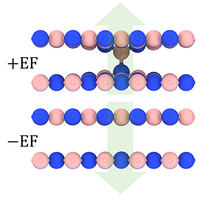
Structural superlubricity is a regime of ultralow friction and wear that emerges when two crystalline surfaces slide in an incommensurate manner. We show that an external electric field can act as an effective control knob to tune structural superlubricity in interfaces of atomically thin layers of hexagonal boron nitride. Using advanced atomistic simulation tools, we demonstrate that electric fields regulate the formation and rupture of interfacial polar bonds, enabling friction to be either enhanced or suppressed. We further introduce a simple stochastic model that links these atomic-scale mechanisms to friction at experimentally relevant sliding speeds, pointing to a general route for electrically controlling friction in layered material contacts.
Article Text
Supplemental Material
References (78)
- A. K. Geim and I. V. Grigorieva, Van der Waals heterostructures, Nature (London) 499, 419 (2013).
- K. S. Novoselov, A. Mishchenko, A. Carvalho, and A. H. Castro Neto, 2D materials and van der Waals heterostructures, Science 353, aac9439 (2016).
- Fengnian Xia, Han Wang, Di Xiao, Madan Dubey, and Ashwin Ramasubramaniam, Two-dimensional material nanophotonics, Nat. Photonics 8, 899 (2014).
- D. Mandelli, W. Ouyang, M. Urbakh, and O. Hod, The princess and the nanoscale pea: Long-range penetration of surface distortions into layered materials stacks, ACS Nano 13, 7603 (2019).
- W. Ouyang, O. Hod, and M. Urbakh, Parity-dependent moire superlattices in graphene/h-BN heterostructures: A route to mechanomutable metamaterials, Phys. Rev. Lett. 126, 216101 (2021).
- M. Dienwiebel, G. S. Verhoeven, N. Pradeep, Joost W. Frenken, J. A. Heimberg, and H. W. Zandbergen, Superlubricity of graphite, Phys. Rev. Lett. 92, 126101 (2004).
- A. E. Filippov, M. Dienwiebel, Joost W. Frenken, J. Klafter, and M. Urbakh, Torque and twist against superlubricity, Phys. Rev. Lett. 100, 046102 (2008).
- D. Mandelli, W. Ouyang, O. Hod, and M. Urbakh, Negative friction coefficients in superlubric graphite-hexagonal boron nitride heterojunctions, Phys. Rev. Lett. 122, 076102 (2019).
- Jin Wang, Ali Khosravi, Andrea Vanossi, and Erio Tosatti, Colloquium: Sliding, and pinning in structurally lubric 2D material interfaces, Rev. Mod. Phys. 96, 011002 (2024).
- L. J. Li, E. C. O’Farrell, K. P. Loh, G. Eda, B. Ozyilmaz, and A. H. Castro Neto, Controlling many-body states by the electric-field effect in a two-dimensional material, Nature (London) 529, 185 (2016).
- S. K. Srivastav, A. Udupa, K. Watanabe, T. Taniguchi, D. Sen, and A. Das, Electric-field-tunable edge transport in bernal-stacked trilayer graphene, Phys. Rev. Lett. 132, 096301 (2024).
- Y. Wang, J. Wang, T. Wu, W. Chen, D. Peng, Z. Wu, M. Ma, and Q. Zheng, The anomalous effect of electric field on friction for microscale structural superlubric graphite/Au contact, Natl. Sci. Rev. 11, nwae019 (2024).
- Diana Berman, Leonardo Israel Farfan-Cabrera, Andreas Rosenkranz, and Ali Erdemir, 2D materials for durable, and sustainable electric vehicles, Nat. Rev. Mater. 9, 527 (2024).
- S. Shaik, R. Ramanan, D. Danovich, and D. Mandal, Structure and reactivity/selectivity control by oriented-external electric fields, Chem. Soc. Rev. 47, 5125 (2018).
- M. Vizner Stern, Y. Waschitz, W. Cao, I. Nevo, K. Watanabe, T. Taniguchi, E. Sela, M. Urbakh, O. Hod, and M. Ben Shalom, Interfacial ferroelectricity by van der Waals sliding, Science 372, 1462 (2021).
- S. Deb, W. Cao, N. Raab, K. Watanabe, T. Taniguchi, M. Goldstein, L. Kronik, M. Urbakh, O. Hod, and M. Ben Shalom, Cumulative polarization in conductive interfacial ferroelectrics, Nature (London) 612, 465 (2022).
- Zhaokuan Yu, Jinbo Bian, Jin Wang, Zonghuiyi Jiang, Xuanyu Huang, Linxin Zhai, Xin Lu, Xiaofei Liu, Quanshui Zheng, and Zhiping Xu, On-device control of electronic friction, Phys. Rev. X 16, 011050 (2026).
- Florian Banhart, Jani Kotakoski, and Arkady V. Krasheninnikov, Structural defects in graphene, ACS Nano 5, 26 (2011).
- X. Gao, M. Urbakh, and O. Hod, Stick-slip dynamics of moire superstructures in polycrystalline 2D material interfaces, Phys. Rev. Lett. 129, 276101 (2022).
- J. H. Jeong, Y. Jung, J. U. Park, and G. H. Lee, Gate-tunable electrostatic friction of grain boundary in chemical-vapor-deposited MoS(2), Nano Lett. 23, 3085 (2023).
- Penghua Ying, Xiang Gao, Diana Berman, Oded Hod, and Michael Urbakh, Scaling-up of structural superlubricity: Challenges, and opportunities, Adv. Funct. Mater. 35, 2423024 (2025).
- Penghua Ying, Amir Natan, Oded Hod, and Michael Urbakh, Effect of interlayer bonding on superlubric sliding of graphene contacts: A machine-learning potential study, ACS Nano 18, 10133 (2024).
- Penghua Ying, Xiang Gao, Amir Natan, Michael Urbakh, and Oded Hod, Chemifriction, and superlubricity: Friends or foes?, J. Phys. Chem. Lett. 16, 2934 (2025).
- G. H. Ryu, H. J. Park, J. Ryou, J. Park, J. Lee, G. Kim, H. S. Shin, C. W. Bielawski, R. S. Ruoff, S. Hong, and Z. Lee, Atomic-scale dynamics of triangular hole growth in monolayer hexagonal boron nitride under electron irradiation, Nanoscale 7, 10600 (2015).
- H. Park, Y. Wen, S. X. Li, W. Choi, G. D. Lee, M. Strano, and J. H. Warner, Atomically precise control of carbon insertion into hBN monolayer point vacancies using a focused electron beam guide, Small 17, e2100693 (2021).
- See Supplemental Material at http://link.aps.org/supplemental/10.1103/s32x-hjrx for additional information on the energy barrier for interlayer binding dynamics in various defected bilayers, DFT calculations, MLP training and validation, reactive sliding dynamics production simulation setup, bond formation and rupture barriers under EFs and normal loads, detailed derivation of Eq. (5), and physifriction and chemifriction of -BN bilayers from sliding dynamics simulations. Supplemental Material includes Refs. [22,27–47].
- Graeme Henkelman, Blas P Uberuaga, and Hannes Jónsson, A climbing image nudged elastic band method for finding saddle points, and minimum energy paths, J. Chem. Phys. 113, 9901 (2000).
- Georg Kresse and Jürgen Furthmüller, Efficient iterative schemes for ab initio total-energy calculations using a plane-wave basis set, Phys. Rev. B 54, 11169 (1996).
- Georg Kresse and Daniel Joubert, From ultrasoft pseudopotentials to the projector augmented-wave method, Phys. Rev. B 59, 1758 (1999).
- Ask Hjorth Larsen, Jens Jørgen Mortensen, Jakob Blomqvist, Ivano E Castelli, Rune Christensen, Marcin Dułak, Jesper Friis, Michael N Groves, Bjørk Hammer, and Cory Hargus, The atomic simulation environment—a Python library for working with atoms, J. Phys. Condens. Matter 29, 273002 (2017).
- P. E Blöchl, Projector augmented-wave method, Phys. Rev. B 50, 17953 (1994).
- Stefan Grimme, Stephan Ehrlich, and Lars Goerigk, Effect of the damping function in dispersion corrected density functional theory, J. Comput. Chem. 32, 1456 (2011).
- Ilyes Batatia, David P Kovacs, Gregor Simm, Christoph Ortner, and Gábor Csányi, MACE: Higher order equivariant message passing neural networks for fast, and accurate force fields, in Advances in Neural Information Processing Systems (Curran Associates, Inc., Red Hook, NY, 2022), p. 11423.
- Penghua Ying, Cheng Qian, Rui Zhao, Yanzhou Wang, Ke Xu, Feng Ding, Shunda Chen, and Zheyong Fan, Advances in modeling complex materials: The rise of neuroevolution potentials, Chem. Phys. Rev. 6, 011310 (2025).
- D. P. Kovacs, I. Batatia, E. S. Arany, and G. Csanyi, Evaluation of the MACE force field architecture: From medicinal chemistry to materials science, J. Chem. Phys. 159, 044118 (2023).
- Diederik P Kingma and Jimmy Ba, Adam: A method for stochastic optimization, arXiv:1412.6980.
- Afshin Zamani zakaria, A two-section beam element to model the B-N covalent bonds in boron nitride nanotubes, Mater. Res. Bull. 145, 111533 (2022).
- T Schneider and E Stoll, Molecular-dynamics study of a three-dimensional one-component model for distortive phase transitions, Phys. Rev. B 17, 1302 (1978).
- https://github.com/ACEsuit/mace (Accessed 2025-09-03).
- Tevis D. B. Jacobs, Bernd Gotsmann, Mark A. Lantz, and Robert W. Carpick, On the application of transition state theory to atomic-scale wear, Tribol. Lett. 39, 257 (2010).
- Ashlie Martini and Seong H. Kim, Activation volume in shear-driven chemical reactions, Tribol. Lett. 69, 150 (2021).
- Ashlie Martini and Seong H. Kim, Correction to: Activation volume in shear-driven chemical reactions, Tribol. Lett. 71, 14 (2022).
- B. Gotsmann and M. A. Lantz, Atomistic wear in a single asperity sliding contact, Phys. Rev. Lett. 101, 125501 (2008).
- S. Kadkhodaei and A. van de Walle, A simple local expression for the prefactor in transition state theory, J. Chem. Phys. 150, 144105 (2019).
- J. Lefèvre López, N. Mousseau, G. Adjanor, and C. Domain, Harmonic transition state theory applied to vacancy diffusion pre-exponential factors in a concentrated solid-solution alloy, Phys. Rev. Mater. 8, 013609 (2024).
- Abraham Savitzky and M. J. E. Golay, Smoothing and differentiation of data by simplified least squares procedures, Anal. Chem. 36, 1627 (1964).
- P. Virtanen et al. (scipy Contributors), scipy 1.0: Fundamental algorithms for scientific computing in Python, Nat. Methods 17, 261 (2020).
- John P Perdew, Kieron Burke, and Matthias Ernzerhof, Generalized gradient approximation made simple, Phys. Rev. Lett. 77, 3865 (1996).
- Alexander Stukowski, Visualization, and analysis of atomistic simulation data with ovito–the open visualization tool, Model. Simul. Mater. Sci. Eng. 18, 015012 (2010).
- O. Hod, Graphite and hexagonal boron-nitride have the same interlayer distance. Why?, J. Chem. Theory Comput. 8, 1360 (2012).
- Fabian Ducry, Dominic Waldhoer, Theresia Knobloch, Miklos Csontos, Nadia Jimenez Olalla, Juerg Leuthold, Tibor Grasser, and Mathieu Luisier, An ab initio study on resistance switching in hexagonal boron nitride, npj 2D Mater. Appl. 6, 58 (2022).
- Manuel Guidon, Jürg Hutter, and Joost VandeVondele, Robust periodic Hartree–Fock exchange for large-scale simulations using Gaussian basis sets, J. Chem. Theory Comput. 5, 3010 (2009).
- J. Behler and M. Parrinello, Generalized neural-network representation of high-dimensional potential-energy surfaces, Phys. Rev. Lett. 98, 146401 (2007).
- V. L. Deringer, M. A. Caro, and G. Csanyi, Machine learning interatomic potentials as emerging tools for materials science, Adv. Mater. 31, 1902765 (2019).
- O. T. Unke, S. Chmiela, H. E. Sauceda, M. Gastegger, I. Poltavsky, K. T. Schutt, A. Tkatchenko, and K. R. Muller, Machine learning force fields, Chem. Rev. 121, 10142 (2021).
- A. P. Thompson, L. P. Swiler, C. R. Trott, S. M. Foiles, and G. J. Tucker, Spectral neighbor analysis method for automated generation of quantum-accurate interatomic potentials, J. Comput. Phys. 285, 316 (2015).
- Alexander V. Shapeev, Moment tensor potentials: A class of systematically improvable interatomic potentials, Multiscale Model. Simul. 14, 1153 (2016).
- Stefan Chmiela, Alexandre Tkatchenko, Huziel E. Sauceda, Igor Poltavsky, Kristof T. Schütt, and Klaus-Robert Müller, Machine learning of accurate energy-conserving molecular force fields, Sci. Adv. 3, e1603015 (2017).
- A. P. Bartok, M. C. Payne, R. Kondor, and G. Csanyi, Gaussian approximation potentials: The accuracy of quantum mechanics, without the electrons, Phys. Rev. Lett. 104, 136403 (2010).
- Zheyong Fan, Zezhu Zeng, Cunzhi Zhang, Yanzhou Wang, Keke Song, Haikuan Dong, Yue Chen, and Tapio Ala-Nissila, Neuroevolution machine learning potentials: Combining high accuracy, and low cost in atomistic simulations, and application to heat transport, Phys. Rev. B 104, 104309 (2021).
- L. Zhang, J. Han, H. Wang, R. Car, and E. W, Deep potential molecular dynamics: A scalable model with the accuracy of quantum mechanics, Phys. Rev. Lett. 120, 143001 (2018).
- Z. Fan et al., GPUMD: A package for constructing accurate machine-learned potentials, and performing highly efficient atomistic simulations, J. Chem. Phys. 157, 114801 (2022).
- S. Batzner, A. Musaelian, L. Sun, M. Geiger, J. P. Mailoa, M. Kornbluth, N. Molinari, T. E. Smidt, and B. Kozinsky, E(3)-equivariant graph neural networks for data-efficient and accurate interatomic potentials, Nat. Commun. 13, 2453 (2022).
- J. Behler, Perspective: Machine learning potentials for atomistic simulations, J. Chem. Phys. 145, 170901 (2016).
- J. Kikkawa, C. Shinei, J. Chen, Y. Masuyama, Y. Yamazaki, T. Mizoguchi, K. Kimoto, T. Taniguchi, and T. Teraji, Observation of boron vacancy concentration in hexagonal boron nitride at nanometer scale, Nano Lett. 25, 13191 (2025).
- Fei Ren, Zongwei Xu, and Yiyuan Wu, Optimization of carbon irradiation parameters for creating spin defects in hexagonal boron nitride, Nanotechnol. Precis. Eng. 8, 033014 (2025).
- Aidan P Thompson, H Metin Aktulga, Richard Berger, Dan S Bolintineanu, W Michael Brown, Paul S Crozier, Pieter J in’t Veld, Axel Kohlmeyer, Stan G Moore, and Trung Dac Nguyen, lammps-a flexible simulation tool for particle-based materials modeling at the atomic, meso, and continuum scales, Comput. Phys. Commun. 271, 108171 (2022).
- T. Sun, E. Gao, X. Jia, J. Bian, Z. Wang, M. Ma, Q. Zheng, and Z. Xu, Robust structural superlubricity under gigapascal pressures, Nat. Commun. 15, 5952 (2024).
- M. Han, D. Peng, D. Yang, J. Wang, Y. Zheng, G. Hu, Y. Shao, J. Li, F. Ding, Z. Xu, M. Urbakh, and Q. Zheng, Observation of robust macroscale structural superlubricity, Phys. Rev. Lett. 136, 076201 (2026).
- Hendrik Anthony Kramers, Brownian motion in a field of force, and the diffusion model of chemical reactions, Physica 7, 284 (1940).
- C. Tang, Y. Jiang, C. Chen, C. Xiao, J. Sun, L. Qian, and L. Chen, Graphene failure under MPa: Nanowear of step edges initiated by interfacial mechanochemical reactions, Nano Lett. 24, 3866 (2024).
- W. Ouyang, S. N. Ramakrishna, A. Rossi, M. Urbakh, N. D. Spencer, and A. Arcifa, Load and velocity dependence of friction mediated by dynamics of interfacial contacts, Phys. Rev. Lett. 123, 116102 (2019).
- L. Caputo, V. H. Nguyen, and J. C. Charlier, First-principles study of the structural and electronic properties of BN-ring doped graphene, Phys. Rev. Mater. 6, 114001 (2022).
- Yalin Dong, Qunyang Li, and Ashlie Martini, Molecular dynamics simulation of atomic friction: A review, and guide, J. Vac. Sci. Technol. A 31, 030801 (2013).
- Pierre Sens, Rigidity sensing by stochastic sliding friction, Europhys. Lett. 104, 38003 (2013).
- Larry C Andrews, Special Functions of Mathematics for Engineers (Spie Press, Bellingham, WA, 1998), Vol. 49.
- O. Hod, E. Meyer, Q. Zheng, and M. Urbakh, Structural superlubricity and ultralow friction across the length scales, Nature (London) 563, 485 (2018).
- P. Ying, Electric-Field Control of Interlayer Binding and Friction in -BN Contacts, Version v1, [dataset], Zenodo, 2026, 10.5281/zenodo.18151591.

