

- Open Access
Entropic Tug of War: Topological Constraints Spontaneously Rectify the Dynamics of a Polymer with Heterogeneous Fluctuations
Phys. Rev. X 16, 011046 – Published 4 March, 2026
DOI: https://doi.org/10.1103/rkms-2v1l
Abstract
Polymers with active segments constitute prospective future materials and are used as a model for some biological systems such as chromatin. The directions of the active forces are typically introduced with temporal or spatial correlations to establish directional motion of the chain and corresponding active dynamics. Instead, here we consider an active-passive copolymer, where the two segments differ only by the magnitude of their fluctuations and feature no artificial correlations. Here we show that although the model itself does not possess directional dynamics, if the chains are concentrated, directional persistent motion spontaneously arises as a consequence of the broken translational symmetry owing to the topological constraints. Using scaling arguments and simulations, we explain the phenomenon and describe the ensuing dynamics. Our work has thus far-reaching consequences for the mechanical properties of all dense active polymeric systems with heterogeneous fluctuations and in particular for chromatin conformation and dynamics that are crucial for biological functionality.
Physics Subject Headings (PhySH)
- Anomalous diffusion
- Dynamical phase transitions
- Genome organization
- Noise-induced transitions
- Nonequilibrium statistical mechanics
- Polymer conformation & topology
- Polymer entanglement
- Polymer folding
- Reptation
- Block copolymers
- Chromatin
- Dry active matter
- Polymer melts
- Langevin equation
- Molecular dynamics
- Polymer scaling theory
- Polymer theory
- Self-similarity
- Tube theories
Popular Summary
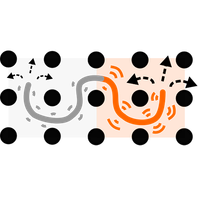
Polymers in biological systems, like chromatin in cell nuclei, can experience heterogeneous activity where some regions fluctuate more vigorously than others. We discovered that even when these fluctuations are completely isotropic—lacking any built-in directional bias—concentrated polymers spontaneously develop persistent directional motion. This surprising behavior emerges from an imbalance of entropic forces at chain ends caused by topological constraints that prevent chains from crossing each other. Using computer simulations and scaling theory, we show that the “hotter” segment pulls the rest of the chain through the entangled mesh, creating superdiffusive dynamics where segments move faster than normal diffusion would predict. This mechanism provides new insight into chromatin dynamics in living cells, where active processes create localized fluctuations. Our findings suggest that topological constraints play a crucial role in converting nondirectional activity into directed motion, with implications for understanding genome organization and designing functional active polymeric materials.
Article Text
References (61)
- I. Eshghi, A. Zidovska, and A. Y. Grosberg, Activity-driven phase transition causes coherent flows of chromatin, Phys. Rev. Lett. 131, 048401 (2023).
- S. Fürthauer, B. Lemma, P. J. Foster, S. C. Ems-McClung, C.-H. Yu, C. E. Walczak, Z. Dogic, D. J. Needleman, and M. J. Shelley, Self-straining of actively crosslinked microtubule networks, Nat. Phys. 15, 1295 (2019).
- V. P. Patil, H. Tuazon, E. Kaufman, T. Chakrabortty, D. Qin, J. Dunkel, and M. S. Bhamla, Ultrafast reversible self-assembly of living tangled matter, Science 380, 392 (2023).
- S. Ramaswamy, The mechanics and statistics of active matter, Annu. Rev. Condens. Matter Phys. 1, 323 (2010).
- M. C. Marchetti, J. F. Joanny, S. Ramaswamy, T. B. Liverpool, J. Prost, M. Rao, and R. A. Simha, Hydrodynamics of soft active matter, Rev. Mod. Phys. 85, 1143 (2013).
- R. G. Winkler, J. Elgeti, and G. Gompper, Active polymers—emergent conformational and dynamical properties: A brief review, J. Phys. Soc. Jpn. 86, 101014 (2017).
- D. Humphrey, C. Duggan, D. Saha, D. Smith, and J. Käs, Active fluidization of polymer networks through molecular motors, Nature (London) 416, 413 (2002).
- D. Breoni, C. Kurzthaler, B. Liebchen, H. Löwen, and S. Mandal, Giant activity-induced stress plateau in entangled polymer solutions, arXiv:2310.02929.
- A. R. Tejedor, R. Carracedo, and J. Ramírez, Molecular dynamics simulations of active entangled polymers reptating through a passive mesh, Polymer 268, 125677 (2023).
- J. Smrek, I. Chubak, C. N. Likos, and K. Kremer, Active topological glass, Nat. Commun. 11, 26 (2020).
- I. Chubak, C. N. Likos, K. Kremer, and J. Smrek, Emergence of active topological glass through directed chain dynamics and nonequilibrium phase segregation, Phys. Rev. Res. 2, 043249 (2020).
- C. Micheletti, I. Chubak, E. Orlandini, and J. Smrek, Topology-based detection and tracking of deadlocks reveal aging of active ring melts, ACS Macro Lett. 13, 124 (2024).
- V. Bianco, E. Locatelli, and P. Malgaretti, Globulelike conformation and enhanced diffusion of active polymers, Phys. Rev. Lett. 121, 217802 (2018).
- A. Lamura, Excluded volume effects on tangentially driven active ring polymers, Phys. Rev. E 109, 054611 (2024).
- M. A. Ubertini, E. Locatelli, and A. Rosa, Universal time and length scales of polar active polymer melts, ACS Macro Lett. 13, 1204 (2024).
- A. R. Tejedor and J. Ramírez, Reptation of active entangled polymers, Macromolecules 52, 8788 (2019).
- T. Eisenstecken, G. Gompper, and R. G. Winkler, Conformational properties of active semiflexible polymers, Polymers 8, 304 (2016).
- L. Natali, L. Caprini, and F. Cecconi, How a local active force modifies the structural properties of polymers, Soft Matter 16, 2594 (2020).
- A. Goychuk, D. Kannan, and M. Kardar, Delayed excitations induce polymer looping and coherent motion, Phys. Rev. Lett. 133, 078101 (2024).
- G. Cavalli and T. Misteli, Functional implications of genome topology, Nat. Struct. Mol. Biol. 20, 290 (2013).
- A. Zidovska, D. A. Weitz, and T. J. Mitchison, Micron-scale coherence in interphase chromatin dynamics, Proc. Natl. Acad. Sci. U.S.A. 110, 15555 (2013).
- R. Bruinsma, A. Grosberg, Y. Rabin, and A. Zidovska, Chromatin hydrodynamics, Biophys. J. 106, 1871 (2014).
- F.-Y. Chu, A. S. Clavijo, S. Lee, and A. Zidovska, Transcription-dependent mobility of single genes and genome-wide motions in live human cells, Nat. Commun. 15, 8879 (2024).
- S. S. Ashwin, T. Nozaki, K. Maeshima, and M. Sasai, Organization of fast and slow chromatin revealed by single-nucleosome dynamics, Proc. Natl. Acad. Sci. U.S.A. 116, 19939 (2019).
- A. Goychuk, D. Kannan, A. K. Chakraborty, and M. Kardar, Polymer folding through active processes recreates features of genome organization, Proc. Natl. Acad. Sci. U.S.A. 120, e2221726120 (2023).
- B. Chan and M. Rubinstein, Activity-driven chromatin organization during interphase: Compaction, segregation, and entanglement suppression, Proc. Natl. Acad. Sci. U.S.A. 121, e2401494121 (2024).
- B. Chan and M. Rubinstein, Theory of chromatin organization maintained by active loop extrusion, Proc. Natl. Acad. Sci. U.S.A. 120, e2222078120 (2023).
- J. Halverson, J. Smrek, K. Kremer, and A. Grosberg, From a melt of rings to chromosome territories: The role of topological constraints in genome folding, Rep. Prog. Phys. 77, 022601 (2014).
- A. Y. Grosberg and J.-F. Joanny, Nonequilibrium statistical mechanics of mixtures of particles in contact with different thermostats, Phys. Rev. E 92, 032118 (2015).
- S. Belan and M. Kardar, Active motion of passive asymmetric dumbbells in a non-equilibrium bath, J. Chem. Phys. 154, 024109 (2021).
- A. Baule, K. V. Kumar, and S. Ramaswamy, Exact solution of a brownian inchworm model for self-propulsion, J. Stat. Mech. (2008) P11008.
- M. Wang and A. Y. Grosberg, Three-body problem for langevin dynamics with different temperatures, Phys. Rev. E 101, 032131 (2020).
- E. Ilker and J.-F. Joanny, Phase separation and nucleation in mixtures of particles with different temperatures, Phys. Rev. Res. 2, 023200 (2020).
- S. F. Edwards, The theory of rubber elasticity, Br. Polym. J. 9, 140 (1977).
- M. Doi and S. F. Edwards, The Theory of Polymer Dynamics (Oxford University Press, New York, 1986).
- M. Rubinstein and R. Colby, Polymer Physics (OUP, Oxford, 2003).
- N. Uchida, G. S. Grest, and R. Everaers, Viscoelasticity and primitive path analysis of entangled polymer liquids: From F-actin to polyethylene, J. Chem. Phys. 128, 044902 (2008).
- R. Everaers, H. A. Karimi-Varzaneh, F. Fleck, N. Hojdis, and C. Svaneborg, Kremer–Grest models for commodity polymer melts: Linking theory, experiment, and simulation at the kuhn scale, Macromolecules 53, 1901 (2020).
- E. Helfand and D. S. Pearson, Statistics of the entanglement of polymers: Unentangled loops and primitive paths, J. Chem. Phys. 79, 2054 (1983).
- K. Kremer and G. S. Grest, Dynamics of entangled linear polymer melts: A molecular-dynamics simulation, J. Chem. Phys. 92, 5057 (1990).
- N. Ganai, S. Sengupta, and G. I. Menon, Chromosome positioning from activity-based segregation, Nucl. Acids Res. 42, 4145 (2014).
- A. Awazu, Segregation and phase inversion of strongly and weakly fluctuating brownian particle mixtures and a chain of such particle mixtures in spherical containers, Phys. Rev. E 90, 042308 (2014).
- S. N. Weber, C. A. Weber, and E. Frey, Binary mixtures of particles with different diffusivities demix, Phys. Rev. Lett. 116, 058301 (2016).
- J. Smrek and K. Kremer, Small activity differences drive phase separation in active-passive polymer mixtures, Phys. Rev. Lett. 118, 098002 (2017).
- A. R. Tejedor and J. Ramírez, Dynamics of entangled polymers subjected to reptation and drift, Soft Matter 16, 3154 (2020).
- J.-X. Li, S. Wu, L.-L. Hao, Q.-L. Lei, and Y.-Q. Ma, Nonequilibrium structural and dynamic behaviors of polar active polymer controlled by head activity, Phys. Rev. Res. 5, 043064 (2023).
- C. Svaneborg and R. Everaers, Characteristic time and length scales in melts of Kremer–Grest bead–spring polymers with wormlike bending stiffness, Macromolecules 53, 1917 (2020).
- L. A. Moreira, G. Zhang, F. Müller, T. Stuehn, and K. Kremer, Direct equilibration and characterization of polymer melts for computer simulations, Macromol. Theory Simul. 24, 419 (2015).
- R. Everaers, S. K. Sukumaran, G. S. Grest, C. Svaneborg, A. Sivasubramanian, and K. Kremer, Rheology and microscopic topology of entangled polymeric liquids, Science 303, 823 (2004).
- S. Brahmachari, T. Markovich, F. C. MacKintosh, and J. N. Onuchic, Temporally correlated active forces drive segregation and enhanced dynamics in chromosome polymers, PRX Life 2, 033003 (2024).
- D. Saintillan, M. J. Shelley, and A. Zidovska, Extensile motor activity drives coherent motions in a model of interphase chromatin, Proc. Natl. Acad. Sci. U.S.A. 115, 11442 (2018).
- C.-H. Chuang, A. E. Carpenter, B. Fuchsova, T. Johnson, P. de Lanerolle, and A. S. Belmont, Long-range directional movement of an interphase chromosome site, Curr. Biol. 16, 825 (2006).
- A. Vivante, E. Brozgol, I. Bronshtein, V. Levi, and Y. Garini, Chromatin dynamics governed by a set of nuclear structural proteins, Genes, Chromosomes Cancer 58, 437 (2019).
- I. Bronshtein, E. Kepten, I. Kanter, S. Berezin, M. Lindner, A. B. Redwood, S. Mai, S. Gonzalo, R. Foisner, Y. Shav-Tal, and Y. Garini, Loss of lamin a function increases chromatin dynamics in the nuclear interior, Nat. Commun. 6, 8044 (2015).
- H. A. Shaban, R. Barth, L. Recoules, and K. Bystricky, Hi-d: Nanoscale mapping of nuclear dynamics in single living cells, Genome Biol. 21, 95 (2020).
- A. Javer, N. J. Kuwada, Z. Long, V. G. Benza, K. D. Dorfman, P. A. Wiggins, P. Cicuta, and M. C. Lagomarsino, Persistent super-diffusive motion of escherichia coli chromosomal loci, Nat. Commun. 5, 3854 (2014).
- T. Germier, S. Kocanova, N. Walther, A. Bancaud, H. A. Shaban, H. Sellou, A. Z. Politi, J. Ellenberg, F. Gallardo, and K. Bystricky, Real-time imaging of a single gene reveals transcription-initiated local confinement, Biophys. J. 113, 1383 (2017).
- P. Mach, P. I. Kos, Y. Zhan, J. Cramard, S. Gaudin, J. Tünnermann, E. Marchi, J. Eglinger, J. Zuin, M. Kryzhanovska, S. Smallwood, L. Gelman, G. Roth, E. P. Nora, G. Tiana, and L. Giorgetti, Cohesin and CTCF control the dynamics of chromosome folding, Nat. Genet. 54, 1907 (2022).
- J. Li, B. Zhang, and Z.-Y. Wang, Activity-induced stiffness, entanglement network and dynamic slowdown in unentangled semidilute polymer solutions, Soft Matter 20, 5174 (2024).
- R. Cerbino and V. Trappe, Differential dynamic microscopy: Probing wave vector dependent dynamics with a microscope, Phys. Rev. Lett. 100, 188102 (2008).
- S. Plimpton, Fast parallel algorithms for short-range molecular dynamics, J. Comput. Phys. 117, 1 (1995).

