

- Open Access
Waves Maintain Large-Scale 2D Flows in Rotating Turbulence and Cause Their Demise
Phys. Rev. X 16, 031013 – Published 21 July, 2026
DOI: https://doi.org/10.1103/rjxp-pcy2
Abstract
Turbulence follows a few well-known organizational principles, rooted in conservation laws. One such principle states that a system conserving two sign-definite invariants self-organizes into large-scale structures. Ordinary three-dimensional turbulence does not fall within this paradigm but is profoundly altered when subject to rotation. In rotating turbulence, 3D inertial waves coexist alongside emergent two-dimensional structures, which tend to take the form of domain-scale flows called condensates. This interplay raises a fundamental question: Why and when are 2D flows sustained if only 3D waves are excited? We develop a quasilinear wave-kinetic theory to answer this question. We show that near-resonant interactions between 3D waves and a large-scale 2D flow impose an additional conservation law: Waves must conserve their helicity separately for each helicity sign. This emergent sign-definite invariant constrains the waves to transfer their energy to large-scale 2D motions, which maintains the latter in statistical steady state. We derive analytical expressions for the 3D-2D energy transfer as a function of rotation, Reynolds number, and domain geometry in a rotation-dominated regime and compare them with extensive numerical simulations of the rotating 3D Navier-Stokes equations. As rotation increases, the energy transfer from the waves to the 2D flow progressively vanishes as the two decouple, leading to a transition between distinct classes of turbulence: from 2D-dominated to 3D-dominated wave turbulence. Our theory shows that this gradual transition is caused by a depletion of modes satisfying the resonance conditions and exhibits good agreement with numerical simulations when the number of near-resonant modes is not too small. We discuss such limitations of our theory, as well as the validity range of its underlying assumptions. Together, these results suggest a mechanism underlying two-dimensionalization in rotating turbulence and, more broadly, illustrate how nonlinear systems sustaining waves can self-organize into anisotropic, zero-frequency structures.
Physics Subject Headings (PhySH)
Popular Summary
Three-dimensional turbulence usually transfers energy toward ever-smaller motions. Rotation, however, profoundly changes this behavior. Rotation generates wavelike motions throughout the fluid while simultaneously promoting the emergence of large-scale, two-dimensional flows that can span the entire system. These sorts of structures play a central role in the dynamics of planetary atmospheres and oceans. We explain how these large-scale flows can be sustained even when energy is injected only into 3D waves. We show that interactions between waves and large-scale motions impose an unexpected conservation law that redirects energy toward large-scale 2D structures. Building on this realization, we develop a theory that analytically predicts the magnitude of this energy transfer as a function of rotation, Reynolds number, and domain geometry that agrees well with numerical simulations. We show how 2D flows become weaker at high rotation, as their coupling to the waves progressively vanishes. The theory solves a major puzzle in how energy can be transferred in geophysical and astrophysical flows, with possible applications in plasma physics, stratified turbulence, and chiral fluids.
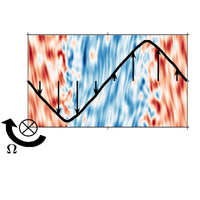
Article Text
References (114)
- J. Callies, R. Ferrari, and O. Bühler, Transition from geostrophic turbulence to inertia–gravity waves in the atmospheric energy spectrum, Proc. Natl. Acad. Sci. U.S.A. 111, 17033 (2014).
- D. Balwada, J.-H. Xie, R. Marino, and F. Feraco, Direct observational evidence of an oceanic dual kinetic energy cascade and its seasonality, Sci. Adv. 8, eabq2566 (2022).
- C. Guervilly, P. Cardin, and N. Schaeffer, Turbulent convective length scale in planetary cores, Nature (London) 570, 368 (2019).
- M. Ghil and V. Lucarini, The physics of climate variability and climate change, Rev. Mod. Phys. 92, 035002 (2020).
- P. H. Diamond, S. Itoh, K. Itoh, and T. Hahm, Zonal flows in plasma—a review, Plasma Phys. Controlled Fusion 47, R35 (2005).
- G. K. Vallis and M. E. Maltrud, Generation of mean flows and jets on a beta plane and over topography, J. Phys. Oceanogr. 23, 1346 (1993).
- C. Connaughton, S. Nazarenko, and B. Quinn, Rossby and drift wave turbulence and zonal flows: The Charney–Hasegawa–Mima model and its extensions, Phys. Rep. 604, 1 (2015).
- C. Caulfield, Layering, instabilities, and mixing in turbulent stratified flows, Annu. Rev. Fluid Mech. 53, 113 (2021).
- L. M. Smith and F. Waleffe, Generation of slow large scales in forced rotating stratified turbulence, J. Fluid Mech. 451, 145 (2002).
- V. Labarre and M. Shavit, Distinguished regimes of 2-D internal gravity wave turbulence, J. Fluid Mech. 1031, A49 (2026).
- X. M. de Wit, M. Fruchart, T. Khain, F. Toschi, and V. Vitelli, Pattern formation by turbulent cascades, Nature (London) 627, 515 (2024).
- R. Fjørtoft, On the changes in the spectral distribution of kinetic energy for two-dimensional, nondivergent flow, Tellus 5, 225 (1953).
- R. H. Kraichnan, Inertial ranges in two-dimensional turbulence, Phys. Fluids 10, 1417 (1967).
- H. K. Moffatt, The degree of knottedness of tangled vortex lines, J. Fluid Mech. 35, 117 (1969).
- Q. Chen, S. Chen, and G. L. Eyink, The joint cascade of energy and helicity in three-dimensional turbulence, Phys. Fluids 15, 361 (2003).
- P. D. Ditlevsen and P. Giuliani, Cascades in helical turbulence, Phys. Rev. E 63, 036304 (2001).
- E. Yarom, Y. Vardi, and E. Sharon, Experimental quantification of inverse energy cascade in deep rotating turbulence, Phys. Fluids 25 (2013).
- F. S. Godeferd and F. Moisy, Structure and dynamics of rotating turbulence: A review of recent experimental and numerical results, Appl. Mech. Rev. 67, 030802 (2015).
- L. M. Smith, J. R. Chasnov, and F. Waleffe, Crossover from two-to three-dimensional turbulence, Phys. Rev. Lett. 77, 2467 (1996).
- L. M. Smith and F. Waleffe, Transfer of energy to two-dimensional large scales in forced, rotating three-dimensional turbulence, Phys. Fluids 11, 1608 (1999).
- L. M. Smith and Y. Lee, On near resonances and symmetry breaking in forced rotating flows at moderate Rossby number, J. Fluid Mech. 535, 111 (2005).
- Q. Chen, S. Chen, G. L. Eyink, and D. D. Holm, Resonant interactions in rotating homogeneous three-dimensional turbulence, J. Fluid Mech. 542, 139 (2005).
- P. D. Mininni, A. Alexakis, and A. Pouquet, Scale interactions and scaling laws in rotating flows at moderate Rossby numbers and large Reynolds numbers, Phys. Fluids 21 (2009).
- P. D. Mininni and A. Pouquet, Rotating helical turbulence. I. Global evolution and spectral behavior, Phys. Fluids 22 (2010).
- E. Deusebio, G. Boffetta, E. Lindborg, and S. Musacchio, Dimensional transition in rotating turbulence, Phys. Rev. E 90, 023005 (2014).
- A. Campagne, B. Gallet, F. Moisy, and P.-P. Cortet, Disentangling inertial waves from eddy turbulence in a forced rotating-turbulence experiment, Phys. Rev. E 91, 043016 (2015).
- L. Biferale, F. Bonaccorso, I. M. Mazzitelli, M. A. T. van Hinsberg, A. S. Lanotte, S. Musacchio, P. Perlekar, and F. Toschi, Coherent structures and extreme events in rotating multiphase turbulent flows, Phys. Rev. X 6, 041036 (2016).
- M. Buzzicotti, P. Clark Di Leoni, and L. Biferale, On the inverse energy transfer in rotating turbulence, Eur. Phys. J. E 41, 1 (2018).
- A. Alexakis and L. Biferale, Cascades and transitions in turbulent flows, Phys. Rep. 767, 1 (2018).
- A. van Kan and A. Alexakis, Critical transition in fast-rotating turbulence within highly elongated domains, J. Fluid Mech. 899, A33 (2020).
- H. Lam, A. Delache, and F. Godeferd, Supply mechanisms of the geostrophic mode in rotating turbulence: Interactions with self, waves and eddies, J. Fluid Mech. 971, A10 (2023).
- O. Shaltiel, A. Salhov, O. Gat, and E. Sharon, Direct measurement of energy transfer in strongly driven rotating turbulence, Phys. Rev. Lett. 132, 224001 (2024).
- I. Kolvin, K. Cohen, Y. Vardi, and E. Sharon, Energy transfer by inertial waves during the buildup of turbulence in a rotating system, Phys. Rev. Lett. 102, 014503 (2009).
- A. M. Rubio, K. Julien, E. Knobloch, and J. B. Weiss, Upscale energy transfer in three-dimensional rapidly rotating turbulent convection, Phys. Rev. Lett. 112, 144501 (2014).
- C. Guervilly, D. W. Hughes, and C. A. Jones, Large-scale vortices in rapidly rotating Rayleigh–Bénard convection, J. Fluid Mech. 758, 407 (2014).
- T. Le Reun, B. Favier, A. J. Barker, and M. Le Bars, Inertial wave turbulence driven by elliptical instability, Phys. Rev. Lett. 119, 034502 (2017).
- P. Clark Di Leoni, A. Alexakis, L. Biferale, and M. Buzzicotti, Phase transitions and flux-loop metastable states in rotating turbulence, Phys. Rev. Fluids 5, 104603 (2020).
- A. J. Aguirre Guzmán, M. Madonia, J. S. Cheng, R. Ostilla-Mónico, Herman J. H. Clercx, and Rudie P. J. Kunnen, Competition between Ekman plumes and vortex condensates in rapidly rotating thermal convection, Phys. Rev. Lett. 125, 214501 (2020).
- I. V. Kolokolov, L. L. Ogorodnikov, and S. S. Vergeles, Structure of coherent columnar vortices in three-dimensional rotating turbulent flow, Phys. Rev. Fluids 5, 034604 (2020).
- X. M. de Wit, A. J. A. Guzmán, H. J. Clercx, and R. P. Kunnen, Discontinuous transitions towards vortex condensates in buoyancy-driven rotating turbulence, J. Fluid Mech. 936, A43 (2022).
- F. Waleffe, The nature of triad interactions in homogeneous turbulence, Phys. Fluids A 4, 350 (1992).
- C. Cambon, N. N. Mansour, and F. S. Godeferd, Energy transfer in rotating turbulence, J. Fluid Mech. 337, 303 (1997).
- G. Bordes, F. Moisy, T. Dauxois, and P.-P. Cortet, Experimental evidence of a triadic resonance of plane inertial waves in a rotating fluid, Phys. Fluids 24 (2012).
- A. Babin, A. Mahalov, and B. Nicolaenko, Regularity and integrability of 3D Euler and Navier–Stokes equations for rotating fluids, Asymptotic Analysis 15, 103 (1997).
- A. Babin, A. Mahalov, and B. Nicolaenko, Global regularity of 3D rotating Navier-Stokes equations for resonant domains, Indiana Univ. Math. J. 1133 (1999).
- B. Gallet, Exact two-dimensionalization of rapidly rotating large-Reynolds-number flows, J. Fluid Mech. 783, 412 (2015).
- P. Billant, Is the Taylor–Proudman theorem exact in unbounded domains? Case study of the three-dimensional stability of a vortex pair in a rapidly rotating fluid, J. Fluid Mech. 920, R1 (2021).
- L. Bourouiba and P. Bartello, The intermediate Rossby number range and two-dimensional–three-dimensional transfers in rotating decaying homogeneous turbulence, J. Fluid Mech. 587, 139 (2007).
- A. Alexakis, Rotating Taylor–Green flow, J. Fluid Mech. 769, 46 (2015).
- P. C. di Leoni and P. D. Mininni, Quantifying resonant and near-resonant interactions in rotating turbulence, J. Fluid Mech. 809, 821 (2016).
- T. Le Reun, B. Gallet, B. Favier, and M. Le Bars, Near-resonant instability of geostrophic modes: Beyond Greenspan’s theorem, J. Fluid Mech. 900, R2 (2020).
- M. Brunet, B. Gallet, and P.-P. Cortet, Shortcut to geostrophy in wave-driven rotating turbulence: The quartetic instability, Phys. Rev. Lett. 124, 124501 (2020).
- G. Batchelor and I. Proudman, The effect of rapid distortion of a fluid in turbulent motion, Q. J. Mech. Appl. Math. 7, 83 (1954).
- J. Marston and S. Tobias, Recent developments in theories of inhomogeneous and anisotropic turbulence, Annu. Rev. Fluid Mech. 55, 351 (2023).
- J. Laurie, G. Boffetta, G. Falkovich, I. Kolokolov, and V. Lebedev, Universal profile of the vortex condensate in two-dimensional turbulence, Phys. Rev. Lett. 113, 254503 (2014).
- I. V. Kolokolov and V. V. Lebedev, Structure of coherent vortices generated by the inverse cascade of two-dimensional turbulence in a finite box, Phys. Rev. E 93, 033104 (2016).
- A. Frishman, The culmination of an inverse cascade: Mean flow and fluctuations, Phys. Fluids 29, 125102 (2017).
- A. Frishman and C. Herbert, Turbulence statistics in a two-dimensional vortex condensate, Phys. Rev. Lett. 120, 204505 (2018).
- A. N. Doludenko, S. V. Fortova, I. V. Kolokolov, and V. V. Lebedev, Coherent vortex in a spatially restricted two-dimensional turbulent flow in absence of bottom friction, Phys. Fluids 33, 011704 (2021).
- K. Srinivasan and W. Young, Zonostrophic instability, J. Atmos. Sci. 69, 1633 (2012).
- J. B. Parker and J. A. Krommes, Zonal flow as pattern formation, Phys. Plasmas 20 (2013).
- J. B. Marston, G. P. Chini, and S. M. Tobias, Generalized quasilinear approximation: Application to zonal jets, Phys. Rev. Lett. 116, 214501 (2016).
- E. Woillez and F. Bouchet, Theoretical prediction of Reynolds stresses and velocity profiles for barotropic turbulent jets, Europhys. Lett. 118, 54002 (2017).
- A. Svirsky, C. Herbert, and A. Frishman, Two-dimensional turbulence with local interactions: Statistics of the condensate, Phys. Rev. Lett. 131, 224003 (2023).
- P. D. Mininni, D. Rosenberg, R. Reddy, and A. Pouquet, A hybrid MPI–OpenMP scheme for scalable parallel pseudospectral computations for fluid turbulence, Parallel Comput. 37, 316 (2011).
- C. Guervilly and D. W. Hughes, Jets and large-scale vortices in rotating Rayleigh-Bénard convection, Phys. Rev. Fluids 2, 113503 (2017).
- K. Seshasayanan and A. Alexakis, Condensates in rotating turbulent flows, J. Fluid Mech. 841, 434 (2018).
- F. Bouchet and E. Simonnet, Random changes of flow topology in two-dimensional and geophysical turbulence, Phys. Rev. Lett. 102, 094504 (2009).
- A. Frishman, J. Laurie, and G. Falkovich, Jets or vortices—what flows are generated by an inverse turbulent cascade?, Phys. Rev. Fluids 2, 032602(R) (2017).
- S. Gomé and A. Frishman, Helicity controls the direction of fluxes in rotating turbulence, arXiv:2512.05253.
- K. Seshasayanan and B. Gallet, Onset of three-dimensionality in rapidly rotating turbulent flows, J. Fluid Mech. 901, R5 (2020).
- C. S. Lohani, S. K. Nayak, and K. Seshasayanan, Effect of confinement on the transition from two-to three-dimensional fast-rotating turbulent flows, Phys. Rev. Fluids 9, 034604 (2024).
- M. Buzzicotti, H. Aluie, L. Biferale, and M. Linkmann, Energy transfer in turbulence under rotation, Phys. Rev. Fluids 3, 034802 (2018).
- S. Galtier, Weak inertial-wave turbulence theory, Phys. Rev. E 68, 015301(R) (2003).
We do not consider the buildup of the condensate here, but this process seems to follow the 2D inverse cascade phenomenology, energy flowing to the largest available mode, at least at low Ro.
- J. Proudman, On the motion of solids in a liquid possessing vorticity, Proc. R. Soc. A 92, 408 (1916).
- G. I. Taylor, Motion of solids in fluids when the flow is not irrotational, Proc. R. Soc. A 93, 99 (1917).
- H. P. Greenspan, The Theory of Rotating Fluids (Cambridge University Press, Cambridge, England, 1969).
- M. Lesieur, Turbulence in Fluids: Stochastic and Numerical Modelling (Nijhoff, Boston, MA, 1987), Vol. 488.
Note that we do not decompose the 2D mode into different chiralities. Our classification of homochiral-wave and heterochiral-wave interactions, therefore, differs from those established in Refs. [29, 41, 73, 81] based on the chirality of the three triadic modes.
- L. Biferale, S. Musacchio, and F. Toschi, Inverse energy cascade in three-dimensional isotropic turbulence, Phys. Rev. Lett. 108, 164501 (2012).
- V. M. Parfenyev, I. A. Vointsev, A. O. Skoba, and S. S. Vergeles, Velocity profiles of cyclones and anticyclones in a rotating turbulent flow, Phys. Fluids 33 (2021).
- V. E. Zakharov, V. S. L’vov, and G. Falkovich, Kolmogorov Spectra of Turbulence I: Wave Turbulence (Springer Science & Business Media, New York, 2012).
- A. C. Newell and B. Rumpf, Wave turbulence, Annu. Rev. Fluid Mech. 43, 59 (2011).
- T. Buckmaster, P. Germain, Z. Hani, and J. Shatah, Onset of the wave turbulence description of the longtime behavior of the nonlinear Schrödinger equation, Inventiones Mathematicae 225, 787 (2021).
- A. C. Newell and S. V. Nazarenko, Augmenting KZ finite flux solutions and nonlocal resonant transfer, Physica D 476, 134642 (2025).
- S. Nazarenko, Wave Turbulence (Springer, New York, 2011), Vol. 825.
- H. Greenspan, On the non-linear interaction of inertial modes, J. Fluid Mech. 36, 257 (1969).
- F. Waleffe, Inertial transfers in the helical decomposition, Phys. Fluids A 5, 677 (1993).
- M. Shavit, O. Bühler, and J. Shatah, Sign-indefinite invariants shape turbulent cascades, Phys. Rev. Lett. 133, 014001 (2024).
- F. P. Bretherton, Resonant interactions between waves. the case of discrete oscillations, J. Fluid Mech. 20, 457 (1964).
- V. S. L’vov, Y. L’vov, A. C. Newell, and V. Zakharov, Statistical description of acoustic turbulence, Phys. Rev. E 56, 390 (1997).
- Y. V. Lvov, K. L. Polzin, and N. Yokoyama, Resonant and near-resonant internal wave interactions, J. Phys. Oceanogr. 42, 669 (2012).
- A. C. Newell, Rossby wave packet interactions, J. Fluid Mech. 35, 255 (1969).
This assumption is difficult to assess. It could be that waves with very large always reenergize the 2D manifold (and then eventually the condensate) via near resonances. However, wave-wave interactions or viscous effects might dominate over such a 2D-3D interaction if is very large, preventing this scenario. We have not found evidence for this scenario in our DNS, which, however, is subject to a finite viscous cutoff.
- D. G. Andrews and M. McIntyre, On wave-action and its relatives, J. Fluid Mech. 89, 647 (1978).
- M. J. Lighthill and J. Lighthill, Waves in Fluids (Cambridge University Press, Cambridge, England, 2001).
- N. A. Ivchenko and S. S. Vergeles, Absorption and reflection of inertial waves by a geostrophic vortex, Phys. Fluids 37 (2025).
- L. Biferale, M. Buzzicotti, and M. Linkmann, From two-dimensional to three-dimensional turbulence through two-dimensional three-component flows, Phys. Fluids 29 (2017).
- A. Alexakis, Helically decomposed turbulence, J. Fluid Mech. 812, 752 (2017).
- G. Nivarti, R. Kerswell, J. Marston, and S. Tobias, Non-equivalence of quasi-linear dynamical systems and their statistical closures, J. Fluid Mech. 1005, A4 (2025).
- G. P. Chini, G. Michel, K. Julien, C. B. Rocha, and C. Caulfield, Exploiting self-organized criticality in strongly stratified turbulence, J. Fluid Mech. 933, A22 (2022).
- A. Campagne, B. Gallet, F. Moisy, and P.-P. Cortet, Direct and inverse energy cascades in a forced rotating turbulence experiment, Phys. Fluids 26, 125112 (2014).
- L. Bourouiba, D. Straub, and M. Waite, Non-local energy transfers in rotating turbulence at intermediate Rossby number, J. Fluid Mech. 690, 129 (2012).
- E. Monsalve, M. Brunet, B. Gallet, and P.-P. Cortet, Quantitative experimental observation of weak inertial-wave turbulence, Phys. Rev. Lett. 125, 254502 (2020).
- B. Favier, L. J. Silvers, and M. R. Proctor, Inverse cascade and symmetry breaking in rapidly rotating Boussinesq convection, Phys. Fluids 26 (2014).
- A. van Kan, K. Julien, B. Miquel, and E. Knobloch, Bridging the Rossby number gap in rapidly rotating thermal convection, J. Fluid Mech. 1010, A42 (2025).
- P. Bartello, Geostrophic adjustment and inverse cascades in rotating stratified turbulence, J. Atmos. Sci. 52 (1995).
- A. Alexakis, R. Marino, P. D. Mininni, A. van Kan, R. Foldes, and F. Feraco, Large-scale self-organization in dry turbulent atmospheres, Science 383, 1005 (2024).
- J. G. Charney, Geostrophic turbulence, J. Atmos. Sci. 28, 1087 (1971).
- S. Gomé and A. Frishman, https://zenodo.org/records/17176520 (2026).
- S. Galtier, A multiple time scale approach for anisotropic inertial wave turbulence, J. Fluid Mech. 974, A24 (2023).
- V. S. L’vov and S. Nazarenko, Discrete and mesoscopic regimes of finite-size wave turbulence, Phys. Rev. E 82, 056322 (2010).
- M. Shavit, O. Bühler, and J. Shatah, Turbulent spectrum of 2D internal gravity waves, Phys. Rev. Lett. 134, 054101 (2025).

