

- Open Access
Resource-Theoretical Unification of Mpemba Effects: Classical and Quantum
Phys. Rev. X 16, 011065 – Published 25 March, 2026
DOI: https://doi.org/10.1103/rbt4-psfd
Abstract
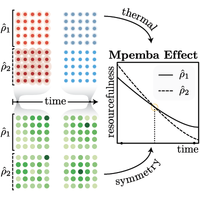
The Mpemba effect originally referred to the observation that, under certain thermalizing dynamics, initially hotter samples can cool faster than colder ones. This effect has since been generalized to other anomalous relaxation behaviors even beyond classical domains, such as symmetry restoration in quantum systems. This work demonstrates that resource theories, widely employed in information theory, provide a unified organizing principle to frame Mpemba physics. We show how the conventional thermal Mpemba effect arises naturally from the resource theory of athermality, while its symmetry-restoring counterpart is fully captured by the resource theories of asymmetry. Leveraging the framework of modes of asymmetry, we demonstrate that the Mpemba effect due to symmetry restoration is governed by the initial overlap with the slowest symmetry-restoring mode, mirroring the role of the slowest Liouvillian eigenmode in thermal Mpemba dynamics. Through this resource-theoretical formalism, we uncover the connection between these seemingly disparate effects and show that the dynamics of thermalization naturally splits into a symmetry-respecting and a symmetry-breaking term.
Physics Subject Headings (PhySH)
- Classical statistical mechanics
- Nonequilibrium & irreversible thermodynamics
- Quantum thermodynamics
- Stochastic thermodynamics
- Floquet systems
- Nonequilibrium systems
- Exact diagonalization
- Ising model
- Lindblad equation
- Markovian processes
- Master equation
- Metropolis algorithm
- Non-Markovian processes
- Quantum master equation
- Quantum spin chains
- SU(N) symmetries
- Spin chains
- Symmetries
- U(N) symmetry
- Z_2 symmetry
Popular Summary
The Mpemba effect, where a hotter system cools faster than a warmer one, has puzzled scientists for centuries. We demonstrate that this counterintuitive phenomenon, along with its counterparts in symmetry restoration and quantum relaxation, can be unified under the framework of resource theories. By treating relaxation as the dissipation of a physical resource—such as athermality, asymmetry, or quantum coherence—we show that the effect occurs when a state with more initial resource overlaps less with the slowest relaxation mode of the dynamics. Our analysis reveals that the symmetry Mpemba effect, previously considered a quantum curiosity, can also manifest in purely classical Markovian systems. These results establish a general principle for predicting and engineering ultrafast relaxation across classical and quantum domains by controlling how resources are depleted.
Article Text
References (119)
- E. B. Mpemba and D. G. Osborne, Cool?, Phys. Educ. 4, 172 (1969).
- Yun-Ho Ahn, Hyery Kang, Dong-Yeun Koh, and Huen Lee, Experimental verifications of Mpemba-like behaviors of clathrate hydrates, Korean J. Chem. Eng. 33, 1903 (2016).
- Cunliang Hu, Jingqing Li, Shaoyong Huang, Hongfei Li, Chuanfu Luo, Jizhong Chen, Shichun Jiang, and Lijia An, Conformation directed Mpemba effect on polylactide crystallization, Cryst. Growth Des. 18, 5757 (2018).
- P. Chaddah, S. Dash, Kranti Kumar, and A. Banerjee, Overtaking while approaching equilibrium, arXiv:1011.3598.
- Zhiyue Lu and Oren Raz, Nonequilibrium thermodynamics of the Markovian Mpemba effect and its inverse, Proc. Natl. Acad. Sci. U.S.A. 114, 5083 (2017).
- Israel Klich, Oren Raz, Ori Hirschberg, and Marija Vucelja, Mpemba index and anomalous relaxation, Phys. Rev. X 9, 021060 (2019).
- A. Gal and O. Raz, Precooling strategy allows exponentially faster heating, Phys. Rev. Lett. 124, 060602 (2020).
- Gianluca Teza, Ran Yaacoby, and Oren Raz, Relaxation shortcuts through boundary coupling, Phys. Rev. Lett. 131, 017101 (2023).
- Gianluca Teza, John Bechhoefer, Antonio Lasanta, Oren Raz, and Marija Vucelja, Speedups in nonequilibrium thermal relaxation: Mpemba and related effects, Phys. Rep. 1164, 1 (2026).
- Avinash Kumar and John Bechhoefer, Exponentially faster cooling in a colloidal system, Nature (London) 584, 64 (2020).
- Avinash Kumar, Raphaël Chétrite, and John Bechhoefer, Anomalous heating in a colloidal system, Proc. Natl. Acad. Sci. U.S.A. 119, e2118484119 (2022).
- Isha Malhotra and Hartmut Löwen, Double Mpemba effect in the cooling of trapped colloids, arXiv:2406.19098.
- A. Lasanta, F. Vega Reyes, A. Prados, and A. Santos, When the hotter cools more quickly: Mpemba effect in granular fluids, Phys. Rev. Lett. 119, 148001 (2017).
- Apurba Biswas, V. V. Prasad, O. Raz, and R. Rajesh, Mpemba effect in driven granular Maxwell gases, Phys. Rev. E 102, 012906 (2020).
- Zhen-Yu Yang and Ji-Xuan Hou, Non-Markovian Mpemba effect in mean-field systems, Phys. Rev. E 101, 052106 (2020).
- Sheng Zhang and Ji-Xuan Hou, Theoretical model for the Mpemba effect through the canonical first-order phase transition, Phys. Rev. E 106, 034131 (2022).
- Monwhea Jeng, The Mpemba effect: When can hot water freeze faster than cold?, Am. J. Phys. 74, 514 (2006).
- Henry C. Buridge and Oscar Hallstadius, Observing the Mpemba effect with minimal bias and the value of the Mpemba effect to scientific outreach and engagement, Proc. R. Soc. A 476, 20190829 (2020).
- Andrea Nava and Michele Fabrizio, Lindblad dissipative dynamics in the presence of phase coexistence, Phys. Rev. B 100, 125102 (2019).
- Federico Carollo, Antonio Lasanta, and Igor Lesanovsky, Exponentially accelerated approach to stationarity in markovian open quantum systems through the Mpemba effect, Phys. Rev. Lett. 127, 060401 (2021).
- Ruicheng Bao and Zhonghuai Hou, Accelerating relaxation in Markovian open quantum systems through quantum reset processes, Phys. Rev. Lett. 135, 150403 (2025).
- Simon Kochsiek, Federico Carollo, and Igor Lesanovsky, Accelerating the approach of dissipative quantum spin systems towards stationarity through global spin rotations, Phys. Rev. A 106, 012207 (2022).
- Felix Ivander, Nicholas Anto-Sztrikacs, and Dvira Segal, Hyperacceleration of quantum thermalization dynamics by bypassing long-lived coherences: An analytical treatment, Phys. Rev. E 108, 014130 (2023).
- Xuanhua Wang and Jin Wang, Mpemba effects in nonequilibrium open quantum systems, Phys. Rev. Res. 6, 033330 (2024).
- S. Aharony Shapira, Y. Shapira, J. Markov, G. Teza, N. Akerman, O. Raz, and R. Ozeri, Inverse Mpemba effect demonstrated on a single trapped ion qubit, Phys. Rev. Lett. 133, 010403 (2024).
- Mattia Moroder, Oisín Culhane, Krissia Zawadzki, and John Goold, Thermodynamics of the quantum Mpemba effect, Phys. Rev. Lett. 133, 140404 (2024).
- David J. Strachan, Archak Purkayastha, and Stephen R. Clark, Non-Markovian quantum Mpemba effect, Phys. Rev. Lett. 134, 220403 (2025).
- Ivan Medina, Oisín Culhane, Felix C. Binder, Gabriel T. Landi, and John Goold, Anomalous discharging of quantum batteries: The ergotropic Mpemba effect, Phys. Rev. Lett. 134, 220402 (2025).
- Mingdi Xu, Zijun Wei, Xiang-Ping Jiang, and Lei Pan, Expedited thermalization dynamics in incommensurate systems, Phys. Rev. A 112, 042210 (2025).
- Philipp Westhoff, Sebastian Paeckel, and Mattia Moroder, Fast and direct preparation of a genuine lattice Bose-Einstein condensate via the quantum Mpemba effect, Phys. Rev. A 112, 061304 (2025).
- N. Beato and G. Teza, Relaxation control of open quantum systems, Phys. Rev. Lett. 136, 070401 (2026).
Throughout this paper, we consider dynamics on a composite Hilbert space , where (system) and (environment) are always distinguished. In the open-dynamics case, describes an external bath; in the closed-dynamics case, is the complementary subsystem within an overall isolated . Local symmetry restoration then means that, after evolving under the joint dynamics, we apply the partial trace and study symmetry recovery on the reduced state .
- Filiberto Ares, Sara Murciano, and Pasquale Calabrese, Entanglement asymmetry as a probe of symmetry breaking, Nat. Commun. 14, 2036 (2023).
- Filiberto Ares, Pasquale Calabrese, and Sara Murciano, The quantum Mpemba effects, Nat. Rev. Phys. (2025), 10.1038/s42254-025-00838-0.
- Bob Coecke, Tobias Fritz, and Robert W. Spekkens, A mathematical theory of resources, Inf. Comput. 250, 59 (2016).
- Eric Chitambar and Gilad Gour, Quantum resource theories, Rev. Mod. Phys. 91, 025001 (2019).
- Iman Marvian and Robert W. Spekkens, Modes of asymmetry: The application of harmonic analysis to symmetric quantum dynamics and quantum reference frames, Phys. Rev. A 90, 062110 (2014).
- John Goold, Marcus Huber, Arnau Riera, Lídia del Rio, and Paul Skrzypczyk, The role of quantum information in thermodynamics—A topical review, J. Phys. A 49, 143001 (2016).
We indicate by the set of density matrices on .
- R. Horodecki, P. Horodecki, M. Horodecki, and K. Horodecki, Quantum entanglement, Rev. Mod. Phys. 81, 865 (2009).
- Philippe Faist, Jonathan Oppenheim, and Renato Renner, Gibbs-preserving maps outperform thermal operations in the quantum regime, New J. Phys. 17, 043003 (2015).
- Milán Mosonyi and Fumio Hiai, On the quantum Rényi relative entropies and related capacity formulas, IEEE Trans. Inf. Theory 57, 2474 (2011).
- Gilad Gour and Robert W. Spekkens, The resource theory of quantum reference frames: Manipulations and monotones, New J. Phys. 10, 033023 (2008).
- Matthew J. Donald, Free energy and the relative entropy, J. Stat. Phys. 49, 81 (1987).
- F. G. S. L. Brandão, M. Horodecki, J. Oppenheim, J. M. Renes, and R. W. Spekkens, Resource theory of quantum states out of thermal equilibrium, Phys. Rev. Lett. 111, 250404 (2013).
- Matteo Lostaglio, David Jennings, and Terry Rudolph, Description of quantum coherence in thermodynamic processes requires constraints beyond free energy, Nat. Commun. 6, 6383 (2015).
- Massimiliano Esposito, Katja Lindenberg, and Christian Van den Broeck, Entropy production as correlation between system and reservoir, New J. Phys. 12, 013013 (2010).
- Udo Seifert, Stochastic thermodynamics, fluctuation theorems and molecular machines, Rep. Prog. Phys. 75, 126001 (2012).
- Matteo Lostaglio, An introductory review of the resource theory approach to thermodynamics, Rep. Prog. Phys. 82, 114001 (2019).
- David J. C. MacKay, Information Theory, Inference & Learning Algorithms (Cambridge University Press, Cambridge, England, 2002).
- Nelly Huei Ying Ng and Mischa Prebin Woods, Resource theory of quantum thermodynamics: Thermal operations and second laws, in Thermodynamics in the Quantum Regime: Fundamental Aspects and New Directions, edited by Felix Binder, Luis A. Correa, Christian Gogolin, Janet Anders, and Gerardo Adesso (Springer International Publishing, Cham, 2018), pp. 625–650.
- Tan Van Vu and Hisao Hayakawa, Thermomajorization Mpemba effect, Phys. Rev. Lett. 134, 107101 (2025).
- Andrea Nava and Reinhold Egger, Mpemba effects in open nonequilibrium quantum systems, Phys. Rev. Lett. 133, 136302 (2024).
- Doruk Can Alyürük, Mahir H. Yeşiller, Vlatko Vedral, and Onur Pusuluk, Thermodynamic limits of the Mpemba effect: A unified resource theory analysis, arXiv:2502.00123.
- Gianluca Teza, Ran Yaacoby, and Oren Raz, Eigenvalue crossing as a phase transition in relaxation dynamics, Phys. Rev. Lett. 130, 207103 (2023).
- Michael Manhart, Markov Processes, Lecture Notes for Physics Vol. 677 (Rutgers University, 2016), https://www.physics.rutgers.edu/morozov/677-f2016/Physics-677-2016-files/Manhart-Markov-Processes–2016.pdf.
- A. Libál, C. Nisoli, and C. J. Olson Reichhardt, Dynamic control of topological defects in artificial colloidal ice, Sci. Rep. 7, 651 (2017).
- Marco Tomamichel, Quantum Information Processing with Finite Resources (Springer International, New York, 2016).
- E. B. Davies, Generators of dynamical semigroups, J. Funct. Anal. 34, 421 (1979).
- Matteo Lostaglio, Álvaro M. Alhambra, and Christopher Perry, Elementary thermal operations, Quantum 2, 52 (2018).
- Robert Alicki, On the detailed balance condition for non-Hamiltonian systems, Rep. Math. Phys. 10, 249 (1976).
- Robert Alicki and Karl Lendi, Quantum Dynamical Semigroups and Applications, Lecture Notes in Physics Vol. 717 (Springer Berlin Heidelberg, Berlin, Heidelberg, 2007), 10.1007/3-540-70861-8.
- Dongheng Qian, Huan Wang, and Jing Wang, Intrinsic quantum Mpemba effect in Markovian systems and quantum circuits, arXiv:2411.18417.
- Dénes Petz, Monotone metrics on matrix spaces, Linear Algebra Appl. 244, 81 (1996).
- Georgios Styliaris and Paolo Zanardi, Symmetries and monotones in Markovian quantum dynamics, Quantum 4, 261 (2020).
- Matteo Scandi, Paolo Abiuso, Jacopo Surace, and Dario De Santis, Quantum Fisher information and its dynamical nature, Rep. Prog. Phys. 88, 076001 (2025).
- Iman Marvian and Robert W. Spekkens, Extending Noether’s theorem by quantifying the asymmetry of quantum states, Nat. Commun. 5, 3821 (2014).
- Colin Rylands, Katja Klobas, Filiberto Ares, Pasquale Calabrese, Sara Murciano, and Bruno Bertini, Microscopic origin of the quantum Mpemba effect in integrable systems, Phys. Rev. Lett. 133, 010401 (2024).
- Sara Murciano, Filiberto Ares, Israel Klich, and Pasquale Calabrese, Entanglement asymmetry and quantum Mpemba effect in the XY spin chain, J. Stat. Mech. (2024) 013103.
- Giuseppe Di Giulio, Xhek Turkeshi, and Sara Murciano, Measurement-induced symmetry restoration and quantum Mpemba effect, Entropy 27, 407 (2025).
- Shion Yamashika, Filiberto Ares, and Pasquale Calabrese, Entanglement asymmetry and quantum Mpemba effect in two-dimensional free-fermion systems, Phys. Rev. B 110, 085126 (2024).
- X. Turkeshi, P. Calabrese, and A. De Luca, Quantum Mpemba effect in random circuits, Phys. Rev. Lett. 135, 040403 (2025).
- Shuo Liu, Hao-Kai Zhang, Shuai Yin, and Shi-Xin Zhang, Symmetry restoration and quantum Mpemba effect in symmetric random circuits, Phys. Rev. Lett. 133, 140405 (2024).
- Filiberto Ares, Sara Murciano, Pasquale Calabrese, and Lorenzo Piroli, Entanglement asymmetry dynamics in random quantum circuits, Phys. Rev. Res. 7, 033135 (2025).
- Lata Kh. Joshi, Johannes Franke, Aniket Rath, Filiberto Ares, Sara Murciano, Florian Kranzl, Rainer Blatt, Peter Zoller, Benoît Vermersch, Pasquale Calabrese, Christian F. Roos, and Manoj K. Joshi, Observing the quantum Mpemba effect in quantum simulations, Phys. Rev. Lett. 133, 010402 (2024).
Noether’s first theorem originally applied to continuous (Lie) groups of differentiable symmetries, but its principles have since been extended to include discrete symmetries such as parity or time reversal.
- Yvette Kosmann-Schwarzbach and Bertram E. Schwarzbach, The Noether Theorems: Invariance and Conservation Laws in the Twentieth Century (Springer, New York, 2011).
- E. Noether, Invariante variationsprobleme, Nachr. Ges. Wiss. Gött. Math.-Phys. Klasse 1918, 235 (1918), https://eudml.org/doc/59024.
- Victor V. Albert and Liang Jiang, Symmetries and conserved quantities in Lindblad master equations, Phys. Rev. A 89, 022118 (2014).
Physically, the more relevant property is that the ratios of Bohr frequencies are rational numbers, in which case the corresponding unitary group forms a projective representation of U(1).
- Katja Klobas, Colin Rylands, and Bruno Bertini, Translation symmetry restoration under random unitary dynamics, Phys. Rev. B 111, L140304 (2025).
- Florent Ferro, Filiberto Ares, and Pasquale Calabrese, Non-equilibrium entanglement asymmetry for discrete groups: The example of the xy spin chain, J. Stat. Mech. (2024) 023101.
- Berislav Buča and Tomaž Prosen, A note on symmetry reductions of the Lindblad equation: Transport in constrained open spin chains, New J. Phys. 14, 073007 (2012).
- M. Keyl and R. F. Werner, Optimal cloning of pure states, testing single clones, J. Math. Phys. (N.Y.) 40, 3283 (1999).
- Iman Marvian, Symmetry, asymmetry and quantum information, Ph.D. thesis, University of Waterloo, https://uwspace.uwaterloo.ca/handle/10012/7088 (2012).
This is sometimes known as the covariant Stinespring dilation theorem.
A broad class of maps that are guaranteed to restore a symmetry consists of quantum Markov processes with a fixed point, as shown in Ref. [88]. However, non-Markovian examples also exist, such as spin star systems [89].
- Alberto Frigerio, Stationary states of quantum dynamical semigroups, Commun. Math. Phys. 63, 269 (1978).
- Heinz-Peter Breuer, Daniel Burgarth, and Francesco Petruccione, Non-markovian dynamics in a spin star system: Exact solution and approximation techniques, Phys. Rev. B 70, 045323 (2004).
- Iman Marvian and Robert W. Spekkens, How to quantify coherence: Distinguishing speakable and unspeakable notions, Phys. Rev. A 94, 052324 (2016).
For channels with multiple Kraus operators, the requirement of G invariance [Eq. (25)] must hold for each Kraus element individually. Equivalently, one can demand that the Lindblad generator be unchanged under independent left- and right-unitary twists, where (ket action) and (bra action) [79, 83].
- Dominik Janzing, Quantum thermodynamics with missing reference frames: Decompositions of free energy into non-increasing components, J. Stat. Phys. 125, 761 (2006).
- Stephen D. Bartlett, Terry Rudolph, and Robert W. Spekkens, Reference frames, superselection rules, and quantum information, Rev. Mod. Phys. 79, 555 (2007).
- Iman Marvian and Robert W. Spekkens, The theory of manipulations of pure state asymmetry: I. Basic tools, equivalence classes and single copy transformations, New J. Phys. 15, 033001 (2013).
- Gilad Gour, Iman Marvian, and Robert W. Spekkens, Measuring the quality of a quantum reference frame: The relative entropy of frameness, Phys. Rev. A 80, 012307 (2009).
- J. A. Vaccaro, F. Anselmi, H. M. Wiseman, and K. Jacobs, Tradeoff between extractable mechanical work, accessible entanglement, and ability to act as a reference system, under arbitrary superselection rules, Phys. Rev. A 77, 032114 (2008).
In the case of equal real parts, modes are further ordered by increasing and then by decreasing the imaginary part.
- Iman Marvian, Restrictions on realizable unitary operations imposed by symmetry and locality, Nat. Phys. 18, 283 (2022).
- Iman Marvian, Theory of quantum circuits with Abelian symmetries, Phys. Rev. Res. 6, 043292 (2024).
- Alessandro Summer, Alex Nico-Katz, Shane Dooley, and John Goold, Anomalous transport in U(1)-symmetric quantum circuits, arXiv:2411.14357.
- D. Burgarth, G. Chiribella, V. Giovannetti, P. Perinotti, and K. Yuasa, Ergodic and mixing quantum channels in finite dimensions, New J. Phys. 15, 073045 (2013).
- Heinz-Peter Breuer, Elsi-Mari Laine, Jyrki Piilo, and Bassano Vacchini, Colloquium: Non-Markovian dynamics in open quantum systems, Rev. Mod. Phys. 88, 021002 (2016).
- Rui-An Chang, Harshank Shrotriya, Wen Wei Ho, and Matteo Ippoliti, Deep thermalization under charge-conserving quantum dynamics, PRX Quantum 6, 020343 (2025).
- Kristian Wold, Zitian Zhu, Feitong Jin, Xuhao Zhu, Zehang Bao, Jiarun Zhong, Fanhao Shen, Pengfei Zhang, Hekang Li, Zhen Wang, Chao Song, Qiujiang Guo, Sergey Denisov, Lucas Sá, H. Wang, and Pedro Ribeiro, Experimental detection of dissipative quantum chaos, arXiv:2506.04325.
- Jader P. Santos, Lucas C. Céleri, Gabriel T. Landi, and Mauro Paternostro, The role of quantum coherence in non-equilibrium entropy production, npj Quantum Inf. 5 (2019).
The resource theory of symmetry-respecting athermality is defined by the free states and the free operations given by -covariant TOs, such as the Davies map in our example. By construction, any free operation maps free states to free states: G covariance, , implies , so for one has , and, hence, .
- A. Summer, M. Moroder, and L. P. Bettmann, resource_theory_mpemba, https://github.com/alessum/resource_theory_mpemba.
- G. Manzano, J. M. Horowitz, and Juan M. R. Parrondo, Quantum fluctuation theorems for arbitrary environments: Adiabatic and nonadiabatic entropy production, Phys. Rev. X 8, 031037 (2018).
- Herbert Spohn, Entropy production for quantum dynamical semigroups, J. Math. Phys. (N.Y.) 19, 1227 (1978).
- Immanuel Bloch, Jean Dalibard, and Wilhelm Zwerger, Many-body physics with ultracold gases, Rev. Mod. Phys. 80, 885 (2008).
- Tony E. Lee, H. Häffner, and M. C. Cross, Collective quantum jumps of Rydberg atoms, Phys. Rev. Lett. 108, 023602 (2012).
- Augustine Kshetrimayum, Hendrik Weimer, and Román Orús, A simple tensor network algorithm for two-dimensional steady states, Nat. Commun. 8, 1291 (2017).
- Tanmay Bhore, Lei Su, Ivar Martin, Aashish A. Clerk, and Zlatko Papić, Quantum Mpemba effect without global symmetries, Phys. Rev. B 112, L121109 (2025).
- Mark Srednicki, Chaos and quantum thermalization, Phys. Rev. E 50, 888 (1994).
- J. M. Deutsch, Quantum statistical mechanics in a closed system, Phys. Rev. A 43, 2046 (1991).
- Peter O’Donovan, Philipp Strasberg, Kavan Modi, John Goold, and Mark T. Mitchison, Quantum master equation from the eigenstate thermalization hypothesis, Phys. Rev. B 112, 014312 (2025).
- Matteo Lostaglio, Kamil Korzekwa, and Antony Milne, Markovian evolution of quantum coherence under symmetric dynamics, Phys. Rev. A 96, 032109 (2017).
- Matteo Polettini and Massimiliano Esposito, Nonconvexity of the relative entropy for Markov dynamics: A Fisher information approach, Phys. Rev. E 88, 012112 (2013).
- Yu Cao, Jianfeng Lu, and Yulong Lu, Gradient flow structure and exponential decay of the sandwiched Rényi divergence for primitive lindblad equations with GNS-detailed balance, J. Math. Phys. (N.Y.) 60, 052202 (2019).

