

- Open Access
Atomic-Scale Chemical Inhomogeneity as a Determinant of Thermoelectric Transport in -Based Materials
Phys. Rev. X 16, 011044 – Published 3 March, 2026
DOI: https://doi.org/10.1103/qqrq-ths7
Abstract
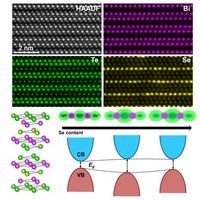
The local structure and chemical environment critically govern transport properties in quantum and energy materials, but their atomic-scale manifestations remain elusive. Here we uncovered the atomic characteristics, intrinsic origin, and thermoelectric implications of chemical inhomogeneity in -based materials with varying Se alloying. Using aberration-corrected electron microscopy, chemical bonding analysis, and thermodynamic modeling, we revealed pronounced Se enrichment in the central layer of a quintuple structure and constructed precise atomic models for this intrinsic inhomogeneity. Atomic-scale charge-density and valence-state measurements provided direct experimental evidence for chemical bonding disparity in , with more covalent bonding in central layers and greater ionic bonding in outer layers. We also showed that this bonding disparity, coupled with entropy-enthalpy competition, drove the observed site preference and local chemical segregation in (, 1.0, 1.5, 2.0, and 2.5). The site-resolved bonding analyses further demonstrated that selective Se occupation tuned both ionic and covalent components of Bi– bonds in . Therefore, this intrinsic chemical inhomogeneity modulated bonding polarity, the electronic band gap, and the Seebeck coefficient, serving as a fundamental determinant of thermoelectric performance. Our findings highlight atomic-scale chemical inhomogeneity as a key factor in tailoring functional properties of layered quantum materials beyond thermoelectrics.
Physics Subject Headings (PhySH)
Popular Summary
Bismuth telluride ()-based materials are widely used as near-room-temperature thermoelectrics, but how local atomic configuration controls the transport properties remains unclear. Using atomic-resolution electron microscopy, we directly visualize where Se atoms sit and find that they preferentially accumulate in the central layer of each quintuple. By combining these site-resolved images with bonding analysis and quantum-mechanical calculations, we reveal why this site preference arises and demonstrate how it tunes chemical bonding, band gap, and ultimately the Seebeck coefficient. This intrinsic chemical inhomogeneity emerges not as an imperfection, but rather as a built-in, adjustable feature that can be leveraged to optimize thermoelectric performance. This clarifies how microscopic chemistry governs macroscopic transport and may also influence the material’s plasticity and topological behavior, offering a broadly useful strategy for engineering layered quantum materials.
Article Text
Supplemental Material
References (66)
- B. Poudel et al., High-thermoelectric performance of nanostructured bismuth antimony telluride bulk alloys, Science 320, 634 (2008).
- S. I. Kim et al., Dense dislocation arrays embedded in grain boundaries for high-performance bulk thermoelectrics, Science 348, 109 (2015).
- D. X. Qu, Y. S. Hor, J. Xiong, R. J. Cava, and N. P. Ong, Quantum oscillations and hall anomaly of surface states in the topological insulator , Science 329, 821 (2010).
- H. Zhang, C. X. Liu, X. L. Qi, X. Dai, Z. Fang, and S. C. Zhang, Topological insulators in and with a single Dirac cone on the surface, Nat. Phys. 5, 438 (2009).
- Y. L. Chen et al., Experimental realization of a three-dimensional topological insulator, , Science 325, 178 (2009).
- Z. H. Zheng et al., Harvesting waste heat with flexible thermoelectric thin film, Nat. Sustain. 6, 180 (2023).
- Y. Lu et al., Staggered-layer-boosted flexible films with high thermoelectric performance, Nat. Nanotechnol. 18, 1281 (2023).
- T. Deng, Z. Gao, Z. Li, P. Qiu, Z. Li, X. Yuan, C. Ming, T. R. Wei, L. Chen, and X. Shi, Room-temperature exceptional plasticity in defective -based bulk thermoelectric crystals, Science 386, 1112 (2024).
- I. T. Witting, T. C. Chasapis, F. Ricci, M. Peters, N. A. Heinz, G. Hautier, and G. J. Snyder, The thermoelectric properties of bismuth telluride, Adv. Electron. Mater. 5, 1800904 (2019).
- S. Nakajima, The crystal structure of , J. Phys. Chem. Solids 24, 479 (1963).
- J. R. Drabble and C. H. L. Goodman, Chemical bonding in bismuth telluride, J. Phys. Chem. Solids 5, 142 (1958).
- P. Pecheur and G. Toussaint, Electronic structure and bonding in bismuth telluride, Phys. Lett. A 135, 223 (1989).
- I. T. Witting, F. Ricci, T. C. Chasapis, G. Hautier, and G. J. Snyder, The thermoelectric properties of n-type bismuth telluride: Bismuth selenide alloys , Research 2020, 4361703 (2020).
- D. L. Greenaway and G. Harbere, Band structure of bismuth telluride, bismuth selenide and their respective alloys, J. Phys. Chem. Solids 26, 1585 (1965).
- H. J. Goldsmid, Recent studies of bismuth telluride and its alloys, J. Appl. Phys. 32, 2198 (1961).
- W. Wong-Ng, H. Joress, J. Martin, P. Y. Zavalij, Y. Yan, and J. Yang, Thermoelectric properties and structural variations in crystals, Appl. Phys. Lett. 100, 082107 (2012).
- S. Wang, G. Tan, W. Xie, G. Zheng, H. Li, J. Yang, and X. Tang, Enhanced thermoelectric properties of -based compounds as n-type legs for low-temperature power generation, J. Mater. Chem. 22, 20943 (2012).
- C. H. Champness, W. B. Muir, and P. T. Chiang, Thermoelectric properties of n-type alloys, Can. J. Phys. 45, 3611 (1967).
- Z. Li, T. Deng, P. Qiu, C. Ming, Z. Gao, L. Chen, and X. Shi, Plasticity of -family thermoelectric crystals, Nat. Commun. 16, 5190 (2025).
- Y. Tung et al., Growth and characterization of molecular beam epitaxy-grown topological insulator alloys, J. Appl. Phys. 119, 055303 (2016).
- C. S. Knox, M. T. Vaughan, A. D. Burnett, M. Ali, S. Sasaki, E. H. Linfield, A. G. Davies, and J. R. Freeman, Effects of structural ordering on infrared active vibrations within , Phys. Rev. B 106, 245203 (2022).
- S. Schreyeck, K. Brunner, A. Kirchner, U. Bass, S. Grauer, C. Schumacher, C. Gould, G. Karczewski, J. Geurts, and L. W. Molenkamp, Kinetic limitation of chemical ordering in layers grown by molecular beam epitaxy, J. Phys. Condens. Matter 28, 145002 (2016).
- A. Ahmad, B. Zhu, Z. Wang, Z. Gui, W. Wang, T. Wang, Y. Yu, L. Huang, and J. He, Largely enhanced thermoelectric performance in p-type -based materials through entropy engineering, Energy Environ. Sci. 17, 695 (2023).
- B. Zhu, W. Wang, J. Cui, and J. He, Point defect engineering: Co-doping synergy realizing superior performance in n-type thermoelectric materials, Small 17, 2101328 (2021).
- L. Hu, T. Zhu, X. Liu, and X. Zhao, Point defect engineering of high-performance bismuth-telluride-based thermoelectric materials, Adv. Funct. Mater. 24, 5211 (2014).
- Y.-M. Kim et al., Atomic-scale chemical mapping of copper dopants in thermoelectric alloy, Mater. Today Phys. 17, 100347 (2021).
- X. Huang et al., The staggered-layer induced elasticity strengthening mechanism in flexible , Matter Radiat. Extremes 8, 102166 (2025).
- P. Olbrich et al., Room-temperature high-frequency transport of Dirac fermions in epitaxially grown - and -based topological insulators, Phys. Rev. Lett. 113, 096601 (2014).
- See Supplemental Material at http://link.aps.org/supplemental/10.1103/qqrq-ths7 for the characterizations, calculations, and measurements, which includes Supplemental Note S1, Figs. S1–S18, and Tables S1–S6.
- S. J. Pennycook, Z-contrast STEM for materials science, Ultramicroscopy 30, 58 (1989).
- W. Wang, S. Liu, Y. Wang, B. Jia, Y. Huang, L. Xie, B. Jiang, and J. He, Tailoring local chemical fluctuation of high-entropy structures in thermoelectric materials, Sci. Adv. 10, 4372 (2024).
- Q. Ding et al., Tuning element distribution, structure and properties by composition in high-entropy alloys, Nature (London) 574, 223 (2019).
- J. Salmon, Z. Harmany, C. A. Deledalle, and R. Willett, Poisson noise reduction with non-local PCA, J. Math. Imaging Vision 48, 279 (2014).
- A. B. Yankovich, C. Zhang, A. Oh, T. J. A. Slater, F. Azough, R. Freer, S. J. Haigh, R. Willett, and P. M. Voyles, Non-rigid registration and non-local principle component analysis to improve electron microscopy spectrum images, Nanotechnology 27, 364001 (2016).
- M. R. Diznab, I. Maleki, S. M. Vaez Allaei, Y. Xia, and S. S. Naghavi, Achieving an ultrahigh power factor in monolayers via valence band convergence, ACS Appl. Mater. Interfaces 11, 46688 (2019).
- S. Jia, H. Ji, E. Climent-Pascual, M. K. Fuccillo, M. E. Charles, J. Xiong, N. P. Ong, and R. J. Cava, Low-carrier-concentration crystals of the topological insulator , Phys. Rev. B 84, 235206 (2011).
- Z. Zhou, R. Wei, X. Zhou, Y. Liu, D. Zhang, and Y. H. Lin, Chemical bonding engineering: Insights into physicochemical performance optimization for energy-storage/conversion, Acc. Mater. Res. 5, 1571 (2024).
- W. G. Zeier, A. Zevalkink, Z. M. Gibbs, G. Hautier, M. G. Kanatzidis, and G. J. Snyder, Thinking like a chemist: Intuition in thermoelectric materials, Angew. Chem., Int. Ed. 128, 6938 (2016).
- N. Shibata, S. D. Findlay, Y. Kohno, H. Sawada, Y. Kondo, and Y. Ikuhara, Differential phase-contrast microscopy at atomic resolution, Nat. Phys. 8, 611 (2012).
- W. Gao et al., Real-space charge-density imaging with sub-ångström resolution by four-dimensional electron microscopy, Nature (London) 575, 480 (2019).
- W. Wang, J. Cui, Z. Sun, L. Xie, X. Mu, L. Huang, and J. He, Direct atomic-scale structure and electric field imaging of triazine-based crystalline carbon nitride, Adv. Mater. 33, 2106359 (2021).
- H. Tan, J. Verbeeck, A. Abakumov, and G. Van, Tendeloo, Oxidation state and chemical shift investigation in transition metal oxides by EELS, Ultramicroscopy 116, 24 (2012).
- Z. Wang et al., Correlating the charge-transfer gap to the maximum transition temperature in , Science 381, 227 (2023).
- L. Miao et al., Chemical environment and structural variations in high entropy oxide thin film probed with electron microscopy, ACS Nano 18, 14968 (2024).
- G. Henkelman, A. Arnaldsson, and H. Jónsson, A fast and robust algorithm for Bader decomposition of charge density, Comput. Mater. Sci. 36, 354 (2006).
- A. V. Powell, P. Vaqueiro, S. Tippireddy, and J. Prado-Gonjal, Exploiting chemical bonding principles to design high-performance thermoelectric materials, Nat. Rev. Chem. 9, 241 (2025).
- P. Vogl, H. P. Hjalmarsons, and J. D. Dow, A semi-empirical tight-binding theory of the electronic structure of semiconductors, J. Phys. Chem. Solids 44, 365 (1983).
- W. M. Foulkes and R. Haydock, Tight-binding models and density-functional theory, Phys. Rev. B 39, 12520 (1989).
- P. Larson, S. D. Mahanti, and M. G. Kanatzidis, Electronic structure and transport of and , Phys. Rev. B 61, 8162 (2000).
- M. Michiardi, I. Aguilera, M. Bianchi, V. E. De Carvalho, L. O. Ladeira, N. G. Teixeira, E. A. Soares, C. Friedrich, S. Blügel, and P. Hofmann, Bulk band structure of , Phys. Rev. B 90, 075105 (2014).
- J. Yang, G. P. Meisner, and L. Chen, Strain field fluctuation effects on lattice thermal conductivity of ZrNiSn-based thermoelectric compounds, Appl. Phys. Lett. 85, 1140 (2004).
- H. S. Oh et al., Engineering atomic-level complexity in high-entropy and complex concentrated alloys, Nat. Commun. 10, 2090 (2019).
- J. Wang et al., Atomic to nanoscale chemical fluctuations: The catalyst for enhanced thermoelectric performance in high-entropy materials, Sci. Adv. 11, eadt6298 (2025).
- L. Wang et al., Homogenizing composition to achieve high-performance -type thermoelectrics, Nano Energy 137, 110797 (2025).
- Y. Zhu et al., Linear-superelastic Ti-Nb nanocomposite alloys with ultralow modulus via high-throughput phase-field design and machine learning, npj Comput. Mater. 7, 205 (2021).
- W. A. Harrison, Electronic Structure and the Properties of Solids: The Physics of the Chemical Bond (Dover Publications, Inc., New York, 2012).
- T. Sandu and R. I. Iftimie, Bandgaps and band bowing in semiconductor alloys, Solid State Commun. 150, 888 (2010).
- Y. Pei, X. Shi, A. Lalonde, H. Wang, L. Chen, and G. J. Snyder, Convergence of electronic bands for high performance bulk thermoelectrics, Nature (London) 473, 66 (2011).
- H. J. Goldsmid and J. W. Sharp, Estimation of the thermal band gap of a semiconductor from seebeck measurements, J. Electron. Mater. 28, 869 (1999).
- Z. M. Gibbs, H. S. Kim, H. Wang, and G. J. Snyder, Band gap estimation from temperature dependent Seebeck measurement–Deviations from the relation, Appl. Phys. Lett. 106 (2015).
- Z. Tang, L. Hu, T. Zhu, X. Liu, and X. Zhao, High performance n-type bismuth telluride based alloys for mid-temperature power generation power generation, J. Mater. Chem. C 3, 10597 (2015).
- O. F. Dippo and K. S. Vecchio, A universal configurational entropy metric for high-entropy materials, Scr. Mater. 201, 113974 (2021).
- G. Kresse and J. Furthmüller, Efficient iterative schemes for ab initio total-energy calculations using a plane-wave basis set, Phys. Rev. B 54, 11169 (1996).
- J. P. Perdew, K. Burke, and M. Ernzerhof, Generalized gradient approximation made simple, Phys. Rev. Lett. 77, 3865 (1996).
- S. Grimme, J. Antony, S. Ehrlich, and H. Krieg, A consistent and accurate ab initio parametrization of density functional dispersion correction (DFT-D) for the 94 elements H-Pu, J. Chem. Phys. 132, 154104 (2010).
- R. Nelson et al., lobster: Local orbital projections, atomic charges, and chemical-bonding analysis from projector-augmented-wave-based density-functional theory, J. Comput. Chem. 41, 1931 (2020).

