

- Open Access
Variational Multi-Gaussian Phase-Space Bosonic Dynamics via Automatic Differentiation
Phys. Rev. X 16, 031077 – Published 24 September, 2026
DOI: https://doi.org/10.1103/q3m5-q44b
Abstract
We introduce a variational method for simulating the dynamics of interacting open quantum bosonic systems deep in the quantum regime. The method is based on a multidimensional Wigner phase-space representation and employs a variational multi-Gaussian Ansatz, whose accuracy is systematically controlled by the number of Gaussian components. The variational equations of motion are derived from the Dirac-Frenkel principle and evaluated efficiently by combining the analytical structure of Gaussian functions with automatic differentiation. As a key physical application, we study a driven-dissipative two-dimensional Bose-Hubbard lattice with two-boson coherent driving and two-body losses. Using our dynamical approach, we compute the finite-size scaling of the Liouvillian spectral gap—extracted from the relaxation dynamics—which vanishes in the thermodynamic limit. Our results reveal critical slowing down with dynamical exponents of the 2D quantum Ising universality class, demonstrating the power of our method to capture complex quantum dynamics in large open systems.
Physics Subject Headings (PhySH)
- Bosons
- Dynamical phase transitions
- Nonlinear optics
- Open quantum systems & decoherence
- Optical parametric oscillators & amplifiers
- Quantum information processing
- Quantum optics
- Quantum states of light
- Quantum complex networks
- Superconducting devices
- Functional analytical methods
- Phase space methods
- Variational approach
Popular Summary
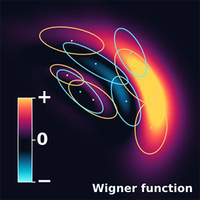
Predicting the dynamics of interacting open quantum bosonic systems is notoriously difficult because the complexity of their quantum state grows exponentially with the number of bosonic modes. Instead of representing the quantum state directly in Hilbert space, we adopt a different perspective based on the Wigner function, a phase-space representation that maps the quantum state onto a quasiprobability distribution in the space of generalized positions and momenta. We describe this distribution using a variational ansatz consisting of a sum of Gaussian functions. Each Gaussian is characterized by a weight, a complex center, and a covariance matrix, and the quantum dynamics is entirely determined by the time evolution of these variational parameters according to the Dirac-Frenkel variational principle. The analytical properties of Gaussian functions allow the multidimensional integrals entering the variational equations to be evaluated exactly, while modern automatic differentiation computes the required high-order derivatives efficiently. This unique combination of analytical mathematics and modern computational techniques yields a remarkably scalable variational phase-space approach for simulating the dynamics of large open quantum bosonic systems. We demonstrate its power by uncovering the universal critical dynamics of a large driven-dissipative Bose-Hubbard lattice, well beyond the reach of previous approaches.
Article Text
References (89)
- S. M. Girvin and K. Yang, Modern Condensed Matter Physics (Cambridge University Press, Cambridge, England, 2019).
- I. Carusotto and C. Ciuti, Quantum fluids of light, Rev. Mod. Phys. 85, 299 (2013).
- T. Ozawa, H. M. Price, A. Amo, N. Goldman, M. Hafezi, L. Lu, M. C. Rechtsman, D. Schuster, J. Simon, O. Zilberberg, and I. Carusotto, Topological photonics, Rev. Mod. Phys. 91, 015006 (2019).
- I. Carusotto, A. A. Houck, A. J. Kollár, P. Roushan, D. I. Schuster, and J. Simon, Photonic materials in circuit quantum electrodynamics, Nat. Phys. 16, 268 (2020).
- M. Mirrahimi, Z. Leghtas, V. V. Albert, S. Touzard, R. J. Schoelkopf, L. Jiang, and M. H. Devoret, Dynamically protected cat-qubits: A new paradigm for universal quantum computation, New J. Phys. 16, 045014 (2014).
- Z. Leghtas, S. Touzard, I. M. Pop, A. Kou, B. Vlastakis, A. Petrenko, K. M. Sliwa, A. Narla, S. Shankar, M. J. Hatridge, M. Reagor, L. Frunzio, R. J. Schoelkopf, M. Mirrahimi, and M. H. Devoret, Confining the state of light to a quantum manifold by engineered two-photon loss, Science 347, 853 (2015).
- D. J. Weigand and B. M. Terhal, Generating grid states from Schrödinger-cat states without postselection, Phys. Rev. A 97, 022341 (2018).
- J. Guillaud and M. Mirrahimi, Repetition cat qubits for fault-tolerant quantum computation, Phys. Rev. X 9, 041053 (2019).
- A. Grimm, N. E. Frattini, S. Puri, S. O. Mundhada, S. Touzard, M. Mirrahimi, S. M. Girvin, S. Shankar, and M. H. Devoret, Stabilization and operation of a Kerr-cat qubit, Nature (London) 584, 205 (2020).
- M. V. Larsen, X. Guo, C. R. Breum, J. S. Neergaard-Nielsen, and U. L. Andersen, Deterministic multi-mode gates on a scalable photonic quantum computing platform, Nat. Phys. 17, 1018 (2021).
- A. Joshi, K. Noh, and Y. Y. Gao, Quantum information processing with bosonic qubits in circuit QED, Quantum Sci. Technol. 6, 033001 (2021).
- R. Gautier, A. Sarlette, and M. Mirrahimi, Combined dissipative and Hamiltonian confinement of cat qubits, PRX Quantum 3, 020339 (2022).
- C. Chamberland, K. Noh, P. Arrangoiz-Arriola, E. T. Campbell, C. T. Hann, J. Iverson, H. Putterman, T. C. Bohdanowicz, S. T. Flammia, A. Keller, G. Refael, J. Preskill, L. Jiang, A. H. Safavi-Naeini, O. Painter, and F. G. S. L. Brandão, Building a fault-tolerant quantum computer using concatenated cat codes, PRX Quantum 3, 010329 (2022).
- X. Pan, J. Schwinger, N.-N. Huang, P. Song, W. Chua, F. Hanamura, A. Joshi, F. Valadares, R. Filip, and Y. Y. Gao, Protecting the quantum interference of cat states by phase-space compression, Phys. Rev. X 13, 021004 (2023).
- A. Hajr, B. Qing, K. Wang, G. Koolstra, Z. Pedramrazi, Z. Kang, L. Chen, L. B. Nguyen, C. Jünger, N. Goss, I. Huang, B. Bhandari, N. E. Frattini, S. Puri, J. Dressel, A. N. Jordan, D. I. Santiago, and I. Siddiqi, High-coherence Kerr-cat qubit in 2D architecture, Phys. Rev. X 14, 041049 (2024).
- A. Marquet, A. Essig, J. Cohen, N. Cottet, A. Murani, E. Albertinale, S. Dupouy, A. Bienfait, T. Peronnin, S. Jezouin, R. Lescanne, and B. Huard, Autoparametric resonance extending the bit-flip time of a cat qubit up to 0.3 s, Phys. Rev. X 14, 021019 (2024).
- A. Z. Ding, B. L. Brock, A. Eickbusch, A. Koottandavida, N. E. Frattini, R. G. Cortiñas, V. R. Joshi, S. J. de Graaf, B. J. Chapman, S. Ganjam, L. Frunzio, R. J. Schoelkopf, and M. H. Devoret, Quantum control of an oscillator with a Kerr-cat qubit, Nat. Commun. 16, 5279 (2025).
- H. Hutin, P. Bilous, C. Ye, S. Abdollahi, L. Cros, T. Dvir, T. Shah, Y. Cohen, A. Bienfait, F. Marquardt, and B. Huard, Preparing Schrödinger cat states in a microwave cavity using a neural network, PRX Quantum 6, 010321 (2025).
- M. Yuan, A. Seif, A. Lingenfelter, D. I. Schuster, A. A. Clerk, and L. Jiang, Universal control in bosonic systems with weak Kerr nonlinearities, Phys. Rev. A 111, 032606 (2025).
- L. M. Sieberer, M. Buchhold, J. Marino, and S. Diehl, Universality in driven open quantum matter, Rev. Mod. Phys. 97, 025004 (2025).
- U. Schollwöck, The density-matrix renormalization group in the age of matrix product states, Ann. Phys. (Amsterdam) 326, 96 (2011).
- R. Orús, Tensor networks for complex quantum systems, Nat. Rev. Phys. 1, 538 (2019).
- D. Kilda, A. Biella, M. Schirò, R. Fazio, and J. Keeling, On the stability of the infinite projected entangled pair operator ansatz for driven-dissipative 2D lattices, SciPost Phys. Core 4, 005 (2021).
- D. A. Hryniuk and M. H. Szymańska, Tensor-network-based variational Monte Carlo approach to the non-equilibrium steady state of open quantum systems, Quantum 8, 1475 (2024).
- G. Carleo and M. Troyer, Solving the quantum many-body problem with artificial neural networks, Science 355, 602 (2017).
- J. Carrasquilla and G. Torlai, How to use neural networks to investigate quantum many-body physics, PRX Quantum 2, 040201 (2021).
- F. Vicentini, A. Biella, N. Regnault, and C. Ciuti, Variational neural-network ansatz for steady states in open quantum systems, Phys. Rev. Lett. 122, 250503 (2019).
- M. J. Hartmann and G. Carleo, Neural-network approach to dissipative quantum many-body dynamics, Phys. Rev. Lett. 122, 250502 (2019).
- N. Yoshioka and R. Hamazaki, Constructing neural stationary states for open quantum many-body systems, Phys. Rev. B 99, 214306 (2019).
- A. Nagy and V. Savona, Variational quantum Monte Carlo method with a neural-network ansatz for open quantum systems, Phys. Rev. Lett. 122, 250501 (2019).
- G. Torlai, G. Mazzola, J. Carrasquilla, M. Troyer, R. Melko, and G. Carleo, Neural-network quantum state tomography, Nat. Phys. 14, 447 (2018).
- F. Carnazza, F. Carollo, D. Zietlow, S. Andergassen, G. Martius, and I. Lesanovsky, Inferring markovian quantum master equations of few-body observables in interacting spin chains, New J. Phys. 24, 073033 (2022).
- D. Luo, Z. Chen, J. Carrasquilla, and B. K. Clark, Autoregressive neural network for simulating open quantum systems via a probabilistic formulation, Phys. Rev. Lett. 128, 090501 (2022).
- Z. Denis and G. Carleo, Accurate neural quantum states for interacting lattice bosons, Quantum 9, 1772 (2025).
- S. Finazzi, A. Le Boité, F. Storme, A. Baksic, and C. Ciuti, Corner-space renormalization method for driven-dissipative two-dimensional correlated systems, Phys. Rev. Lett. 115, 080604 (2015).
- S. Santos, X. Song, and V. Savona, Low-rank variational quantum algorithm for the dynamics of open quantum systems, Quantum 9, 1620 (2025).
- R. Rota, F. Minganti, C. Ciuti, and V. Savona, Quantum critical regime in a quadratically driven nonlinear photonic lattice, Phys. Rev. Lett. 122, 110405 (2019).
- A. Polkovnikov, Phase space representation of quantum dynamics, Ann. Phys. (N. Y.) 325, 1790 (2010).
- P. Deuar, A. Ferrier, M. Matuszewski, G. Orso, and M. H. Szymańska, Fully quantum scalable description of driven-dissipative lattice models, PRX Quantum 2, 010319 (2021).
- Z. Li, A. Delmonte, X. Turkeshi, and R. Fazio, Monitored long-range interacting systems: Spin-wave theory for quantum trajectories, Nat. Commun. 16, 4329 (2025).
- R. E. Wengert, A simple automatic derivative evaluation program, Commun. ACM 7, 463 (1964).
- C. C. Margossian, A review of automatic differentiation and its efficient implementation, WIREs Data Min. Knowl. Discov. 9, e1305 (2019).
- A. Griewank and A. Walther, Evaluating Derivatives: Principles and Techniques of Algorithmic Differentiation, 2nd ed. (SIAM, Philadelphia, 2008).
- H. Cho, D. Venturi, and G. Karniadakis, Numerical methods for high-dimensional probability density function equations, J. Comput. Phys. 305, 817 (2016).
- J. Han, A. Jentzen, and W. E, Solving high-dimensional partial differential equations using deep learning, Proc. Natl. Acad. Sci. U.S.A. 115, 8505 (2018).
- Y. Achdou, O. Bokanowski, and T. Lelièvre, Partial Differential Equations in Finance, Rapport de recherche 363 (CERMICS, Marne-la-Vallée, France, 2007).
- H. Breuer and F. Petruccione, The Theory of Open Quantum Systems, 1st ed. (Oxford University Press, Great Clarendon Street, Oxford, UK, 2002), p. 648.
- R. Fazio, J. Keeling, L. Mazza, and M. Schirò, Many-body open quantum systems, SciPost Phys. Lect. Notes, 99 (2025).
- E. Wigner, On the quantum correction for thermodynamic equilibrium, Phys. Rev. 40, 749 (1932).
- R. J. Glauber, Coherent and incoherent states of the radiation field, Phys. Rev. 131, 2766 (1963).
- E. C. G. Sudarshan, Equivalence of semiclassical and quantum mechanical descriptions of statistical light beams, Phys. Rev. Lett. 10, 277 (1963).
- K. Husimi, Some formal properties of the density matrix, Proc. Phys.-Math. Soc. Jpn., 3rd Ser. 22, 264 (1940).
- J. E. Bourassa, N. Quesada, I. Tzitrin, A. Száva, T. Isacsson, J. Izaac, K. K. Sabapathy, G. Dauphinais, and I. Dhand, Fast simulation of bosonic qubits via Gaussian functions in phase space, PRX Quantum 2, 040315 (2021).
- M. Walschaers, Non-Gaussian quantum states and where to find them, PRX Quantum 2, 030204 (2021).
- Z. Leghtas, G. Kirchmair, B. Vlastakis, R. J. Schoelkopf, M. H. Devoret, and M. Mirrahimi, Hardware-efficient autonomous quantum memory protection, Phys. Rev. Lett. 111, 120501 (2013).
- B. Yurke and D. Stoler, Generating quantum mechanical superpositions of macroscopically distinguishable states via amplitude dispersion, Phys. Rev. Lett. 57, 13 (1986).
- O. Castaños, R. Jáuregui, R. López-Peña, J. Recamier, and V. I. Man’ko, Schrödinger-cat states in Paul traps, Phys. Rev. A 55, 1208 (1997).
- K. Vogel and H. Risken, Determination of quasiprobability distributions in terms of probability distributions for the rotated quadrature phase, Phys. Rev. A 40, 2847 (1989).
- Y.-F. Qu, M. Stefanini, T. Shi, T. Esslinger, S. Gopalakrishnan, J. Marino, and E. Demler, Variational approach to the dynamics of dissipative quantum impurity models, Phys. Rev. B 111, 155113 (2025).
- J. Bettencourt, M. J. Johnson, and D. K. Duvenaud, Taylor-Mode Automatic Differentiation for Higher-Order Derivatives in JAX, Program Transformations for Machine Learning Workshop, NeurIPS 2019 (Vancouver, Canada 2019), https://openreview.net/forum?id=SkxEF3FNPH.
- J. Bradbury, R. Frostig, P. Hawkins, M. J. Johnson, C. Leary, D. Maclaurin, G. Necula, A. Paszke, J. VanderPlas, S. Wanderman-Milne, and Q. Zhang, JAX: Composable transformations of programs, https://github.com/jax-ml/jax (2018).
- X. Yuan, S. Endo, Q. Zhao, Y. Li, and S. C. Benjamin, Theory of variational quantum simulation, Quantum 3, 191 (2019).
- C. Lasser and C. Su, Various variational approximations of quantum dynamics, J. Math. Phys. (N.Y.) 63, 072107 (2022).
- D. Eeltink, F. Vicentini, and V. Savona, Variational dynamics of open quantum systems in phase space, arXiv:2307.07429.
- A. Griewank, J. Utke, and A. Walther, Evaluating higher derivative tensors by forward propagation of univariate taylor series, Math. Comput. 69, 1117 (2000).
- F. Dangel, T. Siebert, M. Zeinhofer, and A. Walther, Collapsing Taylor mode automatic differentiation, arXiv:2505.13644.
- L. Gravina, F. Minganti, and V. Savona, Critical Schrödinger cat qubit, PRX Quantum 4, 020337 (2023).
- J. Johansson, P. Nation, and F. Nori, QuTiP: An open-source Python framework for the dynamics of open quantum systems, Comput. Phys. Commun. 183, 1760 (2012).
- N. Bartolo, F. Minganti, W. Casteels, and C. Ciuti, Exact steady state of a Kerr resonator with one- and two-photon driving and dissipation: Controllable Wigner-function multimodality and dissipative phase transitions, Phys. Rev. A 94, 033841 (2016).
- Z. Li, A. Soret, and C. Ciuti, Dissipation-induced antiferromagneticlike frustration in coupled photonic resonators, Phys. Rev. A 103, 022616 (2021).
- A. Aspuru-Guzik and P. Walther, Photonic quantum simulators, Nat. Phys. 8, 285 (2012).
- J. Tosca, M. C. Strinati, C. Conti, and C. Ciuti, Emergent equilibrium in all-optical single quantum-trajectory Ising machines, Phys. Rev. Lett. 134, 230404 (2025).
This approach would require constrained-optimization techniques to ensure that the state remains physical, i.e., positive semidefinite and with unit trace. In contrast, for time evolution, if the Ansatz is sufficiently expressive (i.e., includes a large enough number of Gaussians) and the initial density matrix is physical, the Lindblad master-equation dynamics preserves the positive-semidefinite character of the density matrix.
- C.-H. Chang, V. Dommes, R. Erramilli, A. Homrich, P. Kravchuk, A. Liu, M. Mitchell, D. Poland, and D. Simmons-Duffin, Bootstrapping the 3D Ising stress tensor, J. High Energy Phys. 03 (2025) 136.
- M. Reehorst, J. High Energy Phys. 09 (2022) 177.
- Z. Komargodski and D. Simmons-Duffin, The random-bond Ising model in 2.01 and 3 dimensions, J. Phys. A 50, 154001 (2017).
- Matthew P. Fisher, P. B. Weichman, G. Grinstein, and D. S. Fisher, Boson localization and the superfluid-insulator transition, Phys. Rev. B 40, 546 (1989).
- J. Cardy, Scaling and Renormalization in Statistical Physics, Cambridge Lecture Notes in Physics (Cambridge University Press, Cambridge, England, 1996).
- F. Minganti, A. Biella, N. Bartolo, and C. Ciuti, Spectral theory of Liouvillians for dissipative phase transitions, Phys. Rev. A 98, 042118 (2018).
- F. Vicentini, F. Minganti, R. Rota, G. Orso, and C. Ciuti, Critical slowing down in driven-dissipative Bose-Hubbard lattices, Phys. Rev. A 97, 013853 (2018).
- W. Verstraelen, R. Rota, V. Savona, and M. Wouters, Gaussian trajectory approach to dissipative phase transitions: The case of quadratically driven photonic lattices, Phys. Rev. Res. 2, 022037(R) (2020).
- L. Adzhemyan, D. Evdokimov, M. Hnatič, E. Ivanova, M. Kompaniets, A. Kudlis, and D. Zakharov, The dynamic critical exponent z for 2d and 3d Ising models from five-loop expansion, Phys. Lett. A 425, 127870 (2022).
- K. Vogel and H. Risken, Quasiprobability distributions in dispersive optical bistability, Phys. Rev. A 39, 4675 (1989).
- S. Haroche and J. M. Raimond, Exploring the Quantum: Atoms, Cavities, and Photons (Oxford University Press, Oxford, 2006).
- R. Simon, N. Mukunda, and B. Dutta, Quantum-noise matrix for multimode systems: U(n) invariance, squeezing, and normal forms, Phys. Rev. A 49, 1567 (1994).
- D. F. Walls and G. J. Milburn, Quantum Optics, 2nd ed. (Springer, New York, 2008).
- G. H. Golub and C. F. Van Loan, Matrix Computations, 3rd ed. (Johns Hopkins University Press, Baltimore, MD, 1996).
- M. Medvidović and D. Sels, Variational quantum dynamics of two-dimensional rotor models, PRX Quantum 4, 040302 (2023).
- F. Vicentini, D. Hofmann, A. Szabó, D. Wu, C. Roth, C. Giuliani, G. Pescia, J. Nys, V. Vargas-Calderón, N. Astrakhantsev, and G. Carleo, Netket 3: Machine learning toolbox for many-body quantum systems, SciPost Phys. Codebases (2022), 10.21468/scipostphyscodeb.7.

