

- Open Access
Robust Orbital-Selective Flat Bands in Layered Transition-Metal Oxyhalides at Room Temperature
Phys. Rev. X 16, 021041 – Published 21 May, 2026
DOI: https://doi.org/10.1103/p3dw-tbqp
Abstract
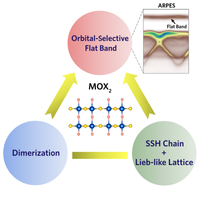
Flat electronic bands, which amplify electron correlations by quenching kinetic energy, provide an ideal foundation for exotic quantum phases. However, prevailing strategies—including geometrically frustrated lattices, moiré superlattices, and heavy-fermion systems—often suffer from inherent trade-offs among robustness, tunability, and orbital control, thereby limiting their broad applicability. Here, we report the experimental discovery of intrinsic orbital-selective flat bands in the layered transition-metal oxyhalide family (, Ta; , Br, I), directly observed by angle-resolved photoemission spectroscopy at room temperature. Importantly, this materials platform exhibits pronounced tunability: The flat-band bandwidth and correlation strength can be systematically tuned via halogen substitution, while the Fermi level is controllable through electrostatic gating and surface charge transfer. Remarkably, the flat band remains stable upon dimensional reduction, persisting from the bulk crystal down to the few-layer limit. Our theoretical analysis reveals that this flat band transcends simple lattice geometry, originating instead from an orbital-driven synergetic Su-Schrieffer-Heeger-Lieb mechanism: a cooperative interplay between quasi-one-dimensional Su-Schrieffer-Heeger chains and a two-dimensional Lieb-like sublattice, reinforced by Peierls dimerization. Together, these findings establish layered transition-metal oxyhalides as a versatile materials-by-design platform for systematically engineering intrinsic flat bands via chemical, electronic, and dimensional control, which provides a robust pathway to exploring room-temperature flat-band physics.
Physics Subject Headings (PhySH)
Popular Summary
Flat electronic bands that suppress electron kinetic energy are essential for amplifying interactions and generating exotic quantum phases, yet most current materials hosting these bands require extremely low temperatures or precise tuning that limits their application. We used angle-resolved photoemission spectroscopy to identify robust, intrinsic flat bands at room temperature within a family of layered transition-metal oxyhalides. Our analysis reveals that these bands arise from an orbital-selective localization mechanism, where electron hopping is strongly suppressed for specific orbitals, confining those electrons within the crystal lattice. We demonstrated that these bands remain stable even when the material is thinned to several atomic layers and are highly tunable through chemical substitution or electrical gating. These findings establish a versatile platform for exploring strongly correlated quantum matter under realistic, ambient conditions. Our work provides a scalable pathway for designing materials that harness flat-band physics for future quantum technologies and fundamental condensed matter research.
Article Text
Supplemental Material
References (77)
- E. Tang, J.-W. Mei, and X.-G. Wen, High-temperature fractional quantum Hall states, Phys. Rev. Lett. 106, 236802 (2011).
- T. Neupert, L. Santos, C. Chamon, and C. Mudry, Fractional quantum Hall states at zero magnetic field, Phys. Rev. Lett. 106, 236804 (2011).
- K. Sun, Z. Gu, H. Katsura, and S. Das Sarma, Nearly flatbands with nontrivial topology, Phys. Rev. Lett. 106, 236803 (2011).
- Z. Liu, F. Liu, and Y.-S. Wu, Exotic electronic states in the world of flat bands: From theory to material, Chin. Phys. B 23, 077308 (2014).
- D. Leykam, A. Andreanov, and S. Flach, Artificial flat band systems: From lattice models to experiments, Adv. Phys. 3, 1473052 (2018).
- J.-X. Yin, B. Lian, and M. Z. Hasan, Topological kagome magnets and superconductors, Nature (London) 612, 647 (2022).
- N. Regnault, Y. Xu, M.-R. Li, D.-S. Ma, M. Jovanovic, A. Yazdani, S. S. P. Parkin, C. Felser, L. M. Schoop, N. P. Ong, R. J. Cava, L. Elcoro, Z.-D. Song, and B. A. Bernevig, Catalogue of flat-band stoichiometric materials, Nature (London) 603, 824 (2022).
- J. G. Checkelsky, B. A. Bernevig, P. Coleman, Q. Si, and S. Paschen, Flat bands, strange metals and the Kondo effect, Nat. Rev. Mater. 9, 509 (2024).
- S. Paschen and Q. Si, Quantum phases driven by strong correlations, Nat. Rev. Phys. 3, 9 (2021).
- S. Peotta and P. Törmä, Superfluidity in topologically nontrivial flat bands, Nat. Commun. 6, 8944 (2015).
- A. Julku, S. Peotta, T. I. Vanhala, D.-H. Kim, and P. Törmä, Geometric origin of superfluidity in the Lieb-lattice flat band, Phys. Rev. Lett. 117, 045303 (2016).
- Y. Cao, V. Fatemi, S. Fang, K. Watanabe, T. Taniguchi, E. Kaxiras, and P. J.-Herrero, Unconventional superconductivity in magic-angle graphene superlattices, Nature (London) 556, 43 (2018).
- L. Balents, C. R. Dean, D. K. Efetov, and A. F. Young, Superconductivity and strong correlations in moiré flat bands, Nat. Phys. 16, 725 (2020).
- E. Y. Andrei and A. H. MacDonald, Graphene bilayers with a twist, Nat. Mater. 19, 1265 (2020).
- B. R. Ortiz, Samuel M. L. Teicher, Y. Hu, J. L. Zuo, P. M. Sarte, E. C. Schueller, A. M. Milinda Abeykoon, M. J. Krogstad, S. Rosenkranz, R. Osborn, R. Seshadri, L. Balents, J. He, and S. D. Wilson, : A topological kagome metal with a superconducting ground state, Phys. Rev. Lett. 125, 247002 (2020).
- M. Imada, A. Fujimori, and Y. Tokura, Metal-insulator transitions, Rev. Mod. Phys. 70, 1039 (1998).
- T. Ohashi, N. Kawakami, and H. Tsunetsugu, Mott transition in kagomé lattice Hubbard model, Phys. Rev. Lett. 97, 066401 (2006).
- Y. Cao, V. Fatemi, A. Demir, S. Fang, S. L. Tomarken, J. Y. Luo, J. D. Sanchez-Yamagishi, K. Watanabe, T. Taniguchi, E. Kaxiras, R. C. Ashoori, and P. J.-Herrero, Correlated insulator behaviour at half-filling in magic-angle graphene superlattices, Nature (London) 556, 80 (2018).
- Y. D. Wang, W. L. Yao, Z. M. Xin, T. T. Han, Z. G. Wang, L. Chen, C. Cai, Y. Li, and Y. Zhang, Band insulator to Mott insulator transition in , Nat. Commun. 11, 4215 (2020).
- S. Gao et al., Discovery of a single-band mott insulator in a van der Waals flat-band compound, Phys. Rev. X 13, 041049 (2023).
- J. Huang, L. Chen, Y. Huang, C. Setty, B. Gao, Y. Shi, Z. Liu, Y. Zhang, T. Yilmaz, E. Vescovo, M. Hashimoto, D. Lu, B. I. Yakobson, P. Dai, J.-H. Chu, Q. Si, and M. Yi, Non-Fermi liquid behaviour in a correlated flat-band pyrochlore lattice, Nat. Phys. 20, 603 (2024).
- L. Ye, S. Fang, M. Kang, J. Kaufmann, Y. Lee, C. John, P. M. Neves, S. Y. F. Zhao, J. Denlinger, C. Jozwiak, A. Bostwick, E. Rotenberg, E. Kaxiras, D. C. Bell, O. Janson, R. Comin, and J. G. Checkelsky, Hopping frustration-induced flat band and strange metallicity in a kagome metal, Nat. Phys. 20, 610 (2024).
- L. Landau, Diamagnetismus der Metalle, Z. Phys. 64, 629 (1930).
- K. V. Klitzing, G. Dorda, and M. Pepper, New method for high-accuracy determination of the fine-structure constant based on quantized Hall resistance, Phys. Rev. Lett. 45, 494 (1980).
- R. B. Laughlin, Anomalous quantum Hall effect: An incompressible quantum fluid with fractionally charged excitations, Phys. Rev. Lett. 50, 1395 (1983).
- E. J. Bergholtz and Z. Liu, Topological flat band models and fractional Chern insulators, Int. J. Mod. Phys. B 27, 1330017 (2013).
- T. Devakul, V. Crépel, Y. Zhang, and L. Fu, Magic in twisted transition metal dichalcogenide bilayers, Nat. Commun. 12, 6730 (2021).
- Y. Xie, A. T. Pierce, J. M. Park, D. E. Parker, E. Khalaf, P. Ledwith, Y. Cao, S. H. Lee, S. Chen, P. R. Forrester, K. Watanabe, T. Taniguchi, A. Vishwanath, P. Jarillo-Herrero, and A. Yacoby, Fractional Chern insulators in magic-angle twisted bilayer graphene, Nature (London) 600, 439 (2021).
- J. Cai, E. Anderson, C. Wang, X. Zhang, X. Liu, W. Holtzmann, Y. Zhang, F. Fan, T. Taniguchi, K. Watanabe, Y. Ran, T. Cao, L. Fu, D. Xiao, W. Yao, and X. Xu, Signatures of fractional quantum anomalous Hall states in twisted , Nature (London) 622, 63 (2023).
- Y. Zeng, Z. Xia, K. Kang, J. Zhu, P. Knüppel, C. Vaswani, K. Watanabe, T. Taniguchi, K. F. Mak, and J. Shan, Thermodynamic evidence of fractional Chern insulator in moiré , Nature (London) 622, 69 (2023).
- H. Park, J. Cai, E. Anderson, Y. Zhang, J. Zhu, X. Liu, C. Wang, W. Holtzmann, C. Hu, Z. Liu, T. Taniguchi, K. Watanabe, J.-H. Chu, T. Cao, L. Fu, W. Yao, C.-Z. Chang, D. Cobden, D. Xiao, and X. Xu, Observation of fractionally quantized anomalous Hall effect, Nature (London) 622, 74 (2023).
- B. Sutherland, Localization of electronic wave functions due to local topology, Phys. Rev. B 34, 5208 (1986).
- E. H. Lieb, Two theorems on the Hubbard model, Phys. Rev. Lett. 62, 1201 (1989).
- A. Mielke, Ferromagnetic ground states for the Hubbard model on line graphs, J. Phys. A 24, L73 (1991).
- A. Mielke, Exact ground states for the Hubbard model on the kagome lattice, J. Phys. A 25, 4335 (1992).
- P. M. Neves, J. P. Wakefield, S. Fang, H. Nguyen, L. Ye, and J. G. Checkelsky, Crystal net catalog of model flat band materials, npj Comput. Mater. 10, 39 (2024).
- Z. Liu, M. Li, Q. Wang, G. Wang, C. Wen, K. Jiang, X. Lu, S. Yan, Y. Huang, D. Shen, J.-X. Yin, Z. Wang, Z. Yin, H. Lei, and S. Wang, Orbital-selective Dirac fermions and extremely flat bands in frustrated kagome-lattice metal CoSn, Nat. Commun. 11, 4002 (2020).
- M. Kang, S. Fang, L. Ye, H. C. Po, J. Denlinger, C. Jozwiak, A. Bostwick, E. Rotenberg, E. Kaxiras, J. G. Checkelsky, and R. Comin, Topological flat bands in frustrated kagome lattice , Nat. Commun. 11, 4004 (2020).
- M. Kang et al., Dirac fermions and flat bands in the ideal kagome metal FeSn, Nat. Mater. 19, 163 (2020).
- B. Song, Y. Xie, W.-J. Li, H. Liu, J. Chen, S. Tian, X. Zhang, Q. Wang, X. Li, H. Lei, Q. Zhang, J.-g. Guo, L. Zhao, S.-L. Yu, X. Zhou, X. Chen, and T. Ying, Realization of Kagome Kondo lattice, Nat. Commun. 16, 5643 (2025).
- A. Devarakonda et al., Frustrated electron hopping from the orbital configuration in a two-dimensional lattice, Nat. Phys. 21, 1260 (2025).
- J. P. Wakefield et al., Three-dimensional flat bands in pyrochlore metal , Nature (London) 623, 301 (2023).
- R. Bistritzer and A. H. MacDonald, moiré bands in twisted double-layer graphene, Proc. Natl. Acad. Sci. U.S.A. 108, 12233 (2011).
- K. P. Nuckolls and A. Yazdani, A microscopic perspective on moiré materials, Nat. Rev. Mater. 9, 460 (2024).
- M. I. B. Utama, R. J. Koch, K. Lee, N. Leconte, H. Li, S. Zhao, L. Jiang, J. Zhu, K. Watanabe, T. Taniguchi, P. D. Ashby, A. Weber-Bargioni, A. Zettl, C. Jozwiak, J. Jung, E. Rotenberg, A. Bostwick, and F. Wang, Visualization of the flat electronic band in twisted bilayer graphene near the magic angle twist, Nat. Phys. 17, 184 (2021).
- S. Lisi et al., Observation of flat bands in twisted bilayer graphene, Nat. Phys. 17, 189 (2021).
- G. R. Stewart, Heavy-fermion systems, Rev. Mod. Phys. 56, 755 (1984).
- Q. Si and F. Steglich, Heavy fermions and quantum phase transitions, Science 329, 1161 (2010).
- Q. Chen et al., Direct observation of how the heavy-fermion state develops in , Phys. Rev. B 96, 045107 (2017).
- V. A. Posey et al., Two-dimensional heavy fermions in the van der Waals metal , Nature (London) 625, 483 (2024).
- D. M. Kennes, M. Claassen, L. Xian, A. Georges, A. J. Millis, J. Hone, C. R. Dean, D. N. Basov, A. N. Pasupathy, and A. Rubio, Moiré heterostructures as a condensed-matter quantum simulator, Nat. Phys. 17, 155 (2021).
- A. Ramachandran, A. Andreanov, and S. Flach, Chiral flat bands: Existence, engineering, and stability, Phys. Rev. B 96, 161104(R) (2017).
- Y. Zheng, L. Li, X. Wang, Y. Li, N. Luo, W. Ren, L.-M. Tang, Y. Feng, K.-Q. Chen, and J. Zeng, Orbital-frustrated flat-band model and its realization in materials, Phys. Rev. B 111, 045118 (2025).
- See Supplemental Material at http://link.aps.org/supplemental/10.1103/p3dw-tbqp for further experimental and theoretical details.
- J. Rijnsdorp and F. Jellinek, The crystal structure of niobium oxide diiodide , J. Less-Common Met. 61, 79 (1978).
- H. Hillebrecht, P. J. Schmidt, H. W. Rotter, G. Thiele, P. Zönnchen, H. Bengel, H.-J. Cantow, S. N. Magonov, and M.-H. Whangbo, Structural and scanning microscopy studies of layered compounds () and (), J. Alloys Compd. 246, 70 (1997).
- Q. Guo et al., Ultrathin quantum light source with van der Waals crystal, Nature (London) 613, 53 (2023).
- L. Ye, W. Zhou, D. Huang, X. Jiang, Q. Guo, X. Cao, S. Yan, X. Wang, D. Jia, D. Jiang, Y. Wang, X. Wu, X. Zhang, Y. Li, H. Lei, H. Gou, and B. Huang, Manipulation of nonlinear optical responses in layered ferroelectric niobium oxide dihalides, Nat. Commun. 14, 5911 (2023).
- C. Liu, X. Zhang, X. Wang, Z. Wang, I. Abdelwahab, I. Verzhbitskiy, Y. Shao, G. Eda, W. Sun, L. Shen, and K. P. Loh, Ferroelectricity in niobium oxide dihalides (): A macroscopic- to microscopic-scale study, ACS Nano 17, 7170 (2023).
- I. Abdelwahab, B. Tilmann, Y. Wu, D. Giovanni, I. Verzhbitskiy, M. Zhu, R. Berté, F. Xuan, L. de S. Menezes, G. Eda, T. C. Sum, S. Y. Quek, S. A. Maier, and K. P. Loh, Giant second-harmonic generation in ferroelectric , Nat. Photonics 16, 644 (2022).
- Q. Guo, Q. Zhang, T. Zhang, J. Zhou, S. Xiao, S. Wang, Y. P. Feng, and C.-W. Qiu, Colossal in-plane optical anisotropy in a two-dimensional van der Waals crystal, Nat. Photonics 18, 1170 (2024).
- M. A. Mohebpour, S. I. Vishkayi, V. Vitale, N. Seriani, and M. B. Tagani, Origin and properties of the flat band in monolayer , Phys. Rev. B 110, 035429 (2024).
- Y. Fang, F. Wang, R. Wang, T. Zhai, and F. Huang, 2D : A chiral semiconductor with highly in-plane anisotropic electrical and optical properties, Adv. Mater. 33, 2101505 (2021).
- M. Huang, W. Chen, S. Luo, Z. Huang, Z. Wang, and X. Qi, Raman scattering evolution in temperature-induced ferroelectric phase transition of few-layer , Appl. Phys. Lett. 124, 111901 (2024).
- N. Ng, M. A. Siegler, S. Bernier, W. Bunstine, and T. M. McQueen, Disordered layers and dimerization in the crystal structure of , J. Solid State Chem. 337, 124771 (2024).
- W. Chen, S. Zhu, R. Duan, C. Wang, F. Wang, Y. Wu, M. Dai, J. Cui, S. H. Chae, Z. Li, X. Ma, Q. Wang, Z. Liu, and Q. J. Wang, Extraordinary enhancement of nonlinear optical interactionin microcavities, Adv. Mater. 36, 2400858 (2024).
- Y. Jia, M. Zhao, G. Gou, X. Zeng, and J. Li, Niobium oxide dihalides : A new family of two-dimensional van der Waals layered materials with intrinsic ferroelectricity and antiferroelectricity, Nanoscale Horiz. 4, 1113 (2019).
- B. Mortazavi, M. Shahrokhi, B. Javvaji, A. V. Shapeev, and X. Zhuang, Highly anisotropic mechanical and optical properties of 2D () revealed by first-principle, Nanotechnology 33, 275701 (2022).
- P. Helmer, M. Dahlqvist, and J. Rosen, Computational screening of transition metal oxydihalides with , and , J. Mater. Chem. C 13, 4769 (2025).
- Q. Yan, Y. Weng, S. Wang, Z. Zhou, Y. Hu, Q. Li, J. Xue, Z. Feng, Z. Luo, R. Feng, L. You, and Liang Fang, Ambient degradation anisotropy and mechanism of van der Waals ferroelectric , ACS Appl. Mater. Interfaces 16, 9051 (2024).
- M. G.-Amigo, C. Felser, I. Errea, and M. G. Vergniory, Emergent chirality and enantiomeric selectivity in layered crystals, arXiv:2505.09749.
- X.-L. Yu, D.-Y. Liu, Y.-M. Quan, J. Wu, H.-Q. Lin, K. Chang, and L.-J. Zou, Electronic correlation effects and orbital density wave in the layered compound , Phys. Rev. B 96, 125138 (2017).
- P. Giannozzi et al., quantum espresso: A modular and open-source software project for quantum simulations of materials, J. Phys. Condens. Matter 21, 395502 (2009).
- P. Giannozzi et al., Advanced capabilities for materials modelling with quantum espresso, J. Phys. Condens. Matter 29, 465901 (2017).
- J. P. Perdew, K. Burke, and M. Ernzerhof, Generalized gradient approximation made simple, Phys. Rev. Lett. 77, 3865 (1996).
- G. Pizzi et al., Wannier90 as a community code: New features and applications, J. Phys. Condens. Matter 32, 165902 (2020).
- S. Coh and D. Vanderbilt, python tight binding (pythtb), Zenodo (2022), 10.5281/zenodo.12721316.

