

- Featured in Physics
- Open Access
Fermion Quantum Criticality far from Equilibrium
Phys. Rev. X 16, 011069 – Published 30 March, 2026
DOI: https://doi.org/10.1103/nj2d-l6pz
Abstract
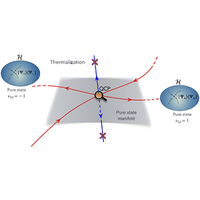
Driving a quantum system out of equilibrium while preserving its subtle quantum mechanical correlations on large scales presents a major challenge, both fundamentally and for technological applications. At its core, this challenge is pinpointed by the question of how quantum effects can persist at asymptotic scales, analogous to quantum critical points in equilibrium. In this work, we construct such a scenario using fermions as building blocks. These fermions undergo an absorbing-to-absorbing state transition between two topologically distinct and quantum-correlated dark states. Starting from a microscopic, interacting Lindbladian, we derive an effective Lindblad-Keldysh field theory in which critical fermions couple to a bosonic bath with hydrodynamic fluctuations associated with particle number conservation. A key feature of this field theory is an emergent symmetry that protects the purity of the fermions’ state even in the presence of the thermal bath. We quantitatively characterize the critical point using a leading-order expansion around the upper critical dimension, thereby establishing the nonequilibrium universality class of fermions. The symmetry protection mechanism, which exhibits parallels to the problem of directed percolation, suggests a pathway toward a broader class of robust, universal quantum phenomena in fermionic systems.
Physics Subject Headings (PhySH)
- Dirac fermions
- Open quantum systems
- Quantum criticality
- Quasiparticles & collective excitations
- Topological phase transition
- Continuous symmetries in condensed matter
- Diagrammatic methods
- Effective field theory
- Hydrodynamics
- Lindblad equation
- Mean field theory
- Nonequilibrium Green's function
- Renormalization group
- Second quantization
 Viewpoint

Symmetry Keeps Fermions Pure in a Noisy World
A theoretical study reveals how to control and drive a quantum system without causing its decoherence.
See more in Physics
Popular Summary
Maintaining quantum behavior in systems driven far from equilibrium is a fundamental challenge for developing robust quantum technologies. We demonstrate that this regime is achievable in interacting fermionic systems, where a unique universality class of nonequilibrium quantum criticality emerges. By investigating a transition between two topologically distinct dark states, we derive a dynamical field theory describing critical fermions coupled to a number-conserving bosonic bath. We show that an emergent antiunitary symmetry, which we call fermionic dark-state symmetry, protects the purity of the fermions and locks fluctuations to dissipation in a nonthermal manner. Unlike previous nonequilibrium models requiring multiple fine-tunings, our scenario reaches criticality by varying only a single parameter. This symmetry-based framework provides a pathway for realizing universal quantum phenomena in platforms ranging from ultracold atoms to superconducting circuits.
Article Text
References (121)
- S. Sachdev, Quantum Phase Transitions, 3rd ed. (Cambridge University Press, Cambridge, England, 2023), 10.1017/CBO9780511622540.
- H. v. Löhneysen, A. Rosch, M. Vojta, and P. Wölfle, Fermi-liquid instabilities at magnetic quantum phase transitions, Rev. Mod. Phys. 79, 1015 (2007).
- S. Sachdev, Quantum magnetism and criticality, Nat. Phys. 4, 173 (2008).
- R. Boyack, H. Yerzhakov, and J. Maciejko, Quantum phase transitions in Dirac fermion systems, Eur. Phys. J. Special Topics 230, 979 (2021).
- P. Gegenwart, Q. Si, and F. Steglich, Quantum criticality in heavy-fermion metals, Nat. Phys. 4, 186 (2008).
- H. Hinrichsen, Non-equilibrium critical phenomena and phase transitions into absorbing states, Adv. Phys. 49, 815 (2000).
- G. Ódor, Universality classes in nonequilibrium lattice systems, Rev. Mod. Phys. 76, 663 (2004).
- U. C. Täuber, Critical Dynamics (Cambridge University Press, Cambridge, England, 2014), 10.1017/CBO9781139046213.
- J. T. Young, A. V. Gorshkov, M. Foss-Feig, and M. F. Maghrebi, Nonequilibrium fixed points of coupled Ising models, Phys. Rev. X 10, 011039 (2020).
- R. Daviet, C. P. Zelle, A. Rosch, and S. Diehl, Nonequilibrium criticality at the onset of time-crystalline order, Phys. Rev. Lett. 132, 167102 (2024).
- A. Nahum and B. Skinner, Entanglement and dynamics of diffusion-annihilation processes with Majorana defects, Phys. Rev. Res. 2, 023288 (2020).
- I. Carusotto and C. Ciuti, Quantum fluids of light, Rev. Mod. Phys. 85, 299 (2013).
- C. Noh and D. G. Angelakis, Quantum simulations and many-body physics with light, Rep. Prog. Phys. 80, 016401 (2016).
- H. Hübener, U. De Giovannini, C. Schäfer, J. Andberger, M. Ruggenthaler, J. Faist, and A. Rubio, Engineering quantum materials with chiral optical cavities, Nat. Mater. 20, 438 (2021).
- A. Cavalleri, Photo-induced superconductivity, Contemp. Phys. 59, 31 (2018).
- F. Mivehvar, F. Piazza, T. Donner, and H. Ritsch, Cavity QED with quantum gases: New paradigms in many-body physics, Adv. Phys. 70, 1 (2021).
- M. Müller, S. Diehl, G. Pupillo, and P. Zoller, Engineered open systems and quantum simulations with atoms and ions, Adv. At. Mol. Opt. Phys. 61, 1 (2012).
- P. M. Harrington, E. J. Mueller, and K. W. Murch, Engineered dissipation for quantum information science, Nat. Rev. Phys. 4, 660 (2022).
- A. Browaeys and T. Lahaye, Many-body physics with individually controlled Rydberg atoms, Nat. Phys. 16, 132 (2020).
- M. Saffman, T. G. Walker, and K. Mølmer, Quantum information with Rydberg atoms, Rev. Mod. Phys. 82, 2313 (2010).
- U. Vool and M. Devoret, Introduction to quantum electromagnetic circuits, Int. J. Circuit Theory Appl. 45, 897 (2017).
- A. Blais, A. L. Grimsmo, S. M. Girvin, and A. Wallraff, Circuit quantum electrodynamics, Rev. Mod. Phys. 93, 025005 (2021).
- J. Preskill, Quantum Computing in the NISQ era and beyond, Quantum 2, 79 (2018).
- L. M. Sieberer, M. Buchhold, and S. Diehl, Keldysh field theory for driven open quantum systems, Rep. Prog. Phys. 79, 096001 (2016).
- H. Weimer, A. Kshetrimayum, and R. Orús, Simulation methods for open quantum many-body systems, Rev. Mod. Phys. 93, 015008 (2021).
- L. M. Sieberer, M. Buchhold, J. Marino, and S. Diehl, Universality in driven open quantum matter, Rev. Mod. Phys. 97, 025004 (2025).
- L. M. Sieberer, S. D. Huber, E. Altman, and S. Diehl, Nonequilibrium functional renormalization for driven-dissipative Bose-Einstein condensation, Phys. Rev. B 89, 134310 (2014).
- A. Mitra, S. Takei, Y. B. Kim, and a. J. Millis, Nonequilibrium quantum criticality in open electronic systems, Phys. Rev. Lett. 97, 236808 (2006).
- V. R. Overbeck, M. F. Maghrebi, A. V. Gorshkov, and H. Weimer, Multicritical behavior in dissipative Ising models, Phys. Rev. A 95, 042133 (2017).
- E. G. Dalla Torre, E. Demler, T. Giamarchi, and E. Altman, Quantum critical states and phase transitions in the presence of non-equilibrium noise, Nat. Phys. 6, 806 (2010).
- J. Marino and S. Diehl, Driven Markovian quantum criticality, Phys. Rev. Lett. 116, 070407 (2016).
- F. Carollo, E. Gillman, H. Weimer, and I. Lesanovsky, Critical behavior of the quantum contact process in one dimension, Phys. Rev. Lett. 123, 100604 (2019).
- F. Thompson and A. Kamenev, Population dynamics of Schrödinger cats, SciPost Phys. 18, 046 (2025).
- A. Chiocchetta, M. Tavora, A. Gambassi, and A. Mitra, Short-time universal scaling in an isolated quantum system after a quench, Phys. Rev. B 91, 220302 (2015).
- A. Chiocchetta, A. Gambassi, S. Diehl, and J. Marino, Dynamical crossovers in prethermal critical states, Phys. Rev. Lett. 118, 135701 (2017).
- S.-K. Jian, S. Yin, and B. Swingle, Universal prethermal dynamics in Gross-Neveu-Yukawa criticality, Phys. Rev. Lett. 123, 170606 (2019).
- L. M. Sieberer, A. Chiocchetta, A. Gambassi, U. C. Täuber, and S. Diehl, Thermodynamic equilibrium as a symmetry of the Schwinger-Keldysh action, Phys. Rev. B 92, 134307 (2015).
- F. M. Haehl, R. Loganayagam, and M. Rangamani, Schwinger-Keldysh formalism. Part II: Thermal equivariant cohomology, J. High Energy Phys. 06 (2017) 070.
- M. Crossley, P. Glorioso, and H. Liu, Effective field theory of dissipative fluids, J. High Energy Phys. 09 (2017) 095.
A more precise analogy is this: The degrees of freedom of the critical long-wavelength theory annihilate a nontrivial quantum vacuum in our case, while the critical theory of absorbing-state transitions in the directed percolation universality class act on a trivial vacuum.
- C.-E. Bardyn, M. A. Baranov, C. V. Kraus, E. Rico, A. İmamoğlu, P. Zoller, and S. Diehl, Topology by dissipation, New J. Phys. 15, 085001 (2013).
- F. Iemini, D. Rossini, R. Fazio, S. Diehl, and L. Mazza, Dissipative topological superconductors in number-conserving systems, Phys. Rev. B 93, 115113 (2016).
- W. Yi, S. Diehl, A. J. Daley, and P. Zoller, Driven-dissipative many-body pairing states for cold fermionic atoms in an optical lattice, New J. Phys. 14, 055002 (2012).
- M. Höning, M. Moos, and M. Fleischhauer, Critical exponents of steady-state phase transitions in fermionic lattice models, Phys. Rev. A 86, 013606 (2012).
- S. Diehl, W. Yi, A. J. Daley, and P. Zoller, Dissipation-induced -wave pairing of fermionic atoms in an optical lattice, Phys. Rev. Lett. 105, 227001 (2010).
- S. Diehl, E. Rico, M. A. Baranov, and P. Zoller, Topology by dissipation in atomic quantum wires, Nat. Phys. 7, 971 (2011).
- C.-E. Bardyn, M. A. Baranov, E. Rico, A. İmamoğlu, P. Zoller, and S. Diehl, Majorana modes in driven-dissipative atomic superfluids with a zero Chern number, Phys. Rev. Lett. 109, 130402 (2012).
- M. Goldstein, Dissipation-induced topological insulators: A no-go theorem and a recipe, SciPost Phys. 7, 067 (2019).
- G. Shavit and M. Goldstein, Topology by dissipation: Transport properties, Phys. Rev. B 101, 125412 (2020).
- Z.-M. Huang, X.-Q. Sun, and S. Diehl, Topological gauge theory for mixed Dirac stationary states in all dimensions, Phys. Rev. B 106, 245204 (2022).
- F. Tonielli, J. C. Budich, A. Altland, and S. Diehl, Topological field theory far from equilibrium, Phys. Rev. Lett. 124, 240404 (2020).
- P. A. Nosov, D. S. Shapiro, M. Goldstein, and I. S. Burmistrov, Reaction-diffusive dynamics of number-conserving dissipative quantum state preparation, Phys. Rev. B 107, 174312 (2023).
- A. A. Lyublinskaya and I. S. Burmistrov, Diffusive modes of two-band fermions under number-conserving dissipative dynamics, JETP Lett. 118, 524 (2023).
- E. G. Dalla Torre, E. Demler, T. Giamarchi, and E. Altman, Dynamics and universality in noise-driven dissipative systems, Phys. Rev. B 85, 184302 (2012).
- J. Marino and S. Diehl, Quantum dynamical field theory for nonequilibrium phase transitions in driven open systems, Phys. Rev. B 94, 085150 (2016).
- A. Altland and M. R. Zirnbauer, Nonstandard symmetry classes in mesoscopic normal-superconducting hybrid structures, Phys. Rev. B 55, 1142 (1997).
- A. Altland, M. Fleischhauer, and S. Diehl, Symmetry classes of open fermionic quantum matter, Phys. Rev. X 11, 021037 (2021).
- B. Kraus, H. P. Büchler, S. Diehl, A. Kantian, A. Micheli, and P. Zoller, Preparation of entangled states by quantum Markov processes, Phys. Rev. A 78, 042307 (2008).
- A. P. Schnyder, S. Ryu, A. Furusaki, and A. W. W. Ludwig, Classification of topological insulators and superconductors in three spatial dimensions, Phys. Rev. B 78, 195125 (2008).
- A. Kitaev, Periodic table for topological insulators and superconductors, AIP Conf. Proc. 1134, 22 (2009).
- S. Ryu, A. P. Schnyder, A. Furusaki, and A. W. W. Ludwig, Topological insulators and superconductors: Tenfold way and dimensional hierarchy, New J. Phys. 12, 065010 (2010).
- C.-K. Chiu, J. C. Y. Teo, A. P. Schnyder, and S. Ryu, Classification of topological quantum matter with symmetries, Rev. Mod. Phys. 88, 035005 (2016).
- R. Moessner and J. E. Moore, Topological Phases of Matter (Cambridge University Press, Cambridge, England, 2021), 10.1017/9781316226308.
This follows from straightforward manipulations of matrices: where .
Moving from the lattice to the continuum changes the topology of the base manifold. However, all symmetry classes can be captured in continuum Dirac models [63]; see Ref. [50] for a discussion of Dirac stationary states. In particular, the microscopic model considered here has a continuum limit preserving the topological properties, as the winding density is concentrated around zero momentum.
- A. Kamenev, Field Theory of Non-Equilibrium Systems (Cambridge University Press, Cambridge, England, 2023), 10.1017/9781108769266.
To do this explicitly, consider the basis where , and then the chiral representation can be obtained by considering a unitary transformation acting on the matrices:
- S.-Q. Shen, Topological Insulators (Springer, Singapore, 2017).
- P. C. Hohenberg and B. I. Halperin, Theory of dynamic critical phenomena, Rev. Mod. Phys. 49, 435 (1977).
- H. Liu and P. Glorioso, Lectures on non-equilibrium effective field theories and fluctuating hydrodynamics, Proc. Sci., TASI2017 (2018) 008.
In the absence of dissipation and/or presence of strong translation invariance, the collective excitations of the bosons are instead described by propagating sound modes.
Since the product of the generators is trivial in odd dimensions, the quadratic action in odd dimensions can also be interpreted as a representative of near-critical topological insulators in class A.
- C. de Groot, A. Turzillo, and N. Schuch, Symmetry protected topological order in open quantum systems, Quantum 6, 856 (2022).
- J. Zinn-Justin, Quantum Field Theory and Critical Phenomena; 4th ed., International Series of Monographs on Physics (Clarendon Press, Oxford, 2002), 10.1093/acprof:oso/9780198509233.001.0001.
Note that the presence of the coefficient, while compatible with the symmetries of the microscopic model, renders nonpositive semidefinite over a certain momentum range and can be set to zero by hand to ensure stability of the dark state.
- B. Buča and T. Prosen, A note on symmetry reductions of the Lindblad equation: Transport in constrained open spin chains, New J. Phys. 14, 073007 (2012).
- J. A. Hertz, Quantum critical phenomena, Phys. Rev. B 14, 1165 (1976).
- A. J. Millis, Effect of a nonzero temperature on quantum critical points in itinerant fermion systems, Phys. Rev. B 48, 7183 (1993).
- S. Sachdev, M. A. Metlitski, and M. Punk, Antiferromagnetism in metals: From the cuprate superconductors to the heavy fermion materials, J. Phys. Condens. Matter 24, 294205 (2012).
- N. Zerf, L. N. Mihaila, P. Marquard, I. F. Herbut, and M. M. Scherer, Four-loop critical exponents for the Gross-Neveu-Yukawa models, Phys. Rev. D 96, 096010 (2017).
- I. Herbut, Wilson-Fisher Fixed Points in the Presence of Dirac Fermions, in: 50 Years of the Renormalization Group (World Scientific, Singapore, 2024), 10.1142/S0217984924300060.
- X.-L. Qi, T. L. Hughes, and S.-C. Zhang, Topological field theory of time-reversal invariant insulators, Phys. Rev. B 78, 195424 (2008).
- P. Goswami and S. Chakravarty, Quantum criticality between topological and band insulators in dimensions, Phys. Rev. Lett. 107, 196803 (2011).
- H. Isobe and L. Fu, Theory of a quantum critical phenomenon in a topological insulator: ()-dimensional quantum electrodynamics in solids, Phys. Rev. B 86, 165127 (2012).
- S. Giombi, R. Huang, I. R. Klebanov, S. S. Pufu, and G. Tarnopolsky, model in : Instantons and complex cfts, Phys. Rev. D 101, 045013 (2020).
- A. Katsevich, I. R. Klebanov, and Z. Sun, Ginzburg-Landau description of a class of non-unitary minimal models, J. High Energy Phys. 03 (2025) 170.
- J. Cardy, The Yang-Lee edge singularity and related problems, arXiv:2305.13288.
- J. Caetano, O. Gurdogan, and V. Kazakov, Chiral limit of SYM and ABJM and integrable Feynman graphs, J. High Energy Phys. 03 (2018) 077.
- N. Gromov, V. Kazakov, and G. Korchemsky, Exact correlation functions in conformal Fishnet theory, J. High Energy Phys. 08 (2019) 123.
- I. R. Klebanov, V. Narovlansky, Z. Sun, and G. Tarnopolsky, Ginzburg-landau description and emergent supersymmetry of the (3, 8) minimal model, J. High Energy Phys. 02 (2023) 066.
There are two equivalent ways of formulating the action of thermal symmetry on the fields; cf. Ref. [37]. Here, we chose the one that emphasizes the similarity to the action of time reversal on field operators.
- R. Kree, B. Schaub, and B. Schmittmann, Effects of pollution on critical population dynamics, Phys. Rev. A 39, 2214 (1989).
- F. van Wijland, K. Oerding, and H. Hilhorst, Wilson renormalization of a reaction–diffusion process, Physica (Amsterdam) 251A, 179 (1998).
- H.-K. Janssen and U. C. Täuber, The field theory approach to percolation processes, Ann. Phys. (Amsterdam) 315, 147 (2005).
- P. Le Doussal and K. J. Wiese, Exact mapping of the stochastic field theory for manna sandpiles to interfaces in random media, Phys. Rev. Lett. 114, 110601 (2015).
- B. Polovnikov, P. Wilke, and E. Frey, Subdiffusive activity spreading in the diffusive epidemic process, Phys. Rev. Lett. 128, 078302 (2022).
- O. Ogunnaike, J. Feldmeier, and J. Y. Lee, Unifying emergent hydrodynamics and Lindbladian low-energy spectra across symmetries, constraints, and long-range interactions, Phys. Rev. Lett. 131, 220403 (2023).
- X. Huang, M. Qi, J.-H. Zhang, and A. Lucas, Hydrodynamics as the effective field theory of strong-to-weak spontaneous symmetry breaking, Phys. Rev. B 111, 125147 (2025).
- B. Skinner, J. Ruhman, and A. Nahum, Measurement-induced phase transitions in the dynamics of entanglement, Phys. Rev. X 9, 031009 (2019).
- Z.-C. Li, Q.-H. Jiang, Z. Lan, W. Zhang, and L. Zhou, Nonlinear floquet dynamics of spinor condensates in an optical cavity: Cavity-amplified parametric resonance, Phys. Rev. A 100, 033617 (2019).
- S. Choi, Y. Bao, X.-L. Qi, and E. Altman, Quantum error correction in scrambling dynamics and measurement-induced phase transition, Phys. Rev. Lett. 125, 030505 (2020).
- M. J. Gullans and D. A. Huse, Dynamical purification phase transition induced by quantum measurements, Phys. Rev. X 10, 041020 (2020).
- O. Alberton, M. Buchhold, and S. Diehl, Entanglement transition in a monitored free-fermion chain: From extended criticality to area law, Phys. Rev. Lett. 126, 170602 (2021).
- M. Buchhold, Y. Minoguchi, A. Altland, and S. Diehl, Effective theory for the measurement-induced phase transition of Dirac fermions, Phys. Rev. X 11, 041004 (2021).
- X. Turkeshi, A. Biella, R. Fazio, M. Dalmonte, and M. Schiró, Measurement-induced entanglement transitions in the quantum Ising chain: From infinite to zero clicks, Phys. Rev. B 103, 224210 (2021).
- M. Fava, L. Piroli, T. Swann, D. Bernard, and A. Nahum, Nonlinear sigma models for monitored dynamics of free fermions, Phys. Rev. X 13, 041045 (2023).
- Y. Bao, S. Choi, and E. Altman, Symmetry enriched phases of quantum circuits, Ann. Phys. (Amsterdam) 435, 168618 (2021).
- K. Chahine and M. Buchhold, Entanglement phases, localization and multifractality of monitored free fermions in two dimensions, Phys. Rev. B 110, 054313 (2024).
- I. Poboiko, P. Pöpperl, I. V. Gornyi, and A. D. Mirlin, Theory of free fermions under random projective measurements, Phys. Rev. X 13, 041046 (2023).
- I. Poboiko, I. V. Gornyi, and A. D. Mirlin, Measurement-induced phase transition for free fermions above one dimension, Phys. Rev. Lett. 132, 110403 (2024).
- X. Cao, A. Tilloy, and A. De Luca, Entanglement in a fermion chain under continuous monitoring, SciPost Phys. 7, 024 (2019).
- E. Starchl, M. H. Fischer, and L. M. Sieberer, Generalized zeno effect and entanglement dynamics induced by fermion counting, PRX Quantum 6, 030302 (2025).
- K. Klocke and M. Buchhold, Majorana loop models for measurement-only quantum circuits, Phys. Rev. X 13, 041028 (2023).
- M. Buchhold, T. Müller, and S. Diehl, Revealing measurement-induced phase transitions by pre-selection, arXiv:2208.10506.
- N. O’Dea, A. Morningstar, S. Gopalakrishnan, and V. Khemani, Entanglement and absorbing-state transitions in interactive quantum dynamics, Phys. Rev. B 109, L020304 (2024).
- P. Sierant and X. Turkeshi, Controlling entanglement at absorbing state phase transitions in random circuits, Phys. Rev. Lett. 130, 120402 (2023).
- T. Iadecola, S. Ganeshan, J. H. Pixley, and J. H. Wilson, Measurement and feedback driven entanglement transition in the probabilistic control of chaos, Phys. Rev. Lett. 131, 060403 (2023).
- L. Piroli, Y. Li, R. Vasseur, and A. Nahum, Triviality of quantum trajectories close to a directed percolation transition, Phys. Rev. B 107, 224303 (2023).
- D. A. Trunin, Pedagogical introduction to the Sachdev–Ye–Kitaev model and two-dimensional dilaton gravity, Phys. Usp. 64, 219 (2021).

