

- Open Access
Prototypes of Nonrelativistic Spin Splitting and Polarization in Symmetry Broken Antiferromagnets
Phys. Rev. X 15, 031076 – Published 25 September, 2025
DOI: https://doi.org/10.1103/mrzv-wmcf
Abstract
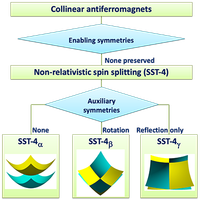
Antiferromagnets that break both space-time reversal and translation-spin-rotation symmetries were recently predicted [L.-D. Yuan, Z. Wang, J.-W. Luo, E. I. Rashba, and A. Zunger, Phys. Rev. B 102, 014422 (2020)] to possess splitting between the otherwise spin-degenerate energy bands even without the relativistic spin-orbit coupling (SOC). Here, we point out that such nonrelativistic spin splitting (NRSS)—in particular, “spin splitting type 4” (SST-4) symmetry-broken antiferromagnets—can be divided into subgroups having distinct patterns of spin splitting and spin textures, depending on additional auxiliary symmetries of spin interconversion and polarity. These SST-4 subgroups include the -type (no spin-interconverting symmetry) having spin splitting at the Brillouin zone center, as well as the subgroup in which a rotation symmetry is applied and determines the alternating spin texture and the subgroup having exclusively reflection spin-interconverting symmetry. Unlike ferrimagnets, the -type compounds are shown to have tiny net magnetization at finite temperature and thus avoid the adverse effect of the stray field. The and subgroups can be either polar or nonpolar, whereas the subgroup is polar only, providing a basis for possible switching by external fields. The combination of NRSS-enabling and auxiliary symmetries is used here as a filter for identifying previously synthesized compounds as specific prototypes. Their characteristic splitting and spin polarization are calculated by density functional theory to the benefit of potential future experimental testing. Interesting results are as follows: (i) SOC-independent NRSS can exceed the magnitude of the SOC-induced Rashba and Dresselhaus spin splitting in semiconductors. (ii) Examples of predicted -type insulating compounds include (nonpolar) and (polar), the latter having spin splitting of 158 meV and 160 meV in the valence and conduction bands, respectively. (iii) The -type ( and ) and -type compounds ( and ) are distinguished both by their auxiliary symmetries and polarity. The spin textures of -type compounds are mirror reflected with spin degeneracy of the wave vectors on that mirror. These observations will likely broaden the experimental playing field of NRSS physics significantly.
Physics Subject Headings (PhySH)
Popular Summary
Antiferromagnets are materials where neighboring atomic magnetic moments point in opposite directions, canceling out overall magnetization. In conventional Néel antiferromagnets, electrons with different spins occupy different energy levels (spin bands); these bands are degenerate in the absence of spin-orbit coupling, a relativistic effect. Previously, we designed collinear antiferromagnets where spin splitting can occur without spin-orbit coupling by breaking two key symmetries: space-time reversal and translation-spin rotation. These special cases form a class we call nonrelativistic spin splitting. Here, we uncover additional “auxiliary symmetries,” such as the ability to interchange opposite-moment sublattices and the presence of polarity, and use them to classify different patterns of spin splitting and polarization.
We classify symmetry-broken collinear antiferromagnets into three subgroups: type, which lacks spin-interconverting symmetry; type, which has rotational symmetry; and type, which has exclusive mirror symmetry. Using density functional theory calculations, we identify example materials for each subgroup and analyze their spin-polarization patterns. In -type materials (altermagnets), the spin polarization alternates, while in -type materials it is mirror reflected. -type materials show an unexpected remarkable spin splitting in the center of the Brillouin zone, a fundamental region of the material’s momentum space. We further distinguish -type antiferromagnets from compensated ferrimagnets by calculating how their total magnetization responds to changes in perturbed electronic occupation. We also find that polarity plays a role in enabling electric switching, with and types being either polar or nonpolar, and type always being polar.
These results show that auxiliary symmetry is a powerful tool for predicting and controlling spin behavior in antiferromagnets. By revealing how different symmetry patterns produce distinct electronic properties, our work provides a road map for discovering new materials for spintronics.
Article Text
Supplemental Material
References (81)
- H. A. Jahn and E. Teller, Stability of polyatomic molecules in degenerate electronic states I-orbital degeneracy, Proc. R. Soc. A 161, 220 (1937).
- J. B. Goodenough, Direct cation--cation interactions in several oxides, Phys. Rev. 117, 1442 (1960).
- O. I. Malyi and A. Zunger, False metals, real insulators, and degenerate gapped metals, Appl. Phys. Rev. 7, 041310 (2020).
- E. I. Rashba, Properties of semiconductors with an extremum loop. 1. Cyclotron and combinational resonance in a magnetic field perpendicular to the plane of the loop, Sov. Phys.-Solid State 2, 1109 (1960).
- Y. A. Bychkov and E. I. Rashba, Properties of a 2D electron-gas with lifted spectral degeneracy, JETP Lett. 39, 78 (1984).
- G. Dresselhaus, Spin-orbit coupling effects in zinc blende structures, Phys. Rev. 100, 580 (1955).
- S. I. Pekar and E. I. Rashba, Combined resonance in crystals in inhomogeneous magnetic fields, Zh. Eksp. Teor. Fiz. 47, 1927 (1964).
- L. D. Yuan, Z. Wang, J. W. Luo, E. I. Rashba, and A. Zunger, Giant momentum-dependent spin splitting in centrosymmetric low-Z antiferromagnets, Phys. Rev. B 102, 014422 (2020).
- M. Naka, S. Hayami, H. Kusunose, Y. Yanagi, Y. Motome, and H. Seo, Spin current generation in organic antiferromagnets, Nat. Commun. 10, 4305 (2019).
- S. Hayami, Y. Yanagi, and H. Kusunose, Momentum-dependent spin splitting by collinear antiferromagnetic ordering, J. Phys. Soc. Jpn. 88, 123702 (2019).
- K. H. Ahn, A. Hariki, K. W. Lee, and J. Kunes, Antiferromagnetism in as d-wave Pomeranchuk instability, Phys. Rev. B 99, 184432 (2019).
- H. Y. Ma, M. L. Hu, N. N. Li, J. P. Liu, W. Yao, J. F. Jia, and J. W. Liu, Multifunctional antiferromagnetic materials with giant piezomagnetism and noncollinear spin current, Nat. Commun. 12, 2846 (2021).
- I. I. Mazin, K. Koepernik, M. D. Johannes, R. González-Hernández, and L. Smejkal, Prediction of unconventional magnetism in doped , Proc. Natl. Acad. Sci. U.S.A. 118, e2108924118 (2021).
- L. Smejkal, J. Sinova, and T. Jungwirth, Beyond conventional ferromagnetism and antiferromagnetism: A phase with nonrelativistic spin and crystal rotation symmetry, Phys. Rev. X 12, 031042 (2022).
- L. Smejkal, A. B. Hellenes, R. González-Hernández, J. Sinova, and T. Jungwirth, Giant and tunneling magnetoresistance in unconventional collinear antiferromagnets with nonrelativistic-momentum, Phys. Rev. X 12, 011028 (2022).
- L. Smejkal et al., Chiral magnons in altermagnetic , Phys. Rev. Lett. 131, 256703 (2023).
- I. V. Solovyev, Magneto-optical effect in the weak ferromagnets (, Mn, and Fe), Phys. Rev. B 55, 8060 (1997).
- S. López-Moreno, A. H. Romero, J. Mejía-López, A. Muñoz, and I. V. Roshchin, First-principles study of electronic, vibrational, elastic, and magnetic properties of as a function of pressure, Phys. Rev. B 85, 134110 (2012).
- M. Kissel-Phillip and W. H. E. Schwarz, Relativistically corrected Schrodinger-equation, Phys. Rev. A 38, 6027 (1988).
- L. Pauling, The nature of the chemical bond IV The energy of single bonds and the relative electronegativity of atoms, J. Am. Chem. Soc. 54, 3570 (1932).
- S. H. Wei and A. Zunger, Electronic-structure of II-VI compounds and their alloys—role of cation d-bands, J. Cryst. Growth 86, 1 (1988).
- D. J. Friedman, G. P. Carey, I. Lindau, and W. E. Spicer, Effect of different cation-anion bond strengths on metal ternary-semiconductor interface formation— and , Phys. Rev. B 34, 5329 (1986).
- B. Weber, Y. L. Hsueh, T. F. Watson, R. Y. Li, A. R. Hamilton, L. C. L. Hollenberg, R. Rahman, and M. Y. Simmons, Spin-orbit coupling in silicon for electrons bound to donors, npj Quantum Inf. 4, 61 (2018).
- Y. Noda, K. Ohno, and S. Nakamura, Momentum-dependent band spin splitting in semiconducting : A density functional calculation, Phys. Chem. Chem. Phys. 18, 13294 (2016).
- A. Zunger, Inverse design in search of materials with target functionalities, Nat. Rev. Chem. 2, 0121 (2018).
- L. D. Yuan, Z. Wang, J. W. Luo, and A. Zunger, Prediction of low-Z collinear and noncollinear antiferromagnetic compounds having momentum-dependent spin splitting even without spin-orbit coupling, Phys. Rev. Mater. 5, 014409 (2021).
- W. Kohn and L. J. Sham, Self-consistent equations including exchange and correlation effects, Phys. Rev. 140, A1133 (1965).
- G. Kresse and J. Furthmuller, Efficiency of ab-initio total energy calculations for metals and semiconductors using a plane-wave basis set, Comput. Mater. Sci. 6, 15 (1996).
- G. Kresse and J. Furthmuller, Efficient iterative schemes for ab initio total-energy calculations using a plane-wave basis set, Phys. Rev. B 54, 11169 (1996).
- S. Zeng and Y. J. Zhao, Description of two-dimensional altermagnetism: Categorization using spin group theory, Phys. Rev. B 110, 054406 (2024).
- S. K. Zeng and Y. J. Zhao, Bilayer stacking-type altermagnet: A general approach to generating two-dimensional altermagnetism, Phys. Rev. B 110, 174410 (2024).
- S. W. Cheong and F. T. Huang, Altermagnetism classification, npj Quantum Mater. 10, 38 (2025).
- See Supplemental Material at http://link.aps.org/supplemental/10.1103/mrzv-wmcf for the supplemental computational results on the identified candidate NRSS materials. The Supplemental Material introduced the differences between two classifications of using magnetic point group (SST) vs spin Laue group, and showed the details of theoretical methods used in this work.
- M. Gu, Y. Liu, H. Zhu, K. Yananose, X. Chen, Y. Hu, A. Stroppa, and Q. Liu, Ferroelectric switchable altermagnetism, Phys. Rev. Lett. 134, 106802 (2025).
- MAGNDATA: https://www.cryst.ehu.es/magndata/index.php?show_db=1.
- J. P. Perdew, K. Burke, and M. Ernzerhof, Generalized gradient approximation made simple, Phys. Rev. Lett. 77, 3865 (1996).
- S. L. Dudarev, G. A. Botton, S. Y. Savrasov, C. J. Humphreys, and A. P. Sutton, Electron-energy-loss spectra and the structural stability of nickel oxide: An study, Phys. Rev. B 57, 1505 (1998).
- Materials Project: https://next-gen.materialsproject.org/.
- V. Stevanovic, S. Lany, X. W. Zhang, and A. Zunger, Correcting density functional theory for accurate predictions of compound enthalpies of formation: Fitted elemental-phase reference energies, Phys. Rev. B 85, 115104 (2012).
- L. D. Yuan, A. B. Georgescu, and J. M. Rondinelli, Nonrelativistic spin splitting at the Brillouin zone center in compensated magnets, Phys. Rev. Lett. 133, 216701 (2024).
- P. F. Liu, J. Y. Li, J. Z. Han, X. G. Wan, and Q. H. Liu, Spin-group symmetry in magnetic materials with negligible spin-orbit coupling, Phys. Rev. X 12, 021016 (2022).
- X. B. Chen et al., Enumeration and representation theory of spin space groups, Phys. Rev. X 14, 031038 (2024).
- C. Darie, C. Goujon, M. Bacia, H. Klein, P. Toulemonde, P. Bordet, and E. Suard, Magnetic and crystal structures of , Solid State Sci. 12, 660 (2010).
- E. Solana-Madruga, A. J. Dos Santos-García, A. M. Arévalo-López, D. Avila-Brande, C. Ritter, J. P. Attfield, and R. Sáez-Puche, High pressure synthesis of polar and non-polar cation-ordered polymorphs of , Dalton Trans. 44, 20441 (2015).
- J. L. Garcia-Munoz, J. Rodriguez-Carvajal, X. Obradors, M. Valletregi, J. Gonzalezcalbet, and M. Parras, Complex magnetic-structures of the rare-earth cuprates (), Phys. Rev. B 44, 4716 (1991).
- J. W. Stout and S. A. Reed, The crystal structure of , , , and , J. Am. Chem. Soc. 76, 5279 (1954).
- J. Strempfer, U. Rütt, and W. Jauch, Absolute spin magnetic moment of from high energy photon diffraction, Phys. Rev. Lett. 86, 3152 (2001).
- Y. Fang, W. P. Zhou, S. M. Yan, R. Bai, Z. H. Qian, Q. Y. Xu, D. H. Wang, and Y. W. Du, Magnetic-field-induced dielectric anomaly and electric polarization in , J. Appl. Phys. 117, 17b712 (2015).
- M. R. Li et al., A polar corundum oxide displaying weak ferromagnetism at room temperature, J. Am. Chem. Soc. 134, 3737 (2012).
- K. Momma and F. Izumi, For three-dimensional visualization of crystal, volumetric and morphology data, J. Appl. Crystallogr. 44, 1272 (2011).
- H. van Leuken and R. A. de Groot, Half-metallic antiferromagnets, Phys. Rev. Lett. 74, 1171 (1995).
- Y. Liu, S.-D. Guo, Y. Li, and C.-C. Liu, Two-dimensional fully compensated ferrimagnetism, Phys. Rev. Lett. 134, 116703 (2025).
- W. N. Lin et al., Interface-based tuning of Rashba spin-orbit interaction in asymmetric oxide heterostructures with 3D electrons, Nat. Commun. 10, 3052 (2019).
- O. Fedchenko et al., Observation of time-reversal symmetry breaking in the band structure of altermagnetic , Sci. Adv. 10, eadj4883 (2024).
- H. Bai et al., Efficient spin-to-charge conversion via altermagnetic spin splitting effect in antiferromagnet , Phys. Rev. Lett. 130, 216701 (2023).
- S. Lee et al., Broken Kramers degeneracy in altermagnetic , Phys. Rev. Lett. 132, 036702 (2024).
- J. Krempasky et al., Altermagnetic lifting of Kramers spin degeneracy, Nature (London) 626, 517 (2024).
- Z. X. Feng et al., An anomalous Hall effect in altermagnetic ruthenium dioxide, National electronics review 5, 735 (2022).
- C. T. Liao, Y. C. Wang, Y. C. Tien, S. Y. Huang, and D. R. Qu, Separation of inverse altermagnetic spin-splitting effect from inverse spin Hall effect in , Phys. Rev. Lett. 133, 056701 (2024).
- T. Aoyama and K. Ohgushi, Piezomagnetic properties in altermagnetic , Phys. Rev. Mater. 8, L041402 (2024).
- T. Osumi, S. Souma, T. Aoyama, K. Yamauchi, A. Honma, K. Nakayama, T. Takahashi, K. Ohgushi, and T. Sato, Observation of a giant band splitting in altermagnetic , Phys. Rev. B 109, 115102 (2024).
- I. I. Mazin, Altermagnetism in : Origin, predicted manifestations, and routes to detwinning, Phys. Rev. B 107, L100418 (2023).
- Z. Lin et al., Observation of giant spin splitting and d-wave spin texture in room temperature altermagnet , arXiv:2402.04995.
- Y. Q. Guo et al., Direct and inverse spin splitting effects in altermagnetic , Adv. Sci. 11, 2400967 (2024).
- P. Wadley et al., Electrical switching of an antiferromagnet, Science 351, 587 (2016).
- E. Solana-Madruga, C. Ritter, C. Aguilar-Maldonado, O. Mentré, J. P. Attfield, and A. M. Arévalo-López, : High-pressure triple perovskite with B-site order and modulated spins, Chem. Commun. (Cambridge) 57, 8441 (2021).
- N. D. Mermin, Thermal properties of the inhomogeneous electron gas, Phys. Rev. 137, A1441 (1965).
- P. Blonski and J. Hafner, Magnetic anisotropy of transition-metal dimers: Density functional calculations, Phys. Rev. B 79, 224418 (2009).
- P. A. McClarty and J. G. Rau, Landau theory of altermagnetism, Phys. Rev. Lett. 132, 176702 (2024).
- I. Turek, Altermagnetism and magnetic groups with pseudoscalar electron spin, Phys. Rev. B 106, 094432 (2022).
- L. Attias, A. Levchenko, and M. Khodas, Intrinsic anomalous Hall effect in altermagnets, Phys. Rev. B 110, 094425 (2024).
- K. D. Belashchenko, Exchange-driven spin Hall effect in anisotropic ferromagnets, Phys. Rev. B 109, 054409 (2024).
- B. Chi, L. Jiang, Y. Zhu, G. Q. Yu, C. H. Wan, and X. F. Han, Anisotropic spin filtering by an altermagnetic barrier in magnetic tunnel junctions, arXiv:2409.03415.
- K. Samanta, D.-F. Shao, and E. Y. Tsymbal, Spin filtering with insulating altermagnets, arXiv:2409.00195.
- X. K. Duan, J. Y. Zhang, Z. Y. Zhu, Y. T. Liu, Z. Y. Zhang, I. Zutic, and T. Zhou, Antiferroelectric altermagnets: Antiferroelectricity alters magnets, Phys. Rev. Lett. 134, 106801 (2025).
- H. Mavani, K. Huang, K. Samanta, and E. Y. Tsymbal, Two-dimensional antiferromagnets with non-relativistic spin splitting switchable by electric polarization, arXiv:2503.09877.
- C. Li et al., Topological Weyl altermagnetism in CrSb, arXiv:2405.14777.
- Q. H. Liu, X. Dai, and S. Blügel, Different facets of unconventional magnetism, Nat. Phys. 21, 329 (2025).
- Z. Wang, Y. Sun, X. Q. Chen, C. Franchini, G. Xu, H. Weng, X. Dai, and Z. Fang, Dirac semimetal and topological phase transitions in (), Phys. Rev. B 85, 195320 (2012).
- Z. J. Wang, H. M. Weng, Q. S. Wu, X. Dai, and Z. Fang, Three-dimensional Dirac semimetal and quantum transport in , Phys. Rev. B 88, 125427 (2013).
- S. Rajpurohit, R. Karaalp, Y. Ping, L. Z. Tan, T. Ogitsu, and P. E. Blöchl, Optical control of spin-splitting in an altermagnet, arXiv:2409.17718.

