

- Open Access
Observation of Wannier-Rydberg and Charge-Transfer Hybrid Moiré Excitons under Pressure
Phys. Rev. X 16, 041007 – Published 6 October, 2026
DOI: https://doi.org/10.1103/lgl7-ww2r
Abstract
Moiré superlattices in van der Waals heterostructures, arising from lattice mismatch or twist angle, provide a powerful platform for engineering correlated electronic and excitonic states. Moiré excitons form when electrons and holes are individually modulated by the moiré potential yet remain bound by Coulomb interaction, resulting in exciton wave functions with a highly nontrivial and rich real-space structure. However, achieving in situ and dynamic control over the interplay between excitonic Coulomb interaction and the moiré potential remains a central challenge. Here, we demonstrate that hydrostatic pressure provides a continuous and effective means of enhancing the moiré potential and tuning moiré excitons in moiré heterobilayers. As pressure increases, intralayer moiré excitons exhibit systematic redshifts as the moiré potential deepens. Crucially, above the system enters a strong-moiré regime, where a new higher-energy intralayer moiré exciton emerges that is not accessible otherwise. Combining dual-gate optical spectroscopy with Bethe-Salpeter equation calculations, we reveal that this emerging moiré exciton state arises from strong pressure-induced hybridization between two distinct exciton series: Wannier-Rydberg and charge-transfer excitons. Enhanced exciton-electron and exciton-exciton interactions observed in doping-dependent photoluminescence further evidence the strengthened moiré potential under pressure. Our work establishes a pioneering paradigm of moiré excitonic wave function engineering, enabling the on-demand creation of tailored excitonic species in moiré superlattices.
Physics Subject Headings (PhySH)
Popular Summary
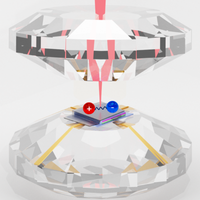
Achieving in situ and dynamic tuning of moiré exciton states in stacked semiconductor superlattices remains challenging because static twist angles permanently fix the landscape of periodic potentials and Coulombic interactions. We addressed this limitation by combining optical spectroscopy with theoretical calculations to demonstrate that hydrostatic pressure acts as a continuous tuning knob for the moiré potential depth.
We observed that applying pressure drives a transition from a moderate- to a strong-moiré regime, triggering strong quantum hybridization between spatially distinct Wannier-Rydberg excitons and charge-transfer excitons. We found that this pressure-induced mixing gives rise to an emergent, hybrid moiré exciton state whose optical response can be continuously controlled. Our work establishes hydrostatic pressure as an effective mechanism for engineering excitonic states and tailoring quantum excitations on demand in moiré materials.
Article Text
Supplemental Material
References (69)
- Y. Cao, V. Fatemi, S. Fang, K. Watanabe, T. Taniguchi, E. Kaxiras, and P. Jarillo-Herrero, Unconventional superconductivity in magic-angle graphene superlattices, Nature (London) 556, 43 (2018).
- Y. Cao et al., Correlated insulator behaviour at half-filling in magic-angle graphene superlattices, Nature (London) 556, 80 (2018).
- Y. Xia, Z. Han, K. Watanabe, T. Taniguchi, J. Shan, and K. F. Mak, Superconductivity in twisted bilayer , Nature (London) 637, 833 (2025).
- Y. Guo et al., Superconductivity in 5.0° twisted bilayer , Nature (London) 637, 839 (2025).
- E. C. Regan et al., Mott and generalized Wigner crystal states in moiré superlattices, Nature (London) 579, 359 (2020).
- Y. Tang et al., Simulation of Hubbard model physics in moiré superlattices, Nature (London) 579, 353 (2020).
- Y. Xu, S. Liu, D. A. Rhodes, K. Watanabe, T. Taniguchi, J. Hone, V. Elser, K. F. Mak, and J. Shan, Correlated insulating states at fractional fillings of moiré superlattices, Nature (London) 587, 214 (2020).
- L. Wang et al., Correlated electronic phases in twisted bilayer transition metal dichalcogenides, Nat. Mater. 19, 861 (2020).
- C. Hu, V. Michaud-Rioux, W. Yao, and H. Guo, Moiré valleytronics: realizing dense arrays of topological helical channels, Phys. Rev. Lett. 121, 186403 (2018).
- A. L. Sharpe, E. J. Fox, A. W. Barnard, J. Finney, K. Watanabe, T. Taniguchi, M. A. Kastner, and D. Goldhaber-Gordon, Emergent ferromagnetism near three-quarters filling in twisted bilayer graphene, Science 365, 605 (2019).
- G. Wang, A. Chernikov, M. M. Glazov, T. F. Heinz, X. Marie, T. Amand, and B. Urbaszek, Colloquium: Excitons in atomically thin transition metal dichalcogenides, Rev. Mod. Phys. 90, 021001 (2018).
- H. Yu, G.-B. Liu, J. Tang, X. Xu, and W. Yao, Moiré excitons: From programmable quantum emitter arrays to spin-orbit–coupled artificial lattices, Sci. Adv. 3, e1701696 (2017).
- K. Tran et al., Evidence for moiré excitons in van der Waals heterostructures, Nature (London) 567, 71 (2019).
- M. H. Naik et al., Intralayer charge-transfer moiré excitons in van der Waals superlattices, Nature (London) 609, 52 (2022).
- C. Hu, M. H. Naik, Y.-H. Chan, J. Ruan, and S. G. Louie, Light-induced shift current vortex crystals in moiré heterobilayers, Proc. Natl. Acad. Sci. U.S.A. 120, e2314775120 (2023).
- A. Kogar et al., Signatures of exciton condensation in a transition metal dichalcogenide, Science 358, 1314 (2017).
- Z. Wang, D. A. Rhodes, K. Watanabe, T. Taniguchi, J. C. Hone, J. Shan, and K. F. Mak, Evidence of high-temperature exciton condensation in two-dimensional atomic double layers, Nature (London) 574, 76 (2019).
- M. M. Fogler, L. V. Butov, and K. S. Novoselov, High-temperature superfluidity with indirect excitons in van der Waals heterostructures, Nat. Commun. 5, 4555 (2014).
- L. Gu et al., Giant optical nonlinearity of Fermi polarons in atomically thin semiconductors, Nat. Photonics 18, 816 (2024).
- X. Zhao et al., Pressure tuning of layer-hybridized excitons in trilayer , Nano Lett. 26, 1035 (2026).
- G. Shen et al., Toward an international practical pressure scale: A proposal for an IPPS ruby gauge (IPPS-Ruby2020), High Press. Res. 40, 299 (2020).
- See Supplemental Material at http://link.aps.org/supplemental/10.1103/lgl7-ww2r for experimental and computational details, additional discussions, and supporting figures, which includes Refs. [23–43].
- Y. Ye, X. Dou, K. Ding, D. Jiang, F. Yang, and B. Sun, Pressure-induced K–Λ crossing in monolayer , Nanoscale 8, 10843 (2016).
- X. Ma et al., Robust interlayer exciton in van der Waals heterostructure under high pressure, Nano Lett. 21, 8035 (2021).
- L. Fu et al., K–Λ crossover transition in the conduction band of monolayer under hydrostatic pressure, Sci. Adv. 3, e1700162 (2017).
- S. Plimpton, Computational limits of classical molecular dynamics simulations, Comput. Mater. Sci. 4, 361 (1995).
- F. H. Stillinger and T. A. Weber, Computer simulation of local order in condensed phases of silicon, Phys. Rev. B 31, 5262 (1985).
- J.-W. Jiang and Y.-P. Zhou, Handbook of Stillinger-Weber Potential Parameters for Two-Dimensional Atomic Crystals (IntechOpen, London, 2017), 10.5772/intechopen.71767.
- M. H. Naik, I. Maity, P. K. Maiti, and M. Jain, Kolmogorov–Crespi potential for multilayer transition-metal dichalcogenides: Capturing structural transformations in moiré superlattices, J. Phys. Chem. C 123, 9770 (2019).
- A. N. Kolmogorov and V. H. Crespi, Registry-dependent interlayer potential for graphitic systems, Phys. Rev. B 71, 235415 (2005).
- D. Xiao, G.-B. Liu, W. Feng, X. Xu, and W. Yao, Coupled spin and valley physics in monolayers of and other group-VI dichalcogenides, Phys. Rev. Lett. 108, 196802 (2012).
- R. Wang, K. Chang, W. Duan, Y. Xu, and P. Tang, Twist-angle-dependent valley polarization of intralayer moiré excitons in van der Waals superlattices, Phys. Rev. Lett. 134, 026904 (2025).
- C. Wang, X.-W. Zhang, X. Liu, Y. He, X. Xu, Y. Ran, T. Cao, and D. Xiao, Fractional Chern insulator in twisted bilayer , Phys. Rev. Lett. 132, 036501 (2024).
- J. M. Soler, E. Artacho, J. D. Gale, A. García, J. Junquera, P. Ordejón, and D. Sánchez-Portal, The SIESTA method for ab initio order-N materials simulation, J. Phys. Condens. Matter 14, 2745 (2002).
- D. R. Hamann, Optimized norm-conserving Vanderbilt pseudopotentials, Phys. Rev. B 88, 085117 (2013).
- M. Schlipf and F. Gygi, Optimization algorithm for the generation of ONCV pseudopotentials, Comput. Phys. Commun. 196, 36 (2015).
- M. Rohlfing and S. G. Louie, Excitonic effects and the optical absorption spectrum of hydrogenated Si clusters, Phys. Rev. Lett. 80, 3320 (1998).
- M. Rohlfing and S. G. Louie, Electron-hole excitations and optical spectra from first principles, Phys. Rev. B 62, 4927 (2000).
- L. V. Keldysh, Coulomb interaction in thin semiconductor and semimetal films, JETP Lett. 29, 658 (1979), http://jetpletters.ru/ps/1455/article_22207.pdf.
- A. Chernikov, T. C. Berkelbach, H. M. Hill, A. Rigosi, Y. Li, B. Aslan, D. R. Reichman, M. S. Hybertsen, and T. F. Heinz, Exciton binding energy and nonhydrogenic Rydberg series in monolayer , Phys. Rev. Lett. 113, 076802 (2014).
- E. Mostaani, M. Szyniszewski, C. H. Price, R. Maezono, M. Danovich, R. J. Hunt, N. D. Drummond, and V. I. Fal’ko, Diffusion quantum Monte Carlo study of excitonic complexes in two-dimensional transition-metal dichalcogenides, Phys. Rev. B 96, 075431 (2017).
- H. C. Kamban and T. G. Pedersen, Interlayer excitons in van der Waals heterostructures: Binding energy, Stark shift, and field-induced dissociation, Sci. Rep. 10, 5537 (2020).
- G. Onida, L. Reining, and A. Rubio, Electronic excitations: Density-functional versus many-body Green’s-function approaches, Rev. Mod. Phys. 74, 601 (2002).
- Y. Li, Y. Rao, K. F. Mak, Y. You, S. Wang, C. R. Dean, and T. F. Heinz, Probing symmetry properties of few-layer and h-BN by optical second-harmonic generation, Nano Lett. 13, 3329 (2013).
- C. Jin et al., Observation of moiré excitons in heterostructure superlattices, Nature (London) 567, 76 (2019).
- A. Weston et al., Atomic reconstruction in twisted bilayers of transition metal dichalcogenides, Nat. Nanotechnol. 15, 592 (2020).
- H. Li et al., Imaging moiré flat bands in three-dimensional reconstructed superlattices, Nat. Mater. 20, 945 (2021).
- Y. Wang et al., Pressure-driven moiré potential enhancement and tertiary gap opening in graphene/h-BN heterostructure, Phys. Rev. Lett. 135, 046303 (2025).
- M. Yankowitz, J. Jung, E. Laksono, N. Leconte, B. L. Chittari, K. Watanabe, T. Taniguchi, S. Adam, D. Graf, and C. R. Dean, Dynamic band-structure tuning of graphene moiré superlattices with pressure, Nature (London) 557, 404 (2018).
- Y. Gao, X. Lin, T. Smart, P. Ci, K. Watanabe, T. Taniguchi, R. Jeanloz, J. Ni, and J. Wu, Band engineering of large-twist-angle graphene-hBN moiré superlattices with pressure, Phys. Rev. Lett. 125, 226403 (2020).
- B. Szentpéteri et al., Tailoring the band structure of twisted double bilayer graphene with pressure, Nano Lett. 21, 8777 (2021).
- M. Yankowitz, S. Chen, H. Polshyn, Y. Zhang, K. Watanabe, T. Taniguchi, D. Graf, A. F. Young, and C. R. Dean, Tuning superconductivity in twisted bilayer graphene, Science 363, 1059 (2019).
- P. Jiao et al., Hydrostatic pressure-enhanced correlated magnetism and Chern insulator in moiré , Phys. Rev. X 16, 011068 (2026).
- K. Wang et al., Interlayer coupling in twisted bilayer heterostructures revealed by optical spectroscopy, ACS Nano 10, 6612 (2016).
- I. Stenger, L. Schué, M. Boukhicha, B. Berini, B. Plaçais, A. Loiseau, and J. Barjon, Low frequency Raman spectroscopy of few-atomic-layer thick hBN crystals, 2D Mater. 4, 031003 (2017).
- C. H. Lui et al., Observation of interlayer phonon modes in van der Waals heterostructures, Phys. Rev. B 91, 165403 (2015).
- J. Yan, J. Xia, X. Wang, L. Liu, J.-L. Kuo, B. K. Tay, S. Chen, W. Zhou, Z. Liu, and Z. X. Shen, Stacking-dependent interlayer coupling in trilayer with broken inversion symmetry, Nano Lett. 15, 8155 (2015).
- J. Xia, J. Yan, Z. Wang, Y. He, Y. Gong, W. Chen, T. C. Sum, Z. Liu, P. M. Ajayan, and Z. Shen, Strong coupling and pressure engineering in heterobilayers, Nat. Phys. 17, 92 (2021).
- L. Liang, J. Zhang, B. G. Sumpter, Q.-H. Tan, P.-H. Tan, and V. Meunier, Low-frequency shear and layer-breathing modes in Raman scattering of two-dimensional materials, ACS Nano 11, 11777 (2017).
- X. Wang et al., Intercell moiré exciton complexes in electron lattices, Nat. Mater. 22, 599 (2023).
- E. Liu, T. Taniguchi, K. Watanabe, N. M. Gabor, Y.-T. Cui, and C. H. Lui, Excitonic and valley-polarization signatures of fractional correlated electronic phases in a moiré superlattice, Phys. Rev. Lett. 127, 037402 (2021).
- W. Zhao et al., Dynamic tuning of moiré excitons in a heterostructure via mechanical deformation, Nano Lett. 21, 8910 (2021).
- B. Aslan, M. Deng, and T. F. Heinz, Strain tuning of excitons in monolayer , Phys. Rev. B 98, 115308 (2018).
- P. Steeger, J. H. Graalmann, R. Schmidt, I. Kupenko, C. Sanchez-Valle, P. Marauhn, T. Deilmann, S. M. de Vasconcellos, M. Rohlfing, and R. Bratschitsch, Pressure dependence of intra- and interlayer excitons in 2H- bilayers, Nano Lett. 23, 8947 (2023).
- F. Wu, T. Lovorn, E. Tutuc, I. Martin, and A. H. MacDonald, Topological insulators in twisted transition metal dichalcogenide homobilayers, Phys. Rev. Lett. 122, 086402 (2019).
- Z. Ye, T. Cao, K. O’Brien, H. Zhu, X. Yin, Y. Wang, S. G. Louie, and X. Zhang, Probing excitonic dark states in single-layer tungsten disulphide, Nature (London) 513, 214 (2014).
- H. Park et al., Dipole ladders with large Hubbard interaction in a moiré exciton lattice, Nat. Phys. 19, 1286 (2023).
- R. Xiong, J. H. Nie, S. L. Brantly, P. Hays, R. Sailus, K. Watanabe, T. Taniguchi, S. Tongay, and C. Jin, Correlated insulator of excitons in moiré superlattices, Science 380, 860 (2023).
- Z. Lian et al., Valley-polarized excitonic Mott insulator in moiré superlattice, Nat. Phys. 20, 34 (2024).

