

- Open Access
Pseudogap with Fermi Arcs and Fermi Pockets in Half-Filled Twisted Transition Metal Dichalcogenides
Phys. Rev. X 16, 011005 – Published 6 January, 2026
DOI: https://doi.org/10.1103/kmn8-y59j
Abstract
Twisted transition metal dichalcogenides are a new platform for realizing strongly correlated physics with high tunability. Recent transport experiments [A. Ghiotto et al., Nature (London) 597, 345 (2021)] have reported the bandwidth-driven evolution of a Mott insulator to a strange metal behavior via the tuning of a displacement field in twisted () fixed at half filling. However, the nature of the correlated states and the related Mott physics involved in the whole process remain to be determined. Here, we unveil theoretically the evolution of the ground state of the half-filled moiré Hubbard model as applied to , transiting from a pseudogap state with Fermi arcs to a 120° Néel ordered Mott insulator, then to another pseudogap state with Fermi pockets, and eventually to a Fermi liquid via a Lifshitz transition. The pseudogap phases are definitely identified by the vanishing of quasiparticle weights over parts of the Fermi surface, with the remaining parts forming disconnected Fermi arcs or pockets with well-defined quasiparticles. We demonstrate that the Fermi arc or pocket results from the electronic band structure reconstruction driven by electron correlations, marked by the coexistence of the poles and zeros of the single-particle Green’s function. We ascribe the ground state of the strange metal featured by the linear- resistivity observed experimentally in to the second pseudogap state by further calculating the temperature dependence of resistivity. This work reveals the fundamental aspects of the Mottness in moiré system and will stimulate the direct probes of the underlying physics beyond transports via the angle-resolved photoemission spectroscopy and scanning tunneling microscopy.
Physics Subject Headings (PhySH)
Popular Summary
Understanding the universal principles of Mottness—how strong electronic correlations drive exotic phases like pseudogaps and strange metals—remains a fundamental challenge in condensed matter physics. The difficulty to continuously adjust the Mott insulator–metal transition in conventional quantum materials impedes the related explorations. Recently, the moiré system with flat bands has emerged as a highly tunable platform to realize strongly correlated physics.
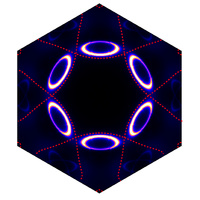
In this work, we unveil theoretically the evolution of the ground state of the half-filled moiré Hubbard model as applied to twisted bilayer tungsten diselenide by tuning the electron bandwidth with an electric displacement field at half filling. Our work reveals that strong correlations reconstruct the electronic structure, leading to a striking sequence of phases: a pseudogap where the Fermi surface fractures into arcs, a Mott insulator, a second pseudogap with isolated Fermi pockets, and finally a conventional Fermi liquid. Crucially, we identify the experimentally observed strange metal behavior, where electrical resistance rises linearly with temperature, as originating from this second pseudogap phase.
Our work clarifies the nature of Mottness in moiré materials and sets the stage for direct experimental imaging of these exotic states using advanced microscopy techniques.
Article Text
References (89)
- J. M. Luttinger and J. C. Ward, Ground-state energy of a many-fermion system. II, Phys. Rev. 118, 1417 (1960).
- J. M. Luttinger, Fermi surface and some simple equilibrium properties of a system of interacting fermions, Phys. Rev. 119, 1153 (1960).
- M. Yamanaka, M. Oshikawa, and I. Affleck, Nonperturbative approach to Luttinger’s theorem in one dimension, Phys. Rev. Lett. 79, 1110 (1997).
- I. Dzyaloshinskii, Some consequences of the Luttinger theorem: The Luttinger surfaces in non-Fermi liquids and Mott insulators, Phys. Rev. B 68, 085113 (2003).
- H. Ding, T. Yokoya, J. C. Campuzano, T. Takahashi, M. Randeria, M. R. Norman, T. Mochiku, K. Kadowaki, and J. Giapintzakis, Spectroscopic evidence for a pseudogap in the normal state of underdoped high- superconductors, Nature (London) 382, 51 (1996).
- M. R. Norman, H. Ding, M. Randeria, J. C. Campuzano, T. Yokoya, T. Takeuchi, T. Takahashi, T. Mochiku, K. Kadowaki, P. Guptasarma, and D. G. Hinks, Destruction of the Fermi surface in underdoped high- superconductors, Nature (London) 392, 157 (1998).
- A. Kaminski, S. Rosenkranz, H. M. Fretwell, J. C. Campuzano, Z. Li, H. Raffy, W. G. Cullen, H. You, C. G. Olson, C. M. Varma, and H. Höchst, Spontaneous breaking of time-reversal symmetry in the pseudogap state of a high- superconductor, Nature (London) 416, 610 (2002).
- A. Damascelli, Z. Hussain, and Z.-X. Shen, Angle-resolved photoemission studies of the cuprate superconductors, Rev. Mod. Phys. 75, 473 (2003).
- K. M. Shen, F. Ronning, D. H. Lu, F. Baumberger, N. J. C. Ingle, W. S. Lee, W. Meevasana, Y. Kohsaka, M. Azuma, M. Takano, H. Takagi, and Z.-X. Shen, Nodal quasiparticles and antinodal charge ordering in , Science 307, 901 (2005).
- A. Kanigel, M. R. Norman, M. Randeria, U. Chatterjee, S. Souma, A. Kaminski, H. M. Fretwell, S. Rosenkranz, M. Shi, T. Sato, T. Takahashi, Z. Z. Li, H. Raffy, K. Kadowaki, D. Hinks, L. Ozyuzer, and J. C. Campuzano, Evolution of the pseudogap from Fermi arcs to the nodal liquid, Nat. Phys. 2, 447 (2006).
- R. Daou, N. Doiron-Leyraud, D. LeBoeuf, S. Y. Li, F. Laliberté, O. Cyr-Choinière, Y. J. Jo, L. Balicas, J. Q. Yan, J. S. Zhou, J. B. Goodenough, and L. Taillefer, Linear temperature dependence of resistivity and change in the Fermi surface at the pseudogap critical point of a high- superconductor, Nat. Phys. 5, 31 (2009).
- A. V. Puchkov, P. Fournier, D. N. Basov, T. Timusk, A. Kapitulnik, and N. N. Kolesnikov, Evolution of the pseudogap state of high- superconductors with doping, Phys. Rev. Lett. 77, 3212 (1996).
- R. Daou, J. Chang, D. LeBoeuf, O. Cyr-Choinière, F. Laliberté, N. Doiron-Leyraud, B. J. Ramshaw, R. Liang, D. A. Bonn, W. N. Hardy, and L. Taillefer, Broken rotational symmetry in the pseudogap phase of a high- superconductor, Nature (London) 463, 519 (2010).
- Y. Li, V. Balédent, G. Yu, N. Barišić, K. Hradil, R. A. Mole, Y. Sidis, P. Steffens, X. Zhao, P. Bourges, and M. Greven, Hidden magnetic excitation in the pseudogap phase of a high- superconductor, Nature (London) 468, 283 (2010).
- F. Rullier-Albenque, H. Alloul, and G. Rikken, High-field studies of superconducting fluctuations in high- cuprates: Evidence for a small gap distinct from the large pseudogap, Phys. Rev. B 84, 014522 (2011).
- S. I. Mirzaei, D. Stricker, J. N. Hancock, C. Berthod, A. Georges, E. van Heumen, M. K. Chan, X. Zhao, Y. Li, M. Greven, N. Barišić, and D. van der Marel, Spectroscopic evidence for Fermi liquid-like energy and temperature dependence of the relaxation rate in the pseudogap phase of the cuprates, Proc. Natl. Acad. Sci. U.S.A. 110, 5774 (2013).
- K. B. Efetov, H. Meier, and C. Pépin, Pseudogap state near a quantum critical point, Nat. Phys. 9, 442 (2013).
- S. Badoux, W. Tabis, F. Laliberté, G. Grissonnanche, B. Vignolle, D. Vignolles, J. Béard, D. A. Bonn, W. N. Hardy, R. Liang, N. Doiron-Leyraud, L. Taillefer, and C. Proust, Change of carrier density at the pseudogap critical point of a cuprate superconductor, Nature (London) 531, 210 (2016).
- M. Mitrano, A. A. Husain, S. Vig, A. Kogar, M. S. Rak, S. I. Rubeck, J. Schmalian, B. Uchoa, J. Schneeloch, R. Zhong, G. D. Gu, and P. Abbamonte, Anomalous density fluctuations in a strange metal, Proc. Natl. Acad. Sci. U.S.A. 115, 5392 (2018).
- R. L. Greene, P. R. Mandal, N. R. Poniatowski, and T. Sarkar, The strange metal state of the electron-doped cuprates, Annu. Rev. Condens. Matter Phys. 11, 213 (2020).
- J. Ayres, M. Berben, M. Čulo, Y. T. Hsu, E. van Heumen, Y. Huang, J. Zaanen, T. Kondo, T. Takeuchi, J. R. Cooper, C. Putzke, S. Friedemann, A. Carrington, and N. E. Hussey, Incoherent transport across the strange-metal regime of overdoped cuprates, Nature (London) 595, 661 (2021).
- S. Cai, J. Zhao, N. Ni, J. Guo, R. Yang, P. Wang, J. Han, S. Long, Y. Zhou, Q. Wu, X. Qiu, T. Xiang, R. J. Cava, and L. Sun, The breakdown of both strange metal and superconducting states at a pressure-induced quantum critical point in iron-pnictide superconductors, Nat. Commun. 14, 3116 (2023).
- T. Kondo, R. Khasanov, T. Takeuchi, J. Schmalian, and A. Kaminski, Competition between the pseudogap and superconductivity in the high- copper oxides, Nature (London) 457, 296 (2009).
- B. Keimer, S. A. Kivelson, M. R. Norman, S. Uchida, and J. Zaanen, From quantum matter to high-temperature superconductivity in copper oxides, Nature (London) 518, 179 (2015).
- J. Chang, E. Blackburn, A. T. Holmes, N. B. Christensen, J. Larsen, J. Mesot, R. Liang, D. A. Bonn, W. N. Hardy, A. Watenphul, M. v. Zimmermann, E. M. Forgan, and S. M. Hayden, Direct observation of competition between superconductivity and charge density wave order in , Nat. Phys. 8, 871 (2012).
- P. W. Phillips, N. E. Hussey, and P. Abbamonte, Stranger than metals, Science 377, eabh4273 (2022).
- J. M. Williams, A. J. Schultz, U. Geiser, K. D. Carlson, A. M. Kini, H. G. Wang, W.-K. Kwok, M.-H. Whangbo, and J. E. Schirber, Organic superconductors—New benchmarks, Science 252, 1501 (1991).
- T. Katsufuji, Y. Taguchi, and Y. Tokura, Transport and magnetic properties of a Mott-Hubbard system whose bandwidth and band filling are both controllable: , Phys. Rev. B 56, 10145 (1997).
- K. Kanoda and R. Kato, Mott physics in organic conductors with triangular lattices, Annu. Rev. Condens. Matter Phys. 2, 167 (2011).
- D. Faltermeier, J. Barz, M. Dumm, M. Dressel, N. Drichko, B. Petrov, V. Semkin, R. Vlasova, C. Meźière, and P. Batail, Bandwidth-controlled Mott transition in : Optical studies of localized charge excitations, Phys. Rev. B 76, 165113 (2007).
- M. Dumm, D. Faltermeier, N. Drichko, M. Dressel, C. Mézière, and P. Batail, Bandwidth-controlled Mott transition in : Optical studies of correlated carriers, Phys. Rev. B 79, 195106 (2009).
- R. Ang, Y. Miyata, E. Ieki, K. Nakayama, T. Sato, Y. Liu, W. J. Lu, Y. P. Sun, and T. Takahashi, Superconductivity and bandwidth-controlled Mott metal-insulator transition in , Phys. Rev. B 88, 115145 (2013).
- H. C. Xu, Y. Zhang, M. Xu, R. Peng, X. P. Shen, V. N. Strocov, M. Shi, M. Kobayashi, T. Schmitt, B. P. Xie, and D. L. Feng, Direct observation of the bandwidth control Mott transition in the multiband system, Phys. Rev. Lett. 112, 087603 (2014).
- L. Wang, E.-M. Shih, A. Ghiotto, L. Xian, D. A. Rhodes, C. Tan, M. Claassen, D. M. Kennes, Y. Bai, B. Kim, K. Watanabe, T. Taniguchi, X. Zhu, J. Hone, A. Rubio, A. N. Pasupathy, and C. R. Dean, Correlated electronic phases in twisted bilayer transition metal dichalcogenides, Nat. Mater. 19, 861 (2020).
- Z. Zhang, Y. Wang, K. Watanabe, T. Taniguchi, K. Ueno, E. Tutuc, and B. J. LeRoy, Flat bands in twisted bilayer transition metal dichalcogenides, Nat. Phys. 16, 1093 (2020).
- A. Ghiotto, E.-M. Shih, G. S. S. G. Pereira, D. A. Rhodes, B. Kim, J. Zang, A. J. Millis, K. Watanabe, T. Taniguchi, J. C. Hone, L. Wang, C. R. Dean, and A. N. Pasupathy, Quantum criticality in twisted transition metal dichalcogenides, Nature (London) 597, 345 (2021).
- Y. Tang, L. Li, T. Li, Y. Xu, S. Liu, K. Barmak, K. Watanabe, T. Taniguchi, A. H. MacDonald, J. Shan, and K. F. Mak, Simulation of Hubbard model physics in moiré superlattices, Nature (London) 579, 353 (2020).
- T. Li, S. Jiang, L. Li, Y. Zhang, K. Kang, J. Zhu, K. Watanabe, T. Taniguchi, D. Chowdhury, L. Fu, J. Shan, and K. F. Mak, Continuous Mott transition in semiconductor moiré superlattices, Nature (London) 597, 350 (2021).
- F. Wu, T. Lovorn, E. Tutuc, and A. H. MacDonald, Hubbard model physics in transition metal dichalcogenide moiré bands, Phys. Rev. Lett. 121, 026402 (2018).
- T. Devakul, V. Crépel, Y. Zhang, and L. Fu, Magic in twisted transition metal dichalcogenide bilayers, Nat. Commun. 12, 6730 (2021).
- J. Zang, J. Wang, J. Cano, A. Georges, and A. J. Millis, Dynamical mean-field theory of moiré bilayer transition metal dichalcogenides: Phase diagram, resistivity, and quantum criticality, Phys. Rev. X 12, 021064 (2022).
- K.-Y. Yang, T. M. Rice, and F.-C. Zhang, Phenomenological theory of the pseudogap state, Phys. Rev. B 73, 174501 (2006).
- T. D. Stanescu and G. Kotliar, Fermi arcs and hidden zeros of the Green function in the pseudogap state, Phys. Rev. B 74, 125110 (2006).
- S. Sakai, Y. Motome, and M. Imada, Evolution of electronic structure of doped Mott insulators: Reconstruction of poles and zeros of Green’s function, Phys. Rev. Lett. 102, 056404 (2009).
- S. Sakai, Y. Motome, and M. Imada, Doped high- cuprate superconductors elucidated in the light of zeros and poles of the electronic Green’s function, Phys. Rev. B 82, 134505 (2010).
- N. Lin, E. Gull, and A. J. Millis, Physics of the pseudogap in eight-site cluster dynamical mean-field theory: Photoemission, Raman scattering, and in-plane and -axis conductivity, Phys. Rev. B 82, 045104 (2010).
- M. Bélanger, J. Fournier, and D. Sénéchal, Superconductivity in the twisted bilayer transition metal dichalcogenide : A quantum cluster study, Phys. Rev. B 106, 235135 (2022).
- H. Pan, F. Wu, and S. Das Sarma, Band topology, Hubbard model, Heisenberg model, and Dzyaloshinskii-Moriya interaction in twisted bilayer , Phys. Rev. Res. 2, 033087 (2020).
- F. Wu, T. Lovorn, E. Tutuc, I. Martin, and A. H. MacDonald, Topological insulators in twisted transition metal dichalcogenide homobilayers, Phys. Rev. Lett. 122, 086402 (2019).
- D. Sénéchal, D. Perez, and D. Plouffe, Cluster perturbation theory for Hubbard models, Phys. Rev. B 66, 075129 (2002).
- M. Potthoff, M. Aichhorn, and C. Dahnken, Variational cluster approach to correlated electron systems in low dimensions, Phys. Rev. Lett. 91, 206402 (2003).
- D. Sénéchal, P.-L. Lavertu, M.-A. Marois, and A.-M. S. Tremblay, Competition between antiferromagnetism and superconductivity in high- cuprates, Phys. Rev. Lett. 94, 156404 (2005).
- P. Sahebsara and D. Sénéchal, Hubbard model on the triangular lattice: Spiral order and spin liquid, Phys. Rev. Lett. 100, 136402 (2008).
- S.-L. Yu, X. C. Xie, and J.-X. Li, Mott physics and topological phase transition in correlated Dirac fermions, Phys. Rev. Lett. 107, 010401 (2011).
- S.-L. Yu and J.-X. Li, Chiral superconducting phase and chiral spin-density-wave phase in a Hubbard model on the kagome lattice, Phys. Rev. B 85, 144402 (2012).
- M. Kohno, Mott transition in the two-dimensional Hubbard model, Phys. Rev. Lett. 108, 076401 (2012).
- S. Rachel, M. Laubach, J. Reuther, and R. Thomale, Quantum paramagnet in a flux triangular lattice Hubbard model, Phys. Rev. Lett. 114, 167201 (2015).
- Z.-L. Gu, K. Li, and J.-X. Li, Quantum cluster approach to the topological invariants in correlated Chern insulators, New J. Phys. 21, 073016 (2019).
- Z. Chen, Y. Wang, S. N. Rebec, T. Jia, M. Hashimoto, D. Lu, B. Moritz, R. G. Moore, T. P. Devereaux, and Z.-X. Shen, Anomalously strong near-neighbor attraction in doped 1D cuprate chains, Science 373, 1235 (2021).
- C. Gu, Z.-L. Gu, S.-L. Yu, and J.-X. Li, Spectral evolution of the antiferromagnetic Heisenberg model: From one to two dimensions, Phys. Rev. B 108, 224418 (2023).
- T. Timusk and B. Statt, The pseudogap in high-temperature superconductors: An experimental survey, Rep. Prog. Phys. 62, 61 (1999).
- V. M. Loktev, R. M. Quick, and S. G. Sharapov, Phase fluctuations and pseudogap phenomena, Phys. Rep. 349, 1 (2001).
- D. Sénéchal and A.-M. S. Tremblay, Hot spots and pseudogaps for hole- and electron-doped high-temperature superconductors, Phys. Rev. Lett. 92, 126401 (2004).
- E. Gull, O. Parcollet, and A. J. Millis, Superconductivity and the pseudogap in the two-dimensional Hubbard model, Phys. Rev. Lett. 110, 216405 (2013).
- T. Valla, A. V. Fedorov, J. Lee, J. C. Davis, and G. D. Gu, The ground state of the pseudogap in cuprate superconductors, Science 314, 1914 (2006).
- L. Landau and E. Lifshitz, Statistical Physics: Theory of the Condensed State, Course of Theoretical Physics (Elsevier Science, New York, 1980).
- P. Coleman, Introduction to Many-Body Physics (Cambridge University Press, Cambridge, England, 2015).
- T. D. Stanescu, P. Phillips, and T.-P. Choy, Theory of the Luttinger surface in doped Mott insulators, Phys. Rev. B 75, 104503 (2007).
- P. Phillips, T.-P. Choy, and R. G. Leigh, Mottness in high-temperature copper-oxide superconductors, Rep. Prog. Phys. 72, 036501 (2009).
- J. C. Slater, Magnetic effects and the Hartree-Fock equation, Phys. Rev. 82, 538 (1951).
- Q.-H. Wang and D.-H. Lee, Quasiparticle scattering interference in high-temperature superconductors, Phys. Rev. B 67, 020511(R) (2003).
- H.-Y. Zhang and J.-X. Li, Quasiparticle scattering interference in iron pnictides: A probe of the origin of nematicity, Phys. Rev. B 94, 075153 (2016).
- D.-B. Zhang, Q. Han, and Z. D. Wang, Local and global patterns in quasiparticle interference: A reduced response function approach, Phys. Rev. B 100, 205112 (2019).
- A. Georges, G. Kotliar, W. Krauth, and M. J. Rozenberg, Dynamical mean-field theory of strongly correlated fermion systems and the limit of infinite dimensions, Rev. Mod. Phys. 68, 13 (1996).
- S. Kunisada, S. Isono, Y. Kohama, S. Sakai, C. Bareille, S. Sakuragi, R. Noguchi, K. Kurokawa, K. Kuroda, Y. Ishida, S. Adachi, R. Sekine, T. K. Kim, C. Cacho, S. Shin, T. Tohyama, K. Tokiwa, and T. Kondo, Observation of small Fermi pockets protected by clean sheets of a high- superconductor, Science 369, 833 (2020).
- https://github.com/ZongYongyue/tWSe2-pseudogap.
- D. Sénéchal, D. Perez, and M. Pioro-Ladrière, Spectral weight of the Hubbard model through cluster perturbation theory, Phys. Rev. Lett. 84, 522 (2000).
- J. Haegeman, J. I. Cirac, T. J. Osborne, I. Pižorn, H. Verschelde, and F. Verstraete, Time-dependent variational principle for quantum lattices, Phys. Rev. Lett. 107, 070601 (2011).
- J. Haegeman, C. Lubich, I. Oseledets, B. Vandereycken, and F. Verstraete, Unifying time evolution and optimization with matrix product states, Phys. Rev. B 94, 165116 (2016).
- S. Paeckel, T. Köhler, A. Swoboda, S. R. Manmana, U. Schollwöck, and C. Hubig, Time-evolution methods for matrix-product states, Ann. Phys. (Amsterdam) 411, 167998 (2019).
- M. Fishman, S. R. White, and E. M. Stoudenmire, The itensor software library for tensor network calculations, SciPost Phys. Codebases 4 (2022), 10.21468/SciPostPhysCodeb.4.
- M. Van Damme, L. Devos, and J. Haegeman, mpskit, 10.5281/zenodo.10654900 (2025).
- J. Hauschild et al., Tensor network python (tenpy) version 1, SciPost Phys. Codebases 41, 41 (2024), 10.21468/SciPostPhysCodeb.41.
- L. Devos and J. Haegeman, tensorkit.jl: A Julia package for large-scale tensor computations, with a hint of category theory, arXiv:2508.10076.
- https://github.com/ZongYongyue/DynamicalCorrelators.jl.
- D. J. Scalapino, S. R. White, and S. C. Zhang, Superfluid density and the Drude weight of the Hubbard model, Phys. Rev. Lett. 68, 2830 (1992).
- D. J. Scalapino, S. R. White, and S. Zhang, Insulator, metal, or superconductor: The criteria, Phys. Rev. B 47, 7995 (1993).
- N. Paris, K. Bouadim, F. Hebert, G. G. Batrouni, and R. T. Scalettar, Quantum Monte Carlo study of an interaction-driven band-insulator–to–metal transition, Phys. Rev. Lett. 98, 046403 (2007).
- C. Bauer, montecarlo.jl: Classical and quantum Monte Carlo simulations in Julia, 10.5281/zenodo.3819449 (2020).

