

- Open Access
Predicting Physical Links in Networks
Phys. Rev. X 16, 021048 – Published 2 June, 2026
DOI: https://doi.org/10.1103/kkwg-kv4c
Abstract
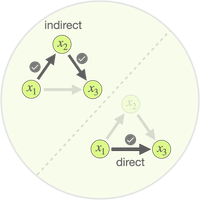
Physical links are fundamental to the structure, function, and ultimately the understanding of many networked systems. Erroneously identified, such direct cause-effect relations undermine the understanding of the system’s dynamics and can impede effective intervention. To address the long-standing challenge of distinguishing direct from indirect links in observational data from complex dynamical networks, we introduce a general inference framework tailored to networked dynamical systems. Our approach combines cross mapping with a novel, physics-informed technique for incremental variable construction that leverages temporal delay effects to identify relevant variables and eliminate indirect links. We validate our method across a diverse set of noisy benchmark and real-world systems, including brain networks, gene regulation, synthetic gene circuits, and biosphere-atmosphere interactions. The method achieves particularly strong gains on mesoscale networks (), consistently outperforming existing approaches under diverse noise conditions. Although designed for small- to medium-sized systems, it continues to outperform competing methods even in larger networks, demonstrating both robustness and broad applicability.
Physics Subject Headings (PhySH)
Popular Summary
Many complex systems, from the communications among neurons in the brain to the tangled feedback between Earth’s atmosphere and biosphere, hide the direct forces that shape their behavior. We developed a physics-informed cross mapping method, Invaxmap, that combines a way to reconstruct a system’s hidden history with a physics-guided process for creating meaningful variables. This approach teases apart genuine interactions from indirect effects. Applied to brain activity, genetic networks, and climate studies, our approach reliably reveals which parts of the system truly drive changes. By identifying the actual drivers behind complex dynamics, we open the door to more precise control—whether guiding neural therapies, manipulating gene circuits, or forecasting environmental shifts. Our methodology is a powerful tool useful for understanding and steering intricate complex systems.
Article Text
References (65)
- A. Banerjee, S. Chandra, and E. Ott, Network inference from short, noisy, low time-resolution, partial measurements: Application to c. elegans neuronal calcium dynamics, Proc. Natl. Acad. Sci. U.S.A. 120, e2216030120 (2023).
- T. P. Peixoto, Network reconstruction and community detection from dynamics, Phys. Rev. Lett. 123, 128301 (2019).
- C.-W. Chang, T. Miki, H. Ye, S. Souissi et al., Causal networks of phytoplankton diversity and biomass are modulated by environmental context, Nat. Commun. 13, 1140 (2022).
- K. J. Preacher, Advances in mediation analysis: A survey and synthesis of new developments, Annu. Rev. Psychol. 66, 825 (2015).
- J. Runge, Causal network reconstruction from time series: From theoretical assumptions to practical estimation, Chaos 28, 075310 (2018).
- R. D. Shah and J. Peters, The hardness of conditional independence testing and the generalised covariance measure, Ann. Stat. 48, 1514 (2020).
- F. Takens, Detecting strange attractors in turbulence, in Dynamical Systems and Turbulence, Warwick 1980, edited by D. Rand and L.-S. Young (Springer, Berlin Heidelberg, 1980), pp. 366–381.
- E. R. Deyle and G. Sugihara, Generalized theorems for nonlinear state space reconstruction, PLoS One 6, e18295 (2011).
- S. Leng, H. Ma, J. Kurths, Y.-C. Lai, W. Lin, K. Aihara, and L. Chen, Partial cross mapping eliminates indirect causal influences, Nat. Commun. 11, 2632 (2020).
- P. V. Krishna and A. K. Tangirala, Inferring direct causality from noisy data using convergent cross mapping, in 2019 58th Annual Conference of the Society of Instrument and Control Engineers of Japan (SICE) (IEEE, Hiroshima, Japan, 2019), pp. 1523–1528.
- E. De Brouwer, A. Arany, J. Simm, and Y. Moreau, Latent convergent cross mapping, in International Conference on Learning Representations (OpenReview.net, Vienna, Austria, 2021).
- M. Ushio, C.-h. Hsieh, R. Masuda, E. R. Deyle, H. Ye, C.-W. Chang, G. Sugihara, and M. Kondoh, Fluctuating interaction network and time-varying stability of a natural fish community, Nature (London) 554, 360 (2018).
- S. Cenci, G. Sugihara, and S. Saavedra, Regularized s-map for inference and forecasting with noisy ecological time series, Methods Ecol. Evol. 10, 650 (2019).
- L. Yang, W. Lin, and S. Leng, Conditional cross-map-based technique: From pairwise dynamical causality to causal network reconstruction, Chaos 33, 063101 (2023).
- G. Sugihara, R. May, H. Ye et al., Detecting causality in complex ecosystems, Science 338, 496 (2012).
- J. Runge, P. Nowack, M. Kretschmer, S. Flaxman, and D. Sejdinovic, Detecting and quantifying causal associations in large nonlinear time series datasets, Sci. Adv. 5, eaau4996 (2019).
- C. W. Chang, T. Miki, M. Ushio, P. J. Ke, H. P. Lu, F. K. Shiah, and C. H. Hsieh, Reconstructing large interaction networks from empirical time series data, Ecol. Lett. 24, 2763 (2021).
- S. Terada, Y. Sakurai, H. Nakahara, and S. Fujisawa, Temporal and rate coding for discrete event sequences in the hippocampus, Neuron 94, 1248 (2017).
- X. Li, S. Rao, W. Jiang et al., Discovery of time-delayed gene regulatory networks based on temporal gene expression profiling, BMC Bioinf. 7, 26 (2006).
- D. C. Galletly and P. D. Larsen, Cardioventilatory coupling during anaesthesia, British Journal of anaesthesia 79, 35 (1997).
- C. Liao and P. Barooah, An integrated approach to occupancy modeling and estimation in commercial buildings, in Proceedings of the 2010 American Control Conference (IEEE, Baltimore, MD, 2010), pp. 3130–3135.
- W. J. Abdallah, K. Hashmi, M. T. Faiz et al., A novel control method for active power sharing in renewable-energy-based micro distribution networks, Sustainability 15, 1579 (2023).
- H. Begleiter, EEG Database (UCI Machine Learning Repository, 1999).
- D. Marbach, T. Schaffter, C. Mattiussi, and D. Floreano, Generating realistic in silico gene networks for performance assessment of reverse engineering methods, J. Comput. Biol. 16, 229 (2009).
- G. Pastorello, C. Trotta, E. Canfora et al., The fluxnet2015 dataset and the oneflux processing pipeline for Eddy covariance data, Sci. Data 7, 225 (2020).
- M. B. Elowitz and S. Leibler, A synthetic oscillatory network of transcriptional regulators, Nature (London) 403, 335 (2000).
- T. W. Wong, T. S. Lau, T. S. Yu, A. Neller, S. L. Wong, W. Tam, and S. W. Pang, Air pollution and hospital admissions for respiratory and cardiovascular diseases in hong kong, Occupational and environmental medicine 56, 679 (1999).
- J. Shi, L. Chen, and K. Aihara, Embedding entropy: A nonlinear measure of dynamical causality, J. R. Soc. Interface 19, 20210766 (2022).
- H. Ye, E. R. Deyle, L. J. Gilarranz, and G. Sugihara, Distinguishing time-delayed causal interactions using convergent cross mapping, Sci. Rep. 5, 14750 (2015).
- G. Grassi, F. L. Severance, and D. A. Miller, Multi-wing hyperchaotic attractors from coupled Lorenz systems, Chaos Solitons Fractals 41, 284 (2009).
- S. K. Stavroglou, A. A. Pantelous, H. E. Stanley, and K. M. Zuev, Unveiling causal interactions in complex systems, Proc. Natl. Acad. Sci. U.S.A. 117, 7599 (2020).
- G. R. Breese, R. Sinha, and M. Heilig, Chronic alcohol neuroadaptation and stress contribute to susceptibility for alcohol craving and relapse, Pharmacol. Therapeut. 129, 149 (2011).
- A. Pfefferbaum, E. V. Sullivan, D. H. Mathalon, and K. O. Lim, Frontal lobe volume loss observed with magnetic resonance imaging in older chronic alcoholics, Alcoholism 21, 521 (1997).
- H. F. Moselhy, G. Georgiou, and A. Kahn, Frontal lobe changes in alcoholism: A review of the literature, Alcohol Alcohol. 36, 357 (2001).
- M. T. Ratti, P. Bo, A. Giardini, and D. Soragna, Chronic alcoholism and the frontal lobe: Which executive functions are imparied?, Acta Neurol. Scand. 105, 276 (2002).
- D. Marbach, R. J. Prill, T. Schaffter, C. Mattiussi, D. Floreano, and G. Stolovitzky, Revealing strengths and weaknesses of methods for gene network inference, Proc. Natl. Acad. Sci. U.S.A. 107, 6286 (2010).
- R. J. Prill, D. Marbach, J. Saez-Rodriguez, P. K. Sorger, L. G. Alexopoulos, X. Xue, N. D. Clarke, G. Altan-Bonnet, and G. Stolovitzky, Towards a rigorous assessment of systems biology models: The dream3 challenges, PLoS One 5, e9202 (2010).
- K. B. Delwiche, S. H. Knox, A. Malhotra et al., FLUXNET-: A global, multi-ecosystem dataset and analysis of methane seasonality from freshwater wetlands, Earth Syst. Sci. Data 13, 3607 (2021).
- C. Chen, W. J. Riley, I. C. Prentice, and T. F. Keenan, fertilization of terrestrial photosynthesis inferred from site to global scales, Proc. Natl. Acad. Sci. U.S.A. 119, e2115627119 (2022).
- C. E. Moore, K. Meacham-Hensold, P. Lemonnier, R. A. Slattery, C. Benjamin, C. J. Bernacchi, T. Lawson, and A. P. Cavanagh, The effect of increasing temperature on crop photosynthesis: From enzymes to ecosystems, J. Exp. Bot. 72, 2822 (2021).
- Z. Fu, P. Ciais, I. C. Prentice, P. Gentine, D. Makowski, A. Bastos, X. Luo, J. K. Green, P. C. Stoy, H. Yang, and T. Hajima, Atmospheric dryness reduces photosynthesis along a large range of soil water deficits, Nat. Commun. 13, 989 (2022).
- C. Krich, M. D. Mahecha, M. Migliavacca, M. G. De Kauwe, A. Griebel, J. Runge, and D. G. Miralles, Decoupling between ecosystem photosynthesis and transpiration: A last resort against overheating, Environ. Res. Lett. 17, 044013 (2022).
- W. Yuan, Y. Zheng, S. Piao et al., Increased atmospheric vapor pressure deficit reduces global vegetation growth, Sci. Adv. 5, eaax1396 (2019).
- J. Runge, S. Bathiany, E. Bollt, G. Camps-Valls et al., Inferring causation from time series in earth system sciences, Nat. Commun. 10, 2553 (2019).
- J. Runge, Modern causal inference approaches to investigate biodiversity-ecosystem functioning relationships, Nat. Commun. 14, 1917 (2023).
- J. M. Mooij, D. Janzing, and B. Schölkopf, From ordinary differential equations to structural causal models: The deterministic case, in Proceedings of the Twenty-Ninth Conference on Uncertainty in Artificial Intelligence (AUAI Press, Bellevue, WA, 2013), pp. 440–448.
- H. Ma, K. Aihara, and L. Chen, Detecting causality from nonlinear dynamics with short-term time series, Sci. Rep. 4, 7464 (2014).
- E. De Brouwer, Deep counterfactual estimation with categorical background variables, in Proceedings of the 36th International Conference on Neural Information Processing Systems, New Orleans, LA, USA (Curran Associates Inc., 2022), ISBN [Amazon][WorldCat].
- C. E. Rasmussen and C. K. I. Williams, Gaussian Processes for Machine Learning (The MIT Press, Cambridge, MA, 2005).
- G. J. Székely, M. L. Rizzo, and N. K. Bakirov, Measuring and testing dependence by correlation of distances, Ann. Stat. 35, 2769 (2007).
- C.-h. Hsieh, S. M. Glaser, A. J. Lucas, and G. Sugihara, Distinguishing random environmental fluctuations from ecological catastrophes for the north pacific ocean, Nature (London) 435, 336 (2005).
- N. T. J. Bailey, Statistical Methods in Biology (Cambridge University Press, Cambridge, England, 1995).
- C. W. J. Granger, Investigating causal relations by econometric models and cross-spectral methods, Econometrica 37, 424 (1969).
- J. F. Geweke, Measures of conditional linear dependence and feedback between time series, J. Am. Stat. Assoc. 79, 907 (1984).
- M. Ding, Y. Chen, and S. L. Bressler, Granger causality: Basic theory and application to neuroscience, arXiv: Quantitative Methods 437 (2006).
- R. Krishna and S. Guo, A partial Granger causality approach to explore causal networks derived from multi-parameter data, in Computational Methods in Systems Biology, edited by M. Heiner and A. M. Uhrmacher (Springer, Berlin Heidelberg, 2008), pp. 9–27.
- S. Guo, C. Ladroue, and J. Feng, Granger causality: Theory and applications, in Frontiers in Computational and Systems Biology, edited by J. Feng, W. Fu, and F. Sun (Springer, London, 2010), pp. 83–111.
- T. Schreiber, Measuring information transfer, Phys. Rev. Lett. 85, 461 (2000).
- P. Spirtes, C. Glymour, and R. Scheines, Causation, Prediction, and Search (The MIT Press, Cambridge, MA, 2001).
- R. Milo, S. Shen-Orr, S. Itzkovitz, N. Kashtan, D. Chklovskii, and U. Alon, Network motifs: Simple building blocks of complex networks, Science 298, 824 (2002).
- U. Alon, Network motifs: Theory and experimental approaches, Nat. Rev. Genet. 8, 450 (2007).
- J. Runge, Conditional independence testing based on a nearest-neighbor estimator of conditional mutual information, in Proceedings of the Twenty-First International Conference on Artificial Intelligence and Statistics, Playa Blanca, Lanzarote, Canary Islands, Spain (PMLR, Playa Blanca, Lanzarote, Canary Islands, 2018), pp. 938–947, https://proceedings.mlr.press/v84/runge18a.html.
- B. A. Franklin, R. Brook, and C. Arden Pope, Air pollution and cardiovascular disease, Curr. Prob. Cardiol. 40, 207 (2015).
- A. Milojevic, P. Wilkinson, B. Armstrong, K. Bhaskaran, L. Smeeth, and S. Hajat, Short-term effects of air pollution on a range of cardiovascular events in England and Wales: Case-crossover analysis of the minap database, hospital admissions and mortality, Heart 100, 1093 (2014).
- S. H. Park, S. Ha, and J. K. Kim, A general model-based causal inference method overcomes the curse of synchrony and indirect effect, Nat. Commun. 14, 4287 (2023).

